The short answer is that both terms often describe the same physical product. But the longer answer — covering when they diverge, what actually drives performance, and how to spec either one correctly — is worth understanding before your next tank purchase or repair decision.
Key Takeaways
- GRP (Glass Reinforced Plastic) is a specific type of FRP (Fiber Reinforced Plastic) — the terms overlap but aren't interchangeable
- The naming difference is largely geographic: North American standards (AWWA, ASTM) say "fiberglass-reinforced"; UK/European standards (BS EN 13280) say "glass fibre reinforced"
- For water tanks, the resin system — polyester, vinylester, or epoxy — drives performance far more than the fiber label
- The internal corrosion barrier liner is the first point of failure — periodic inspection is essential for both tank types
FRP vs GRP: Quick Comparison
| Factor | FRP | GRP |
|---|---|---|
| Full name | Fiber Reinforced Plastic | Glass Reinforced Plastic |
| Reinforcement | Glass, carbon, aramid, basalt, or other fibers | Glass fiber specifically |
| Primary region | North America (AWWA, ASTM standards) | UK, Europe, parts of Asia (BS EN 13280) |
| Typical resins | Polyester, vinylester, epoxy | Polyester, vinylester, epoxy |
| Common tank format | Monolithic (filament wound, contact molded) | Modular panel (sectional assembly) |
| Water tank applications | Industrial, municipal, chemical, wastewater | Potable water, fire suppression, above-ground cold storage |
| Cost (glass fiber) | Comparable | Comparable |
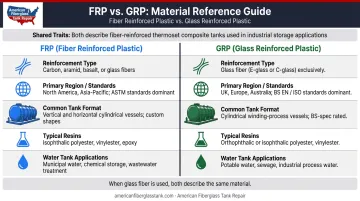
One note on the cost row above: when both use standard glass fiber reinforcement — the norm for water storage — pricing is essentially equivalent. Cost differences only arise when FRP incorporates carbon or aramid fibers, which almost never appear in water storage specifications.
What is FRP (Fiber Reinforced Plastic)?
FRP is a composite category, not a single material. It combines a polymer resin matrix with reinforcing fibers — and because the fiber type can vary (glass, carbon, aramid, basalt), FRP functions as an umbrella term. That distinction matters when reading tank specs: a document that says "FRP tank" without naming the fiber type tells you almost nothing about chemical resistance or structural performance.
CompositesWorld's composites glossary defines FRP as a general term for polymer-matrix composites reinforced with cloth, mat, strands, or other fiber forms. For water storage, tank standards narrow this significantly — ASTM D3299-24 covers filament-wound tanks made specifically with glass-fiber-reinforced polyester or vinylester resin.
Resin Systems That Matter
The resin is the more critical specification for water tank performance:
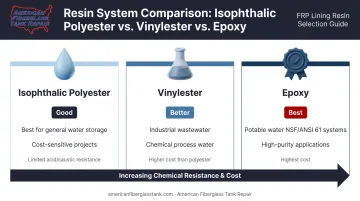
- Isophthalic/terephthalic polyester: cost-effective for general water storage; isophthalic grades handle continuous water contact better due to stronger hydrolysis resistance
- Vinylester: better chemical resistance for industrial use, including wastewater treatment and process water with higher chemical loads
- Epoxy: the highest resistance tier, used in specialty applications and potable water systems requiring NSF/ANSI 61 certified formulations
Manufacturing Methods
ASTM recognizes two primary fabrication methods, each with distinct structural implications:
- Filament winding (ASTM D3299) — continuous glass fiber wound under tension around a mandrel; produces consistent wall thickness and high structural strength in cylindrical tanks
- Contact molding / hand lay-up (ASTM D4097) — layers of mat and woven fabric applied manually; allows complex geometries and custom configurations
The corrosion barrier liner is a separate inner layer — typically a resin-rich surface veil — applied regardless of fabrication method. Its integrity is what protects the structural laminate from chemical attack.
Where FRP Tanks Are Used
FRP's design flexibility makes it well-suited for large-scale industrial applications:
- Chemical storage (acids, caustics, oxidizers)
- Water treatment and municipal storage
- Wastewater treatment plant vessels
- Industrial process water systems
- On-site potable water storage requiring custom configurations
What is GRP (Glass Reinforced Plastic)?
GRP is a naming convention, not a competing material. The term became standard in the UK, Europe, and parts of Asia, particularly in construction and utilities sectors. BS EN 13280:2001, the British Standard governing glass fibre reinforced cisterns for above-ground cold-water storage, represents the defining regulatory framework for GRP tanks in that market.
TWI, the UK technical body, defines GRP as glass fibers embedded in a polymer matrix. When glass fibers are used in an FRP tank, the two terms describe the same material.
The Modular Panel Format
The most distinctive feature of GRP in water storage is the modular panel construction associated with BS EN 13280 compliance. Rather than a single monolithic vessel, GRP sectional tanks are:
- Factory-manufactured in standard panel dimensions
- Assembled on-site using bolted connections and sealant systems
- Available with WRAS approval for potable water contact (verified by manufacturers including Balmoral and Bluewater)
This format offers practical advantages: panels can be transported through standard access points, capacity can be expanded by adding panels, and individual sections can be replaced without condemning the whole tank. That said, joints and seals require periodic inspection — unlike a monolithic FRP vessel, where the shell itself is the primary focus of any maintenance program.
Where GRP Terminology Applies
GRP panel tanks are most commonly specified for:
- Above-ground potable water storage in commercial and residential buildings
- Fire suppression water reserves
- Municipal cold-water storage systems
- Sites with restricted access where pre-assembled monolithic tanks can't be installed
- Projects with phased capacity requirements
FRP vs GRP: What's the Real Difference for Water Tanks?
At the material science level, a glass-fiber-reinforced FRP tank and a GRP tank are the same thing. The practical differences come down to three factors:
- Terminology — regional naming convention, not a material distinction
- Construction format — monolithic FRP vessels vs. modular GRP panel systems
- Resin specification — the variable that determines performance
Resin Choice Is the Real Decision
Regardless of the label on the spec sheet, the resin system determines chemical compatibility, temperature tolerance, and service life. The resin system — not the fiber label — is what determines whether a tank handles your specific chemical, temperature, and service conditions. The same resin options apply to both:
| Resin | Best For | Key Limitation |
|---|---|---|
| Isophthalic polyester | General water storage, cost-sensitive projects | Limited resistance to strong acids/caustics |
| Vinylester | Industrial wastewater, chemical process water | Higher cost than polyester |
| Epoxy | Potable water (NSF/ANSI 61 certified versions), high-purity systems | Highest cost; requires controlled cure conditions |
How to Specify Correctly
- For industrial or wastewater applications, demand full resin and laminate specifications — whether the document says "FRP" or "GRP" is irrelevant.
- For potable water storage, confirm NSF/ANSI 61 certification at the product level, not just the resin family — certification is product-specific, not automatic.
- For modular panel tanks, verify that joint and seal materials meet the same chemical standard as the panel laminate itself.
Getting the specification right upfront is what makes repair and maintenance decisions straightforward later. AFTR's field service teams work across both FRP and GRP vessels using custom-blended resin systems — isophthalic/terephthalic polyester, vinylester, and epoxy — paired with over 45 laminate types including mat, chopped strand, Nexus, Harlar, and carbon veil. The repair approach is dictated by what the tank is actually made of, not what it's called on the spec sheet.
Why Ongoing Maintenance Matters for Both FRP and GRP Water Tanks
The internal corrosion barrier liner is the tank's primary defense. It's a resin-rich inner layer that takes the full chemical load of whatever is stored. Over time, that liner degrades — and when it fails, the structural laminate behind it becomes vulnerable.
AFTR's field inspectors identify several common failure modes in water storage tanks:
- Spidering and micro-cracking — surface fractures in the resin coat, often early indicators of stress or thermal cycling
- Disbondment — liner separating from the structural wall
- Emulsification — moisture absorption causing resin degradation
- Capillary migration — stored liquid penetrating beneath the corrosion coat and compromising structural layers
- Abrasion wear and floor stress cracking — mechanical degradation concentrated at high-contact areas
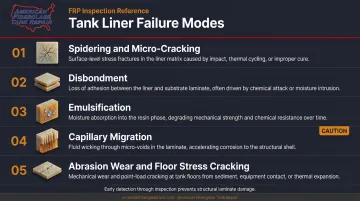
Capillary migration deserves particular attention: a tank can pass a hydrostatic test while this process is already underway. By the time a leak becomes visible, the structural laminate may already be compromised.
What a Professional Inspection Involves
AFTR's inspection programs, supervised by Fiberglass Tank & Pipe Institute certified inspectors, use three primary testing methods:
- Ultrasonic thickness testing — measures wall thickness and detects delamination within the laminate
- High-intensity backlight inspection — reveals internal defects and resin degradation not visible under normal conditions
- Laser testing — precise surface measurement and structural distortion identification
These methods, combined with Barcol hardness testing and visual survey, produce a condition report covering both surface-level defects and subsurface deterioration. The cost logic is straightforward: liner repairs run significantly less than full relining, and full relining costs far less than tank replacement.
In most cases, even when a tank has breached its corrosion barrier, the structural laminate remains intact — making it a sound base for a new corrosion layer, adding years of service life at a fraction of replacement cost.
AFTR provides inspection and repair services across all 50 U.S. states, with field crews deployable via Service-Pack shipping containers pre-stocked with resin systems and laminates. Scheduling an inspection ahead of a planned shutdown consistently produces the lower-cost outcome — catching liner degradation before it reaches the structural laminate is where the real savings are.
Conclusion
FRP and GRP aren't competing materials — GRP is a glass-fiber version of FRP, and for water tank applications, the labels are interchangeable in practice. What drives actual tank performance is the resin system, the laminate design, the construction format, and how well the vessel has been maintained for its specific service environment.
Whether you're sourcing a new tank or managing a vessel that's been in service for years, the decisions that matter are:
- Is the resin system compatible with what's stored?
- Has the corrosion barrier been inspected within a reasonable service interval?
- If liner degradation is present, can repair extend service life rather than force premature replacement?
The material label on the nameplate matters far less than honest answers to those three questions — regardless of whether the tank says FRP or GRP.
Frequently Asked Questions
What is the difference between FRP and GRP tanks?
GRP (Glass Reinforced Plastic) is technically a subset of FRP (Fiber Reinforced Plastic) where glass fibers are the reinforcement. In water tank applications, the terms are widely interchangeable. The distinction is primarily geographic: FRP appears in North American specifications (AWWA, ASTM), while GRP is standard in UK and European standards (BS EN 13280).
Is FRP cheaper than GRP?
When both use glass fiber reinforcement — as is standard in water storage — costs are essentially equivalent. FRP can cost more when higher-performance fibers like carbon or aramid are specified, but these are rarely used in water tank applications where glass fiber meets the structural and chemical requirements.
Are FRP and GRP tanks safe for drinking water storage?
Both can be safe for potable water when manufactured with NSF/ANSI 61 certified resin systems. Certification is product-specific, not automatic by resin family — buyers should confirm the specific tank or liner system holds NSF/ANSI 61 listing and that the corrosion barrier meets applicable drinking water contact standards.
How long do FRP or GRP water tanks typically last?
With proper design, installation, and routine maintenance, FRP/GRP water tanks can remain in service for 30 years or more. According to Belding Tank, fiberglass water tanks average 30 to 40 years. The corrosion barrier liner typically degrades first and is the primary focus of inspection programs.
Can FRP or GRP water tanks be repaired if damaged?
Yes. Liner degradation, laminate damage, nozzle failures, and structural cracks can all be addressed by qualified FRP repair contractors using compatible resin systems and laminate materials. When a corrosion barrier has been breached, the structural laminate typically remains intact — making relining a cost-effective alternative to full replacement.
When writing a tank specification, should I use the term FRP or GRP?
The label matters less than the detail behind it. Whichever term you use, define the reinforcement fiber type, resin system, corrosion barrier thickness, and applicable standards (ASTM D3299, ASTM D4097, AWWA D120, or BS EN 13280 depending on jurisdiction). A specification that omits resin and laminate details is incomplete.