Fiberglass reinforced plastic (FRP) tanks address those risks directly — but only when you understand how they're built, how to select the right configuration, and what separates a tank that lasts 30+ years from one that fails prematurely.
This guide covers FRP tank construction and applications, key advantages, material comparisons, installation considerations, and the inspection and repair practices that determine long-term performance.
Key Takeaways
- FRP tanks resist corrosion from water, chlorine, and treatment chemicals without coatings or cathodic protection
- The internal corrosion liner is the most critical component — its condition determines tank lifespan and water safety
- Fiberglass outperforms steel and concrete on maintenance burden and long-term cost
- Poly tanks cost less upfront but can't be structurally repaired — FRP tanks can be relined and extended for years
- Professional inspections every 3–5 years catch liner degradation before it causes containment failure
What Are Fiberglass Water Storage Tanks?
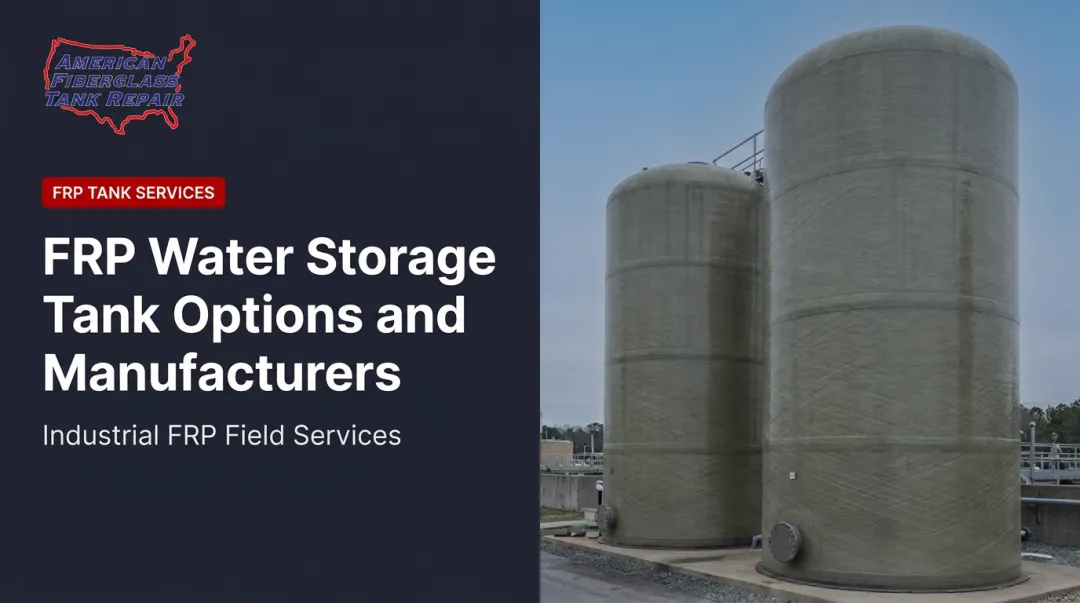
Fiberglass water storage tanks are composite structures built from layers of fiberglass mat, chopped strand, and resin (isophthalic or terephthalic polyester, vinylester, or epoxy) formed into a corrosion-resistant shell. Fabrication follows ASTM C582 and ASTM D3299 standards, and water service tanks must meet ANSI/AWWA D120 or D121 requirements depending on tank type.
The Internal Corrosion Liner
The liner is the most important layer in any FRP water tank. It's the innermost resin-rich barrier between the stored water and the structural laminate behind it. When intact, the tank performs as designed. When it degrades, water migrates into the laminate and problems escalate quickly.
AFTR's field inspectors regularly identify liner failure modes including:
- Spidering and cracking: surface fractures that expose the laminate to stored product
- Disbondment and delamination: layer separation that undermines structural integrity
- Emulsification: moisture absorption that breaks down the resin matrix over time
- Capillary migration: liquid traveling beneath the corrosion coat with no visible surface evidence
- Floor stress cracking and shell distortion: late-stage structural indicators of advanced degradation
- UV degradation: resin breakdown on exposed exterior surfaces
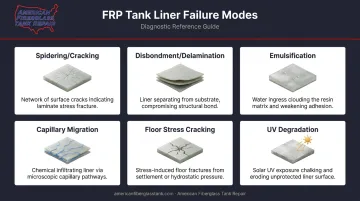
Capillary migration is particularly deceptive: it often passes a hydrostatic test. A tank can hold water today and fail containment in three months — which is exactly why visual inspection alone is insufficient.
Common Applications
FRP water tanks serve a wide range of end uses:
- Municipal potable water distribution and storage
- Water treatment plant process water
- Industrial deionized water systems
- Agricultural and emergency reserve storage
- Fire suppression and rainwater harvesting
Key Advantages of Fiberglass Water Storage Tanks
Corrosion Resistance
Corrosion is a systemic problem in water infrastructure. The EPA's distribution system fact sheet confirms that corroding metals and their byproducts react with disinfectants, reducing residual chlorine and creating conditions for microbial growth. A NACE cost-of-corrosion study puts the total annual direct cost for US drinking water and sewer systems at $36 billion.
FRP eliminates the corrosion mechanism entirely. Key maintenance burdens that steel tanks carry — and fiberglass avoids:
- No metal to oxidize or rust
- No interior protective coatings to maintain as a corrosion barrier
- No cathodic protection system to monitor or manage
- No recoating cycles (even AWWA-rated steel systems need recoating after ~30 years)
Lightweight and Structurally Strong
FRP's high strength-to-weight ratio has real practical value during installation. A 30,000-gallon fiberglass tank weighs roughly 9,400–10,300 lbs empty. A comparable concrete structure weighs orders of magnitude more, requiring heavier equipment, stronger foundations, and more complex site logistics. For above-ground installations or remote sites with access constraints, the weight difference translates directly into installation cost savings.
Long Service Life Potential
Manufacturers including Xerxes back their fiberglass tanks with 30-year limited warranties. Manufacturer estimates from DT Fiberglass place realistic service life at 25–40 years or more with proper maintenance. Those numbers aren't automatic — they depend heavily on liner integrity and consistent inspection practices.
AFTR's field experience reinforces this: even when a tank's corrosion barrier has been breached, the structural shell is often still sound and serves as an ideal substrate for a new corrosion layer. Repair, rather than replacement, is frequently the right call.
NSF/ANSI 61 Certification for Potable Water
For any tank storing drinking water, NSF/ANSI 61 certification is the standard that matters. It evaluates health effects from contaminants potentially imparted to drinking water by materials and components in contact with it — including tank liners and coatings.
NSF 61 certification applies to specific products and formulations, not resin families broadly. When sourcing a fiberglass tank for potable water use, verify that the specific tank and liner system carries NSF 61 listing. NSF maintains a searchable certified-product database for confirmation.
Thermal Performance
Steel conducts heat at roughly 50 W/(m·K). FRP conducts at roughly 0.3–0.4 W/(m·K) — about 100 times lower. For water storage, that difference produces measurable operational benefits:
- More stable stored water temperatures
- Reduced condensation on tank exteriors
- Less thermal cycling stress on the tank structure and liner
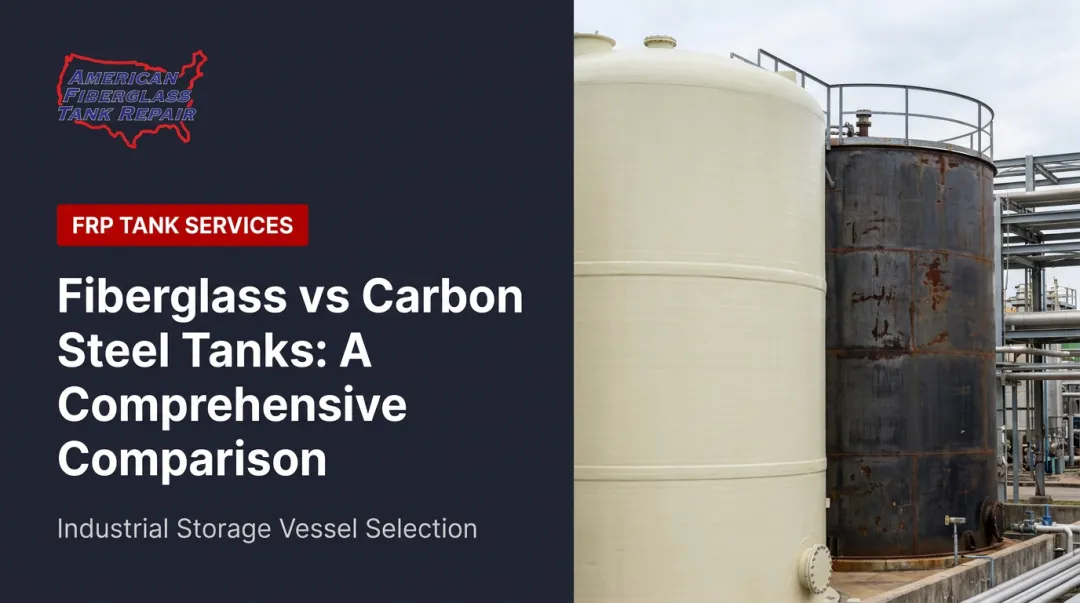
Fiberglass vs. Other Tank Materials
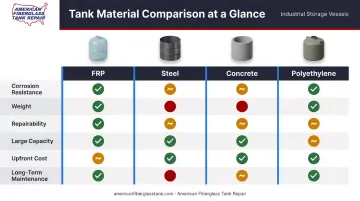
| Attribute | FRP | Steel | Concrete | Polyethylene |
|---|---|---|---|---|
| Corrosion resistance | Inherent | Requires coatings | Moderate | Good |
| Weight | Light | Heavy | Very heavy | Light |
| Repairability | Yes — relinable | Yes — recoatable | Limited | Generally no |
| Large capacity | Yes | Yes | Yes | Limited |
| Upfront cost | Moderate | Moderate-high | High | Low |
| Long-term maintenance | Low | Moderate-high | Moderate | Low-moderate |
FRP vs. Steel
Steel tanks have a proven track record; some have been in service for over 100 years. That longevity, however, comes with consistent maintenance investment:
- Interior coating systems and cathodic protection
- Periodic recoating on a recurring cycle
- AWWA coating systems with service lives approaching 30 years, after which full recoating is required
FRP eliminates that maintenance cycle. The corrosion resistance is built into the material, not applied on top of it. For facilities where treatment chemicals like sodium hypochlorite are present, that distinction is operationally significant — chlorine-based chemicals that cause pitting and crevice corrosion in metals don't affect FRP the same way.
FRP vs. Concrete
Concrete tanks can last decades, but they come with challenges:
- Significant weight loads require engineered foundations
- Cracking over time creates leakage and contamination pathways
- A 2023 PNWS-AWWA presentation on aging concrete reservoirs documented common concerns including concrete deterioration and leakage in reservoirs 20–50+ years old
- Seismic performance in concrete elevated tanks has been flagged as a vulnerability concern in engineering literature
- Concrete requires on-site construction; FRP tanks arrive pre-built and ready to install
FRP vs. Polyethylene (HDPE)
Poly tanks win on upfront cost for small applications — they're widely available, easy to source, and require no special handling. But the comparison shifts for larger capacities and longer time horizons:
- FRP maintains structural rigidity at high capacities; poly tanks have practical upper limits
- FRP can be professionally relined when the corrosion barrier degrades — poly tanks generally cannot be structurally repaired
- Once a poly tank degrades beyond a certain point, replacement is the only option
That repairability gap is why AFTR's work is exclusively FRP: when a corrosion barrier degrades in a fiberglass tank, relining is a viable path forward. With poly, it isn't.
Installation and Siting Considerations
Improper installation causes more premature FRP tank failures than almost any other factor — and those failures are almost always avoidable.
Foundation and Site Preparation
- Above-ground tanks require a level, structurally adequate base — typically a concrete pad or ring wall. AWWA D121 covers foundation requirements for bolted aboveground FRP panel tanks.
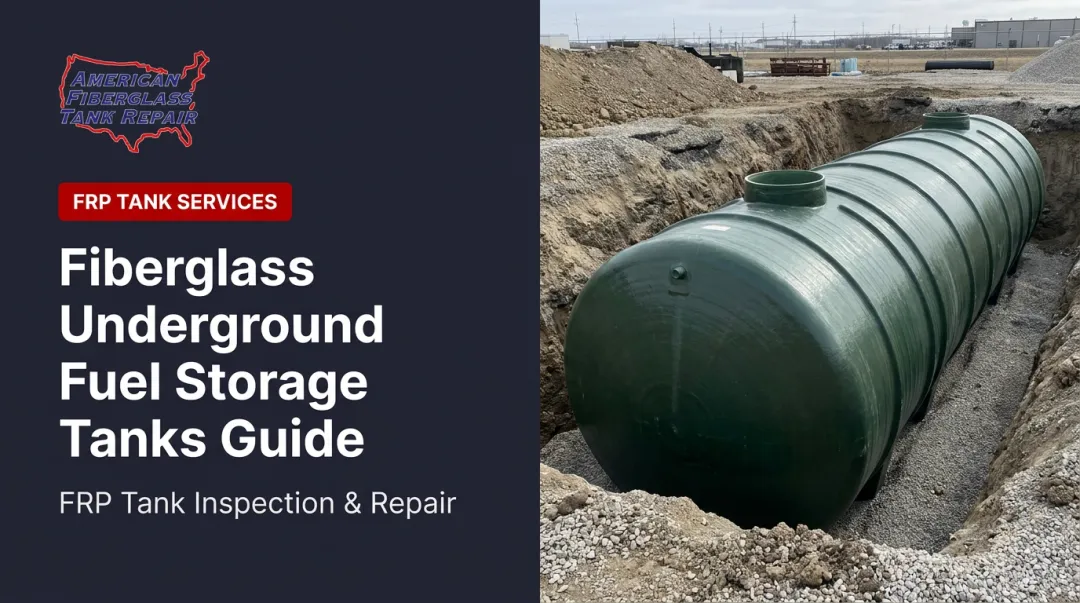
- Underground tanks require engineered backfill, proper bedding, and anti-buoyancy measures. NOV/Containment Solutions' installation documentation emphasizes that contractor work is critical — improper installation can lead to tank failure.
- Settlement, uneven bearing, or inadequate compaction under an FRP tank creates stress that concentrates at the floor-to-wall joint — a common location for stress cracking.
Regulatory and Permitting
Potable water storage tanks typically require:
- Local building and plumbing permits
- Engineering sign-off for tanks above threshold capacities
- Compliance with state drinking water regulations
- Review by the local Authority Having Jurisdiction (AHJ)
Requirements vary significantly by state. Confirm with your AHJ before installation begins.
Fittings and Penetrations
Field errors here cause real damage. FRP tanks require resin-rated fittings matched to the specific resin system used in fabrication. Field-drilled penetrations that bypass proper laminate protocols compromise the liner at exactly the point most vulnerable to moisture ingress — and that damage often isn't visible until it's costly.
AFTR's field teams regularly handle nozzle modifications on tanks already in service — relocating, resizing, and blocking off nozzles using protocols matched to the tank's specific resin system. Any penetration added or changed after fabrication deserves the same care as the original build.
Inspection, Maintenance, and Repair: Protecting Your Investment
Why Inspection Can't Wait
The liner degrades gradually. Chemical exposure, thermal cycling, UV, and mechanical stress all contribute — and the early stages are invisible to the naked eye. By the time you see obvious surface damage, liquid may already be migrating through the laminate.
AFTR makes this point clearly: a hydrostatic test only confirms containment at that moment. A tank that passes today might not pass in three months. That's the core argument for periodic professional inspection — catching degradation while it's still repairable.
What a Professional FRP Tank Inspection Covers
AFTR's FTPI-certified inspectors evaluate tanks using a combination of methods:
- Visual inspection — corrosion coat condition, spidering, surface cracking, UV damage
- Barcol hardness testing — measures resin cure; low readings indicate compromised liner integrity
- Ultrasonic thickness testing — measures wall thickness from one side; detects laminate voids and wall thinning
- High-intensity backlight testing — reveals internal defects and capillary migration beneath the corrosion coat
- Laser measurement — dimensional assessment for shell distortion and structural geometry
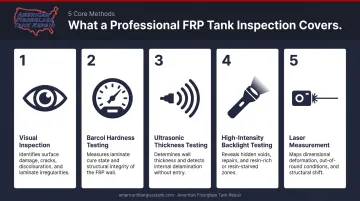
The inspection covers the interior corrosion coat, structural body, exterior shell, and all nozzles and incorporated interfaces. Clients receive detailed reports documenting existing conditions and recommendations for action.
Recommended Inspection Frequency
The Illinois EPA recommends water storage tank inspection at least every five years, with more frequent inspection depending on local conditions. For tanks storing chemically treated water, the aggressive chemistry warrants a shorter interval.
Factors that warrant more frequent inspection:
- Chemical additions to stored water (chlorine, fluoride, treatment chemicals)
- Prior liner repairs or known damage history
- Tanks approaching 15–20 years of service
- Unusual operating conditions or temperature extremes
Repair vs. Replacement
Most liner failures don't require full tank replacement. AFTR's field experience shows that even after a corrosion barrier breach, the structural shell is typically still sound — making it an ideal substrate for a new corrosion layer.
Repair is typically viable when:
- Liner damage is localized (spidering, spot delamination, surface cracking)
- Structural wall thickness measurements remain within acceptable range
- Shell geometry is intact
- Damage is caught before through-wall failure
Replacement becomes the better path when:
- Structural degradation is widespread throughout the laminate
- Through-wall failures have occurred
- Tank age exceeds engineered service life
- Repair scope would approach replacement cost
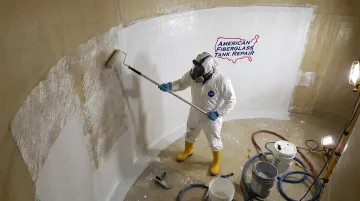
Making that call accurately requires inspection data — not guesswork. AFTR's inspection, repair, and relining services cover fiberglass water storage tanks across all 50 states. FTPI-certified inspectors use ultrasonic, laser, and high-intensity backlight testing to assess condition and define repair scope. Relining draws from over 45 fiberglass mat and veil laminates with resins — isophthalic and terephthalic polyester, vinylester, and epoxy — matched to each tank's water chemistry and service requirements, including potable contact compliance where applicable.
Frequently Asked Questions
Are fiberglass water tanks safe?
Yes, when constructed with NSF/ANSI 61-certified resins for potable water applications, fiberglass tanks are safe for water storage. The internal liner prevents leaching into stored water. Maintaining that safety over time requires periodic inspection to confirm liner integrity — NSF 61 certification covers the initial material, not ongoing condition.
How long do fiberglass water tanks last?
Manufacturer warranties run to 30 years, and service life estimates reach 25–40+ years with proper maintenance. The realistic upper end depends almost entirely on liner condition — regular inspections and timely repairs are what push tanks past those initial estimates.
How much does a 30,000-gallon fiberglass tank weigh?
Documented manufacturer specs for 30,000-gallon fiberglass water tanks show empty weights in the range of 9,400–10,300 lbs, based on Darco and RainFlo product data. Weight varies by manufacturer, wall thickness, and design — get exact specifications from your supplier for foundation planning.
What maintenance do fiberglass water tanks require?
Core maintenance tasks include:
- Periodic internal inspections of the liner surface for cracking or surface changes
- Checking fittings and nozzles for leaks or signs of movement
- Protecting exposed exterior surfaces from UV where applicable
Maintenance demands are much lower than steel, but neglecting liner condition is what turns a repairable problem into a full replacement.
Can a fiberglass water tank be repaired instead of replaced?
In most cases, yes. Professional relining, laminate patching, and corrosion barrier restoration can extend tank life significantly — and cost far less than full replacement. Even tanks with breached liners are often repairable when the structural shell remains intact.
What is the difference between fiberglass and polyethylene water tanks?
FRP tanks offer greater structural strength, higher capacity ceilings, and the ability to be professionally relined when the corrosion barrier degrades. Poly tanks cost less upfront and suit smaller applications well, but once structural degradation occurs, replacement is typically the only option — poly cannot be structurally repaired the way FRP can.