Fiberglass reinforced plastic (FRP) tanks have become the preferred alternative across municipal, industrial, and chemical processing applications precisely because they sidestep most of those problems. They don't corrode, they resist biological growth, and they're roughly 70% lighter than equivalent steel vessels according to Mordor Intelligence's FRP vessels market analysis — a meaningful advantage for installation and site engineering.
This article profiles five leading U.S. FRP water storage tank manufacturers, explains the tank types buyers encounter, and covers the selection criteria that actually determine whether a tank is fit for purpose.
Key Takeaways
- FRP tanks offer corrosion resistance, 30+ year service life, and lower maintenance costs than steel or concrete
- Top U.S. manufacturers include Xerxes Corporation, Containment Solutions, Belco Manufacturing, Texas Fiberglass Group, and Enduro Composites
- NSF/ANSI 61 certification is required for potable water; AWWA D120 governs FRP tanks in water supply service
- Installation type (underground vs. aboveground), wall configuration, and resin selection all affect cost, compliance, and long-term performance
- Certified FRP inspection and repair determines whether a tank actually reaches that 30+ year service life
FRP Water Storage Tanks: Market Context and Why They're Gaining Ground
FRP water storage tanks are composite laminate vessels designed to store potable water, process water, or wastewater using layers of resin and glass fiber reinforcement. That combination resists corrosion, biological growth, and UV degradation better than traditional alternatives. Unlike steel, FRP doesn't require interior coatings or cathodic protection systems to maintain that resistance.
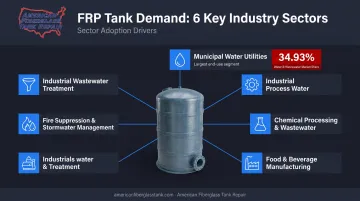
TechSci Research values the global FRP tank market at USD 3.97 billion in 2025, projected to reach USD 5.54 billion by 2031 at a 5.71% CAGR. Water and wastewater treatment is the dominant end-use sector, accounting for 34.93% of FRP vessels market revenue in 2025 per Mordor Intelligence.
Key sectors driving adoption include:
- Municipal water utilities and waterworks
- Industrial process water and cooling systems
- Chemical processing and wastewater treatment
- Food and beverage manufacturing
- Fire suppression and stormwater management
Water storage applications also benefit from one material-specific advantage that's easy to overlook. FRP is not susceptible to microbial influenced corrosion (MIC). The Fiberglass Tank & Pipe Institute has documented that fiberglass reinforced thermosetting plastic tanks don't corrode from MIC and don't provide a nutrient source for it — a meaningful operational benefit wherever biological activity is a concern.
Top FRP Water Storage Tank Manufacturers in the U.S.
These manufacturers were evaluated based on certifications, product range, application versatility, and documented presence in water storage markets — not brand recognition alone. Each entry below includes key application data, certification status, and a note on what sets that manufacturer apart.
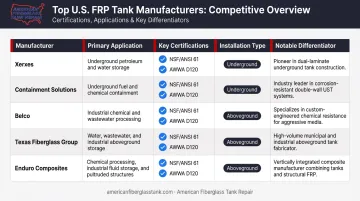
Xerxes Corporation
Xerxes has manufactured fiberglass underground storage tanks since 1979 and is now a Mattr brand. It's one of the most widely recognized FRP tank manufacturers in North America, with a strong foothold in municipal and industrial water storage.
| Category | Details |
|---|---|
| Key Applications | Potable water storage, fire suppression, stormwater detention/retention, rainwater harvesting, wastewater, septic, industrial washdown, landfill leachate |
| Certifications / Standards | NSF/ANSI/CAN 61 (potable water), ANSI/AWWA D120, NFPA 20/22/1142 (fire protection) |
| Tank Configurations | Underground horizontal; 4 ft to 12 ft nominal diameter; 600 to 60,000 gallons (potable line); 500 to 60,000 gallons across full product range |
Standout detail: Xerxes potable water tanks are explicitly engineered to meet NSF/ANSI/CAN 61 and AWWA D120 — the two certifications most relevant to municipal water storage procurement.
Containment Solutions
Containment Solutions, an NOV brand, brings more than 50 years of FRP tank manufacturing experience and hundreds of thousands of installations across North America. Their patented manufacturing process sets them apart from competitors without proprietary process technology.
| Category | Details |
|---|---|
| Key Applications | Potable drinking water, rainwater/stormwater capture, gray water, wastewater |
| Certifications / Standards | NSF 61 (confirmed via NOV/Flowtite), AWWA standards for potable water |
| Tank Configurations | Underground; single-wall and double-wall with annular monitoring; 300 to 60,000 gallons; UL-evaluated for up to 7 ft burial depth |
Standout detail: The dual-wall configuration with dry annular space monitoring is particularly relevant for applications where secondary containment or leak detection is required by regulation.
Belco Manufacturing
Belco, also an NOV brand, has fabricated FRP tanks and process vessels since 1980. They're the right call when standard catalog tanks don't fit: their custom fabrication capability handles non-standard geometries, configurations, and resin requirements.
| Category | Details |
|---|---|
| Key Applications | Water and chemical storage, industrial process vessels, containment applications |
| Certifications / Standards | ASME RTP-1 accredited; tanks built to ASTM D3299, ASTM D4097, and ANSI/AWWA D120 (per industry sources) |
| Tank Configurations | Vertical and horizontal; flat, cone, or dished bottoms; 12 in. to 20 ft diameter; up to 40,000 gallons; polyester, vinyl ester, and novalac vinyl ester resin options |
Worth noting: Resin flexibility across polyester, vinyl ester, novalac vinyl ester, and fire-retardant systems makes Belco a strong fit for buyers who need chemical resistance beyond what standard polyester provides.
Texas Fiberglass Group (TFG)
Texas Fiberglass Group is a Gulf Coast-based FRP manufacturer serving water, chemical, and oil and gas markets with a broad above-ground product catalog. Their regional manufacturing position makes them a common choice for Gulf Coast industrial facilities.
Note: Independent verification of TFG's certifications, capacity ranges, and laminate methods from primary sources was not available. Request current product specifications, certifications, and reference projects directly from TFG before specifying.
| Category | Details |
|---|---|
| Key Applications | Municipal water storage, industrial and agricultural water, chemical storage, oil and gas |
| Certifications / Standards | Verify NSF/ANSI 61 and AWWA D120 status directly with manufacturer |
| Tank Configurations | Above-ground vertical and horizontal; flat-bottom and dome designs — confirm current size range with manufacturer |
Enduro Composites
Enduro describes itself as one of the largest FRP product suppliers in the U.S. and holds ISO 9001:2015 certification. Their strongest presence in water infrastructure is in the treatment plant segment: tank covers, baffle walls, clarifier systems, and odor-control enclosures, rather than standalone storage vessels.
| Category | Details |
|---|---|
| Key Applications | Water and wastewater treatment infrastructure; FRP tank covers, baffles, partition walls, clarifier systems |
| Certifications / Standards | NSF/ANSI 61 (baffle and partition wall systems confirmed); ISO 9001:2015 |
| Tank Configurations | Water/wastewater treatment components and enclosures; confirm standalone storage tank availability directly with Enduro |
Key differentiator: If the project involves water treatment infrastructure rather than bulk storage, Enduro's engineering support and treatment-plant product depth may be more relevant than a pure storage tank manufacturer.
Types of FRP Water Storage Tanks to Know Before You Buy
Underground vs. Aboveground
Underground FRP tanks maximize site space efficiency and protect the vessel from UV exposure, temperature swings, and weather damage. The tradeoff is installation complexity: backfill material, compaction requirements, and burial depth limits (some UL-evaluated tanks cap out at 7 feet of burial depth, for example) all factor into cost and site engineering.
Aboveground tanks offer easier inspection access, more customization flexibility, and straightforward installation. They're standard for industrial process water, fire suppression reserves, and applications where periodic visual inspection is operationally important.
General guidance:
- Underground: potable water storage, stormwater detention, sites with space constraints
- Aboveground: industrial process water, fire suppression, applications needing frequent access
Orientation and Structural Design
| Variable | Options | Primary Impact |
|---|---|---|
| Orientation | Vertical / Horizontal | Vertical maximizes volume per footprint; horizontal suits tight ceiling clearances |
| Bottom design | Flat / Cone / Dished | Affects drainage, sediment management, and structural loading |
| Wall construction | Single-wall / Dual-wall | Dual-wall required in some regulated environments; adds secondary containment |
Potable vs. Industrial-Grade
Tanks intended for drinking water must carry NSF/ANSI 61 certification — the standard confirms that resin and liner materials won't leach harmful substances into stored water at harmful concentrations. Tanks used for fire suppression, process water, or industrial chemical storage follow different standards and may use resin systems that aren't cleared for potable contact.
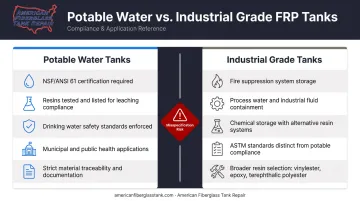
Confirm intended use with the manufacturer before purchase. Specifying the wrong tank grade for a potable application creates both a compliance violation and a direct public health risk.
How We Chose These FRP Water Storage Tank Manufacturers
Manufacturers on this list were assessed against a consistent framework:
- Certifications present: NSF/ANSI 61 for potable water, AWWA D120 for water supply service, ASTM D3299 (filament-wound tanks) and D4097 (contact-molded tanks) for structural laminate quality
- Product configuration breadth: Range of capacities, installation types, and design options
- Resin system options: Manufacturers offering vinyl ester or epoxy alongside standard polyester provide meaningful flexibility for chemically demanding applications
- Engineering support: Availability of application engineering for non-standard installations
- Documented application history: Verifiable presence in water storage markets, not just general FRP fabrication
One mistake buyers consistently make: selecting on upfront price without confirming certification status. An uncertified tank in a potable water application creates regulatory exposure that costs far more to resolve than the price difference.
Resin system quality deserves as much attention as certification. ASTM D3299 and D4097 both identify polyester and vinyl ester as the resin systems for corrosion-resistant FRP tanks — but for applications involving aggressive chemistry, disinfectants, or elevated temperatures, vinyl ester or epoxy systems provide substantially better resistance.
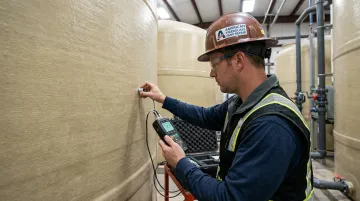
Once a tank is in service, protecting that investment requires routine inspection — not just at purchase. American Fiberglass Tank Repair (AFTR) provides engineer-driven FRP tank inspections, ultrasonic testing, laser analysis, and structural repairs for water storage tanks across all 50 states.
AFTR's inspectors are certified by the Fiberglass Tank & Pipe Institute (FTPI). That means inspections go beyond a visual check to detect subsurface problems like capillary migration under the corrosion coat, delamination, and liner emulsification before they become structural failures.
Conclusion
The right FRP water storage tank manufacturer depends on whether your certifications, resin systems, and design configurations match your specific application. Each use case has distinct requirements:
- Potable storage: NSF/ANSI 61 certification is non-negotiable
- Secondary containment: Dual-wall construction with interstitial monitoring
- Municipal infrastructure: Large-volume capacity with structural load ratings
- Industrial process vessels: Chemical-compatible resin systems and custom configurations
Lifecycle cost — not purchase price — should drive the final decision. Factor in maintenance, inspection, potential repair, and expected service life. A well-maintained FRP tank regularly achieves 30+ years of service. A neglected one fails well before that, often requiring full replacement instead of the far cheaper option of periodic relining.
For organizations that already own FRP water storage tanks, protecting that service life requires periodic inspection and proactive maintenance. AFTR provides certified inspection, testing, and repair services nationwide — helping facilities extend tank life rather than replace it. Contact the team at 877-427-0090 to schedule an assessment.
Frequently Asked Questions
How much does an FRP water tank cost?
Pricing depends on capacity, construction type (single- vs. dual-wall), installation method, resin system, and certification level — with fittings, nozzles, and monitoring systems adding to the total. Request quotes from multiple manufacturers using identical specifications to get a meaningful comparison.
How long do FRP water storage tanks last?
Properly manufactured and maintained FRP tanks typically exceed 30 years of service life. Longevity depends on resin quality, installation conditions, fluid chemistry, and inspection frequency. Corrosion liner degradation caught early can be repaired, extending service life without full replacement.
What are the advantages of FRP water tanks over steel or concrete?
FRP tanks don't corrode, don't require interior coatings, and weigh roughly 70% less than equivalent steel vessels. Unlike concrete, FRP doesn't crack under hydrostatic pressure or develop the porosity issues that allow leaching. Design flexibility and the absence of ongoing coating maintenance are additional practical advantages over both materials.
What certifications should FRP water tank manufacturers have?
For potable water applications, NSF/ANSI 61 certification is the baseline requirement — it confirms materials won't leach harmful substances into drinking water. AWWA D120 governs FRP tanks used in water supply service. ASTM D3299 and D4097 cover structural laminate requirements. Manufacturers serving regulated industries may also carry ASME RTP-1 accreditation or ISO 9001 certification.
Can FRP water storage tanks be repaired if damaged?
Yes. Trained specialists can address structural damage, delamination, liner emulsification, nozzle failures, and corrosion coat degradation using compatible resin and laminate systems. Even tanks that have breached their corrosion barrier often retain enough structural integrity to be relined — typically at a fraction of replacement cost.
What sizes do FRP water storage tanks come in?
FRP water storage tanks range from a few hundred gallons for on-site applications to 60,000 gallons or more for municipal and industrial installations. Most manufacturers offer standard size ranges alongside custom fabrication for non-standard capacity or dimensional requirements.