What surprises many buyers is how much prices vary. A small commercial FRP tank might cost a few thousand dollars. A large, custom-engineered industrial unit can exceed $100,000 — before installation. Misreading what drives that spread leads to underbudgeting, poor tank selection, or expensive surprises over the tank's operating life.
This guide covers current US price ranges, the key factors that determine cost, a full breakdown of what buyers actually spend beyond the purchase price, and how to budget correctly for the right tank.
Key Takeaways
- FRP water storage tank prices range from roughly $2,500 for small units to $100,000+ for large custom industrial tanks
- The biggest cost drivers: capacity, resin system, wall construction, manufacturing method, and compliance requirements
- Mid-range tanks offer the best value for standard water storage; corrosive or regulated applications justify premium resins
- Total project cost, covering installation, inspection, and maintenance, routinely exceeds the tank purchase price alone
- Budgeting for inspection and maintenance over a 20–30 year service life is essential to accurately comparing FRP tank ownership costs
How Much Does an FRP Water Storage Tank Cost?
There is no single price for an FRP water storage tank. Cost depends on capacity, resin system, wall thickness, manufacturing method, and whether the unit is a standard catalog tank or custom-engineered for a specific application.
Two equally sized tanks can differ by 200–300% in price based on resin grade and construction spec alone. Buyers tend to make two predictable mistakes: underbudgeting by focusing only on the unit price, or over-specifying premium resins and laminates for applications that don't require them. Understanding where your project falls in the capacity tiers below helps avoid both errors.
Price Ranges by Capacity
The table below reflects current US market prices for standard resin FRP tanks from published product pages. These are tank-only prices — freight, installation, accessories, and custom engineering are not included.
| Capacity | Approximate Price (Standard Resin) | Typical Use Case |
|---|---|---|
| 1,380 gal | ~$2,495 | Commercial backup supply, irrigation |
| 2,000 gal | ~$3,751 | Small commercial buildings, agriculture |
| 2,500 gal | ~$4,120 | Light industrial, non-corrosive storage |
| 4,500 gal | ~$5,754 | Commercial fire suppression, farm storage |
| 5,000 gal | ~$6,030 | Municipal water systems, schools |
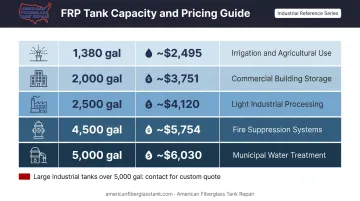
Source: RHFS/Design Tanks published product pricing.
For tanks above 5,000 gallons, public pricing is rarely not listed — most manufacturers require a quote. Industrial FRP tanks in the 10,000–60,000 gallon range are available from suppliers including Tank Depot, National Storage Tank, and Precision Tank, but pricing reflects site-specific configuration, resin selection, and engineering scope.
What Each Tier Typically Includes
Each price tier reflects a meaningful jump in resin quality, construction complexity, and documentation — not just tank size.
Entry-Level (Under 5,000 Gallons)
- Standard orthophthalic or isophthalic polyester resin
- Single-wall construction with basic inlet/outlet fittings
- Best for: commercial water storage, irrigation, non-corrosive liquid containment
Mid-Range Industrial (5,000–25,000 Gallons)
- Isophthalic or vinylester resin options
- Reinforced laminate layers, manhole access, UV-resistant exterior coating
- Best for: municipal water systems, schools, fire suppression, light industrial process water
Large or Custom Industrial (25,000+ Gallons)
- Premium vinylester or epoxy resin systems, custom laminate layup schedules
- Engineering documentation, AWWA/ASTM compliance, corrosion-resistant interior lining
- Best for: chemical plants, wastewater treatment, potable water infrastructure, food processing
Key Factors That Affect FRP Tank Pricing
Resin System and Laminate Construction
Resin choice is the single largest driver of price variation between otherwise identical tanks. The hierarchy runs from lowest to highest cost — and from least to most chemical resistance:
- Orthophthalic polyester — most economical, suitable for clean water and low-risk liquids
- Isophthalic polyester — better strength, flexibility, and chemical resistance than orthophthalic; widely used for industrial water storage
- Vinylester — significantly higher cost than polyester; provides strong resistance to aggressive chemicals and solvents
- Epoxy — premium option, highest chemical resistance, most demanding applications
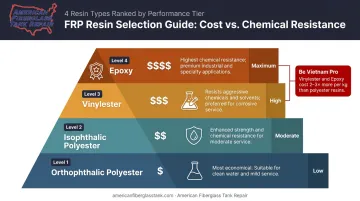
Vinylester and epoxy resins can cost two to three times more per kilogram than polyester systems, and that differential flows directly into tank pricing.
Laminate construction compounds the effect. AFTR works with custom-blended isophthalic and terephthalic polyester, vinylester, and epoxy resins alongside over 45 laminate types — including fiberglass mat, chopped strand, Nexus veil, Harlar veil, and carbon veil.
Resin and laminate selection is matched to the specific chemical in service, its concentration, and operating temperature. These are engineered decisions based on application requirements, and the price reflects that.
Tank Size and Manufacturing Method
Cost per gallon generally decreases as capacity increases — but total cost rises substantially at larger volumes. Above-ground and underground configurations also carry different structural requirements: buried tanks need reinforcement to handle soil load and hydrostatic pressure, adding cost over equivalent above-ground units.
Manufacturing method matters too. Filament-wound tanks — where glass fiber content runs approximately 65% reinforcement to 35% resin — deliver better structural integrity and pressure resistance than hand-layup construction but cost more to produce. Per ACMA, hand layup inverts that ratio (65% resin, 35% reinforcement), which suits complex custom shapes but produces a less fiber-efficient structure. The method directly affects both material cost and long-term performance.
Customization and Compliance Requirements
Off-the-shelf tanks cost considerably less than custom-engineered units requiring:
- AWWA D120 — thermosetting FRP tanks for water supply service
- ASTM D4097 — contact-molded FRP tanks for aggressive chemical containment
- NSF/ANSI 61 — potable water contact certification
Regulatory and compliance applications — chemical storage, potable water, food processing — add 15–30% to the base tank price. Custom engineering fees, third-party certification, and documentation add further cost beyond that.
Full Cost Breakdown: Beyond the Purchase Price
The tank unit is only part of what a buyer actually spends. Here's how the full project cost breaks down:
Initial Purchase
- Tank unit cost based on capacity, resin, and configuration
- Standard fittings (manhole, inlet/outlet)
- Excludes: freight, accessories, custom engineering fees
Installation and Setup
Installation costs vary by configuration and site conditions. Access constraints, freight distance, and piping complexity all affect the final number.
- Above-ground tanks: foundation preparation, structural anchoring, piping connections
- Buried tanks: excavation, engineered backfill, installation per manufacturer specs (such as Fiber Glass Systems' installation procedures), and backfill compaction requirements
Budget installation as a real line item, not an afterthought. For industrial projects, installation often represents a significant share of total project cost depending on site conditions.
Operating and Maintenance Costs
Annual operating costs for FRP are low — no painting, no rust treatment, no cathodic protection. Periodic professional inspection, however, is non-negotiable if you want the asset to last.
AFTR's certified inspection programs include:
- Ultrasonic testing — detects subsurface conditions including capillary migration of liquid beneath the corrosion coat, invisible to surface examination
- High-intensity backlight testing — reveals delamination, voids, and internal structural anomalies
- Visual and instrument inspection — identifies spidering, disbondment, abrasion wear, emulsification, floor stress cracking, shell distortion, UV degradation, and low Barcol hardness
All inspections are supervised by Fiberglass Tank & Pipe Institute (FTPI) certified inspectors and include detailed written reports with recommended actions. Industry guidance suggests inspection every five years for standard water storage, and every two years for aggressive chemical service.
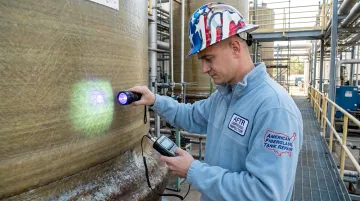
Early detection matters. Problems caught at the corrosion coat stage are simpler and cheaper to fix than those that have reached the structural laminate.
Repairs and Lining Restoration
Over a 20–30 year service life, most FRP tanks will require at least one of the following:
- Interior relining — restoring the corrosion barrier before stored product reaches the structural body
- Nozzle repair or replacement — relocating, resizing, or blocking off nozzles and manways as piping layouts change
- Structural reinforcement — addressing compromised laminate after prolonged chemical exposure
Repair cost is heavily influenced by how early the problem is caught. When a tank's corrosion barrier has failed but structural integrity remains intact, AFTR's field crews can fabricate a new corrosion layer on-site, turning what would have been a full replacement into a planned relining job. Deferred maintenance consistently results in larger repair scope and higher cost.
Budget vs. Premium FRP Tanks — What's the Real Difference?
Budget tanks are adequate for clean water storage — they are not appropriate for chemically aggressive or regulated environments.
| Factor | Standard Polyester | Vinylester / Epoxy |
|---|---|---|
| Chemical resistance | Clean water, low-risk liquids | Aggressive chemicals, acids, caustics |
| Expected service life | 15–20 years (well maintained) | 25–30+ years (well maintained) |
| Lining integrity | Adequate for non-corrosive service | Required for demanding applications |
| Compliance suitability | Limited | NSF/ANSI 61, AWWA D120, ASTM D4097 |
| Long-term TCO | Lower upfront; higher if misapplied | Higher upfront; lower over full service life |
The risk of under-specifying is concrete: a standard polyester tank storing moderately corrosive chemicals will show corrosion barrier failure — spidering, disbondment, emulsification — years ahead of schedule. AFTR's field inspection work routinely identifies exactly these failure modes. Once liquid migrates past the corrosion coat and into the structural body, repair scope expands significantly.
Specifying the wrong resin system for a potable water or chemical application also creates compliance liability — failed NSF/ANSI 61 conformance, permit violations, and potential public health exposure. Those consequences go well beyond replacement cost.
How to Estimate the Right Budget
The right budget covers the full installed cost plus lifecycle maintenance — not just the tank purchase price.
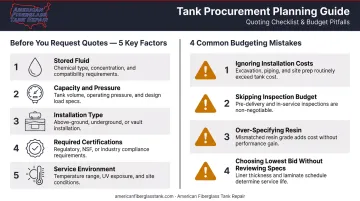
Before requesting quotes, clarify these factors:
- Stored fluid — water, chemicals, wastewater, food-grade liquids (determines resin requirement)
- Required capacity and pressure rating — drives size and wall construction
- Installation type — above-ground vs. buried (affects structural spec and installation cost)
- Applicable certifications — NSF/ANSI 61 for potable water, AWWA D120, ASTM D4097
- Service environment — indoor/outdoor, UV exposure, temperature range, freeze conditions
Once those factors are defined, the next step is avoiding the mistakes that inflate costs or compromise performance.
The most common budgeting mistakes:
- Ignoring installation costs — assuming they're minor when they can be substantial
- Skipping inspection in the lifecycle budget — professional inspection every 5 years is a real cost of owning a 25-year asset
- Over-specifying for clean water — vinylester or epoxy resins where standard isophthalic polyester is fully adequate
- Selecting the lowest bid without reviewing specs — laminate thickness, resin grade, and compliance documentation are what you're actually buying
For industrial, municipal, or chemical applications, consulting a certified FRP specialist before committing to a tank can prevent costly specification errors. AFTR's inspection and assessment services are designed to help industrial operators evaluate current tank condition, identify what repairs or maintenance are needed, and plan budgets for FRP assets over their full service life. Field teams deploy directly to customer sites across all 50 US states— no need to transport equipment off-site.
Frequently Asked Questions
How much does an FRP water storage tank cost in the US?
Published prices for standard resin FRP tanks start around $2,500 for units under 1,500 gallons and reach approximately $6,000 for 5,000-gallon units. Large industrial tanks above 25,000 gallons are typically quote-only and can exceed $100,000 depending on resin system, engineering requirements, and compliance certifications.
How long do FRP water storage tanks last?
Well-maintained FRP tanks typically last 20–30 years or more. Service life depends on resin quality, the chemical or fluid stored, operating temperature, and whether the tank receives periodic professional inspection. Some manufacturers offer 30-year limited warranties on specific configurations and uses.
What resin type is best for an FRP water storage tank?
Isophthalic polyester is appropriate for most standard water storage applications. Vinylester is the better choice for industrial process water, light chemical exposure, or regulated applications. Epoxy resin is reserved for the most demanding chemical environments. Resin selection should always be matched to the stored fluid, concentration, and operating conditions.
Are FRP water storage tanks approved for drinking water?
Yes, when manufactured with appropriate food-grade resins and certified to NSF/ANSI 61, which covers materials in contact with drinking water. Buyers should verify NSF/ANSI 61 certification before selecting any tank for potable water service — not all FRP tanks carry this certification.
How much does FRP tank installation typically add to the total cost?
Installation costs — covering foundation or excavation, labor, piping connections, and freight — typically add 20–50% to the tank purchase price and should be budgeted as a separate line item. Buried tank installations generally cost more than above-ground setups due to excavation, engineered backfill, and access requirements.
When should an FRP water storage tank be inspected or repaired?
Industry guidance recommends comprehensive professional inspection every five years for standard water storage, and every two years for tanks storing aggressive chemicals. FTPI-certified inspectors — like those at American Fiberglass Tank Repair — assess laminate integrity, corrosion coat condition, and structural soundness using ultrasonic, backlight, and visual methods. Early detection consistently lowers repair costs and prevents unexpected failures.