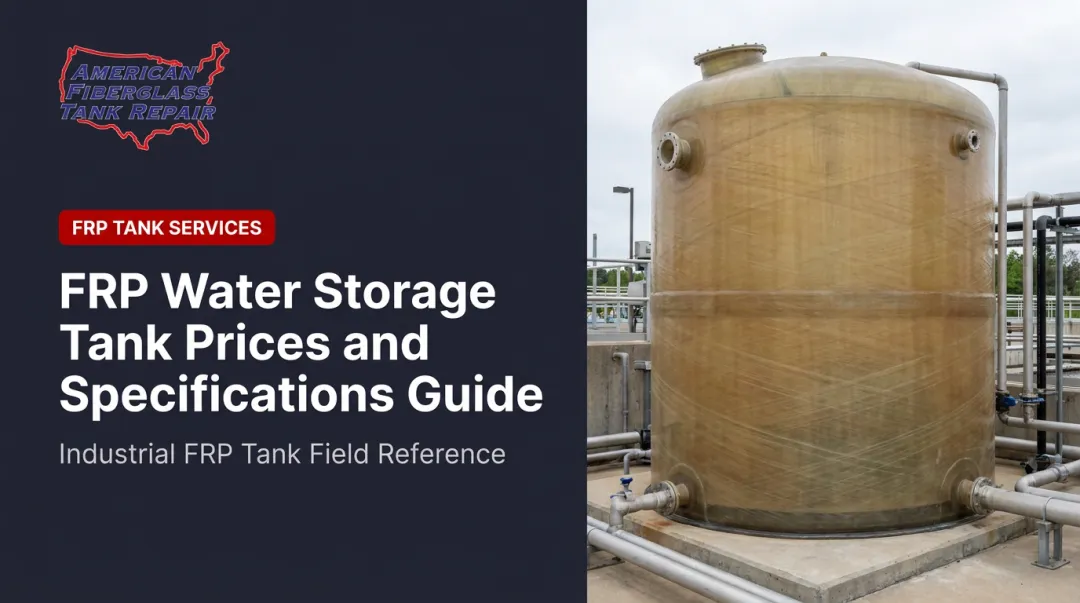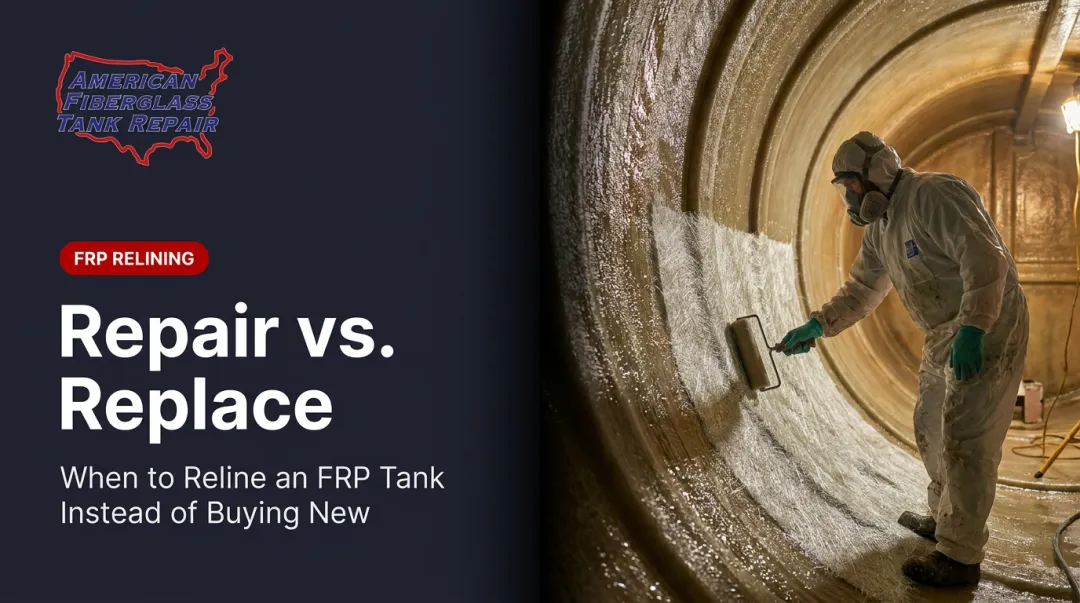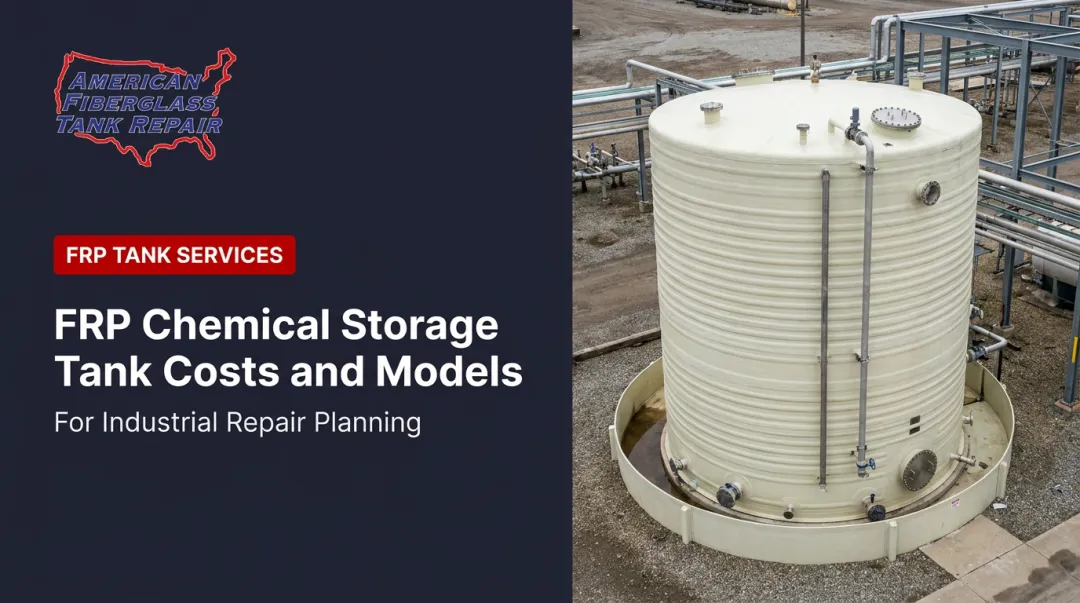
What trips up most buyers: FRP tank pricing is not fixed. A standard above-ground potable water tank and a custom-engineered double-wall chemical tank both qualify as "FRP" — but their costs can differ by an order of magnitude.
This guide breaks down typical U.S. price ranges, the factors that drive cost up or down, total lifecycle economics, and what you need to get an accurate quote.
Key Takeaways
- Standard FRP water tanks in the 2,500–6,000 gallon range carry market list prices of $4,120 to $6,888 (roughly $1.15–$1.65 per gallon) — useful reference points when evaluating repair vs. replacement decisions
- Cost drivers: tank size, resin system, construction method, certifications, and site complexity
- Custom-engineered and large-capacity tanks (10,000+ gallons) are quote-only: no published list prices exist
- FRP lining refurbishment can cost as little as 20% of full tank replacement, making maintenance the smarter long-term investment
- Lifecycle costs over 20–30 years frequently exceed the upfront price gap between a budget tank and a properly maintained one
How Much Does an FRP Water Storage Tank Cost?
FRP water storage tanks don't carry a one-size-fits-all price. Costs shift significantly based on tank size, resin system, construction method, and whether the application requires specialty certifications or custom engineering. Understanding what drives each tier helps you budget accurately from the start.
Pricing generally falls into three tiers: standard off-the-shelf tanks, mid-range industrial tanks, and large custom-engineered vessels.
Entry-Level / Standard Tanks
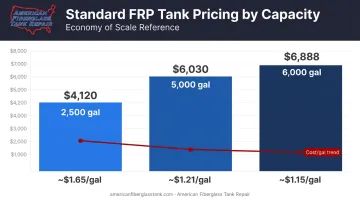
For small, above-ground tanks using standard resin systems, public list pricing does exist. RHFS listings for Design Tanks FRP tanks show:
| Tank Size | List Price | Price per Gallon |
|---|---|---|
| 2,500 gal | $4,120.27 | ~$1.65/gal |
| 5,000 gal | $6,030.19 | ~$1.21/gal |
| 6,000 gal | $6,888.58 | ~$1.15/gal |
What's typically included at this tier: off-the-shelf dimensions, standard polyester resin, basic fittings, no specialty coatings or certifications.
Best for: Smaller municipalities, on-site potable water backup, light commercial use.
Note the price-per-gallon decline as capacity increases — this economy of scale continues into mid-range tanks but flattens at custom sizes.
Mid-Range Industrial Tanks
Mid-range tanks use filament-wound or SMC panel construction with application-specific resin systems. Manufacturers rarely publish prices at this tier.
A useful benchmark from Fibrex: a 12 ft diameter, 15,000 gallon tank runs approximately $21,000 in isophthalic polyester or $30,000 in vinyl ester resin, which represents a roughly 43% premium for chemical-resistant performance.
What's typically included: isophthalic polyester or vinyl ester resin, NSF/ANSI 61 compliance options for potable water applications.
Best for: Water treatment plants, wastewater facilities, food processing, agricultural irrigation.
Large / Custom-Engineered Tanks
Manufacturers including Design Tanks and Tank Depot offer fiberglass tanks up to 50,000–60,000 gallons, but at this scale, pricing is quote-driven. No public benchmarks exist for large custom FRP tanks.
Standard package includes: engineer-driven design, premium vinyl ester or epoxy resin, specialized internal coatings, double-wall construction, and custom dimensions and fittings.
Best for: Chemical plants, large municipal waterworks, industrial process water, aerospace and defense applications.
Key Factors That Drive FRP Tank Pricing
Pricing depends on technical specifications, material choices, installation complexity, and site conditions. Understanding each factor prevents budget surprises.
Tank Type and Manufacturing Method
Two construction methods dominate the market, and each has a different cost profile:
Filament-wound tanks use continuous glass roving wound through a thermoset resin matrix, producing seamless cylindrical vessels with high structural strength. ASTM D3299 governs this construction method for corrosion-resistant applications. They cost more to fabricate but deliver superior integrity for pressure-rated or chemical service.
SMC/GRP sectional panel tanks are modular systems assembled on-site. Balmoral's GRP sectional tanks, for example, range from 1 m³ to 10,000 m³ and carry WRAS potable water approval and LPCB fire water certification. They're easier to transport to constrained sites and typically less expensive — the trade-off is on-site assembly labor and joint integrity requirements.
Filament-wound tanks suit engineered cylindrical containment; panel systems make more sense when site access, large rectangular storage, or modular potable water certification drives the specification.
Resin System and Material Specifications
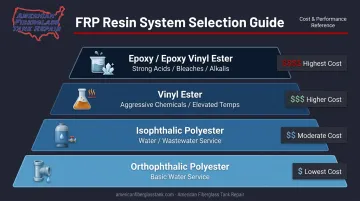
Resin choice has the largest impact on material cost. The hierarchy from lowest to highest:
- Orthophthalic polyester — lowest cost; not recommended for chemical contact applications
- Isophthalic polyester — moderately higher cost; better corrosion resistance for water/wastewater service
- Vinyl ester — higher cost; suited for aggressive chemicals, higher temperatures, and demanding industrial service
- Epoxy / epoxy vinyl ester — highest cost; reserved for highly corrosive environments with strong acids, bleaches, or alkalis
NSF/ANSI 61 certification for potable water contact doesn't mandate a specific resin by name — it establishes health-effects requirements for materials that contact drinking water. Manufacturers like Design Tanks specify NSF/ANSI 61-certified materials across their potable water product line.
When AFTR reseals or relinies FRP water storage tanks, the team selects from custom-blended isophthalic, terephthalic polyester, vinyl ester, and epoxy resins matched to the stored product's chemistry and temperature — the same logic that governs new tank specification.
Customization and Special Features
Each of these additions increases fabrication time and material cost:
- Additional nozzles and custom fitting configurations
- Internal coatings or specialty liners for chemical compatibility
- UV-resistant exterior gel coat for outdoor installations
- Double-wall construction for secondary containment compliance
- Manway access ports and confined space entry systems
- Engineered anchorage systems for seismic zones or buried applications
Nozzle modifications in the field — relocating, adding, or resizing ports — are a core part of AFTR's service work because facilities often need to adapt tanks after installation. Getting the nozzle configuration right during fabrication is far cheaper than field modification later.
Installation and Site Requirements
Installation costs are site-specific and should be quoted as separate line items. Key drivers include:
- Foundation or concrete pad preparation
- Crane or lifting equipment for large-diameter tanks
- Underground excavation and backfill for buried installations
- Piping, valve, and instrumentation connections
- Site access constraints (remote locations, confined yards, rooftop placements)
Improper installation is a documented cause of tank failure — NOV/Containment Solutions' installation guidance explicitly warns that installation errors can lead to product release. Don't accept a combined tank-plus-installation quote without itemized breakdowns.
Total Cost of Ownership: Beyond the Purchase Price
The purchase price is only the starting point. A complete budget accounts for installation, inspection, maintenance, repair, and eventual replacement across a 20–40 year service life.
Initial Purchase and Installation
The tank fabrication price is the visible number, but installation — foundation prep, crane work, piping connections, commissioning — adds significant cost depending on site complexity. Always request itemized quotes covering:
- Tank fabrication and freight
- Crane/unloading and rigging
- Foundation prep or excavation
- Piping connections and nozzles
- Inspection and pressure testing
Routine Inspection and Maintenance
FRP tanks require periodic inspection of the laminate, internal corrosion lining, fittings, and nozzle interfaces. FTPI RP 2007-1 (the Fiberglass Tank & Pipe Institute's recommended practice for in-service inspection) identifies inspection triggers of 10 years for non-hazardous tanks over 10,000 gallons and 5 years for hazardous service.
Skipping inspections is where deferred costs accumulate fast. A hydrostatic test only tells you whether the tank holds liquid at that moment — it won't catch capillary migration beneath the corrosion coat, delamination within the structural laminate, or early-stage disbondment at nozzle interfaces.
AFTR's inspections use ultrasonic, laser, and high-intensity backlight testing methods to detect hidden conditions that pressure testing misses:
AFTR's inspections use ultrasonic, laser, and high-intensity backlight testing methods to detect hidden conditions that pressure testing misses:
- Spidering and floor stress cracking
- Shell distortion and emulsification
- UV degradation and early-stage liner disbondment at nozzle interfaces
Inspections are supervised by Fiberglass Tank & Pipe Institute certified inspectors and deliver written reports with specific remediation recommendations.
Early detection directly controls cost. A tank with early-stage liner degradation needs a relining job; one found after years of deferred inspection often needs full replacement.
Repair and Lining Restoration
FRP lining refurbishment can cost as little as 20% of full tank replacement, according to Water Industry Journal. Even when a tank's internal corrosion barrier has been breached, the structural laminate often remains intact — and that intact shell is an ideal substrate for a new corrosion lining.
AFTR's relining work restores tanks that would otherwise be condemned, at a fraction of new-tank capital expenditure and without the long lead times for replacement vessels. Repair scope and cost escalate sharply once liner deterioration reaches the structural body, which is why acting on early findings matters.
End-of-Life Planning
Well-maintained FRP tanks typically last 20–40 years, with industry service providers reporting:
Well-maintained FRP tanks typically last 20–40 years, with industry service providers reporting:
- KBK Industries: 20–40 years under standard conditions
- DT Fiberglass: 25–40+ years with proper care and maintenance
Tanks under active inspection and repair programs consistently reach the upper end of that range.
Budget your lifecycle plan for eventual relining or replacement. Facilities running proactive inspection programs routinely convert what would have been replacement projects into planned relining jobs — extending service life well past the original design horizon.
FRP vs. HDPE Water Storage Tanks: A Cost Comparison
HDPE (high-density polyethylene) is the most common alternative to FRP for water storage. The right choice depends on the application, not just the purchase price.
| Factor | FRP | HDPE |
|---|---|---|
| Initial cost | Higher — FRP can cost 3–5× more than crosslinked polyethylene | Lower upfront cost |
| Large capacity | Available to 50,000–60,000+ gal | Less common at very large capacities |
| Chemical resistance | Resin-dependent; vinyl ester handles aggressive chemistries | Chemical-specific; suitable for many industrial fluids |
| Structural strength | High; engineer-specified wall thickness | Lower structural rigidity at large diameters |
| Repairability | Repairable and relineable; extends service life | Crosslinked polyethylene is difficult to repair; typically requires replacement |
| Service life | 20–40 years with maintenance | No widely verified industrial benchmark |
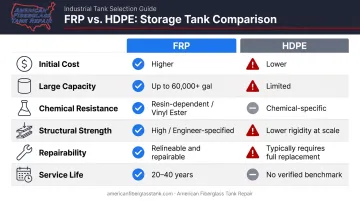
Repairability is where the two materials diverge most sharply over time. FRP tanks can be relined, structurally repaired, and have nozzles modified — all without removal from the foundation. When a crosslinked polyethylene HDPE tank is compromised, full replacement is typically the only option.
For large-capacity industrial applications, chemical service, or systems where long-term maintainability matters, FRP generally delivers lower total cost of ownership. Repair and relining services — rather than full replacement — are what make that lifecycle math work in FRP's favor.
How to Get an Accurate FRP Tank Quote
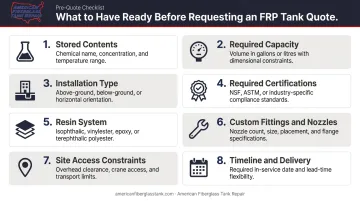
FRP tank quotes vary widely between suppliers because fabrication is highly customized. Vague requests produce quotes that can't be meaningfully compared — give every supplier the same complete specifications from the start.
Before requesting a quote, have the following ready:
- Stored contents — potable water, process water, wastewater, specific chemical name and concentration
- Required capacity — in gallons or liters
- Installation type — above ground, underground, horizontal, vertical
- Required certifications — NSF/ANSI 61 for potable water, ASTM D3299 (filament-wound) or D4097 (contact-molded), AWWA D120 for water-sector applications
- Resin system preference or chemical compatibility requirements
- Custom fittings, nozzles, manways, or coatings needed
- Site location and access constraints — crane access, rooftop, remote location
- Timeline and delivery requirements
The same specification discipline applies when evaluating repair versus replacement. AFTR's Field Service Engineers — operating across all 50 U.S. states since 2003 — assess tanks on-site and build repair or relining quotes from documented condition data, resin compatibility requirements, and structural findings. That approach produces numbers that reflect actual scope, not rough estimates, so the repair-versus-replace comparison holds up under scrutiny.
Common FRP Tank Budgeting Mistakes
Mistake 1: Chasing the Lowest Purchase Price
Skipping evaluation of resin quality, wall thickness, or compliance certifications to save upfront cost is the most expensive mistake in the long run. A tank built to inadequate specifications will fail corrosion requirements earlier, require more frequent repair, or need full replacement before a properly specified alternative would.
The reverse applies too. Specifying vinyl ester resin for a standard potable water backup tank that would perform fine with isophthalic polyester is unnecessary capital spend. Match the resin to the application — nothing more, nothing less.
Mistake 2: Ignoring Lifecycle Costs
Many facilities budget for the tank and installation but leave recurring inspection, periodic lining restoration, and eventual replacement out of the capital plan entirely. A tank without a maintenance program will almost always incur higher total costs than one under a proactive service schedule — and the gap widens as the tank ages.
AFTR's philosophy: the best surprise is no surprise at all. An FRP tank under a periodic inspection program rarely fails unexpectedly. One without inspection history usually does.
Frequently Asked Questions
How much does an FRP water storage tank cost for 10,000 L or 20,000 L?
Comparable standard FRP tanks in the 2,500–5,000 gallon range (roughly equivalent to 10,000–20,000 L) typically run $4,120–$6,030 in the U.S. market. Final cost depends on resin type, certifications, and customization. Request a detailed quote from your supplier for accurate figures based on your specific application.
Which is better for water storage: HDPE tanks or FRP tanks?
FRP is generally superior for large-capacity, industrial, or chemical applications due to structural strength, resin-specific chemical resistance, and repairability. HDPE suits smaller, simpler storage needs at lower upfront cost. FRP's ability to be relined and repaired gives it a clear lifecycle cost advantage in demanding service.
How long do FRP water storage tanks last?
Properly maintained FRP tanks typically last 20–40 years. Tanks enrolled in active inspection and repair programs consistently reach the upper end of that range — some extending well beyond it. Deferred maintenance dramatically shortens expected service life. AFTR's periodic maintenance programs are designed to keep tanks safely in service for as long as possible.
What information do I need to provide to get an accurate FRP tank quote?
Stored contents (with chemical name and concentration), required capacity, installation type, resin or certification requirements (NSF/ANSI 61, ASTM D3299), custom fittings or coatings, site access details, and delivery timeline. Omitting any of these details leads to estimates that are difficult to compare or rely on.
Are FRP water storage tanks safe for potable water?
Yes — FRP tanks can be manufactured and relined to NSF/ANSI 61 standards for potable water contact. The resin system, internal corrosion lining, and fittings must all be specified and certified accordingly. Not all FRP tanks meet this standard by default; AFTR performs relining work using NSF/ANSI 61-compliant materials for tanks requiring potable water certification.
What is the difference between filament-wound and SMC panel FRP tanks?
Filament-wound tanks are seamlessly constructed cylindrical vessels offering high structural strength for industrial and chemical service. SMC panel tanks are modular systems assembled on-site, better suited for large potable water or fire suppression storage where site access is limited. Filament-wound tanks generally cost more but deliver superior performance for pressure-rated or chemical applications.