That sequencing problem is expensive. Specifying a water-grade tank for corrosive chemical service, or ignoring freight and installation costs entirely, leads to chronic underbudgeting and, in worst cases, premature tank failure.
Prices have grown more variable in recent years as resin material costs have shifted and chemical resistance requirements have become more specialized. Small standard tanks can run a few thousand dollars. Large custom-engineered vessels for aggressive chemical service can reach $80,000 or well beyond — and that's before installation.
This guide breaks down current price ranges by tank tier, the cost factors that matter most, and how to build a budget that reflects what you're actually paying for.
Key Takeaways
- FRP chemical storage tank costs range from roughly $3,000–$10,000 for small standard units to $80,000+ for large or highly customized chemical-grade vessels
- Resin system, tank capacity, and manufacturing method drive most of the price variation
- Chemical plants storing aggressive acids, caustics, or solvents should expect a 20–40% premium over water-storage-grade FRP
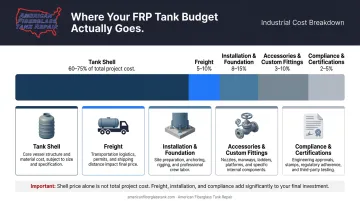
- The tank shell is typically only 60–75% of total project cost; freight, installation, accessories, and inspection make up the rest
- Total cost of ownership over a 20–25 year service life often exceeds the initial purchase price by 2–3×
How Much Does an FRP Chemical Storage Tank Cost?
No single price covers all FRP chemical storage tanks. Cost depends on capacity, resin system, wall thickness, configuration, and — critically — what chemical the tank will hold.
The most common budgeting mistake is treating FRP chemical tanks as interchangeable with water storage tanks. A tank specified for dilute sodium hydroxide storage requires a meaningfully different resin and laminate schedule than one storing municipal water. Buying the wrong specification is often more expensive than paying the right price upfront.
Entry-Level Tanks (250–2,500 Gallons, Standard Service)
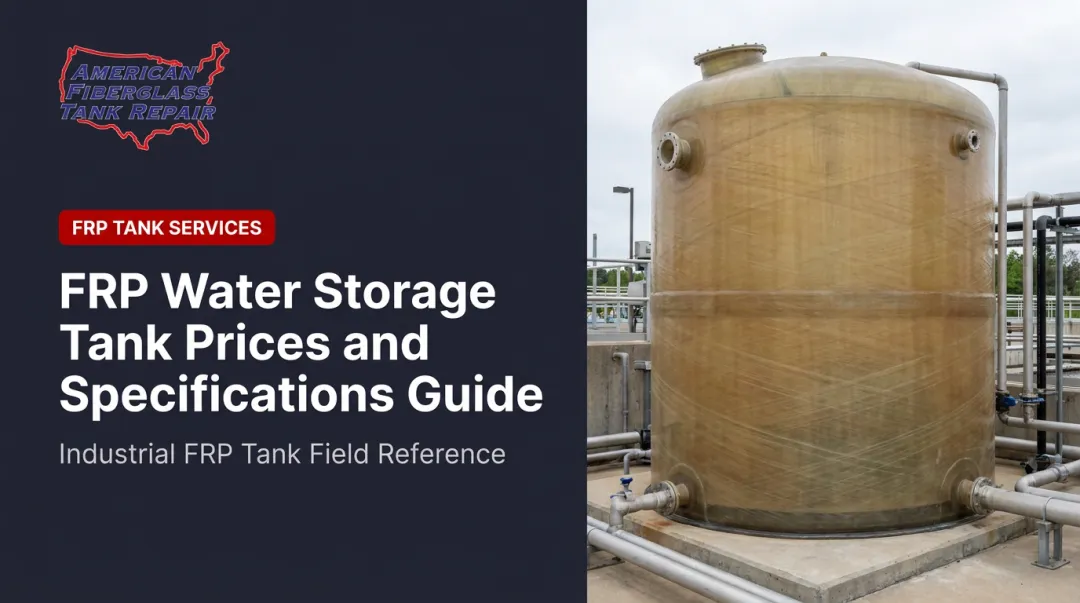
For small tanks in the 250–2,500 gallon range using standard polyester resin, publicly listed distributor pricing provides some reference points. One major distributor lists a 225-gallon FRP tank at approximately $710 and a 1,000-gallon unit at roughly $3,470. These figures represent individual distributor SKUs — not a verified market range — and typically cover the tank shell with basic fittings and a standard manway. Freight, installation, secondary containment, and specialty accessories are excluded.
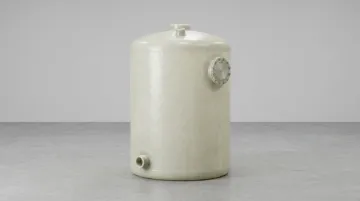
Typical applications:
- Light industrial applications with dilute chemical storage
- Facilities replacing smaller process tanks on limited budgets
- Non-aggressive chemicals where standard polyester resin is appropriate
Mid-Range Industrial Tanks (2,500–15,000 Gallons, Vinyl Ester Resin)
Mid-size tanks in this range with vinyl ester resin systems represent the most common tier for serious industrial chemical service. Distributor data shows a 3,000-gallon FRP tank at approximately $4,100 at the lower end of this range. Vinyl ester upgrades, custom outlets, pressure ratings, and compliance certifications such as NSF or ASTM D3299 listings push pricing considerably higher as capacity and specification requirements increase.
Best suited for:
- Chemical processing plants handling moderately aggressive acids or caustics
- Municipal water treatment facilities storing sodium hypochlorite or ferric chloride
- Industrial manufacturers requiring ASTM D3299 or D4097 compliance
Large-Capacity or Custom Chemical Tanks (15,000+ Gallons or Severe Service)
At this tier, catalog pricing largely disappears. Tanks above 15,000 gallons — or any vessel requiring epoxy resin systems, elevated temperature ratings, or specialized laminate schedules for highly corrosive chemicals — are almost always custom-quoted.
Manufacturers such as NOV and PPE Tanks build factory-fabricated FRP vessels up to 60,000 gallons. Very large tanks sometimes require on-site assembly due to transportation constraints.
Common use cases:
- Large chemical manufacturers and bulk chemical storage operations
- Wastewater facilities handling concentrated acids, high-temperature caustics, or aggressive industrial influents
- Aerospace, defense, and high-purity manufacturing operations
- Any application with high-temperature or highly concentrated chemical exposure
Key Factors That Affect FRP Chemical Tank Pricing
FRP tank pricing reflects a combination of material science, engineering specifications, and site-specific requirements. Understanding each factor helps buyers avoid both over-specifying and under-specifying.
Resin System and Chemical Compatibility
The resin system is the single largest cost variable in chemical storage tanks.
| Resin Type | Best For | Cost Profile |
|---|---|---|
| Isophthalic polyester | Mild chemicals, dilute solutions | Most economical |
| Vinyl ester | Strong acids, solvents, caustics | Moderate premium over polyester |
| Epoxy (including Novolac) | Most aggressive environments, high temps | Highest cost |
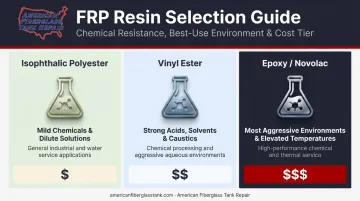
Interplastic's CoREZYN isophthalic resins are described as cost-effective alternatives to vinyl esters when high-performance properties aren't required — which confirms that resin selection is a genuine cost lever, not just a specification formality.
That said, resin selection must be driven by the specific chemical being stored, its concentration, operating temperature, and any cycling between multiple chemicals. Using underspecified resin to reduce upfront cost is one of the most reliable paths to premature lining failure.
AFTR's field service teams encounter this scenario regularly, particularly with aggressive chemicals like sodium hypochlorite, hydrochloric acid, ferric chloride, and sodium hydroxide, where resin compatibility is non-negotiable.
Tank Capacity and Wall Thickness
Per-gallon cost generally decreases as tank capacity increases, driven by material and manufacturing efficiencies. However, tanks storing denser or more aggressive chemicals require heavier laminate schedules, which partially offsets those economies.
A 2018 municipal procurement in Warwick, Rhode Island illustrates this directly: a 5,500-gallon FRP sodium hypochlorite tank required a brominated Bis-A epoxy vinyl ester resin laminate with a 106-mil corrosion barrier — heavier than a standard water-storage laminate by a wide margin.
Wall thickness requirements driven by chemical density or operating pressure translate directly into higher material and labor cost, regardless of tank size.
ASTM C582 governs thickness and physical property requirements for contact-molded FRP laminates in corrosion-resistant service and is the relevant standard for specifying laminate schedules.
Manufacturing Method
Two primary methods govern FRP chemical tank construction:
- Filament winding (ASTM D3299): Automated process producing consistent wall thickness and predictable mechanical properties; generally preferred for chemical service
- Contact molding / hand lay-up (ASTM D4097): More flexible for irregular shapes and custom configurations; used for both standard and specialty tanks
Filament-wound tanks typically carry a cost premium but deliver more consistent performance over time — relevant for chemical service where wall uniformity directly affects containment integrity.
For very large tanks that can't be shipped as a single unit, on-site fabrication adds substantial labor cost. Creative Composites Group, for example, uses field fabrication methods for tanks exceeding 24 feet in diameter. Factory-manufactured and delivered tanks remain far less expensive when site access and transport allow.
Customization, Accessories, and Compliance
Standard nozzle packages include inlets, outlets, vents, overflow connections, drains, and a manway. Beyond that, the cost additions accumulate:
- Custom outlet configurations and nozzle sizing
- ANSI B16.5 flanged nozzle assemblies (available in 1–12 inch sizes)
- Agitator mounts and heating coil connections
- Secondary containment sumps or integrated bunds
- Ladders, platforms, and hold-down lugs
Accessories and custom fittings can add 10–25% to the base shell price, depending on complexity.
Compliance requirements add cost but are often non-negotiable. NSF/ANSI 61 certification applies to components in drinking water contact. ASTM D3299 and D4097 are the primary fabrication standards for filament-wound and contact-molded chemical tanks respectively. Budget these from the start — discovering a required certification late in procurement adds time and cost.
Total Cost Breakdown: What You're Actually Paying For
The tank shell purchase price is typically only 60–75% of total project cost for chemical storage applications. Most buyers discover this on their first FRP tank purchase, usually after the freight quote arrives.
Here's where the rest of the budget goes:
One-Time Costs:
- Tank shell — the shell, standard fittings, and any factory-applied linings; varies most by capacity and resin system
- Freight — FRP tanks are lighter than steel, but oversized loads still carry meaningful transport costs; very large tanks may require specialized hauling and permits
- Installation — foundation preparation (flat-bottom vessels require full, uniform support across the entire base), rigging, piping connections, and secondary containment construction
Recurring Costs:
- Inspections and compliance testing — certified FRP inspections are required for chemical service tanks; industry guidance under FRP RP 2007-1 recommends external inspection every five years for hazardous-substance service
- Maintenance and repair — interior lining restoration, nozzle repair, and structural reinforcement are routine over a tank's lifecycle; proactive lining work typically runs far less than emergency remediation or full replacement
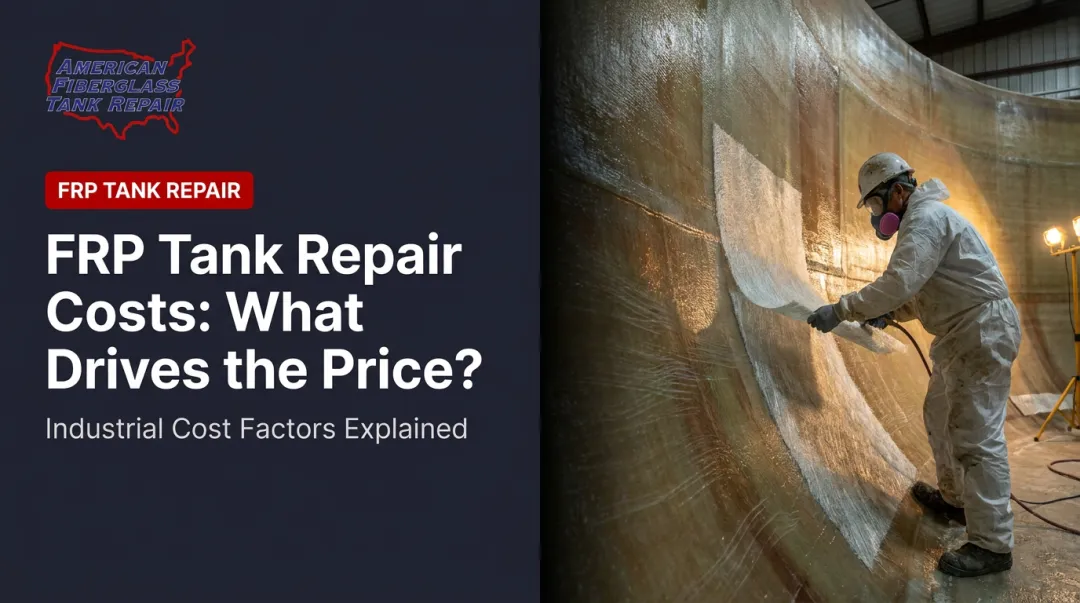
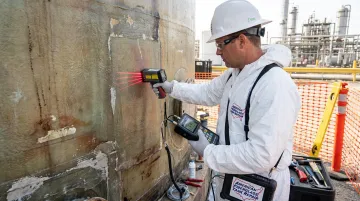
Inspection quality matters as much as frequency. AFTR's programs, supervised by Fiberglass Tank & Pipe Institute certified inspectors, use ultrasonic, laser, and high-intensity backlight testing to catch subsurface issues — such as capillary migration beneath the corrosion coat — before they escalate. Early detection converts what would otherwise be a tank replacement into a planned relining project, which is where the real cost savings accumulate over a vessel's life.
How to Budget Accurately — and What Most Buyers Get Wrong
Accurate FRP tank budgeting starts from operational requirements, not from the lowest available price. The right question isn't "what's the cheapest FRP tank at this capacity?" — it's "what does this application actually require?"
Before requesting quotes, confirm:
- The specific chemicals to be stored, including concentrations and pH
- Operating temperature range (and any temperature cycling)
- Required capacity with a 10–20% safety margin above maximum working volume
- Site infrastructure — foundation type, access, available utilities
- Regulatory compliance requirements — NSF certifications, ASTM standards, state-level requirements
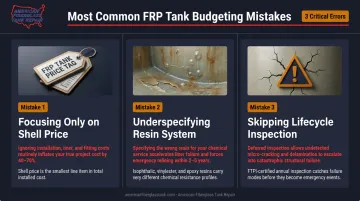
The three most common budgeting mistakes:
Focusing only on the tank shell price. Freight, installation, and accessories routinely add 25–40% to total project cost. An itemized quote that separates shell cost, fittings, freight, and installation is the only reliable basis for comparison.
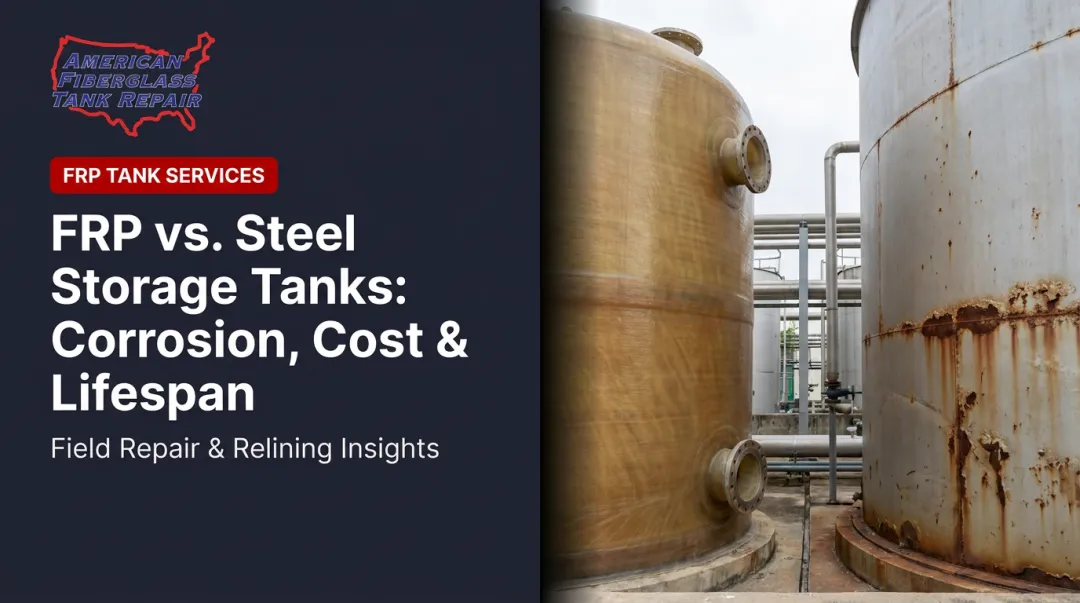
Choosing polyester resin to cut cost on a chemical application that requires vinyl ester or epoxy. This single specification decision generates more emergency repair calls than any other. Premature lining failure in aggressive chemical service (blistering, fiber blooming, delamination, osmotic damage) can require full relining or tank condemnation well before the expected service life.
Neglecting to budget for lifecycle inspection and maintenance. Tanks without regular certified inspections tend to fail without warning, turning a manageable repair into a full replacement. In AFTR's field work, catching capillary migration, shell distortion, or corrosion coat breakdown early converts what would be a capital replacement into a scheduled maintenance outage.
When comparing suppliers, request total installed cost — not purchase price alone. Suppliers who quote shell price only are hiding the number that actually matters: what it costs on day one of service.
Conclusion
FRP chemical storage tank costs vary widely: from a few thousand dollars for small standard units to well over $80,000 for large or severely chemically exposed vessels. Resin system, capacity, manufacturing method, and customization requirements each shift that number meaningfully.
The cheapest tank at purchase is rarely the lowest-cost option over a 20–25 year service life. A realistic budget accounts for full installed cost, compliance requirements, and a lifecycle maintenance program that keeps certified inspectors involved before problems become emergencies.
Working with experienced FRP professionals, from initial specification through ongoing inspection and repair, is the most reliable way to protect that capital investment. American Fiberglass Tank Repair has provided engineer-driven inspection, relining, and repair services across all 50 states since 2003 — with Fiberglass Tank & Pipe Institute certified inspectors ready to assess your vessels before small issues become costly failures.
Frequently Asked Questions
What is the cost of an FRP storage tank?
FRP chemical storage tank costs typically range from approximately $3,000–$10,000 for small standard tanks (250–2,500 gallons) to $80,000 or more for large-capacity or custom chemical-grade vessels. Pricing varies significantly based on resin system, capacity, and the specific chemicals being stored.
How long do FRP chemical storage tanks last?
Properly specified and maintained FRP chemical tanks typically last 20–25 years or longer. Regular certified inspections and timely lining repairs can extend service life well beyond that range by catching corrosion coat deterioration before it reaches the structural body.
What resin system should I choose for chemical storage?
Resin selection depends on the specific chemical, its concentration, and operating temperature. Standard polyester suits mild applications, vinyl ester handles most aggressive acids and solvents, and epoxy resins are required for the most demanding chemical environments and elevated temperatures.
Is it cheaper to repair or replace an aging FRP chemical storage tank?
Repair is generally far more cost-effective than replacement when structural integrity is intact and damage is limited to the interior lining. A certified inspection (using ultrasonic, laser, and high-intensity backlight testing) is the only reliable way to determine which path makes financial sense.
What is the difference between a standard and custom FRP chemical storage tank?
Standard tanks are manufactured in fixed sizes with common resin systems and basic fittings. Custom tanks are engineered to specific capacities, chemical services, outlet configurations, and compliance requirements, and carry a cost premium that reflects the engineering and material selection involved.
How does tank capacity affect cost per gallon for FRP chemical storage?
Per-gallon cost generally decreases as tank size increases due to manufacturing and material efficiencies. However, chemical tanks requiring heavy laminate schedules or premium resin systems may see this economy of scale partially offset by increased material costs.