Several standards bodies govern FRP tanks, and which ones apply depends entirely on the application. A tank storing sodium hypochlorite at a water treatment plant faces different requirements than one holding crude oil or process chemicals in an industrial facility. This guide covers the three primary frameworks — ASTM, AWWA, and NACE/AMPP — plus two additional standards worth knowing: API 12P and ASME RTP-1.
American Fiberglass Tank Repair (AFTR), a member of both AWWA and NACE with Fiberglass Tank & Pipe Institute certified inspectors on staff, works within these exact frameworks daily. That field-level perspective shapes everything in this guide.
Key Takeaways
- ASTM D3299 sets manufacturing specs for filament-wound FRP tanks; ASTM D4097 covers contact-molded versions
- AWWA D120 governs thermosetting FRP tanks for water service (above and below ground); AWWA D121 covers bolted aboveground panel-type tanks
- NACE/AMPP standards define corrosion control, lining integrity, and inspection protocols for tanks handling aggressive chemicals
- Most industrial FRP tanks must satisfy multiple standards simultaneously: ASTM for construction, AWWA for water service, and NACE for ongoing inspection
- Standards overlap and stack — knowing which apply to your tank determines your compliance and maintenance obligations
ASTM Standards for FRP Tanks: D3299 and D4097
ASTM International sets the foundational construction and material specifications for FRP tanks. Before a tank enters service, ASTM standards define what it's made of and how it must be built — covering resin systems, laminate composition, wall thickness, and testing. Two standards sit at the center of FRP tank manufacturing: D3299 and D4097.
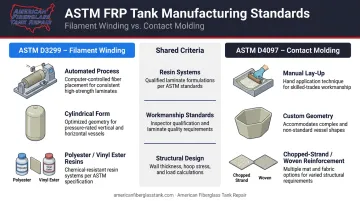
ASTM D3299 — Glass-Fiber-Reinforced Thermoset Resin Tanks
ASTM D3299-26 is the current active standard, last updated April 2026. It covers cylindrical, corrosion-resistant tanks fabricated from glass-fiber-reinforced polyester or vinyl ester thermoset resin, designed for aboveground vertical installation at atmospheric pressure.
Key scope elements include:
- Materials: Commercial-grade glass-fiber reinforcement in polyester or vinyl ester resin systems
- Design limits: Service temperatures up to 180°F (82°C); pressures above atmospheric require special design consideration
- Applications: Tanks intended to contain aggressive chemicals, acids, and industrial process fluids
- Construction: Cylindrical tanks with filament-wound or other reinforcement configurations
Note that designs for vacuum conditions, pressures above atmospheric, and liquids heated above their flash points fall outside the standard's core scope and require additional engineering consideration.
ASTM also maintains a separate acoustic emission testing standard — ASTM E1067/E1067M-25 — specifically covering acoustic emission examination of FRP tanks and vessels to determine structural integrity.
ASTM D4097 — Contact-Molded FRP Tanks
ASTM D4097-19 covers cylindrical tanks fabricated by contact molding (hand lay-up) for aboveground vertical installation at essentially atmospheric pressure. This manufacturing method differs from filament winding in that layers are applied manually using chopped-strand mat, woven roving, nonwoven biaxial fabric, or surface mat. That makes it well-suited for custom shapes, complex geometries, and smaller production volumes.
D4097 shares D3299's focus on corrosion resistance but reflects the different material placement and laminate characteristics of contact-molded construction. Both standards:
- Define acceptable resin systems (polyester, vinyl ester)
- Address workmanship, finish, and appearance requirements
- Cover structural design and construction criteria
Together, these criteria establish the manufacturing baseline that inspectors reference when evaluating in-service tanks. When AFTR's inspectors assess an FRP tank for deterioration — looking for delamination, disbondment, spidering, blistering, or low Barcol hardness — what the tank was built to is the starting point for evaluating what's changed.
One active gap to flag: ASTM D2563, which covered visual defect acceptance criteria for glass-reinforced plastic laminates, was withdrawn in 2024 with no direct replacement. ASTM has a pending reinstatement work item (WK91947), but until that resolves, inspectors and engineers referencing visual defect classification should confirm which criteria they're applying.
AWWA D120 and D121: Standards for Water Storage Applications
The American Water Works Association (AWWA) publishes standards specific to FRP tanks used in water service — potable, reclaimed, and non-potable water systems. AWWA standards don't replace ASTM construction specs; they layer on top, adding water-quality and service-specific requirements.
AWWA D120 — Thermosetting FRP Tanks for Water Service
AWWA D120-19(R25) establishes minimum requirements for thermosetting FRP tanks used to store water or other liquids in water-supply service. The standard was reaffirmed in 2025 without revision.
Scope: Atmospheric-pressure, vented, cylindrical and spherical tanks — installed either aboveground or underground.
D120 covers:
- Material composition and performance requirements
- Design and construction practices
- Workmanship standards
- Testing methods
For potable water applications, the standard addresses resin system selection to prevent leaching and protect water-quality safety.
Waterworks operators and facility managers specifying repair or relining work on D120-governed tanks should confirm that materials used (resins, veils, laminates) are compatible with the tank's original water-service specification and any applicable NSF/ANSI/CAN 61 requirements for components in contact with drinking water.
AWWA D121 — Bolted Aboveground FRP Panel-Type Tanks
AWWA D121-24 covers bolted aboveground thermosetting FRP panel-type tanks for potable, reclaimed, and non-potable water storage. This differs from D120 tanks: instead of one-piece fabricated vessels, D121 tanks are assembled from prefabricated panels bolted together on-site.
The 2024 revision was substantial. Key updates include:
- Expanded scope: Reclaimed water and non-potable water added alongside potable water
- Updated seismic requirements: Roof live loads and seismic risk categories revised to ASCE/SEI 7-22
- NSF/ANSI/CAN 61: Updated to cover all tank parts in contact with potable water
- Elastomer guidance: Added chlorine and chloramine degradation of elastomers to the foreword
- Compliance additions: OSHA requirements and new verification and delivery sections
D121's evolution reflects real-world field experience. The chlorine/chloramine elastomer guidance, for example, addresses a failure mode water system operators have encountered with seal and gasket materials.
Practical implication: When specifying a new FRP water storage tank, confirm whether your application calls for D120 (one-piece fabricated tanks, above or below ground) or D121 (bolted panel-type, aboveground only). Vendor documentation should explicitly reference the applicable standard — and AFTR, as an AWWA member working regularly with waterworks operators, can help confirm whether existing or replacement materials meet D120 or D121 requirements.
NACE Standards and Corrosion Protection for FRP Tanks
NACE International merged with SSPC in 2021 to form AMPP (Association for Materials Protection and Performance). Legacy NACE standards and designations remain active under AMPP, and the organization's focus — corrosion control, protective coatings, and lining integrity — is directly relevant to FRP tanks in chemical, wastewater, and industrial service.
ASTM and AWWA set the construction and water service baseline. NACE/AMPP standards pick up from there, governing what happens to a tank's corrosion barrier over its full service life.
AFTR holds NACE membership, and that membership directly shapes how the company's inspection teams evaluate corrosion barrier condition — from degradation pattern recognition to lining integrity assessment on chemical storage vessels.
Corrosion Mechanisms NACE Standards Address
FRP tanks are not immune to degradation — they fail through specific mechanisms that NACE inspection protocols are designed to detect early:
- Chemical permeation: Aggressive chemicals migrate through the resin matrix, degrading the corrosion barrier layer beneath the surface
- Hydrolysis at the glass-fiber/resin interface: Water and chemical ingress breaks down the bond between glass fibers and resin, reducing structural integrity over time
- Blister formation: Pressure differentials from permeated chemicals or absorbed moisture create subsurface blisters in the laminate
- UV degradation: Exterior resin surfaces exposed to sunlight degrade the outer laminate without proper protection
AFTR's inspection teams use ultrasonic, laser, and high-intensity backlight testing to detect subsurface anomalies — including capillary migration of liquid product beneath the corrosion coat — before they reach through-wall stage.
Resin Selection and Lining Integrity
NACE/AMPP guidance informs resin system selection based on the stored chemical environment. AMPP proceedings include published research on FRP resin and corrosion barrier selection validated through ASTM C581 laboratory coupons and field immersion testing.
In practice, AFTR selects from custom-blended resin systems matched to the specific chemical, concentration, and operating temperature:
- Isophthalic polyester — general chemical service and water storage
- Terephthalic polyester — elevated temperature and moderate chemical exposure
- Vinyl ester — aggressive chemicals including oxidizers and solvents
- Epoxy — select high-concentration acid and alkali environments
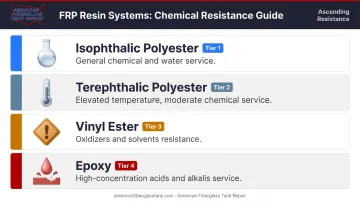
For tanks storing sodium hypochlorite, one of the most aggressive chemicals handled in FRP vessels, resin and veil system selection is critical to maintaining corrosion barrier life.
Other Key FRP Tank Standards: API 12P and ASME RTP-1
API Specification 12P
API Specification 12P (Fourth Edition, 2016) published by the American Petroleum Institute covers shop-fabricated, vertical, cylindrical aboveground FRP tanks at atmospheric pressure. It specifies material, design, fabrication, and testing requirements for this tank configuration.
API 12P is distinct from ASTM D3299/D4097 in that it was developed specifically for the petroleum industry context. Unsupported cone-bottom tanks fall outside its scope.
ASME RTP-1
Where API 12P addresses petroleum service at atmospheric pressure, ASME RTP-1 (2025 edition) — Reinforced Thermoset Plastic Corrosion-Resistant Equipment — applies to stationary vessels used for storage, accumulation, or processing of corrosive substances at pressures not exceeding 15 psig. It provides the most detailed and stringent design and quality requirements available for FRP vessels.
ASME offers formal certification of fabricators' quality-control systems under RTP-1, making it a meaningful quality marker. Tanks built to this standard undergo a higher level of third-party quality oversight than those built only to ASTM specifications.
Quick Reference: Which Standard Applies
| Application | Primary Standard(s) |
|---|---|
| Industrial chemical storage (general) | ASTM D3299 / D4097 |
| Water service (above or below ground, one-piece tanks) | AWWA D120 |
| Bolted aboveground panel tanks, water service | AWWA D121 |
| Petroleum/oil field service | API 12P |
| Pressure-rated or high-consequence chemical service | ASME RTP-1 |
| Corrosion inspection and lining integrity | NACE/AMPP |
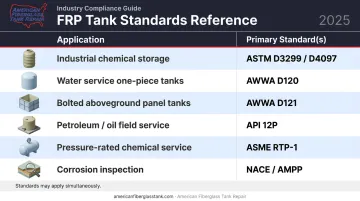
Standards are not mutually exclusive. A single tank in chemical service may need to satisfy both ASTM D3299 and ASME RTP-1 depending on pressure rating and the consequences of failure.
Applying These Standards: Inspection and Maintenance Compliance
Standards compliance doesn't end at manufacture. It must be maintained throughout the tank's service life through regular inspection — and the EPA's SPCC regulations reinforce this for aboveground bulk storage containers, requiring integrity testing that combines visual inspection with nondestructive testing methods such as ultrasonic, radiographic, or acoustic emission testing.
What a Standards-Compliant Inspection Covers
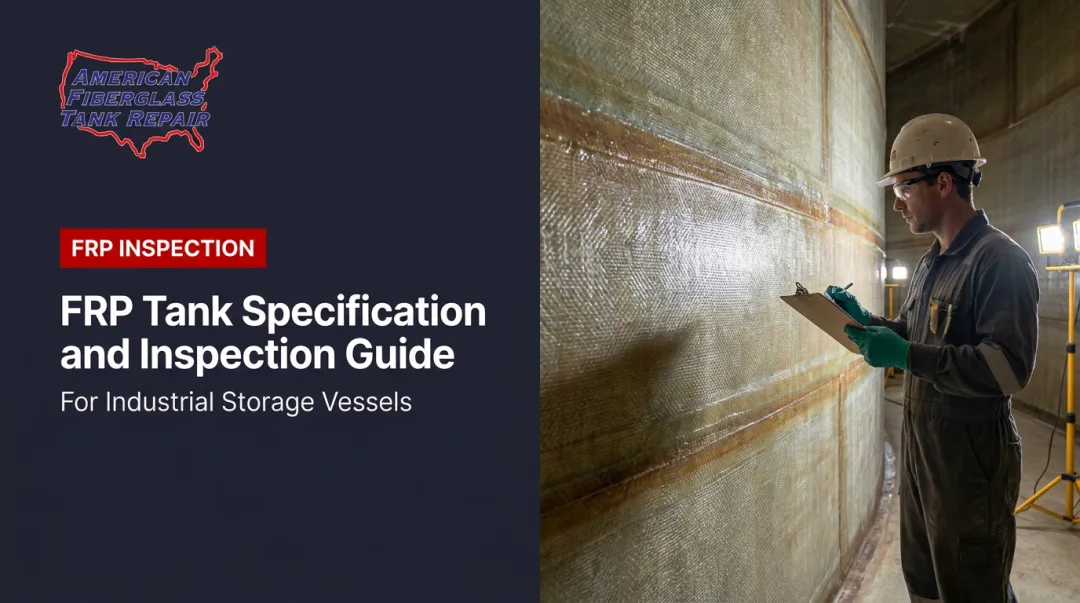
AFTR's engineer-driven inspections, supervised by Fiberglass Tank & Pipe Institute certified inspectors, include:
- Interior and exterior visual evaluation: Checking for UV degradation, delamination, spidering, disbondment, blistering, crazing, floor stress cracking, and shell distortion
- Barcol hardness testing: Assessing resin cure state and surface condition
- Ultrasonic thickness testing: Measuring wall thickness and detecting subsurface laminate anomalies
- High-intensity backlight testing: Identifying voids, inclusions, and subsurface defects
- Laser testing: Assessing structural body conditions
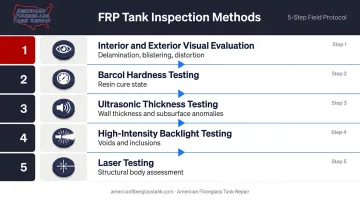
Findings are documented in detailed reports that reference existing conditions and provide specific remediation recommendations — giving tank owners documented evidence of current compliance status.
The Cost Case for Proactive Compliance
Tanks that fall out of compliance due to unrepaired corrosion liner damage, laminate degradation, or structural compromise create safety risks, regulatory exposure, and direct liability. The EPA notes that even a minor petroleum release cleanup can run approximately $10,000, with average cleanups estimated at $154,000 and groundwater-impact cases ranging from $100,000 to over $1 million.
Those figures are petroleum-specific, but the financial logic applies broadly: catching a corrosion liner failure during inspection costs far less than managing a release after one.
For FRP tanks, proactive relining and re-inspection routinely extend service life by many years. For large municipal tanks especially, that matters: new-tank replacement lead times stretch budgets in ways a scheduled reline program does not.
Frequently Asked Questions
What are the AWWA, API, and ASTM standards for water storage tanks?
AWWA D120 and D121 cover FRP tanks in water service; ASTM D3299 and D4097 address filament-wound and contact-molded FRP tank construction; API 12P governs FRP tanks in petroleum applications. These standards address different aspects — construction quality, water safety, and application context — and can apply simultaneously to a single tank.
What is an FRP tank used for in wastewater treatment?
FRP tanks are widely used for chemical storage (sodium hypochlorite, caustic soda, sulfuric acid for pH adjustment), process equalization, and effluent holding. Their corrosion resistance makes them well-suited to the aggressive chemicals and biological environments common in wastewater treatment operations.
What is the difference between FRP and PP tanks?
FRP tanks use glass fiber embedded in thermosetting resin (polyester, vinyl ester, or epoxy), providing high structural strength suited to larger diameters and aggressive chemical service. PP (polypropylene) tanks are thermoplastic, easier to fabricate in small sizes, but not rated for the same structural loads or operating temperatures as FRP vessels.
How often should FRP tanks be inspected per industry standards?
Comprehensive FRP tank inspections are recommended every five years, with more frequent assessments for tanks in aggressive chemical service. Routine visual checks should be performed semi-annually, with intervals confirmed by a qualified FRP engineer for your specific application.
Does AWWA D120 apply to both above-ground and underground FRP tanks?
Yes — AWWA D120 covers atmospheric, vented cylindrical and spherical thermosetting FRP tanks in both aboveground and underground configurations. AWWA D121 is specifically scoped to bolted aboveground panel-type tanks, so the applicable standard depends on the tank's construction type and installation.
What does NACE certification mean for FRP tank inspections?
NACE (now AMPP) certification qualifies inspectors to evaluate protective coatings and linings using standardized methodologies. For FRP tank owners, working with NACE-affiliated inspectors means assessments follow recognized industry protocols for identifying corrosion degradation, lining failures, and required remediation actions.