Introduction
FRP tanks and vessels have become foundational infrastructure across some of the most demanding industrial environments on earth. Chemical plants, municipal wastewater facilities, active mine sites, water utilities, and food processors all rely on fiberglass reinforced plastic for one straightforward reason: other materials consistently fail where FRP performs.
That adoption isn't coincidental. FRP's combination of corrosion resistance, structural strength, and design flexibility addresses challenges that steel and concrete handle poorly, and at costs that compound over time.
Global corrosion costs an estimated $2.5 trillion annually, roughly 3.4% of global GDP, with a significant share directly attributable to industrial storage and infrastructure failures.
Those costs make the choice of vessel material a long-term financial decision, not just an engineering one.
This article covers five industries where FRP has become the dominant vessel material: chemical processing, wastewater treatment, mining, waterworks, and food processing. It examines what drives adoption in each environment and what's at stake when those vessels age, degrade, or go uninspected.
Key Takeaways
- FRP outperforms steel and concrete in corrosive environments because resin chemistry can be matched to specific chemical threats
- Corrosion costs hazardous materials storage facilities $7 billion per year in the U.S. alone
- Chemical plants, wastewater facilities, mining operations, and water utilities all rely on FRP for distinct but related reasons
- Aging FRP tanks can often be relined rather than replaced, typically at significantly lower cost than full replacement
- FTPI-certified inspection determines the right path forward: repair, relining, or full replacement
What Makes FRP the Preferred Material for Harsh Industrial Environments
The Material at a Basic Level
FRP is a composite: glass fiber reinforcement embedded in a polymer resin matrix. The resin type — polyester, vinylester, or epoxy — is chosen specifically to resist the chemicals a given tank will contact. That selectability is what allows a single material category to perform reliably across radically different industries.
ASTM C581 governs chemical resistance testing for thermosetting resins used in glass-fiber-reinforced structures, and ASTM D3299 sets the construction standard for filament-wound chemical-resistant tanks. Resin selection is a standards-backed engineering decision.
Corrosion Resistance Over Steel and Concrete
FRP does not rust or corrode when exposed to acids, alkalis, chlorinated compounds, or sulfur-bearing gases. Concrete degrades under sustained chemical exposure and biological attack. Carbon steel corrodes under both.
That corrosion vulnerability carries a direct financial cost across U.S. infrastructure:
- $276 billion per year in direct metallic corrosion costs in the U.S. (3.1% of GDP)
- $7 billion per year attributable specifically to hazardous materials storage
- $36 billion per year for drinking water and sewer systems
- Up to $875 billion per year potentially avoidable through available corrosion-control practices
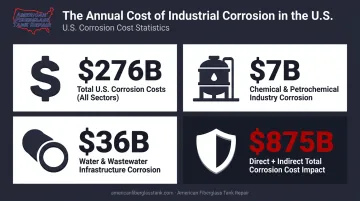
FRP doesn't eliminate corrosion risk — it shifts it significantly by removing the substrate that corrodes most aggressively.
Strength-to-Weight and Lifecycle Economics
GFRP's strength-to-weight ratio runs three to seven times higher than steel, at roughly one-third the density. In practice, that translates to:
- Reduced structural loading on foundations
- Simpler installation without heavy lifting equipment
- Large-diameter and custom configurations that heavier materials can't practically achieve
On lifecycle cost, a documented industry case found a company saved more than $2 million by specifying 85 vinyl ester and E-CR glass tanks over stainless steel alternatives. FRP's upfront cost typically looks higher than carbon steel — until you factor in maintenance cycles, coating programs, and replacement frequency. Over a full asset lifecycle, the math routinely favors FRP.
FRP in Chemical Processing
The Chemical Storage Challenge
Chemical plants store some of the most reactive substances in industrial use: strong mineral acids (hydrochloric, sulfuric, nitric), caustic alkalis like sodium hydroxide, chlorinated compounds, solvents, and bleach solutions. Even minor material compatibility mismatches can result in tank failure, chemical release, and serious regulatory consequences.
Approximately 12,000 U.S. facilities are regulated under EPA's Risk Management Program, including chemical manufacturers, water and wastewater treatment facilities, and refineries. Containment integrity is a compliance requirement, not a discretionary decision.
Resin Selection in Chemical Service
The resin system determines FRP's chemical compatibility:
- Vinylester resins — specified for aggressive chemical service including strong acids and oxidizing agents
- Isophthalic/terephthalic polyester resins — used for moderate chemical environments
- Epoxy systems — selected for specialized high-performance applications
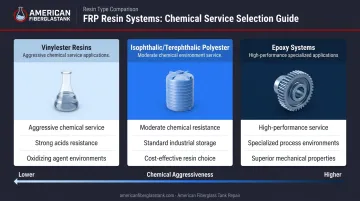
American Fiberglass Tank Repair works with custom-blended isophthalic, terephthalic polyester, vinylester, and epoxy resins matched to the specific chemical, concentration, and operating temperature of each application. For hydrochloric acid service, for example, AFTR's Field Service Engineers assess the stored product and its conditions on-site before specifying the repair resin — not after.
Resin selection feeds directly into how FRP performs across the range of equipment found in chemical facilities.
Common FRP Applications in Chemical Plants
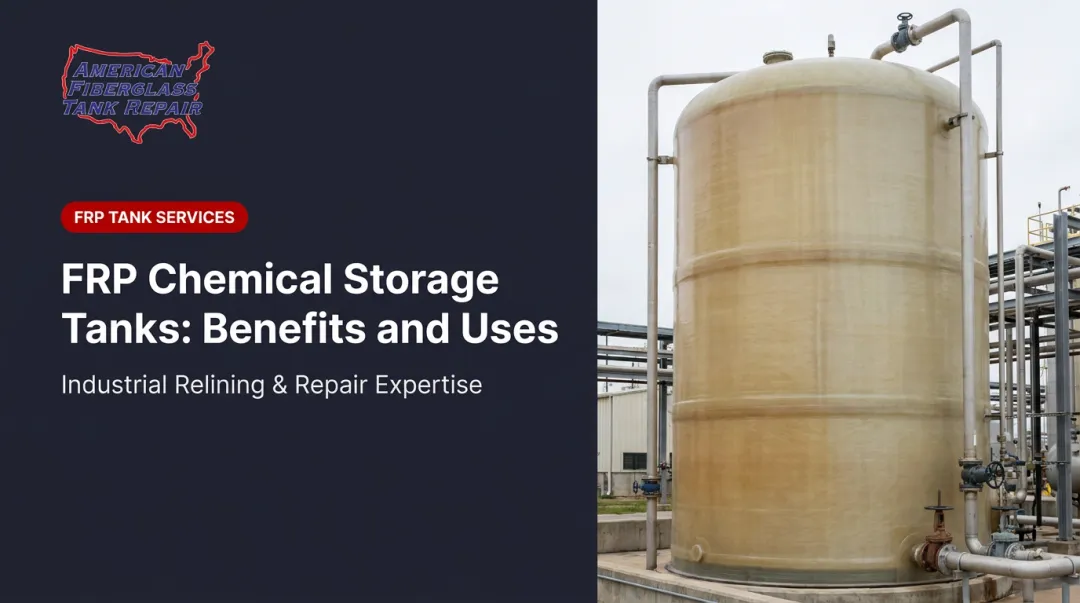
- Above-ground storage tanks for acids, caustics, and solvents
- Process vessels and chemical day tanks
- Secondary containment systems
- Air pollution control scrubbers (dry, wet, and biological)
- Chemical piping systems
FRP scrubbers are standard in chemical manufacturing because the material withstands corrosive process fluids and scrubbing solutions that degrade metal alternatives. AFTR services FRP ductwork feeding scrubbers and neutralizers, with many repairs completed in place — avoiding the cost and downtime of full replacement.
How Chemical Service Degrades FRP Over Time
The internal corrosion barrier (the resin-rich liner layer) absorbs the primary chemical attack. Over years of service, this liner can develop:
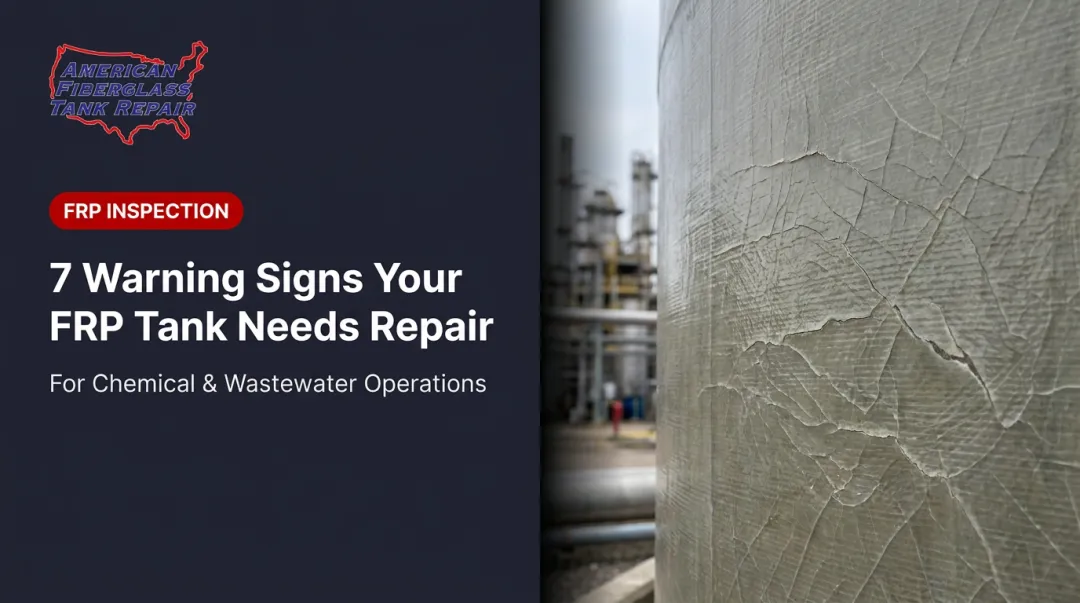
- Spidering and crazing
- Disbondment and blistering
- Floor stress cracking
- Emulsification and abrasion wear
- Capillary migration of stored product beneath the corrosion coat
Liner degradation doesn't automatically mean the structural laminate is compromised. It does, however, require timely inspection before the damage progresses inward.
AFTR uses ultrasonic, laser, and high-intensity backlight testing to detect what's happening inside the laminate body, not just at the surface. Early detection turns a potential replacement into a planned relining.
FRP in Wastewater Treatment
A Uniquely Corrosive Environment
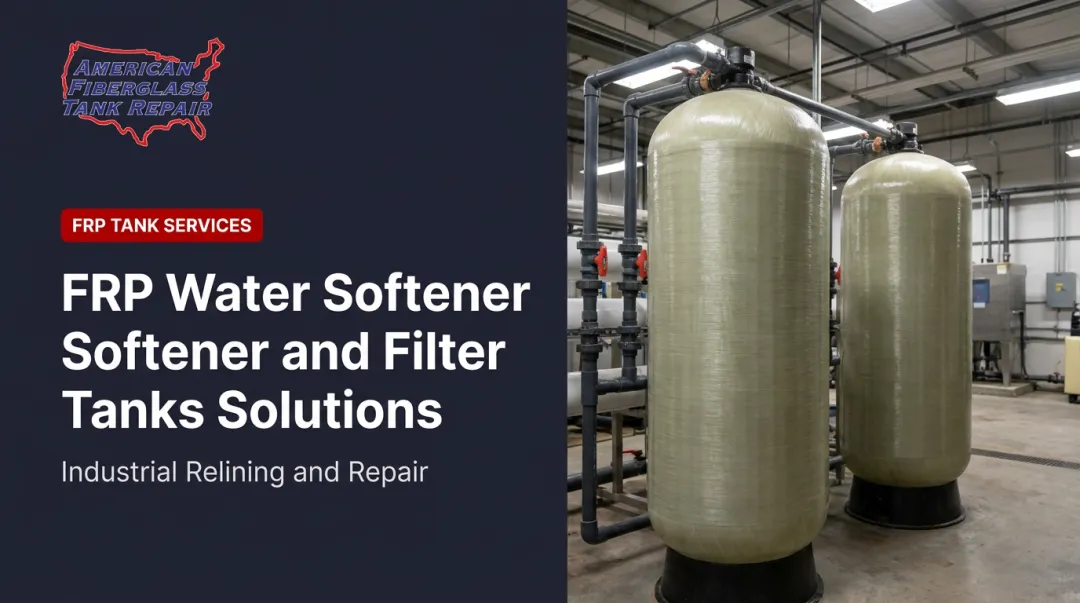
Wastewater treatment creates a chemical environment that destroys conventional materials from multiple directions simultaneously. FRP tanks are exposed to:
- Biological waste and industrial effluents
- Hydrogen sulfide gas, which converts to sulfuric acid on wet surfaces
- Chlorine and chloramine disinfectants
- Caustic cleaning solutions
This combination is known as crown corrosion when it attacks concrete sewer infrastructure, and it's equally destructive to carbon steel. FRP's resistance to these combined threats makes it the practical default, not an upgrade.
FRP Applications in Wastewater Facilities
AFTR repairs and reLines FRP assets across municipal and industrial wastewater plants, including:
- Chemical storage tanks for sodium hypochlorite, ferric chloride, and sodium bisulfite
- Scrubbers and neutralizers for odor control
- Ductwork feeding treatment systems
- Wet wells and clarifiers
- Process vessels for secondary treatment
FRP odor control scrubbers are standard equipment in municipal wastewater plants because they must handle the humid, sulfur-rich, corrosive airstream coming from active treatment processes. AFTR repairs these scrubbers and their associated ductwork in place, which keeps systems online and avoids the cost and downtime of full replacement.
The Aging Infrastructure Challenge
Many municipal systems installed FRP tanks during infrastructure build-outs in the 1970s through 1990s. These vessels may now show laminate degradation from decades of H2S exposure, cleaning cycles, and thermal stress. EPA's 2022 Clean Watersheds Needs Survey reports $630.1 billion in total clean-water infrastructure needs — a figure that reflects tight capital budgets and deferred maintenance across the sector.
When evaluating aging wastewater FRP tanks, the structural body and the corrosion liner are two separate concerns. A vessel can have a fully degraded liner while the structural laminate remains sound — making it a strong relining candidate rather than a replacement. AFTR's inspectors assess both layers independently:
- A compromised corrosion barrier with intact structural laminate → reline and extend service life
- Structural degradation beyond threshold → flag for replacement before failure
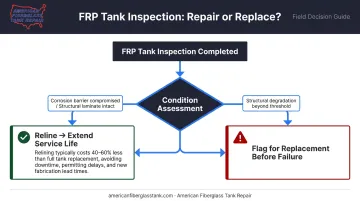
This distinction matters because relining a sound vessel typically costs significantly less than sourcing, installing, and commissioning a new tank.
FRP in Mining and Metal Processing
Why Mining Is Among the Harshest FRP Environments
Hydrometallurgical processes generate some of the most chemically aggressive conditions in any industrial sector. Sulfuric acid heap leaching for copper, nickel, and uranium recovery — combined with solvent extraction and electrowinning — frequently demands vinylester or epoxy resin systems capable of withstanding concentrated acids.
Corrosion costs in mining are often hidden and not properly tracked, according to AMPP. Facilities may not recognize their financial exposure until containment fails — at which point repair costs dwarf what proactive maintenance would have required.
Common FRP Applications in Mining
FRP addresses these risks across the full range of mining process equipment:
- Storage tanks for leach solutions and concentrated acids
- Electrolyte holding tanks (copper sulfate and similar solutions)
- Reagent and tailings liquor storage
- Process vessels in solvent extraction circuits
- Scrubber systems for ventilation and process gas treatment
FRP carries an additional advantage in electrowinning and electroplating circuits: it's non-conductive. Stray current corrosion attacks metal alternatives in these environments; FRP is unaffected.
FRP vs. Rubber-Lined Steel
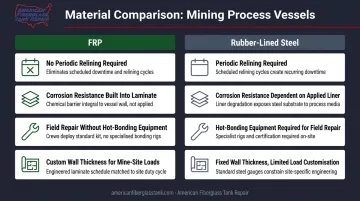
Rubber-lined steel has historically been a competing material in mining. FRP increasingly displaces it because:
- No periodic rubber relining required
- Corrosion resistance is engineered into the laminate, not applied as a surface coating
- Field repair doesn't require specialized hot-bonding equipment
- Large-diameter vessels can be fabricated with wall thickness and laminate schedules engineered for thermal expansion, ground movement, and vibration loads specific to mine sites
AFTR's ultrasonic, laser, and high-intensity backlight inspection methods can assess laminate integrity on large-diameter mining vessels without taking tanks out of service — a critical capability where operational continuity is difficult to interrupt.
FRP Across Water/Waterworks, Food Processing, and Other Industries
Water and Waterworks
FRP tanks serve a wide range of municipal water applications, including:
- Potable water storage
- Treatment chemical storage (chlorine, fluoride, coagulants)
- Pump station wet wells
- Pressure vessels
NSF/ANSI 61 certification for drinking water system components is the key qualification that opens the door for municipal use.
AFTR's potable water tank services use resin and veil systems selected specifically for potable contact and the water chemistry of each installation. Post-relining work includes disinfection before tanks return to service — a requirement that separates potable water work from general industrial relining.
Municipalities choose FRP because steel tanks require ongoing corrosion protection programs. FRP, when properly maintained, avoids that recurring cost entirely.
Food and Beverage Processing
FDA's current good manufacturing practice regulations at 21 CFR 117.40 require food-contact surfaces to be corrosion-resistant, nontoxic, and designed to withstand their operating environment. FRP meets those requirements where metals may not.
Common food processing applications include:
- Brine tanks and vinegar storage
- Syrup and juice storage
- CIP (Clean-In-Place) chemical tanks
- Heated process tanks for food and beverage operations
FRP doesn't impart taste or odor to stored products — a limitation that disqualifies some metals. AFTR has direct experience relining and repairing tanks in food and beverage facilities, with material selection matched to food-processing fluid compatibility and operating temperatures.
Additional Industries
FRP's corrosion resistance extends well beyond chemical and water applications:
- Pulp and paper — sodium hydroxide and chlorine dioxide storage
- Agriculture — fertilizer and pesticide storage
- Mining — acid mine drainage containment and process chemical storage
In each case, the driver is the same: alternative materials either fail faster or cost significantly more to maintain over time.
Maintaining FRP Tanks Across Any Industry
The "Low Maintenance" Misconception
FRP requires significantly less routine maintenance than steel or concrete. It is not maintenance-free. The internal corrosion barrier degrades over time based on chemical exposure, thermal cycling, and operating conditions.
Without periodic inspection, early-stage liner degradation goes undetected. By the time visible failure occurs, the structural laminate may already be compromised — which converts a repairable liner problem into a far more expensive structural repair or full replacement.
What a Professional FRP Inspection Covers
AFTR's inspection program examines the interior corrosion coat, internal structural body, exterior shell, and all nozzle interfaces using a multi-method approach:
| Method | What It Detects |
|---|---|
| Visual inspection | Surface crazing, spidering, UV degradation, shell distortion |
| Barcol hardness testing | Resin cure quality and surface degradation |
| Ultrasonic thickness testing | Laminate integrity, wall thickness variation |
| High-intensity backlight testing | Delamination, voids, capillary migration |
| Laser inspection | Precise structural assessment of laminate condition |
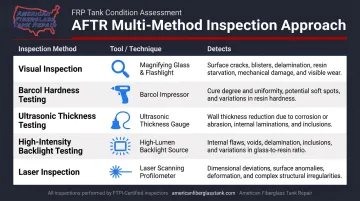
Inspection findings determine one of three outcomes: the tank continues in service as-is, requires targeted repair, or needs full relining. Customers receive a detailed report with conditions documented and remediation recommendations specified.
All AFTR inspections are supervised by Fiberglass Tank & Pipe Institute certified inspectors. Composite engineers interpret test data and translate findings into actionable plans, going beyond surface observations to deliver decisions owners can act on.
AFTR's Role Across All Industries
American Fiberglass Tank Repair provides engineer-driven inspection, repair, relining, and maintenance services for FRP tanks across chemical, wastewater, mining, waterworks, and food processing environments. Field teams operate across all 50 U.S. states, Canada, Puerto Rico, and select international locations.
Operational capabilities are built around minimizing downtime:
- Field teams deploy with Service-Pack containers pre-stocked with resins and laminate materials, eliminating supply-chain delays
- Emergency response available 24/7 for unplanned failures
- Planned maintenance scheduled around shutdowns, night shifts, and weekends
For facilities managing aging FRP assets in any of these sectors, the starting point is a professional inspection. Early detection keeps a liner repair from becoming a full structural replacement — and that difference is measured in tens of thousands of dollars.
Frequently Asked Questions
What does FRP stand for?
FRP stands for Fiberglass Reinforced Plastic — a composite material made by embedding glass fiber reinforcement in a polymer resin matrix. The term GRP (Glass Reinforced Plastic) is used interchangeably, particularly in Europe and Commonwealth countries.
What is FRP used for in walls?
FRP wall panels and liners provide corrosion-resistant surfaces in chemical plants, wastewater facilities, and similar environments where chemicals, moisture, or biological activity would degrade conventional materials. Applications include interior walls, containment areas, and structural panels.
How long do FRP tanks typically last in industrial applications?
FRP tanks can remain in service for 30–50 years or more when properly specified and maintained. Tanks that go uninspected may develop liner degradation that shortens usable life considerably — frequently with no visible external warning.
Can FRP tanks be repaired instead of replaced?
Yes. The majority of FRP tanks with liner degradation, delamination, or localized laminate damage can be repaired and relined at a fraction of replacement cost — provided the structural laminate remains intact. Professional inspection determines which approach is appropriate.
What resin system is used for aggressive chemical service?
Vinylester resins are the standard specification for aggressive chemical environments including strong acids, oxidizing agents, and chlorinated compounds. Isophthalic or terephthalic polyester resins handle moderate chemical service; epoxy resins are used for high-temperature or specialized industrial applications.
How often should industrial FRP tanks be inspected?
Chemical plants and wastewater facilities typically inspect high-risk tanks every 3–5 years. Any change in stored media, process temperature, or visible surface anomaly warrants an unscheduled inspection outside the regular cycle.