That's a problem. FRP tanks can and do fail without obvious warning, and containment breaches can occur before any noticeable signs of trouble emerge, according to inspection documentation from American Fiberglass Tank Repair (AFTR).
This guide covers how FRP water softener and filter tanks are built, why they outperform steel and HDPE in most water treatment contexts, where they're commonly specified, and what it takes to keep them running safely for decades.
Key Takeaways
- FRP tanks combine glass fiber reinforcement with a thermosetting resin matrix to deliver corrosion resistance and structural strength that neither material achieves alone
- They handle flow rates from a few GPM up to 800+ GPM and operate at up to 150 psi, with one key limitation: minimal vacuum tolerance
- For most commercial and light industrial water treatment, FRP beats carbon steel on corrosion resistance and beats HDPE on pressure ratings
- The inner corrosion liner is the most failure-prone layer; visual inspection alone cannot fully assess its condition
- Professional inspection every 3–5 years, combined with early liner repair, is far cheaper than tank replacement
What Are FRP Water Softener and Filter Tanks?
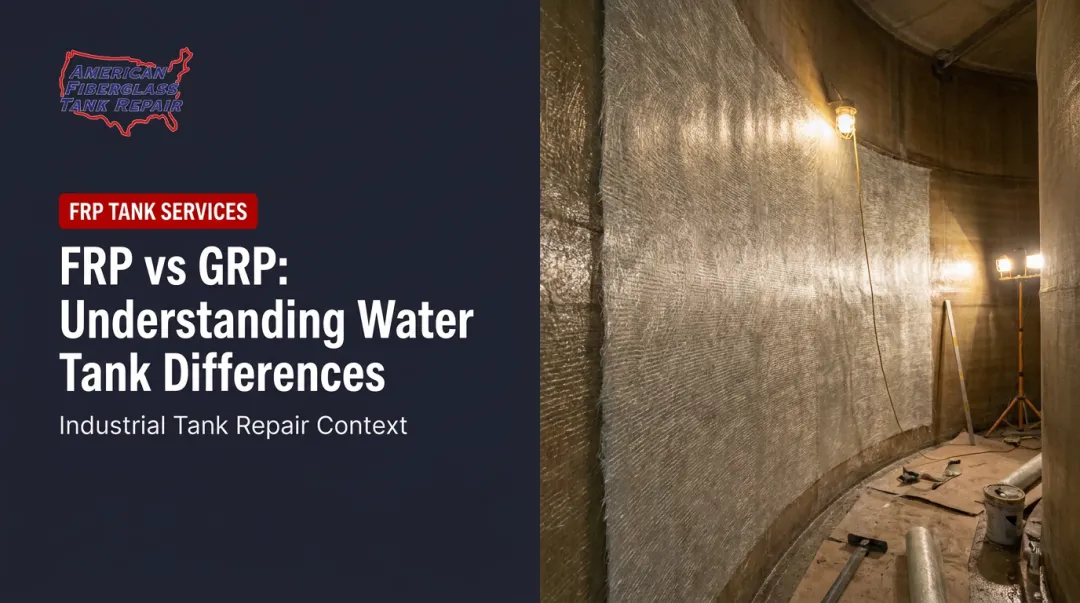
FRP (Fiberglass Reinforced Plastic, or more precisely Fiberglass Reinforced Thermosetting Plastic) is a composite material combining glass fiber reinforcement with a cured thermosetting resin. The Fiberglass Tank & Pipe Institute defines it as glass fiber reinforcement embedded in a thermosetting resin system, with resin-rich surface veils on corrosion-barrier surfaces.
Common resin options include polyester, vinylester, and epoxy, each selected based on the chemical and thermal demands of the application.
The composite structure is what makes FRP useful. Glass fiber alone lacks chemical resistance; resin alone lacks structural strength. Together, the laminate handles operating pressures that would deform HDPE while resisting the corrosive environments that attack steel.
How FRP Tanks Function in Softening and Filtration
In a water softening system, the FRP vessel houses ion exchange resin. As water passes through, calcium and magnesium ions are exchanged for sodium, removing hardness. The tank must then withstand repeated brine regeneration cycles without the vessel wall or inner liner degrading from salt exposure.
In a filtration system, the tank houses a media bed — activated carbon, multimedia, iron removal media, or sediment filter material. Water flows down through the media, then back through during backwash. The vessel handles continuous pressure cycling throughout its service life.
Construction Layers
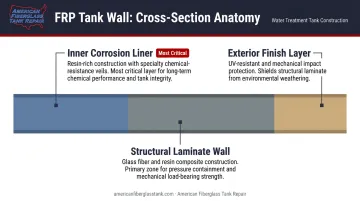
Every FRP water treatment tank includes three functional layers:
- Inner corrosion liner — a resin-rich layer, often with specialty veils, that contacts the water and media directly; this is the most critical layer for long-term performance
- Structural laminate wall — the glass fiber and resin layers that provide pressure containment and mechanical strength
- Exterior finish layer — UV and mechanical protection for the outer surface
Size and Pressure Range
Understanding construction helps explain why size and pressure ratings matter for system selection. Commercial and industrial FRP tanks are produced in standardized formats that integrate directly with control valves and automated regeneration systems. Pentair's Structural composite pressure vessel line spans diameters from 18 to 63 inches, including a 63×144-inch vessel with 1,600-gallon capacity. Vessels are rated at 150 psi maximum operating pressure with a 4:1 safety factor and 250,000-cycle test endurance. Wave Cyber categorizes 14–24 inch tanks as commercial scale and 30–63 inch as industrial.
Key Advantages of FRP in Water Treatment Applications
Corrosion Resistance
Unlike carbon steel, FRP resists the corrosion mechanisms that most damage metallic vessels in water treatment service. Per FTPI guidance, that includes galvanic, aerobic, pitting, and intergranular corrosion.
In water softening specifically, brine regeneration creates a chemically aggressive environment, and iron-laden source water accelerates metal degradation. Matching resin selection to the specific water chemistry and temperature is what delivers reliable corrosion protection over time.
Lighter Than Steel
FRP tanks are significantly lighter than equivalent steel vessels. That reduces:
- Installation labor and equipment requirements
- Structural load demands on mounting pads or frames
- Handling complexity during replacement or relocation
- Freight costs for remote deployments
Smooth, Non-Reactive Inner Surface
The resin liner doesn't leach contaminants into the water stream and resists biological fouling better than bare metal. That matters for potable water, food and beverage, and pharmaceutical applications where water-contact material safety is non-negotiable.
NSF/ANSI/CAN 61, the standard covering health effects from materials contacting drinking water, applies to FRP water-contact components. Certified products are listed in the NSF database.
Flow Range and Cost Position
FRP vessels cover a wide range of commercial and industrial flow requirements:
- Media filtration (commercial): 1.9–250 GPM
- Media filtration (industrial): up to 806 GPM
- Water softening: 1–850 GPM per tank
For most flow rates in this range, FRP delivers a lower total cost of ownership than stainless steel while providing comparable corrosion protection. Capital costs vary by vessel size and resin specification, so supplier quotes for specific configurations give the clearest comparison.
FRP vs. Steel vs. HDPE: Choosing the Right Tank Material
The right vessel material depends on four variables: required flow rate and tank size, source water chemistry, operating pressure and vacuum conditions, and budget.
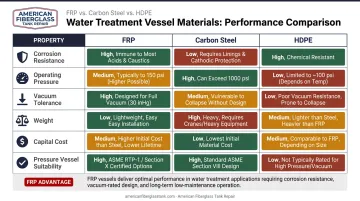
| Factor | FRP | Carbon Steel | HDPE |
|---|---|---|---|
| Corrosion resistance | Excellent | Poor (without coating) | Excellent |
| Operating pressure | Up to 150 psi | High | Atmospheric only |
| Vacuum tolerance | ~5 in. Hg max | Good | Poor |
| Weight vs. steel | ~25–30% lighter | Baseline | Lightest |
| Capital cost vs. SS | Lower | Lower | Lowest |
| Pressure vessel use | Yes | Yes | No |
FRP vs. Carbon Steel
Carbon steel softeners can be configured up to 5,000 GPM in large industrial systems; one industry supplier positions FRP softeners up to approximately 1,000 GPM before steel becomes the practical choice at the largest flow scales. Steel also handles vacuum better, which matters in certain configurations.
FRP's critical limitation: it tolerates only about 5 inches Hg of vacuum below atmospheric pressure. Both Pentair's specification data and Wave Cyber's installation guidelines confirm this threshold, and both require vacuum breakers when negative pressure could exceed it.
Facilities installing FRP vessels ahead of RO systems or booster pumps that can create suction must install vacuum breakers — skipping this step is how tanks collapse. Steel doesn't carry this risk, which is worth factoring into designs where sustained suction conditions are likely.
FRP vs. Stainless Steel
Stainless steel handles vacuum well and offers excellent durability, but at significantly higher capital cost. FRP is the practical choice for mid-range applications where full stainless is out of budget but corrosion protection is still required — a common scenario in municipal softening, light industrial filtration, and commercial RO pretreatment.
FRP vs. HDPE
HDPE has strong chemical resistance and works well for atmospheric brine storage tanks and chemical day tanks, but it can't handle the sustained operating pressures required in pressurized softening and filtration vessels. Polyethylene storage tank guidance from Poly Processing confirms these are atmospheric-only systems.
Once operating pressure exceeds atmospheric conditions — typically anything above 15–20 psi in a closed vessel — HDPE is no longer a viable option. FRP's laminate construction is what enables rated pressure service up to 150 psi, making it the only viable non-metallic option for pressurized softening and filtration applications.
Common Applications of FRP Water Softener and Filter Tanks
FRP softener and filter vessels appear across a wide range of industries — from municipal water systems to pharmaceutical manufacturing. Food and beverage processing, power generation, microelectronics, refineries, and chemical processing all rely on these tanks as core components of their water treatment infrastructure.
Verified primary applications include:
- Municipal and potable water pretreatment
- Food and beverage processing (hardness removal, iron removal, carbon filtration)
- Boiler feedwater pretreatment — a 2024 case study from Hill Water documents a wood-products manufacturer using multimedia filters and softeners at 300 GPM ahead of boilers
- Industrial water softening for manufacturing and process water systems
- Deionized water pretreatment for pharmaceutical and microelectronics applications
Specialized water treatment uses:
- Whole-building softening for commercial facilities (hotels, laundries, healthcare)
- Iron and manganese removal for well water systems using greensand or birm media
- Activated carbon dechlorination ahead of RO membranes
- Neutralization filtration for low-pH condensate or acidic water
FRP filter tanks are particularly common as pretreatment vessels ahead of reverse osmosis systems, where feed water quality significantly affects membrane service life. Clean, conditioned feedwater entering an RO system extends membrane service intervals and lowers chemical cleaning costs — which is why the upstream FRP filter vessel often determines total system operating cost as much as the RO unit itself.
Maintaining and Extending the Life of FRP Water Softener and Filter Tanks
Routine Maintenance Requirements
FRP water treatment tanks aren't maintenance-free. Key ongoing tasks include:
- Pressure monitoring — verify operating pressure stays within the vessel's rated limits; overpressure events accelerate laminate fatigue
- Distributor and lateral inspection — blockage or breakage disrupts flow distribution and can cause media channeling
- Brine concentration management — regeneration salt concentrations outside recommended ranges can stress the inner liner through osmotic pressure effects
- Exterior inspection — look for chalking, discoloration, or UV degradation on the outer surface
Why Visual Inspection Isn't Enough
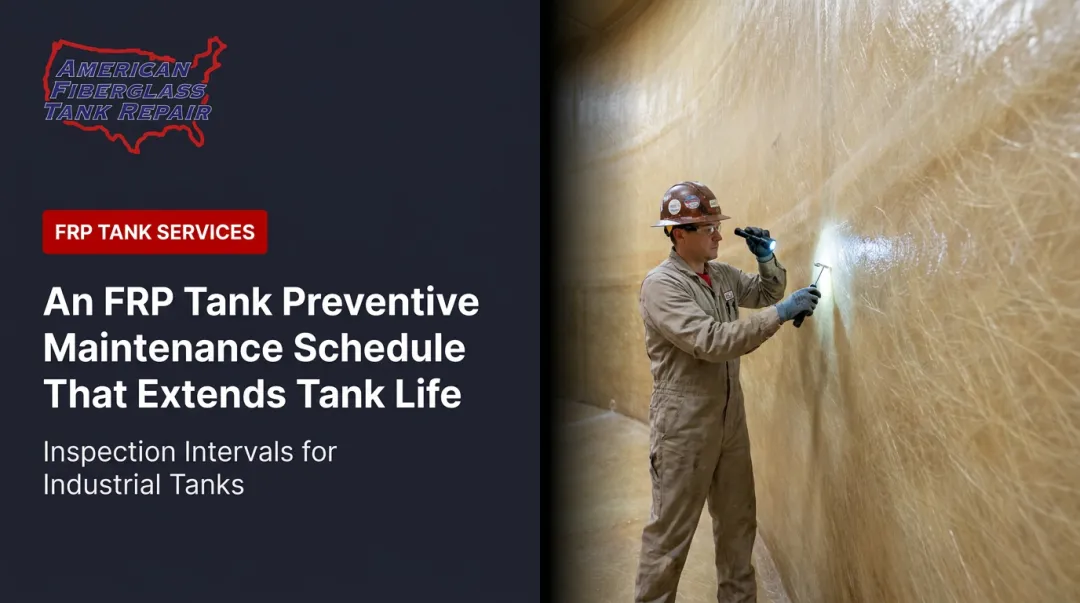
Visual inspection alone misses the subsurface damage that leads to liner failure. A hydrostatic test only tells you whether a vessel can hold liquid at that exact moment — it says nothing about what's happening inside the laminate.
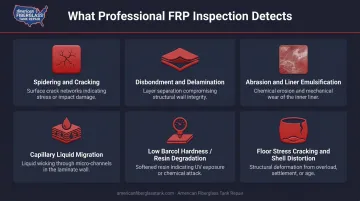
AFTR's inspection methodology combines visual assessment with ultrasonic, laser, and high-intensity backlight testing to examine conditions within the structural body of the tank, not just at the surface. These methods detect:
- Spidering and cracking in the corrosion liner
- Disbondment and delamination between layers
- Abrasion wear and emulsification of the liner surface
- Capillary migration of liquid beneath the corrosion coat (invisible to the naked eye)
- Low Barcol hardness readings indicating resin degradation
- Floor stress cracking and shell distortion
All AFTR inspection services are supervised by Fiberglass Tank & Pipe Institute certified inspectors, and AFTR documents findings in detailed reports with recommendations for repair or continued service. Inspections can be scheduled as one-time assessments or on a periodic program built around planned shutdowns, nights, or weekends.
The Cost Case for Proactive Maintenance
Early intervention consistently costs less than tank replacement. AFTR's internal corrosion liner restoration services are designed to address degradation before it reaches the structural laminate wall.
In most cases, even when the corrosion barrier has been compromised, the structural body of the vessel remains intact, providing a sound substrate for relining with compatible resin and laminate systems.
That relining work draws on a broad material library matched to each application:
- Isophthalic and terephthalic polyester, vinylester, and epoxy resin systems (custom-blended)
- 45+ laminate options including chopped strand, Nexus, Harlar, and carbon veils
- Resin and veil systems rated for potable water and food-grade contact where required
Warning Signs Your FRP Water Treatment Tank Needs Attention
Don't wait for a failure to schedule an inspection. These signs indicate a tank needs professional assessment now.
Physical warning signs:
- Visible surface cracks or crazing on the tank wall
- Bulging or distortion of the vessel shell
- Chalking or whitening on the exterior surface (UV degradation)
- Water staining, efflorescence, or mineral deposits around fittings and nozzles
- Any active leakage at nozzle connections or seams
Performance warning signs:
- Unexplained drop in softening capacity or shorter filter run times
- Hardness breakthrough earlier in the service cycle
- Increased pressure differential across the vessel at similar flow rates
- Particulate or discoloration appearing in treated water
Each of these symptoms points to an underlying problem — media channeling, distributor damage, or internal liner degradation — that will worsen without intervention.
When to call a specialist: Schedule a professional assessment if any of these signs are present, or if the tank has been in service for 10 or more years without a formal inspection. AFTR provides emergency and routine inspection and repair services for water treatment vessels across all 50 U.S. states, with field teams positioned regionally for rapid response.
Frequently Asked Questions
What is an FRP water softener storage tank?
An FRP water softener storage tank is a pressurized fiberglass-reinforced plastic vessel that houses ion exchange resin for removing hardness minerals from water. It combines a corrosion-resistant resin liner with a structural glass fiber laminate wall designed to withstand repeated brine regeneration cycles without degrading.
What is the life expectancy of an FRP water softener storage tank?
FRP water softener tanks are engineered for long service life, with longevity shaped by water chemistry, operating pressure, brine concentrations, and liner maintenance history. Tanks operating within design limits and receiving periodic professional inspection routinely achieve 20–30+ years of reliable service.
How does an FRP water softener tank compare to HDPE and GRP tanks?
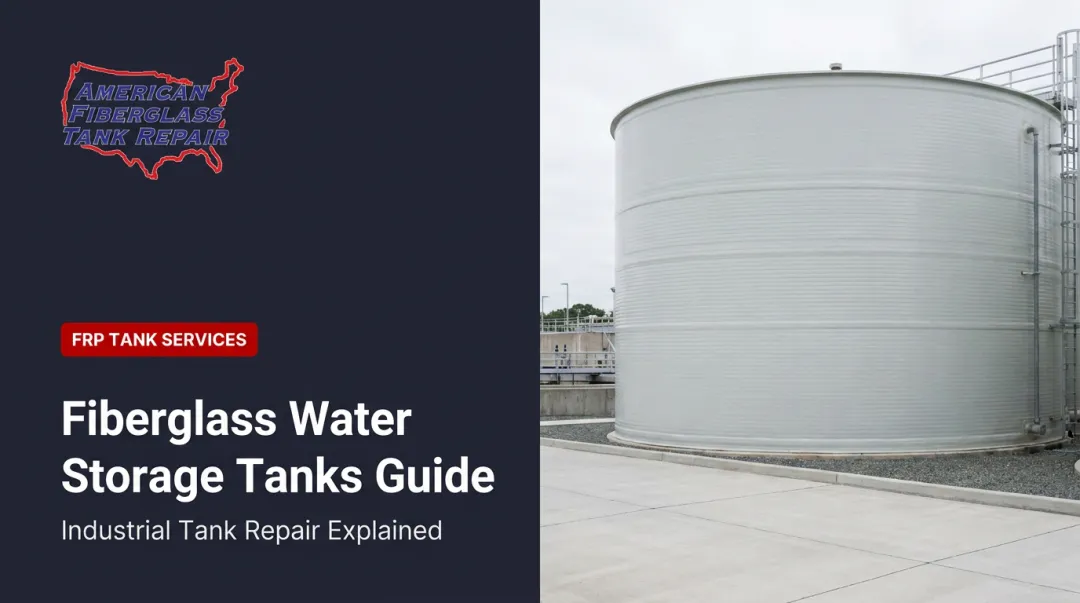
GRP (Glass Reinforced Plastic) is another name for FRP — the materials are the same. Compared to HDPE, FRP/GRP tanks have substantially higher structural strength and pressure ratings, making them suitable for pressurized softening and filtration service where HDPE cannot safely operate.
What are common signs of damage in an FRP water softener or filter tank?
Key indicators include visible surface cracking, bulging tank walls, leakage at nozzles, hardness breakthrough or declining filter run times, and increased pressure drop across the vessel. Any of these signs warrant immediate professional FRP inspection rather than a wait-and-see approach.
Can a damaged FRP water treatment tank be repaired instead of replaced?
Yes, in most cases. Damaged FRP linings, cracked corrosion barriers, and compromised nozzle interfaces can often be repaired using compatible resin and laminate systems, restoring the vessel to full service at significantly lower cost than replacement. The key is catching damage before it penetrates the structural laminate wall.
How often should FRP water filter and softener tanks be professionally inspected?
Every 3–5 years as part of a preventative maintenance program, or sooner if any performance anomalies or visible damage appear. Tanks in aggressive water chemistry environments — high iron, low pH, or high brine concentrations — warrant inspection on the shorter end of that interval.