Most operators default to replacement. It feels like the clean solution. What they don't account for is that replacement carries a full burden of indirect costs — removal, rigging, temporary chemical storage, new piping connections, procurement lead times that can stretch weeks or months — that can dwarf the price of the tank itself.
The better question isn't "how old is this tank?" It's "what condition is the structural laminate in?" That single factor determines whether you're looking at a fraction of replacement cost or a full capital expenditure. And the only way to answer it accurately is through a professional inspection.
Key Takeaways
- Relining restores the corrosion barrier without disturbing the structural wall; it's the right call when the structural laminate is still intact
- Replacement is warranted when structural damage is widespread, the tank is at end-of-life, or it no longer meets code or capacity requirements
- A 20-year-old tank with a sound structural wall is often a better relining candidate than a 10-year-old tank with structural delamination
- Hidden replacement costs — removal, rigging, temporary storage, reinstallation — frequently make relining the smarter financial choice
- Professional inspection — not visual assumption — is the only reliable basis for this decision
Relining vs. Replacement: Quick Comparison
| Factor | Relining | Replacement |
|---|---|---|
| Upfront Cost | Significantly lower | Higher tank cost plus substantial indirect costs |
| Indirect Costs | Minimal — tank stays in place | Removal, rigging, temporary storage, repiping, reinstallation |
| Downtime | Shorter — no removal or procurement delay | Longer — procurement lead times can run weeks to months |
| Damage Threshold | Corrosion barrier degraded; structural laminate sound | Structural wall failure, through-wall cracking, or widespread deep delamination |
| Lifespan Impact | Extends service life many years when correctly specified | Full design-life reset — but only if root causes are addressed |
| Best For | Mid-life tanks with intact structural integrity | End-of-life tanks, structural failure, code non-compliance, capacity changes |
Installed replacement costs routinely run two to three times the tank-only price. A 5,000-gallon standard-resin FRP tank lists around $6,030 — but that's before a single wrench turns. Bay County, Florida's sodium hypochlorite tank replacement, for example, required demolition of existing piping, pump systems, heat tracing, new SS316 supports, isolation valves, headers, and full system testing across four tanks on top of equipment costs.
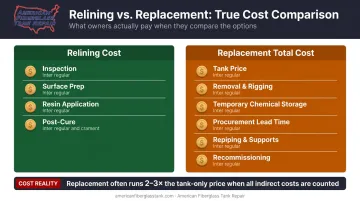
Relining sidesteps nearly all of that.
What Is FRP Tank Relining?
Every FRP tank has two functional zones: the corrosion barrier (the inner sacrificial layer that contacts the stored chemical) and the structural laminate behind it, which carries the mechanical loads. The corrosion barrier is designed to take the chemical punishment so the structural wall doesn't have to.
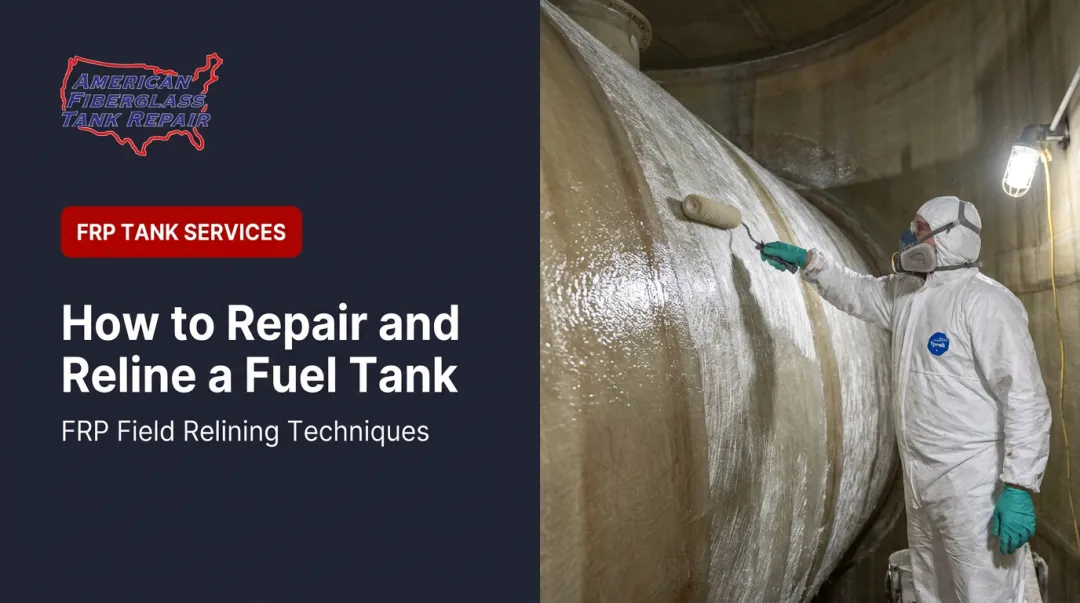
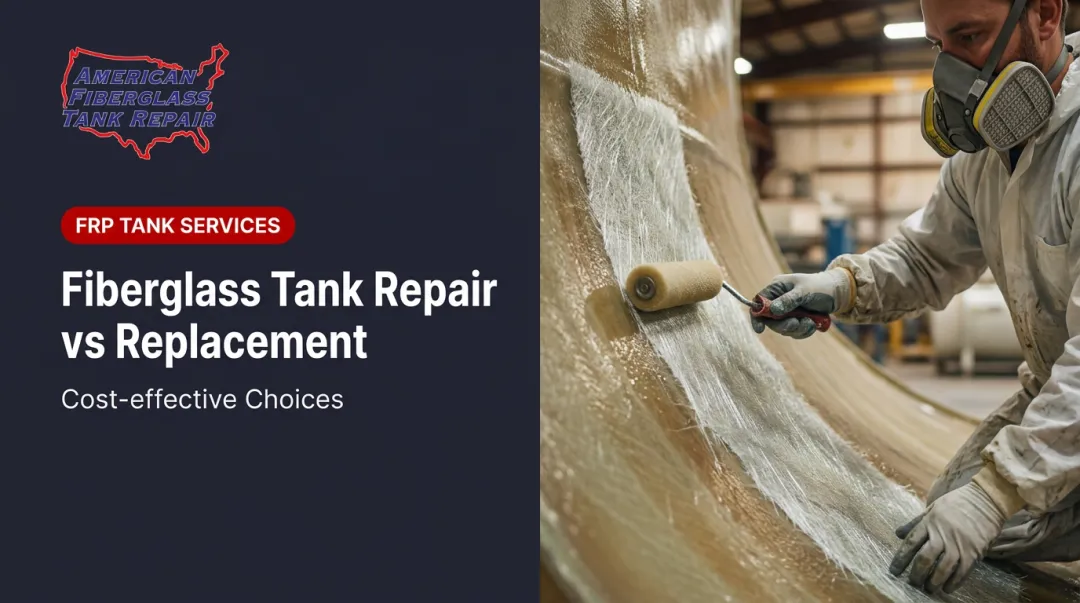
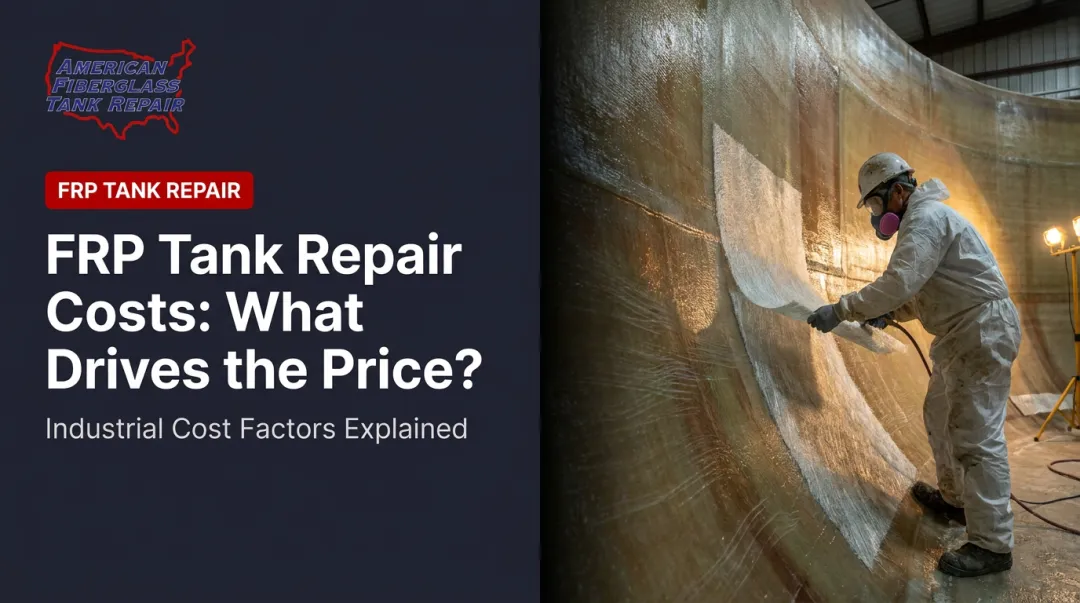
When the corrosion barrier degrades, the structural laminate is usually still sound. Relining means applying a new chemically resistant laminate (resin plus fiberglass reinforcement) to the tank's interior, restoring that protective layer without disturbing the structural wall.
Resin Selection: The Make-or-Break Factor
Not all resin systems are interchangeable. Matching resin to chemical service is critical — mismatch is one of the most common causes of premature reline failure.
- Isophthalic and terephthalic polyester resins work well for water service and moderate chemical applications, though they're generally limited to pH below 10.5 per Reichhold's FRP Material Selection Guide
- Vinylester resins handle aggressive chemicals where polyester falls short — Ashland's Derakane guide confirms brominated epoxy vinyl ester resins perform well in chlorine and bleach environments, with the 411-series rated for 15% sodium hypochlorite service up to 50°C
- Epoxy resins are used for the most demanding applications where maximum chemical resistance and adhesion are required
AFTR selects resin based on the specific chemical, its concentration, and operating temperature — using custom-blended polyester, vinylester, and epoxy systems. The laminate portfolio covers over 45 fiberglass mat, chopped strand, Nexus, Harlar, and carbon veil options, each matched to the chemical environment.
The Relining Process
Resin selection only matters if the application sequence is executed correctly. AFTR's relining protocol follows a defined sequence — each step builds on the last:
- Take tank out of service and perform comprehensive inspection (visual, ultrasonic, high-intensity backlight, laser testing)
- Assess the corrosion coat to identify spidering, disbondment, emulsification, abrasion wear, capillary migration of product beneath the barrier
- Remove or repair the compromised corrosion coat and prepare the substrate to create a proper bonding surface
- Apply multi-layer product-specific resin and veil system using compatible glass media and application-specific polymer matrixes
- Post-cure the new laminate to maximize chemical resistance
- Inspect and certify for return to service
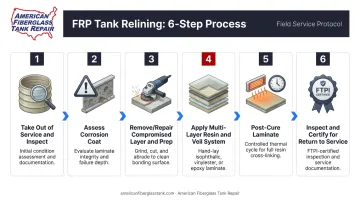
The comprehensive pre-reline inspection (particularly the detection of capillary migration) is what separates a successful reline from one that fails in two years. If product has migrated beneath the corrosion coat into the structural layers, a new barrier applied over that substrate won't hold.
When Should You Replace an FRP Tank Instead?
Relining has a hard limit: it restores the corrosion barrier but cannot fix structural damage. Once damage penetrates the structural laminate, load-bearing capacity is compromised — and a new interior lining won't restore it. The triggers for replacement fall into three categories: physical indicators, repair history, and regulatory or capacity changes.
Physical Indicators That Point to Replacement
These are the signs that structural integrity is in question:
- Through-wall cracks or penetrations
- Fiber blooming that extends beyond the corrosion barrier layer into structural plies
- Visible deformation, buckling, or shell distortion
- Wall thickness measurements (via ultrasonic testing) falling below the minimum structural requirement
- Widespread delamination across large sections of the vessel wall
When Repair History Tips the Economics
A tank that has undergone multiple relines eventually reaches a point where the remaining sound laminate is too limited to reliably accept a new bonded layer. The economics shift at that threshold.
The practical test: if inspection reveals the majority of the structural wall is compromised or has been built up with multiple prior repair layers, run a replacement cost comparison against a realistic reline scope. An optimistic scope will skew the decision in the wrong direction.
Regulatory and Capacity Triggers
Some replacement decisions have nothing to do with physical condition:
- Tanks that no longer comply with NSF/ANSI 61 requirements for potable water contact after a relining material change
- Vessels that have exceeded their original design life without documented maintenance records
- Tanks that are now undersized or chemically incompatible with a changed stored product
NSF/ANSI 61 governs health-effects requirements for materials contacting drinking water, and 48 states have legislation requiring compliance for nonmetallic potable-water materials. A reline that changes the contact material without verifying NSF certification status can create a compliance gap.
The Full Replacement Cost — What Gets Left Out of the Budget
When operators compare relining quotes to replacement quotes, they often compare the reline cost against the tank-only price. That comparison is misleading. Real replacement costs include:
- Draining and decontaminating the existing tank
- Rigging and removal, including cutting up tanks too large to exit through a door
- Temporary chemical storage during the transition
- Procurement lead times for custom FRP vessels
- New piping connections, supports, valves, and leak testing
- System recommissioning and downtime costs
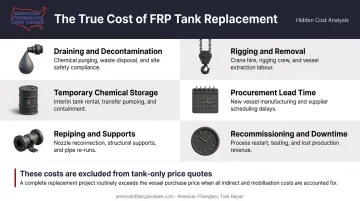
The Bay County replacement scope is a useful reference point: a four-tank sodium hypochlorite replacement required demolition of pump systems, heat tracing, insulation, safety shower systems, full repiping, new SS316 supports, isolation valves, headers, and sight glasses — all documented in the project ITB. None of that shows up in a tank-only price comparison.
Which Option Is Right for Your Tank?
The decision framework comes down to one question: is the structural laminate still sound?
Choose relining when:
- Damage is confined to the corrosion barrier — blistering, oxidation, surface crazing, minor interior delamination
- Ultrasonic thickness testing confirms the structural wall meets minimum requirements
- The tank is in mid-life with documented service history
- Available resin systems are compatible with the stored chemical
Choose replacement when:
- Through-wall cracking or structural delamination is confirmed
- Repair costs approach or exceed the fully-loaded replacement cost
- The tank no longer meets regulatory requirements or capacity needs
- Inspection reveals the remaining sound laminate area is insufficient for a new bonded lining
A 20-year-old tank with an intact structural wall and a degraded interior lining is a strong relining candidate. A 10-year-old tank with confirmed structural delamination may need replacement sooner. Age is a secondary factor — condition drives the decision. Knowing which condition you're dealing with, however, requires more than a visual walkdown.
Why a Professional Inspection Isn't Optional
Visual assessment alone can't answer this question. The tools that matter are:
- Ultrasonic testing — measures remaining wall thickness and detects subsurface voids
- High-intensity backlight testing — reveals delamination and structural voids not visible to the naked eye
- Laser testing — provides additional subsurface analysis
- Barcol hardness measurement — quantifies chemical degradation of the laminate
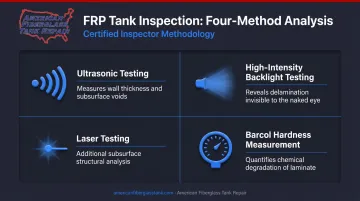
AFTR's inspections are supervised by Fiberglass Tank & Pipe Institute (FTPI) certified inspectors, following FTPI SP8310 credentialing standards. The FTPI 2007-1 guidance recommends certified inspections every five years for hazardous-substance service. Catching degradation before it reaches the structural laminate is what preserves relining as a viable path — once the wall is compromised, the math shifts toward replacement.
Real-World Scenario: Choosing to Reline Instead of Replace
Consider a scenario AFTR's field teams encounter regularly at water treatment facilities: a bulk sodium hypochlorite storage tank showing obvious interior degradation — yellowing of the corrosion barrier, blistering in the vapor-phase zone near the top of the tank, and crystal buildup around fittings. The initial assumption from the facility team is that the tank has failed and needs to come out.
The inspection tells a different story. Ultrasonic thickness testing confirms the structural laminate is at full specified thickness. High-intensity backlight reveals delamination is confined entirely to the interior corrosion coat — there's no capillary migration into the structural body. The substrate is sound.
With that data in hand, AFTR specifies a vinylester reline system for sodium hypochlorite service. The compromised corrosion coat is removed, the substrate is prepared, and a multi-layer product-specific resin and veil system is applied and post-cured. The tank returns to service with none of the disruption a replacement would have triggered:
- No removal from the pad or rigging costs
- No temporary chemical storage procurement
- No weeks of lead time waiting on a custom FRP vessel
The fully-loaded replacement cost — tank, removal, rigging, temporary storage, repiping — would have run several times the relining cost. The tank continues in sodium hypochlorite service with years of remaining life added.
If your tank shows similar signs of corrosion barrier degradation but passes a structural inspection, relining is the more cost-effective path. Contact AFTR for a professional tank inspection and relining assessment to find out where your tank stands.
Conclusion
The repair-vs-replace decision is simpler than it looks once you have the right data. Is the structural laminate intact? If yes, relining can restore your tank to full chemical service at a fraction of replacement cost. If not, a new tank is the right investment — delaying it risks catastrophic failure and unplanned downtime that will cost far more than the vessel itself.
This decision requires objective information from a proper inspection — not assumptions based on tank age, not a visual check from outside the manway. A qualified assessment covers:
- Ultrasonic thickness testing across the laminate
- High-intensity backlight inspection for voids and delamination
- Barcol hardness readings to confirm resin cure
- Full review by a Fiberglass Tank & Pipe Institute (FTPI) certified inspector
Get that inspection right and you protect multiple outcomes at once: cost avoidance, extended asset life, regulatory compliance, and uninterrupted operation of critical treatment or storage processes. If you're weighing reline vs. replace on an FRP vessel, AFTR's FTPI-certified inspectors can assess your tank's structural condition and give you a clear, data-backed answer — contact us at 877-427-0090 to schedule an evaluation.
Frequently Asked Questions
Can FRP be repaired?
Yes. FRP tanks can be repaired through patching, relining, or structural laminate repair depending on the damage type and extent. Most approaches require the structural wall to be fundamentally intact — once structural integrity is compromised, options narrow significantly.
How long do FRP tanks last?
Well-maintained FRP tanks can last 30–50 years or more. According to Picon's FRP inspection guidance, the corrosion barrier typically requires relining every 10–25 years depending on the chemical service, with sodium hypochlorite service driving shorter intervals (10–12 years) than less aggressive applications.
How much does it cost to reline an FRP tank compared to replacing it?
Relining typically costs significantly less than full replacement, and the difference grows once indirect costs — removal, rigging, temporary storage, repiping, reinstallation — are included. For large or complex installations, a tank-only price comparison understates the true cost of replacement by a wide margin.
What are the warning signs that an FRP tank needs relining?
Key indicators include: yellowing or loss of surface sheen on the interior (oxidation), blistering on the corrosion barrier, surface crazing or cracking, crystal buildup around fittings, and discoloration in the vapor-phase zone near the top of the tank. These are corrosion barrier signals — not necessarily structural ones.
How long does a reline last on an FRP tank?
A properly specified and applied reline can last 10–20 years or more depending on chemical service. The resin system, surface preparation quality, and post-cure all affect that lifespan. Regular inspections every 3–5 years help catch early wear before it shortens the service window.