Introduction
Pipes and tanks that lose thermal efficiency or show surface degradation create compounding problems: energy bills climb, corrosion accelerates, and downtime becomes an expensive reality. For facility operators managing chemical storage, water treatment, or industrial process systems, these aren't abstract risks — they're budget line items.
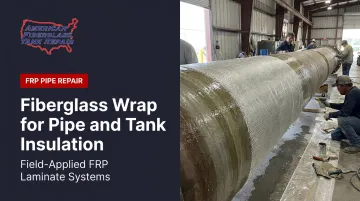
Fiberglass wrap addresses these problems directly. It's a material made from glass fibers (woven, bonded, or mat-formed) applied around pipes and tanks to insulate, reinforce, or protect surfaces from chemical and environmental attack.
This article covers what fiberglass wrap is and how it works, the main product types, key performance benefits, application steps, selection criteria, and when structural laminate work requires professional hands.
Key Takeaways
- Fiberglass wrap serves two functions: thermal insulation and structural reinforcement of damaged surfaces
- Key performance benchmark: k-value of 0.23 Btu·in/hr·ft²·°F at 75°F — one of the lowest thermal conductivity values for industrial pipe insulation
- DOE data shows pipe insulation can reduce steam energy losses by up to 90%
- Resin selection (vinylester, epoxy, polyester) determines chemical resistance; no single resin suits every service condition
- Structural laminate work on process tanks requires professional installation — DIY risks delamination and containment failure
What Is Fiberglass Wrap and How Does It Work?
Fiberglass wrap is a broad category covering woven cloth, chopped strand mat, blanket, and tape formats — all made from glass fibers bound together with or without resin systems. Depending on the product and application, it functions as either a thermal insulator or a structural reinforcement layer, and sometimes both simultaneously.
Thermal Insulation Mechanism
Fiberglass insulates because its glass fiber structure traps air within the material matrix. Air is a poor conductor of heat, so the result is a product with very low thermal conductivity. Johns Manville's Micro-Lok HP and Knauf's Performance+ Earthwool both publish a k-value of 0.23 Btu·in/hr·ft²·°F at 75°F mean temperature — a reliable benchmark for specification decisions. At higher process temperatures, conductivity rises: Owens Corning lists 0.54 Btu·in/hr·ft²·°F at 500°F mean temperature for their pipe insulation products.
Standard fiberglass pipe insulation is rated to 850°F, with select products usable up to 1,000°F when manufacturer heat-up schedules are followed.
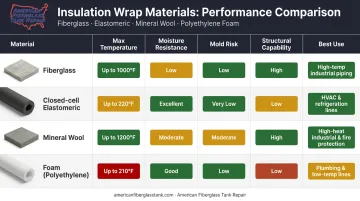
How Fiberglass Compares to Other Insulating Wraps
| Material | Max Temp | Moisture Resistance | Mold Risk | Structural Capability |
|---|---|---|---|---|
| Fiberglass | 850–1,000°F | Moderate (jacket-dependent) | None (inorganic) | Yes (laminate systems) |
| Closed-cell elastomeric | ~220°F | High (built-in vapor barrier) | Low | No |
| Mineral wool | ~1,200°F | Low | Low | No |
| Foam (polyethylene) | ~200°F | Moderate | Low | No |
Fiberglass tolerates higher operating temperatures than foam or elastomeric alternatives, does not support mold growth, and — through resin-saturated laminate systems — offers structural reinforcement that no other wrap type provides. That structural capability is what separates industrial-grade fiberglass systems from the consumer products sharing the same name.
Self-Adhesive vs. Resin-Saturated Systems
Industrial pipe and tank applications use resin-saturated fiberglass laminates that cure to a rigid, chemically resistant shell — a fundamentally different product class from the self-bonding tape sold for residential plumbing repairs. Specifying consumer-grade tape on process equipment leaves the substrate unprotected: it lacks the chemical resistance, mechanical strength, and adhesion required to survive industrial service conditions.
Types of Fiberglass Wrap for Pipes and Tanks
Fiberglass Pipe Wrap Insulation (Thermal)
Standard thermal pipe wrap comes in two primary formats:
- Pre-slit spiral-wrap sections — factory-formed hollow cylinders that snap around standard iron pipe sizes from ½" to 24" NPS (and copper tube from ⅜" to 6")
- Flat wrap tape — hand-applied roll products for irregular sizes, custom fittings, and field repairs
Common facing options include ASJ (all-service jacket), FSK (foil-scrim-kraft), and PSK facings, with vapor permeance ratings of 0.02 perms or less for below-ambient service. Large-diameter products are available with inside diameters up to 42" and insulation thickness up to 5".
For below-ambient (chilled water, refrigeration) systems, jacket integrity is critical — fiberglass itself is inorganic and won't grow mold, but damaged vapor retarders allow moisture migration that undermines system performance.
Fiberglass Reinforcing Wrap Tape
Water-activated or two-part resin fiberglass reinforcing tape serves a structurally different purpose than thermal insulation wrap. Products like SylWrap HD are engineered for live-leak and pressure pipe repair, with performance specs that reflect that demanding use case:
- Cures to a rigid composite shell in 30–45 minutes
- Working time of just 2–5 minutes — suitable for active leak conditions
- Service pressures exceeding 30 bar
- Temperature resistance up to 120°C
These systems are governed by ISO 24817:2015 and ASME PCC-2 — the recognized composite repair standards for pipework and pressure equipment. No ASTM standard specific to fiberglass repair wrap tape systems currently exists.
Fiberglass Laminate Systems for Tanks
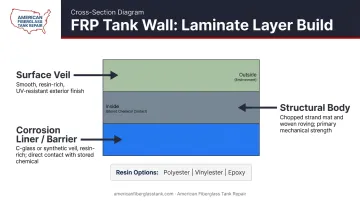
Where pipe repair wrap operates at the component level, large storage vessels require engineered multi-layer laminate systems. The typical build includes:
- Corrosion liner/barrier — resin-saturated C-glass or synthetic veil creates a resin-rich layer that contacts the stored chemical
- Structural layers — chopped strand mat and woven roving provide mechanical strength
- Surface veil — the outermost layer provides a smooth, resin-rich, UV-resistant finish
American Fiberglass Tank Repair (AFTR) works with over 45 laminate types — including fiberglass mat, chopped strand, Nexus veil, Harlar veil, and carbon veil — combined with custom-blended isophthalic polyester, terephthalic polyester, vinylester, and epoxy resin systems. Resin selection is matched to the specific stored chemical, concentration, and operating temperature.
For tanks storing sodium hypochlorite — one of the most aggressive chemicals handled in FRP vessels — AFTR notes that careful selection of resin, cure method, surfacing veil, and laminate architecture is required to achieve meaningful service life.
Key Benefits of Using Fiberglass Wrap
Thermal Efficiency and Energy Savings
The energy case for pipe insulation is straightforward. A 1" bare steam line at 150 psig loses 285 MMBtu per year per 100 feet. Add insulation, and that number drops dramatically. According to the U.S. Department of Energy, insulation can typically reduce steam distribution and condensate-return energy losses by 90%.
For facilities with uninsulated steam or hot-water piping, this is the highest-return insulation investment available.
Corrosion and Chemical Resistance
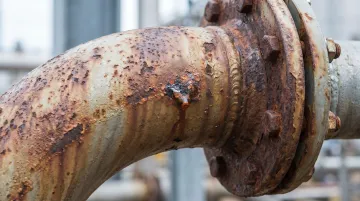
Fiberglass wrap isolates the pipe or tank surface from moisture, oxygen, and chemical exposure — the conditions that drive external corrosion on metal and FRP surfaces alike. The level of protection depends on resin selection:
- Polyester resins — suitable for moderate chemical exposure and general service
- Vinylester resins — preferred for aggressive acids, alkalis, and bleaches including sodium hypochlorite and hydrochloric acid
- Epoxy resins — specified for demanding chemical service where maximum chemical resistance and adhesion are required
NACE/AMPP estimates global corrosion costs at $2.5 trillion annually — 3.4% of global GDP — with available corrosion-control practices capable of reducing those costs by 15–35%. For industrial operators managing chemical storage or process piping, fiberglass wrap and laminate systems are among the most practical corrosion-control measures available.
Extended Service Life
Both thermal insulation wraps and structural laminate rehabilitations extend asset life, though through different mechanisms:
- Thermal insulation prevents condensation cycling, freeze-thaw damage, and corrosion under insulation (CUI)
- Structural laminates rebuild compromised corrosion liners before product permeates the structural body of the tank
AFTR's field experience confirms that even tanks with breached corrosion barriers — where the barrier has failed but structural integrity remains — are strong candidates for relining that adds years of service life at a fraction of replacement cost.
As a benchmark for long-term performance, Owens Corning's environmental product declarations model fiberglass pipe insulation over 60–75 year service-life assumptions. Actual field longevity depends on jacket condition, temperature, UV exposure, and maintenance.
Freeze Protection for Cold-Climate Operations
Fiberglass wrap extends the time-to-freeze for above-ground and exposed piping by slowing heat loss to ambient air. Pipe insulation does not prevent freezing indefinitely — if ambient temperatures stay below 32°F long enough, stationary water will still freeze without a heat source.
For reliable freeze protection, fiberglass insulation is most effective when paired with heat trace systems. The insulation locks in the heat trace output, reducing the energy required to maintain above-freezing temperatures.
How to Apply Fiberglass Wrap
Surface Preparation
No fiberglass wrap performs well over a contaminated substrate. Before any application:
- Remove dirt, oil, grease, rust scale, and deteriorated coatings
- For structural laminate applications: abrade the surface to promote mechanical adhesion, then solvent-wipe to remove residue
- Confirm the surface is dry — moisture beneath a laminate system causes delamination
Application Steps for Thermal Pipe Wrap
- Start at one end of the pipe run and work consistently in one direction
- Overlap each pass by 50% — this maintains consistent insulation thickness and eliminates gaps
- Secure ends with mechanical fasteners, banding, or self-adhesive jacket tape
- Add a protective jacket for outdoor, wet, or UV-exposed environments — ASJ/FSK facings need additional protection in these conditions
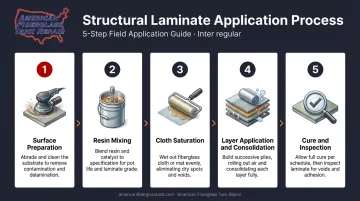
Application Steps for Structural and Tank Laminate Wrap
Structural laminate work follows a distinct process that demands a different skill set:
- Prepare and clean the substrate to bare, abraded FRP
- Mix catalyzed resin to the correct ratio — ratio errors cause incomplete cure
- Saturate fiberglass cloth or mat thoroughly before application
- Apply successive layers with proper overlap, consolidating each layer to eliminate air voids
- Monitor cure before returning to service; post-cure inspection confirms laminate integrity
A note on DIY structural laminate work: Improper resin ratios, incomplete cure, air voids, and delamination can all result in premature failure — sometimes worse than the original damage. AFTR's field teams apply the same laminate protocols used in tank manufacturing environments, bringing shop-quality execution directly to the job site.
Choosing the Right Fiberglass Wrap
Operating Temperature and Chemical Service
Temperature and chemistry are the primary selection drivers:
- Above 500°F: verify manufacturer k-value (thermal conductivity) tables at operating temperature, not just at the standard 75°F baseline
- Acids, caustics, bleaches, and solvents: vinylester or epoxy resin systems outperform standard polyester in chemically aggressive service
- Cold service: vapor retarder jacket integrity takes priority over other specifications
Pipe Diameter, Tank Geometry, and Regulatory Requirements
The vessel's geometry determines which product format applies:
- Standard pipe wrap tape: straight runs, small to medium diameters
- Pre-formed pipe sections: factory dimensions for common IPS and copper tube sizes
- Blanket insulation and custom laminates: large-diameter tanks, fittings, and irregular shapes
For outdoor applications, UV-resistant jacketing or protective coatings are required, since bare fiberglass facings degrade under sustained UV exposure.
Regulatory compliance is product-specific, not assumed. Key requirements by application:
- Potable water contact: NSF/ANSI/CAN 61 certification is required for FRP linings and components that contact drinking water
- Food processing: FDA 21 CFR 117.40 equipment standards apply
Confirm certification at the product level with your supplier. General-purpose fiberglass wrap carries no automatic compliance with either standard.
When to Call a Professional
Thermal pipe insulation is within the reach of trained maintenance personnel. Structural laminate work on process tanks is not.
Professional application is essential for:
- Tanks storing hazardous or corrosive chemicals (sodium hypochlorite, hydrochloric acid, ferric chloride, sodium hydroxide)
- Large-diameter industrial pipes under pressure requiring structural repair
- Any application subject to regulatory inspection or compliance documentation
- Emergency structural rehabilitation where containment integrity is at stake
Here's what a professional engagement with AFTR looks like in practice:
- Condition assessment: Certified inspectors evaluate the vessel using ultrasonic, laser, and high-intensity backlight testing — revealing capillary migration, disbondment, spidering, and low Barcol hardness that visual inspection misses.
- System specification: The correct resin system and laminate architecture are matched to exact service conditions and chemical exposure requirements.
- Field application: Crews apply the laminate with proper layering, overlap, and void consolidation using the same protocols followed in tank manufacturing environments.
- Post-cure inspection: Fiberglass Tank & Pipe Institute certified inspectors confirm integrity before the tank returns to service.
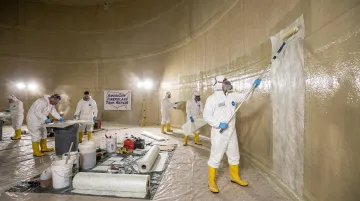
For emergency situations, AFTR deploys Service-Pack shipping containers pre-loaded with blended resins and laminate materials, enabling field crews to begin work immediately on arrival — 24/7, across all 50 U.S. states and Canada.
Frequently Asked Questions
What are fiberglass wraps?
Fiberglass wraps are insulating or reinforcing materials made from glass fibers in tape, mat, or blanket form. They're applied around pipes and tanks to reduce heat transfer, prevent corrosion, or structurally reinforce damaged surfaces — with product formats ranging from consumer pipe wrap kits to industrial multi-layer laminate systems.
How much does a roll of fiberglass wrap cost?
Consumer-grade pipe wrap kits start under $10 for basic residential sizes, while industrial ASJ tape runs $52–$58 per 150 ft roll at industrial distributors. Industrial laminate systems for tanks vary by scope, resin type, and labor. Contact a specialist for a project-specific quote.
Is it okay to touch fiberglass cloth?
Dry fiberglass cloth can cause skin irritation from fine glass fiber contact — wear gloves and long sleeves when handling it. Fully cured resin-saturated fiberglass is safe to handle. Uncured resin requires additional PPE including chemical-resistant gloves and eye protection.
What is the difference between fiberglass pipe wrap and foam pipe insulation?
Fiberglass handles higher temperatures (up to 1,000°F vs. ~200°F for foam), resists moisture and mold, and supports structural reinforcement through laminate systems. Foam insulation is easier to install and better suited for lower-temperature residential or light commercial plumbing where structural performance isn't required.
Can fiberglass wrap be used on both hot and cold pipes?
Yes. Fiberglass wrap is effective for hot-pipe applications (retaining heat, protecting against burns) and cold-pipe applications (slowing freeze progression, preventing condensation). Product selection varies by temperature range, and below-ambient systems require vapor retarder jacketing to prevent moisture infiltration.
How long does fiberglass pipe wrap insulation last?
Owens Corning's environmental product declarations model fiberglass pipe insulation over 60–75 years for building lifecycle analysis. Actual field longevity depends on jacket integrity, UV exposure, operating temperature, and maintenance. Protected indoor systems commonly reach the high end of that range; outdoor installations without UV-resistant jacketing may require recoating or replacement in 20–30 years.