Introduction
Fiberglass reinforced plastic (FRP) tanks have earned their place across chemical processing, waterworks, wastewater treatment, and food processing — but facility managers who treat them as a set-and-forget solution often run into trouble. The material has real, well-documented strengths — and equally real limitations.
According to a ResearchAndMarkets report via BusinessWire, the global FRP tank market was projected to grow at a 4.8% CAGR from 2021 to 2026, driven by chemical plant expansion and oil and gas storage demand. That growth reflects genuine confidence in FRP — confidence that still depends heavily on the right application, specification, and ongoing maintenance.
What follows covers where FRP outperforms competing materials, where it creates operational risk, and what separates tanks that last decades from those that fail early.
TLDR: Fiberglass Tank Pros and Cons at a Glance
- Exceptional corrosion resistance makes FRP ideal for acids, alkalis, and aggressive chemicals
- At roughly 1/4 the density of steel, fiberglass tanks are significantly easier and cheaper to transport and install
- Service life typically reaches 30–40 years in water and compatible chemical applications
- Brittle by nature — cracks under impact and deforms under external load without proper engineering
- UV exposure and temperature extremes degrade the resin matrix — above-ground tanks require UV-protective coatings
Key Advantages of Fiberglass Tanks
Corrosion and Chemical Resistance
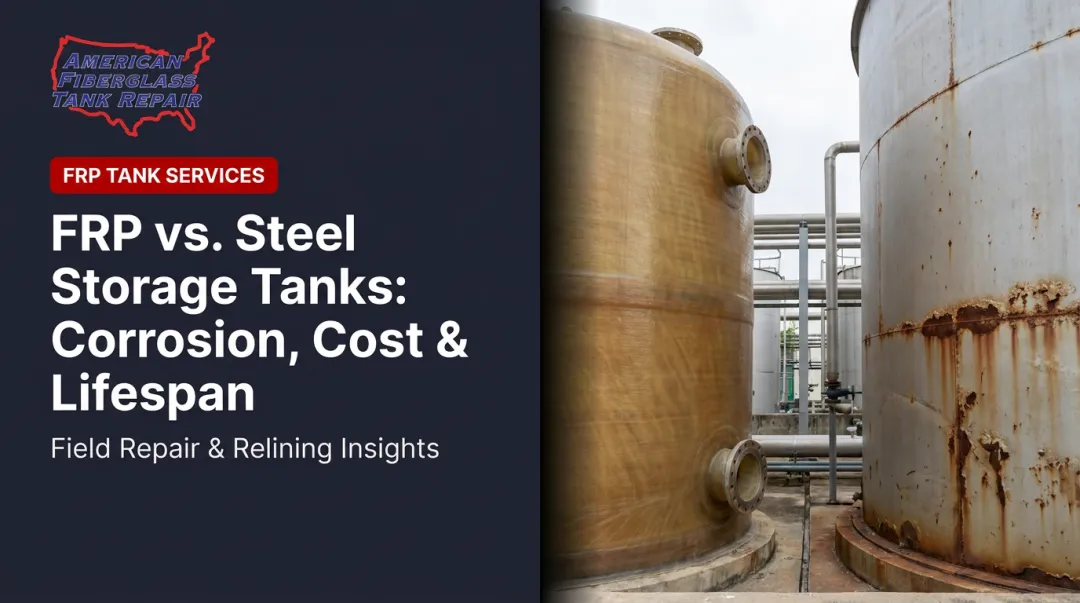
Fiberglass doesn't rust. That single fact explains why FRP tanks dominate corrosive chemical storage applications where carbon steel would require constant recoating and eventual replacement.
ASTM D3299-18 and ASTM D4097-19 explicitly cover fiberglass tanks for aggressive chemical service at atmospheric pressure — a standards-recognized application, not just a marketing claim. The key nuance is that "fiberglass is corrosion resistant" is incomplete without specifying which resin, which chemical, and at what concentration and temperature.
Resin selection drives chemical compatibility:
- Isophthalic polyester — good general corrosion resistance for many acids and salts
- Terephthalic polyester — comparable to isophthalic with application-specific advantages
- Vinylester — broader chemical resistance, including many oxidizing environments
- Epoxy — strong performance in highly alkaline and specialized chemical environments
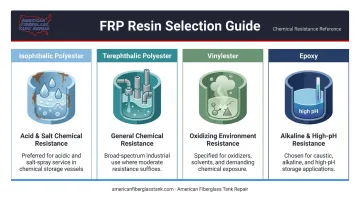
The Reichhold FRP Material Selection Guide illustrates how specific this gets: hydrochloric acid is manageable up to 37% commercial concentration below 110°F, while sulfuric acid above 76% concentration can dehydrate the resin entirely.
In AFTR's repair and relining work across chemical plants and wastewater facilities, the most common aggressive chemicals handled include sodium hypochlorite (NaOCl), sodium hydroxide (NaOH), ferric chloride (FeCl₃), and hydrochloric acid (HCl) — all of which would rapidly degrade unlined carbon steel. Getting the resin-to-chemical match right is what separates a tank that performs for decades from one that fails in a few years.
For potable water applications, fiberglass is inert and does not leach contaminants — but tanks must meet NSF/ANSI 61 and AWWA D120 requirements before being used in drinking water systems.
Lightweight Design and Installation Advantage
FRP weighs roughly 1/4 the density of steel and nearly 30 times less than comparable concrete tanks — a weight advantage that translates directly into lower crane, transport, and installation costs. For underground installations or space-constrained facilities, this matters.
What the lighter weight doesn't mean: reduced structural capability. The glass fiber-resin matrix delivers a high strength-to-weight ratio, and tanks can be engineered with ribbing, additional laminate layers, or thicker walls for specific structural demands.
Practical installation advantages include:
- Easier handling with lighter equipment on site
- Reduced foundation and support structure requirements versus concrete
- More viable placement options (above-ground, underground, elevated)
- Lower freight costs for long-distance delivery
Long Service Life and Low Maintenance Demand
A well-specified fiberglass tank in water service can last 30–40 years. Bleach or oxidizing chemical service may cut that to 10–15 years, and poorly built tanks can fail within 1–3 years. In other words, "fiberglass lasts a long time" is only true when the right resin, fabrication, and maintenance conditions are in place.
Those conditions directly shape ongoing maintenance demands. Day-to-day requirements are genuinely low compared to steel — no painting, no rust treatment, no routine recoating under normal conditions. But low-maintenance is not zero-maintenance:
- Periodic visual and structural inspections
- Fitting and nozzle condition checks
- UV coating renewal on above-ground tanks
Carbon steel tanks typically require interior linings to prevent corrosion of contact surfaces, according to the Fiberglass Tank & Pipe Institute's EPA docket comment. FRP avoids that burden entirely in compatible service.
AFTR's philosophy reflects this directly: detecting problems early through inspection makes repairs simpler and adds years to a tank's service life. The company's field experience shows that even after a corrosion barrier has been breached, the structural body of most tanks remains sound enough to reline — extending service life at a fraction of replacement cost.
Customizability and Design Flexibility
FRP tanks can be fabricated across a wide range of configurations, with custom nozzle placements, fittings, and accessories built in at the manufacturing stage:
- Vertical or horizontal orientation
- Above-ground, underground, or elevated placement
- Capacities from small process vessels to large bulk storage
- Custom inlet/outlet nozzle positions and sizes
Beyond geometry, resin and laminate combinations are engineered to meet specific chemical, temperature, or structural requirements. AFTR works with custom-blended isophthalic, terephthalic, vinylester, and epoxy resins alongside 45+ laminate types — including chopped strand mat, woven roving, Nexus, Harlar, and carbon veil. That material depth allows precise matching of the corrosion barrier system to the stored substance and operating environment, something standard carbon steel or concrete simply can't replicate.
Key Limitations of Fiberglass Tanks
Brittleness and Structural Fragility Under Impact
Fiberglass has roughly 1/30 the modulus of elasticity of steel, which means it lacks ductility. Steel bends under impact; fiberglass cracks.
In practice, this shows up in ways that are more common than many operators expect:
- Forklift impacts into tank shells — AFTR's field teams describe these as "not really that uncommon"
- Electric motors or mixing assemblies falling into tanks during maintenance
- Tanks tipped over during repositioning or transport incidents
Inspection surveys regularly identify spidering, floor stress cracking, and shell distortion as damage patterns linked to mechanical loading and impact events.
The low-modulus problem also affects underground installations. Without adequate engineered support — proper sand bedding over compacted substrate, controlled backfill — FRP tanks can deform under soil load. Structural ribbing and engineered laminate thickness compensate for this, but only when specified and installed correctly.
UV Degradation and Temperature Constraints
Prolonged UV exposure breaks down the resin matrix on the tank's exterior surface. AFTR's inspections assess for UV degradation alongside disbondment, abrasion wear, and emulsification. For above-ground tanks in direct sunlight, UV-protective coatings — including aliphatic compounds — are a necessary part of the maintenance program, not optional.
Temperature limits vary by resin system and stored chemical:
- General-purpose resins trigger special design consideration above 180°F (82°C) per ASTM D3299 and D4097
- Concentrated HCl must stay below 110°F regardless of resin type
- Specialty vinylester and epoxy systems extend the upper usable range for specific applications
There's no single temperature ceiling for "fiberglass tanks" — the correct number depends on the resin, the chemical, the concentration, and the laminate construction.
Repair Complexity and Higher Initial Cost
FRP tanks typically carry a higher upfront cost than polyethylene or carbon steel tanks of comparable size. For budget-constrained projects, this creates a barrier — though lifecycle economics generally favor FRP in corrosive service over time.
Repair complexity is the more pressing operational concern. Effective FRP repair requires:
- Surface preparation — removal of compromised corrosion coat before any laminate work
- Product-specific resin selection — matched to the stored chemical, concentration, and temperature
- Correct laminate layup — following tank-manufacturing protocols, not generic patch procedures
- Controlled curing — ensuring proper conditions regardless of ambient temperature
- Post-cure inspection — confirming structural integrity before return to service
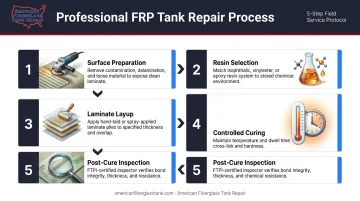
Shortcuts at any of these steps create weak points that fail under service pressure — often without warning. AFTR's field teams manage curing conditions in extreme heat or cold, with all critical work supervised by FTPI-certified inspectors.
Manufacturing Quality Variability
Not all FRP tanks are built to the same standard. Common fabrication defects — often invisible at delivery — create structural vulnerabilities that surface only under service conditions:
Not all FRP tanks are built to the same standard. Common fabrication defects — often invisible at delivery — create structural vulnerabilities that surface only under service conditions:
- Resin-to-glass ratio inconsistencies
- Incomplete curing and air voids
- Inadequate laminate thickness
- Overheating or processing errors during manufacture
The Fiberglass Tank & Pipe Institute notes that these issues can reduce tank interior integrity over time. ASME RTP-1 certification of fabricators provides a quality assurance baseline — procurement specifications should include it.
AFTR's inspection methodology — combining ultrasonic testing, high-intensity backlight, and visual laminate assessment — is designed to detect these hidden conditions, including capillary migration of product beneath the corrosion coat before visible leaks appear.
How to Overcome Fiberglass Tank Limitations
Most fiberglass tank failures are preventable. The interventions are straightforward, even if they require discipline to execute consistently.
Installation practices eliminate several problems upfront:
- Underground tanks require sand bedding over compacted substrate and controlled backfill
- Tanks should be padded and strapped during transport to prevent impact damage
- Above-ground placement should account for forklift traffic and mechanical impact zones
Resin and laminate selection drives chemical compatibility, temperature resistance, and UV durability. Matching the resin system to the stored substance and environment before fabrication or relining — not after a failure — determines whether a tank performs or degrades prematurely. AFTR addresses this through custom-blended resin systems and 45+ laminate types, selected specifically for each chemical service and temperature condition.
Scheduled inspections catch problems before they become failures. The FTPI recommends certified external inspections every 5 years for hazardous-substance service and every 10 years for tanks over 10,000 gallons in other services. AFTR's inspection services use ultrasonic, laser, and high-intensity backlight testing to assess:
- Corrosion coat condition and thickness
- Structural laminate integrity
- Exterior shell and all nozzle interfaces
Detailed reports and remediation recommendations are supervised by FTPI-certified inspectors.
When damage does occur, professional repair restores structural integrity without replacing the entire vessel. AFTR's field teams serve all 50 U.S. states, with Service-Pack shipping containers pre-stocked with resins and laminates for rapid deployment. Even tanks with breached corrosion barriers can often be relined, preserving the structural shell and avoiding full replacement costs.
Fiberglass vs. Other Tank Materials: A Quick Comparison
No single tank material is right for every application. The table below compares fiberglass (FRP) against the three most common alternatives across the factors that matter most to industrial operators.
| Fiberglass (FRP) | Carbon Steel | Concrete | Polyethylene (HDPE) | |
|---|---|---|---|---|
| Corrosion resistance | Excellent (resin-dependent) | Poor without lining | Moderate | Good |
| Weight | ~1/4 of steel | Heavy | Very heavy (~30x FRP) | Light |
| Impact resistance | Lower (brittle) | High (ductile) | Moderate | High |
| Chemical customization | High (resin/laminate selection) | Limited | Very limited | Limited |
| Large-volume capacity | Good to ~400,000 L | Best | Good | Limited |
| Maintenance burden | Low (no recoating) | High (lining, rust treatment) | Moderate | Low |
| Upfront cost | Higher than PE/steel | Moderate | Lower for large installs | Lowest |
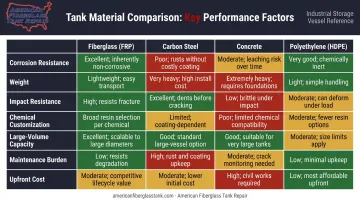
Key takeaways:
- Steel leads on impact toughness and very large-volume storage; FRP outperforms on corrosion resistance, chemical customization, and installed weight
- Concrete suits large infrastructure on cost but is heavy, inflexible, and costly to repair precisely
- Polyethylene works well for smaller, lower-demand applications; FRP scales better and handles harsh chemical exposure
Is a Fiberglass Tank the Right Choice for Your Operation?
FRP is clearly the superior choice when:
- The stored substance is corrosive — acids, alkalis, bleach, ferric chloride, sodium hydroxide
- The application requires potable water compatibility (with NSF/ANSI 61 and AWWA D120 compliance)
- The installation environment is harsh and corrosion risk is high
- Underground storage is needed and weight savings matter for installation logistics
- Long-term lifecycle cost matters more than lowest upfront price
FRP may not be ideal when:
- The environment carries extreme mechanical impact risk with no mitigation possible
- Continuous operating temperatures exceed the selected resin's rated range
- Storage volumes above approximately 400,000 liters make large-format steel more cost-effective
- Budget constraints are severe and a lower-cost polyethylene tank meets the chemical service requirements
If the stored substance is corrosive or requires purity, the installation environment is demanding, and long-term lifecycle cost is the primary metric, fiberglass is the right material. The tank still needs to be correctly specified for the chemistry and temperature, properly installed, and maintained with scheduled inspections. A well-specified, well-maintained FRP tank can remain in safe service for 30 to 50 years — but only if those conditions are met.
Frequently Asked Questions
Which is better, fiberglass or polyethylene tanks?
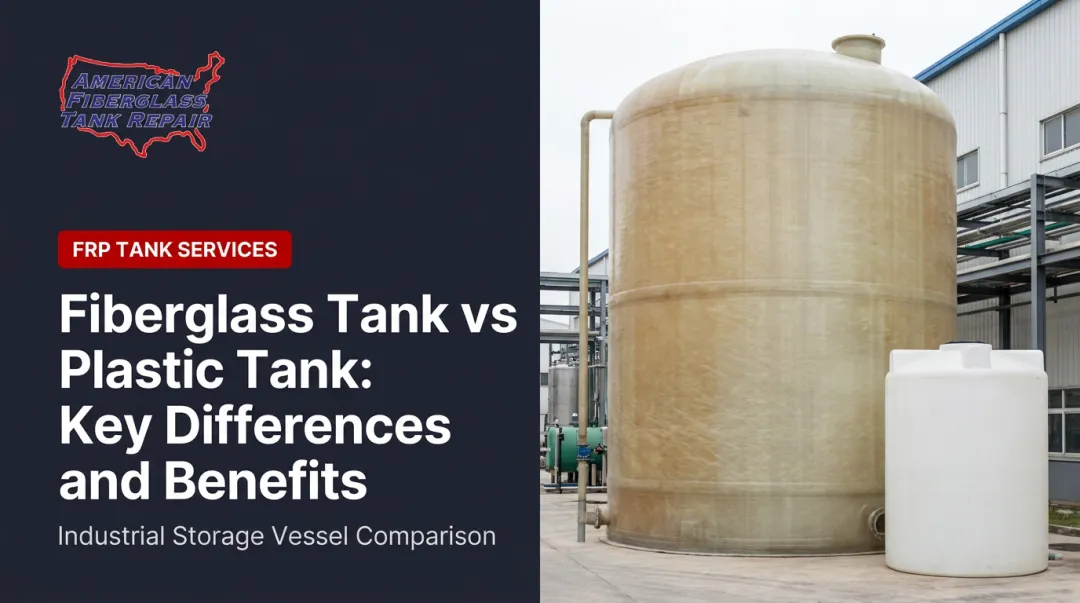
The better choice depends on the application. Fiberglass offers greater structural strength, chemical customization, and scalability for large industrial tanks and aggressive chemical environments. Polyethylene costs less and resists impact better for smaller, less chemically demanding applications.
How long do fiberglass tanks last?
Water service tanks with proper design and maintenance typically last 30–40 years. Aggressive oxidizing chemicals like bleach can cut that to 10–15 years, while poor fabrication or wrong resin selection can cause failure within 1–3 years. Service life is application-dependent, not guaranteed.
Are fiberglass tanks safe for storing drinking water?
Fiberglass is inert and does not leach contaminants into stored water. Potable water tanks must use wetted materials meeting NSF/ANSI 61 requirements and comply with AWWA D120 — not every FRP tank qualifies by default.
Can a damaged fiberglass tank be repaired?
Yes, and often more cost-effectively than replacement. Effective repair requires compatible resin systems, correct laminate layup, proper surface preparation, and controlled curing. Professional FRP repair specialists — not general contractors or DIY methods — are necessary to restore structural integrity reliably.
What are the temperature limits for fiberglass tanks?
General-purpose resins begin losing strength around 122°F (50°C) under continuous exposure; ASTM standards require special design consideration above 180°F (82°C). Specialty vinylester and epoxy systems can extend that range — the correct limit depends on the specific resin system and stored chemical.
Do fiberglass tanks require regular maintenance?
Significantly less than steel, but not zero. Above-ground tanks need UV coating upkeep, fittings and connections should be checked periodically, and scheduled ultrasonic and backlight inspections are essential for catching internal degradation before it causes failures.