FRP (fiber reinforced polymer) tanks are increasingly the answer facilities reach for, but the case for FRP goes well past "it doesn't rust." The real advantages show up in inspection schedules, maintenance budgets, and years of service life that steel tanks in corrosive environments simply can't match.
This article breaks down three concrete operational advantages FRP tanks hold over steel — and what it takes to actually realize them.
Key Takeaways
- FRP tanks eliminate rust and corrosion-driven maintenance cycles — the primary cost driver for steel tank operators
- Steel tanks require cyclical recoating, cathodic protection, and API 653 inspections; FRP avoids all three
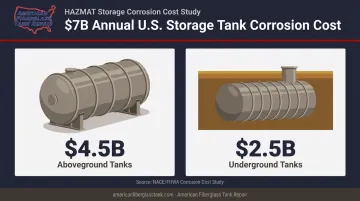
- The NACE/FHWA corrosion cost study estimated $7B in annual U.S. storage tank corrosion costs — a number FRP selection directly addresses
- FRP's lower lifetime maintenance spend typically offsets its higher upfront cost over a 20–30 year horizon
- Periodic inspection is still required; skipping it is the most common cause of premature FRP tank failure
What Is FRP in the Context of Tank Storage?
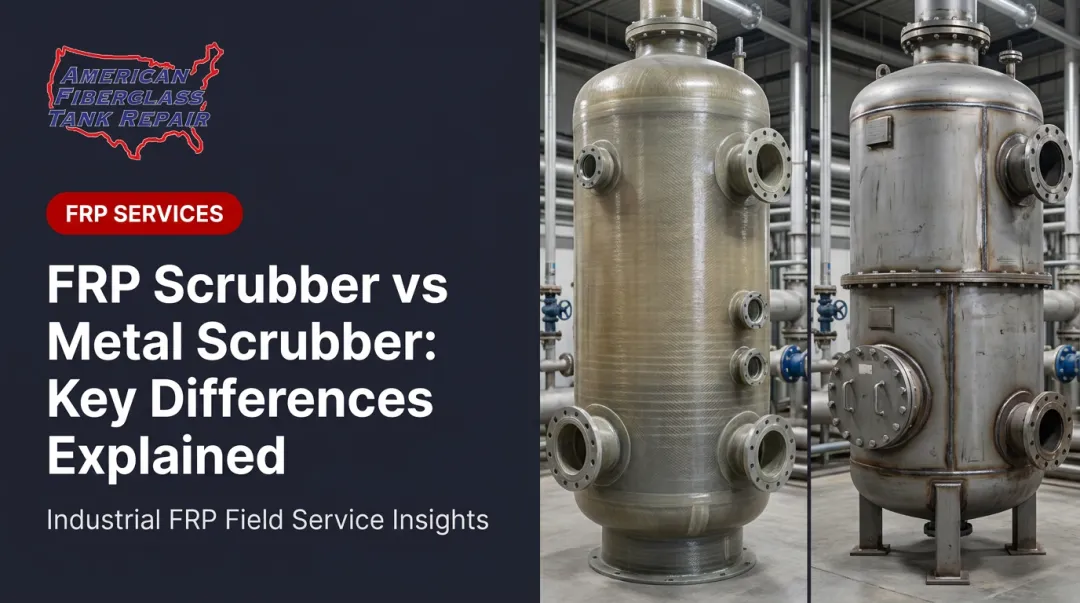
FRP is a composite material — glass fibers embedded in a polymer resin matrix — engineered to store liquids, chemicals, water, and process fluids in industrial environments. Purpose-built FRP storage tanks are specified under ASTM D3299 (filament-wound) and ASTM D4097 (contact-molded) for aggressive chemical service — not the construction-grade fiberglass used in general applications.
Where FRP tanks are typically deployed:
- Chemical processing (acids, alkalis, oxidizers, chlorinated solutions)
- Water and wastewater treatment
- Potable water storage
- Food and beverage production
- Petrochemical and pulp and paper operations
Reinforced thermoset plastic has been used for industrial tank storage since the 1950s. The advantages over steel become clear when you evaluate total maintenance cost and lifecycle performance alongside purchase price — not instead of it.
American Fiberglass Tank Repair (AFTR) has worked across all of these sectors since 2003. The company services tanks storing sodium hypochlorite, sodium hydroxide, ferric chloride, hydrochloric acid, and potable water at chemical plants, municipal water systems, and wastewater treatment facilities across all 50 states.
Key Advantages of FRP Tanks Over Steel
The three advantages below are grounded in what facility managers actually track: maintenance spend, downtime frequency, inspection obligations, and years of reliable service.
Advantage 1: Inherent Corrosion Resistance — Inside and Out
Steel tanks face corrosion from two directions at once. External atmospheric moisture, humidity, and weather attack the outer surface. Internally, the chemistry of stored contents — acids, alkalis, chlorinated water, hydrogen sulfide in wastewater — attacks from the inside out. Neither vector stops.
FRP resists both. The polymer resin matrix is chemically inert to most stored substances when matched to the stored chemical. The outer laminate is unaffected by moisture and atmospheric exposure. Corrosion is not a structural failure mode for a properly specified FRP tank.
Why this matters operationally:
The NACE/FHWA corrosion cost study estimated $7 billion in annual U.S. HAZMAT storage corrosion costs — $4.5B for aboveground tanks, $2.5B for underground tanks. For steel, corrosion isn't a question of if but when. Each event requires a sequence of interventions: inspection, surface preparation, recoating, or lining repair — and those costs compound across a tank's operating life.
Beyond cost, a corroding steel tank introduces contamination risk to stored product, potential leak or spill liability, and unplanned shutdowns.
KPIs directly impacted:
- Maintenance labor hours per tank per year
- Coating and lining replacement frequency
- Unplanned downtime events
- Product contamination incidents
- Regulatory inspection pass rates
Where the gap is largest:
This advantage is most pronounced in tanks storing acidic or alkaline chemicals, tanks in coastal or high-humidity locations, wastewater tanks exposed to hydrogen sulfide, and potable water tanks where steel corrosion byproducts affect water quality.
One important caveat: FRP's corrosion resistance is resin-specific, not universal. Derakane's chemical resistance guide, for example, rates different resin families — vinylester, epoxy, isophthalic polyester — against specific chemicals at defined concentrations and temperatures. "FRP resists acids" is not a safe specification shortcut. The right resin, matched to the actual stored chemical, concentration, and operating temperature, is what makes the resistance claim true.
Advantage 2: Lower Ongoing Maintenance Requirements
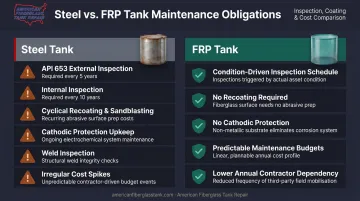
Steel tanks operate on a mandatory maintenance cycle. API 653 — the governing standard for aboveground steel storage tanks — requires external inspection at least every 5 years and internal inspection intervals based on measured corrosion rates, capped at 20 years (or 30 years with a release-prevention barrier). When corrosion rates are unknown, the internal interval defaults to 10 years.
Each internal inspection requires planned shutdown, cleaning, and surface assessment. Recoating, sandblasting, weld inspection, and cathodic protection upkeep layer on top.
FRP breaks this cycle. Because corrosion isn't a structural threat, maintenance shifts from reactive and cyclical to inspection-based and condition-driven. The corrosion liner and laminates are monitored for integrity, but the material itself doesn't demand the same recurring intervention schedule steel does.
What this means for facility operations:
- Fewer planned shutdowns tied to mandatory recoating or corrosion-rate measurement
- Reduced dependency on specialty contractors — sandblasters, welders, coating applicators
- More predictable maintenance budgets without the irregular cost spikes steel recoating creates
- Lower annual labor and contractor costs per tank
AWWA D102 governs coating systems for steel water tanks. Certain interior coating systems carry an estimated service life approaching 30 years — but that's the coating's life, not the tank's, and it assumes proper surface preparation and application each cycle. Each recoating event requires shutdown, inspection, surface prep, application, and cure time.
Where this advantage is most financially meaningful:
- Large tank farms where maintenance cost multiplies across many units
- Operations where shutdowns carry high production loss costs
- Facilities in locations where corrosion-specialist contractors are costly or difficult to mobilize
- Organizations operating under tight maintenance budgets with limited contractor flexibility
Advantage 3: Extended Service Life and Lower Total Cost of Ownership
FRP tanks have a well-documented service history. The Fiberglass Tank & Pipe Institute notes that reinforced thermoset plastic has been in service in aggressive industrial environments since the 1950s. When properly specified — the right resin for the stored chemical, a fabrication standard matched to the application, and a sound corrosion liner — and maintained with periodic inspection, FRP tanks can remain in service for decades.
The reason comes down to degradation pathways. Steel tanks in corrosive service lose wall thickness, develop pitting, and require progressive structural intervention over time. FRP tanks, when the corrosion liner is maintained, don't face the same structural attrition — corrosion simply isn't how they fail.
The repair-versus-replace distinction:
When FRP liner damage does occur, it's typically addressable. Even tanks that have breached their corrosion barrier often retain intact structural laminates — the ideal substrate for relining. AFTR's field teams regularly restore tanks storing sodium hypochlorite, sodium hydroxide, and ferric chloride to continued service through targeted repair or full relining, at a fraction of new-tank capital cost.
That option doesn't exist in the same way for steel. Internal corrosion damage to a steel tank is difficult to reverse without full relining or replacement, and structural pitting may eliminate the relining option entirely.
KPIs directly impacted:
- Total cost of ownership over a 20–30 year horizon
- Capital replacement cycle frequency
- Asset depreciation rate
- Lifecycle maintenance-to-capital cost ratio
Where this advantage compounds most:
Service life extension matters most where replacement is expensive — buried tanks, large-diameter tanks, tanks in constrained or remote facilities, and tanks in continuous chemical service where any replacement window carries high operational disruption cost.
What Happens When FRP Tank Maintenance Is Overlooked
FRP's low-maintenance profile does not mean zero maintenance. The corrosion liner and laminate system that make FRP tanks durable still degrade under UV exposure, mechanical stress, chemical concentration, and thermal cycling if left uninspected.
AFTR's certified inspectors, when called in to assess tanks with no prior inspection history, commonly encounter:
- Spidering and disbondment in the corrosion coat
- Abrasion wear and emulsification at the liner surface
- Low Barcol hardness readings indicating resin degradation
- Floor stress cracking and shell distortion
- UV degradation on external surfaces
- Capillary migration — stored chemical penetrating beneath the corrosion coat and working toward structural laminates
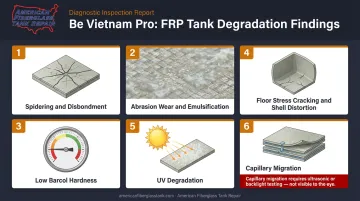
That last finding is the critical one. Capillary migration isn't visible in a standard visual inspection. It requires ultrasonic, laser, or high-intensity backlight testing to detect. A tank that passes a hydrostatic test today can be in active structural compromise three months later.
The cost gap between catching a liner issue early — a targeted repair — versus discovering it late — full relining or tank decommissioning — can mean the difference between a one-day repair crew and a full tank replacement decision. A containment breach that reaches structural laminates turns a planned relining job into a capital expenditure — typically months of lost service time and five to ten times the repair cost.
Keeping that cost gap manageable means following a structured inspection schedule. FTPI RP 2007-1 recommends trained external inspections every 5 years for hazardous-substance FRP tanks and every 10 years for tanks over 10,000 gallons in other service. Inspections are also required after any material stress event, leak, service change, or relocation.
How to Get the Most Value from Your FRP Tank Investment
FRP tanks deliver their full maintenance and longevity advantages when they're treated as managed assets, not set-and-forget infrastructure. Two practices determine whether a tank reaches its service-life potential or falls short of it.
Specify the Right Resin System Upfront
Resin selection at the specification stage determines how aggressively the corrosion liner is challenged in service. Vinylester, isophthalic polyester, and epoxy each perform differently against specific chemicals, concentrations, and operating temperatures. An incorrect specification accelerates the very deterioration FRP is designed to resist.
For tanks storing particularly aggressive substances like sodium hypochlorite, the resin is only part of the equation. AFTR matches each project to the right system from its custom-blended resin portfolio — isophthalic polyester, terephthalic polyester, vinylester, and epoxy — with veil selection, cure method, and postcure conditions specified to the stored chemical and operating temperature.
Build an Inspection Program That Matches Service Risk
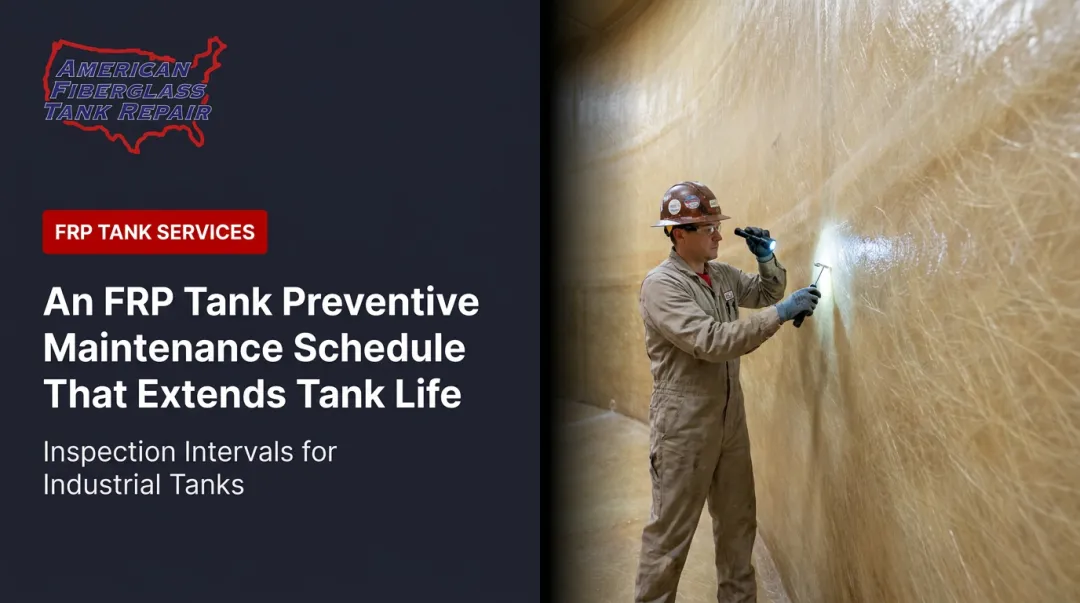
Scheduled inspections using qualified methods are what separate FRP tanks that reach multi-decade service lives from those that fail prematurely. The inspection should assess the corrosion coat, structural laminates, exterior shell, and all nozzle and fitting interfaces — not just a visual pass.
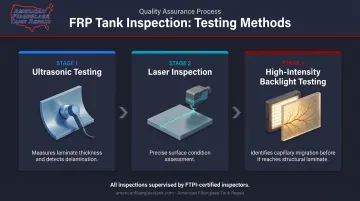
AFTR's inspections are supervised by Fiberglass Tank & Pipe Institute certified inspectors and cover more than a surface walkdown. Testing methods include:
- Ultrasonic testing to measure laminate thickness and detect delamination
- Laser inspection for precise surface condition assessment
- High-intensity backlight testing to identify capillary migration before it reaches the structural laminate
Detailed reports specify current condition and remediation steps, so facilities plan repairs rather than react to failures. AFTR provides these services for FRP vessels across all 50 states.
Conclusion
FRP's advantages over steel in maintenance and longevity are real and measurable: corrosion immunity, lower maintenance burden, and service life that steel vessels rarely match. But those gains are conditional — they depend on correct resin selection, proper fabrication, and periodic professional inspection.
For facilities operating in chemically aggressive, high-humidity, or continuous-service environments, the shift from steel to FRP isn't just a materials decision. It's an asset management decision — one that reduces lifecycle costs, prevents unplanned shutdowns, and extends reliable service by decades. That outcome requires the right materials expertise upfront and a consistent inspection program to catch problems before they compound. Companies like American Fiberglass Tank Repair, whose certified inspectors work with custom-blended resins matched to specific chemical environments, exist precisely to support that long-term approach.
Frequently Asked Questions
Is FRP better than steel?
For liquid containment in corrosive service environments, FRP is typically the superior long-term choice. It eliminates rust and corrosion-driven maintenance cycles that steel tanks require. Steel retains advantages in high-load structural applications, but for chemical, water, or wastewater storage, FRP outperforms steel on maintenance cost and service longevity.
Is FRP more expensive than steel?
FRP can carry a higher upfront cost than carbon steel. Over a 20–30 year horizon, however, total cost of ownership (accounting for maintenance, recoating, downtime, and replacement cycles) typically favors FRP, particularly in corrosive service conditions where steel maintenance costs compound continuously.
What is the lifespan of FRP material?
FRP tanks have been in industrial service since the 1950s, and properly specified and maintained tanks can remain in reliable service for decades. Actual lifespan depends on resin system selection, chemical compatibility, operating conditions, and the consistency of periodic inspection and liner maintenance.
Does FRP require maintenance?
FRP requires significantly less maintenance than steel but is not maintenance-free. Periodic inspection of the corrosion liner and structural laminates is recommended to catch early-stage degradation. Timely minor repairs prevent far costlier interventions. Skipped inspections are the most common reason FRP tanks fall short of their full service life.
What causes FRP tanks to fail prematurely?
The most common causes are incorrect resin selection for the stored chemical, skipped or infrequent inspections that allow liner damage to progress undetected, mechanical damage to fittings or nozzles, and UV degradation on external surfaces when protective coatings are not maintained.
Can FRP tanks be repaired instead of replaced?
Yes — FRP tanks are highly repairable. Laminate damage, liner blistering, and fitting failures can typically be addressed through targeted repair or full relining. Even tanks that have breached their corrosion barrier often retain intact structural laminates, making repair a cost-effective alternative to replacement when issues are caught before structural laminates are compromised.