FRP (Fiberglass Reinforced Plastic) maintenance walkways are increasingly specified across heavy industry, but the conversation often stops at material properties. What matters operationally is what those properties mean for maintenance budgets, safety records, and capital planning over a 20-30 year facility lifecycle.
This article examines the concrete operational advantages of FRP maintenance walkways — the kind that show up in OSHA audits, annual maintenance spend, and unplanned repair events.
Key Takeaways
- Built for chemically aggressive, high-moisture environments, FRP walkways provide safe access where steel and aluminum fail
- Unlike steel or galvanized iron, FRP does not rust, oxidize, or degrade from chemical exposure — Strongwell documented one offshore installation retaining over 80% of structural integrity after 40 years
- Built-in anti-slip grating surfaces address one of industry's leading injury categories: falls, slips, and trips account for nearly 1 in 5 nonfatal workplace injuries
- At up to 70% lighter than steel, FRP cuts installation labor, crane costs, and ongoing maintenance burden
- Delaying walkway upgrades means delayed access to critical assets — and that deferred maintenance compounds into far costlier repairs down the line
What Are FRP Maintenance Walkways?
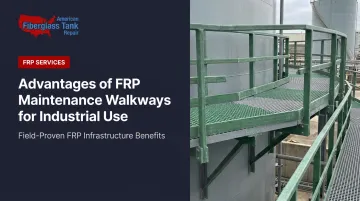
FRP maintenance walkways are elevated or ground-level access platforms constructed from fiberglass reinforced plastic — typically in grating or panel form — designed to give workers stable, safe footing while servicing industrial equipment. That includes storage tanks, process vessels, piping systems, and filtration equipment.
They're deployed across:
- Chemical processing plants
- Water and wastewater treatment facilities
- Food processing operations
- Refineries and offshore platforms
- Coastal industrial sites with high salt and humidity exposure
Two primary construction types exist: molded grating, which offers bi-directional strength and is common in chemical environments, and pultruded grating, which provides higher load-bearing capacity for heavy-traffic platforms. Both are manufactured to meet ANSI/ACMA/FGMC grating standards (reaffirmed by ANSI in 2025) and are testable under ASTM F3059-24.
Understanding the construction specs matters, but the operational case is just as straightforward: FRP maintenance walkways determine whether maintenance work gets done safely, on schedule, and without compliance exposure. That's not a minor distinction — deferred or unsafe access to tanks and process equipment is one of the more common causes of unplanned downtime in chemical and water treatment facilities.
Key Advantages of FRP Maintenance Walkways for Industrial Use
The advantages below map directly to outcomes industrial operators track: maintenance costs, safety incident rates, regulatory compliance, asset uptime, and capital expenditure planning.
Corrosion Resistance That Preserves Access Infrastructure
Corrosion resistance is FRP's most consequential property in industrial maintenance settings. FRP walkways do not rust, oxidize, or degrade when exposed to chemicals, moisture, saltwater, or industrial cleaning agents — conditions that steadily destroy steel and galvanized iron alternatives.
Fibergrate states that in highly corrosive applications, metal products often deteriorate in "a few years or less," while FRP products last many times longer. For a facility manager, that gap means the difference between one capital replacement over a facility's lifecycle and several — each requiring downtime to execute.
Strongwell documented a DURAGRID pultruded grating installation on an offshore platform that, after 40 years of exposure, retained over 80% of its flexural modulus and maximum load capability — conditions far more aggressive than most inland industrial sites.
Why this matters beyond replacement cost:
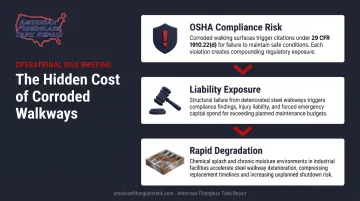
- Corroded walkways create OSHA-relevant structural hazards under 29 CFR 1910.22(d), which requires walking-working surfaces to be maintained in a safe condition; OSHA has issued citations specifically for failure to inspect and maintain surfaces under this standard
- Structurally compromised access infrastructure doesn't just cost money to replace — it creates liability exposure and may trigger compliance findings that force unplanned capital expenditure under deadline pressure
- In chemical processing and wastewater treatment environments, where aggressive compounds are routinely present at platform level, steel walkway degradation is predictable and relatively rapid
When this advantage matters most: Chemical exposure environments, coastal and high-humidity sites, wastewater treatment operations, and any facility where cleaning agents or process chemicals reach platform level regularly.
Worker Safety: Slip Resistance and Electrical Non-Conductivity
FRP maintenance walkways are manufactured with textured, anti-slip grating surfaces that maintain traction when wet, oily, or coated with process residue. That surface performance directly addresses one of industrial work's most consistent injury risks.
According to BLS 2024 data, falls, slips, and trips accounted for 479,480 nonfatal workplace injuries — roughly 19.3% of all private-industry nonfatal injuries and illnesses that year. Workers accessing tank tops, elevated platforms, and process equipment in wet or chemically contaminated conditions face exactly the conditions that drive these statistics.
The compliance picture:
- OSHA recommends walking surfaces achieve a static coefficient of friction of 0.5 (per OSHA interpretation guidance)
- ASTM F3059 skid-resistance requirements specify a 0.75 COF measured by ASTM D2047 — a threshold well-made FRP grating is designed to meet
- OSHA 29 CFR 1910.22(a)(3) requires walking-working surfaces to be maintained free of hazards including corrosion and spills; 1910.28(b)(1)(i) requires fall protection at unprotected edges 4 feet or more above a lower level
FRP also offers a safety property steel cannot match without expensive add-ons: electrical non-conductivity. FRP grating is inherently non-conductive and non-sparking — Fibergrate and Strongwell both manufacture products to this specification. This makes FRP the preferred material in substations, chemical dosing areas with nearby electrical equipment, and any facility where conductive flooring creates a risk of electrical incident.
In facilities subject to frequent OSHA audits, that combination of slip resistance and electrical safety reduces audit exposure on two separate fronts simultaneously.
Lightweight Construction That Reduces Installation and Lifecycle Cost
FRP maintenance walkways weigh up to 70% less than steel equivalents. A standard Strongwell DURAGRATE molded panel runs approximately 2.4 lb/ft² — a fraction of comparable steel grating weight.
Installation advantages:
- FRP panels can be carried and positioned by small crews without crane hire or heavy lifting equipment
- FRP can be cut with ordinary hand tools — no welding, no hot work permits required
- Lighter sections are faster to remove and reinstall when walkway access is needed for below-floor maintenance
The retrofit context is especially relevant. When facilities need to replace deteriorated walkways around existing tank infrastructure, the absence of crane requirements simplifies logistics considerably — particularly in confined or elevated locations where heavy equipment access is restricted.
Lifecycle cost factors:
| Cost Category | Steel Walkways | FRP Walkways |
|---|---|---|
| Periodic repainting | Required | Not required |
| Re-galvanizing or re-coating | Required | Not required |
| Corrosion-driven replacement | Periodic | Substantially reduced |
| Hot work permits for cutting/modification | Required | Not required |
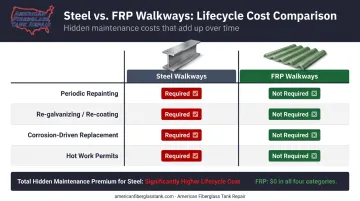
Fibergrate specifically notes that FRP products require no scraping, sandblasting, or painting — maintenance activities that recur throughout steel walkway service life and require facility coordination, labor, and material cost every cycle.
When this advantage matters most: Retrofits where heavy equipment access is limited, facilities with ongoing maintenance access requirements, and budget-constrained projects where total lifecycle cost — not just upfront spend — drives procurement decisions.
What Happens When FRP Maintenance Walkways Are Neglected
The failure pattern is consistent across industrial facilities. Deteriorating access infrastructure reduces maintenance visit frequency, which delays detection of asset degradation in tanks, vessels, and connected equipment — and deferred detection eventually produces emergency repairs that cost far more than proactive maintenance would have.
AFTR's inspection philosophy captures this directly: the company emphasizes that "detecting problems early makes repairs simpler and can add many years of useful service life to a fiberglass tank." That logic depends entirely on reliable access.
Inspections that require workers to navigate corroded or structurally questionable walkways don't happen on schedule. When they don't, conditions like corrosion coat disbondment, capillary migration of product under the liner, and floor stress cracking go undetected until they require major intervention.
The safety consequences are concrete, not theoretical. A 2003 fatal incident documented in an OSHA Safety Hazard Information Bulletin involved a skid-steer loader falling through a corroded grate system where the connecting hardware had deteriorated — a structural failure mode directly attributable to deferred maintenance on industrial grating.
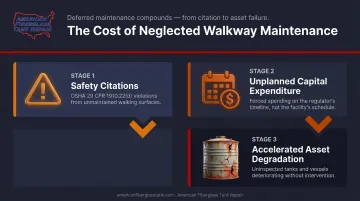
In chemical processing and water treatment, where regulatory inspections of both infrastructure and worker safety practices are routine, neglected walkway systems create compounding risk:
- Safety citations under 29 CFR 1910.22(d) for failing to maintain walking surfaces in good condition
- Unplanned capital expenditure on a regulator's timeline rather than the facility's own maintenance schedule
- Accelerated asset degradation in tanks and vessels that go uninspected due to unsafe access
How to Get the Most Value from FRP Maintenance Walkways
Match the Resin System to Your Chemical Environment
FRP walkways are not a single, uniform product. The resin system — polyester, vinylester, or epoxy — must be selected based on the specific chemicals present at the facility.
- Isophthalic polyester suits general industrial environments with moderate chemical exposure
- Vinylester handles moderate-to-high chemical exposure and applications requiring longer service life (per Bedford's resin guidance)
- Manufacturer guides from Fibergrate and Strongwell rate specific chemical/resin combinations from continuous exposure to "not recommended" — the wrong resin in an aggressive environment can underperform even a correctly sized panel
AFTR applies this same resin-matching approach when repairing and relining FRP storage tanks: material chemistry is matched to actual exposure conditions, not specified generically.
Pair Walkway Access with a Structured Inspection Program
FRP walkways deliver their full operational value when paired with a disciplined inspection program for the equipment they provide access to. A walkway that gets technicians to a tank is only as useful as the inspection conducted once they arrive.
For industrial operators managing FRP tanks and storage vessels, AFTR's engineer-driven inspection services — supervised by Fiberglass Tank & Pipe Institute certified inspectors — evaluate tank integrity using ultrasonic, laser, and high-intensity backlight testing. These methods identify conditions like corrosion coat disbondment, capillary migration, and structural wear that surface-level observation alone would miss.
Maintain the Walkways Themselves
Routine visual inspections of FRP walkways preserve structural warranty and extend service life. Check for:
- Surface wear on anti-slip grating texture
- Grating panel integrity and connector condition
- Any UV degradation on outdoor installations
Document findings to build a maintenance record that supports compliance audits and capital planning.
Conclusion
The advantages of FRP maintenance walkways — corrosion resistance, built-in worker safety features, and low lifecycle cost — compound over the life of a facility. A walkway system that stays structurally sound for decades costs less to maintain, keeps workers safer on routine access tasks, and keeps maintenance programs running on schedule rather than reactively.
Those lifecycle savings hinge on one decision: material selection at installation or retrofit. Replacing a corroded steel walkway system under compliance pressure costs significantly more — in capital, downtime, and operational disruption — than specifying the right material from the outset. The same principle applies across all FRP infrastructure: proactive specification and periodic inspection protect capital investment far better than reactive replacement ever can. For facilities managing FRP tanks alongside walkway systems, that means pairing the right materials with a structured maintenance program from day one.
Frequently Asked Questions
Is fiberglass reinforced plastic suitable for walkways?
Yes. FRP is well-suited for industrial maintenance walkways due to its corrosion resistance, structural load capacity, and manufactured anti-slip surface properties. It's a preferred alternative to steel in chemically aggressive and high-moisture environments where steel grating would require frequent maintenance or replacement.
What is the difference between a GI walkway and an FRP walkway?
GI (galvanized iron) walkways are steel coated with zinc to slow corrosion — a process that degrades over time in aggressive chemical environments. FRP walkways are non-metallic composite structures that are inherently corrosion-resistant. FRP is also significantly lighter, requires no recoating, and outperforms galvanized steel in sustained chemical or high-humidity exposure.
What are the benefits of covered walkways?
Covered FRP walkways add weather protection, reduce surface contamination from rain or debris, and can extend walkway service life by limiting UV exposure and moisture infiltration. They're particularly relevant in outdoor industrial environments subject to extreme weather or direct sun exposure on corrosion-sensitive surfaces.
How long do FRP maintenance walkways last?
Service life varies by resin system and environment. Strongwell documented a pultruded FRP grating installation that retained over 80% of structural integrity after 40 years of offshore exposure. Fibergrate notes that metal alternatives in highly corrosive applications often deteriorate in "a few years or less" — making properly specified FRP significantly longer-lived in comparable conditions.
Do FRP maintenance walkways require special maintenance?
No special maintenance is required. FRP needs no repainting, re-coating, or galvanizing — the recurring activities that drive steel walkway lifecycle costs. Routine visual inspections for surface wear, grating integrity, and connector condition are recommended to maintain safety compliance and extend service life.
Are FRP maintenance walkways OSHA compliant?
FRP grating walkways can be designed and installed to meet OSHA's walking-working surface requirements under 29 CFR 1910.22, with fall protection per 1910.28 and guardrail criteria per 1910.29. Because OSHA's requirements are performance-based, compliance depends on correct specification and installation — verify both with your walkway supplier or an FRP engineering consultant.