Introduction
When a fiberglass reinforced plastic (FRP) oil tank fails unexpectedly, the costs go well beyond replacement: environmental cleanup, regulatory penalties, and unplanned downtime can easily dwarf the original installation expense. Tightening EPA oversight and aging tank infrastructure have pushed material selection from a routine procurement decision to a critical operational one.
Fiberglass oil tanks are widely chosen for their durability, but their real value only becomes clear under actual operating conditions. A tank that's properly specified and consistently maintained can serve decades longer than one that receives no attention after installation.
This article covers the concrete operational advantages of FRP oil tanks over steel, what realistically determines how long they last, and what it takes to protect that service life.
Key Takeaways
- FRP oil tanks resist the corrosion and chemical attack that cause most steel tanks to fail prematurely
- Manufacturers like NOV/Containment Solutions and Xerxes back their FRP tanks with 30-year limited warranties against corrosion and structural failure
- Actual service life depends on stored substance, UV exposure, installation quality, and inspection consistency
- The internal corrosion liner is the most wear-critical component — its condition determines whether a tank reaches full service life
- Non-destructive testing is the most reliable way to catch liner degradation before it becomes a containment failure
What Are Fiberglass Oil Tanks?
Fiberglass oil tanks — formally called FRP (fiberglass-reinforced plastic) tanks — are storage vessels constructed from layers of resin and reinforcing glass fiber, engineered to contain corrosive, flammable, and chemically aggressive liquids including petroleum, biodiesel, and industrial chemicals.
Construction methods and governing standards vary by application. ASTM D3299 covers filament-wound tanks using polyester or vinylester thermoset resin; ASTM D4097 covers contact-molded construction. Underground fuel storage tanks fall under UL 1316, recognized under 40 CFR Part 280 — the federal technical standards for underground storage tank (UST) systems.
These tanks appear across a wide range of industries:
- Oil and gas production and fuel distribution
- Chemical processing (acids, chlorinated compounds, caustics)
- Water and wastewater treatment
- Commercial heating oil storage
- Pulp and paper, food processing, and mining operations
FRP tanks are long-term infrastructure assets, not off-the-shelf commodities. Material selection and ongoing maintenance programs are what separate a tank that lasts 20 years from one that reaches 50.
Key Benefits of Fiberglass Oil Tanks
Corrosion and Chemical Resistance
Steel tanks corrode from the inside out. By the time corrosion becomes visible, structural damage is already underway. FRP tanks don't corrode because they're inherently non-metallic. The internal corrosion liner is specifically engineered to resist the stored substance, whether that's petroleum, sodium hypochlorite, hydrochloric acid, or ethanol-blended fuels.
The EPA's own data frames this risk clearly. A 2022 EPA Leaking Underground Storage Tank Cleanup Cost Study found approximately 62,000 UST releases in active cleanup nationally, with average closed-site remediation costs reaching $300,241 in Kansas and $135,636 in South Carolina. Average remedial action duration runs 1,842 days — five years of active remediation for a single release event.
Separately, a 2016 EPA study of diesel UST systems found 35 of 42 inspected systems (83%) had moderate or severe metal corrosion.
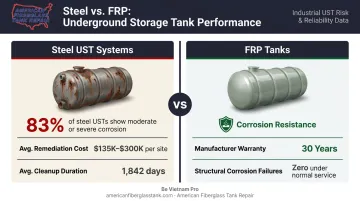
FRP's corrosion resistance is most critical in:
- Underground installations where groundwater accelerates steel corrosion
- Coastal or high-humidity environments
- High-concentration chemical applications (acids, chlorinated compounds)
- Tanks storing ethanol-blended fuels — the Fiberglass Tank & Pipe Institute notes fiberglass UST systems have been compatible with up to 100% ethanol for over 40 years
Lightweight Construction and Installation Efficiency
FRP tanks are significantly lighter than steel equivalents — a difference that ripples through the entire project. Underground installations don't require the same heavy equipment steel demands, and above-ground work in constrained locations becomes far more practical.
For operators replacing tanks during planned shutdowns, that weight advantage matters operationally:
- Reduces crane requirements and heavy lift costs
- Speeds mobilization and site setup
- Lowers total installation cost even when the tank carries a higher purchase price than steel
- Makes multi-facility rollouts easier to schedule and execute
Long-Term Cost Efficiency
The upfront cost of FRP is higher than steel. Over a 30-plus year horizon, the total cost of ownership often tells a different story.
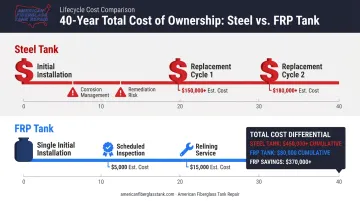
Consider the comparison across a 40-year horizon:
- Steel tank: Replacement every 15–20 years means two to three full replacement cycles, plus ongoing corrosion management and the statistical risk of remediation costs
- FRP tank: One vessel with periodic inspection and lining maintenance — no replacement cycles, no corrosion-related structural failures under normal operating conditions
Major manufacturers back this with substance: both NOV/Containment Solutions and Xerxes offer 30-year limited warranties against corrosion and structural failure on their petroleum storage tanks. A 30-year warranty means a manufacturer is committing to zero structural corrosion failures across three decades of normal service — a commitment no steel tank manufacturer matches.
The long-term savings are most significant for:
- Large-capacity tanks where replacement logistics are expensive
- Multi-tank installations
- Remote or difficult-access sites
- Facilities under tight capital expenditure budgets where predictable maintenance spend is preferable to unpredictable replacement cycles
How Long Do Fiberglass Oil Tanks Last?
The 30-year limited warranties from leading manufacturers establish a documented performance baseline. Well-maintained tanks operating beyond that threshold do occur — but no authoritative source supports treating any specific service life as guaranteed. What a tank actually delivers depends on what happens after installation.
Factors That Shorten Service Life
UV exposure: Uncoated above-ground FRP tanks exposed to direct sunlight experience surface degradation over time. Protective coatings or underground installation reduce this substantially.
Stored substance chemistry: Aggressive chemicals, high-sulfur fuels, or substances outside the tank's design specification accelerate internal lining wear. The EPA has noted that emerging fuels may not be compatible with all UST systems and can increase corrosion in metal components — operators changing stored products should verify compatibility with the tank's original design specification before making the switch.
Temperature extremes: Both the stored liquid's temperature and ambient environmental conditions affect resin integrity. Tanks consistently exposed to temperatures outside design limits show accelerated degradation.
Installation quality: Improper bedding for underground tanks, inadequate anchoring for above-ground tanks, and poor nozzle installation create stress points that initiate structural compromise over time. NOV's installation manual explicitly notes that improper installation can lead to tank failure and product release.
The Corrosion Liner: The Most Wear-Critical Component
The internal corrosion liner is the first and primary defense against chemical attack. Its degradation is often invisible on the surface, yet it's the leading reason tanks fail before their time.
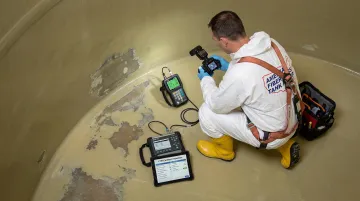
AFTR's field inspection teams, supervised by Fiberglass Tank & Pipe Institute certified inspectors, regularly identify conditions that a routine walkthrough simply won't catch:
- Spidering and disbondment
- Abrasion wear and emulsification
- Low Barcol hardness readings
- Floor stress cracking
- Capillary migration of stored product beneath the corrosion coat
A tank can pass a hydrostatic test today and fail three months later. The liner's subsurface condition is what actually determines remaining service life.
Regulatory and Insurance Considerations
Even a structurally sound tank may face mandated replacement — because physical durability and permitted service life aren't always the same number. Federal regulations under 40 CFR Part 280 focus on corrosion protection, release detection, and secondary containment, not a fixed age-based retirement schedule. State and insurer requirements add another layer:
- Federal baseline: 40 CFR Part 280 sets performance standards, not age limits
- State variation: California, for example, has prohibited new single-walled USTs and set hard deadlines for existing ones
- Insurer requirements: Coverage terms may impose stricter conditions than regulations require
Operators should confirm both regulatory and insurer requirements for their specific jurisdiction before assuming a performing tank can stay in service indefinitely.
What Happens When Fiberglass Tank Maintenance Is Neglected
The most dangerous characteristic of FRP tank degradation is that it's internal and often invisible. Unlike steel, which shows visible rust and surface corrosion as warning signs, fiberglass liner failure can progress silently until a containment breach occurs.
By the time a leak or structural failure surfaces, the cost picture has changed dramatically. The EPA's documented remediation costs — averaging hundreds of thousands of dollars per site, with cleanup timelines measured in years — represent the financial endpoint of deferred maintenance.
The consequences of a release event include:
- Regulatory penalties under 40 CFR Part 280 — owners and operators who fail to comply face civil penalties of up to $16,000 per tank per day of violation under RCRA Section 9006
- Loss of operating permits and required reporting to regulatory agencies within 24 hours of a suspected release
- Soil and groundwater contamination requiring professional remediation
- Insurance claim denials when maintenance records cannot demonstrate due diligence
These consequences share a common root. Across chemical, water treatment, and industrial work, AFTR's field teams consistently observe that "even moderate concentrations of corrosive substances can compromise the interior corrosion barriers of fiberglass tanks, leading to containment failure" when maintenance is deferred.
What makes this preventable: the structural body of a vessel often remains intact even after the liner is compromised. Early detection through professional inspection can turn a potential tank replacement into a scheduled relining job — a fraction of the cost and downtime of emergency response or site remediation.
How to Maximize the Lifespan of Your Fiberglass Oil Tank
Three practices consistently separate tanks that reach full service life from those that don't.
1. Scheduled Professional Inspection
Visual inspection is not sufficient for FRP tanks. Surface conditions don't reflect what's happening inside the laminate. Effective inspection requires non-destructive testing methods — ultrasonic thickness testing, high-intensity backlight testing, laser testing, and Barcol hardness measurement — to assess the structural body of the tank, not just its surfaces.
FTPI RP 2007-1 recommends certified inspections every 5 years for hazardous substance service and every 10 years for tanks over 10,000 gallons in non-hazardous service. Tanks approaching 15–20 years of service, or those storing aggressive chemicals, warrant more frequent assessment.
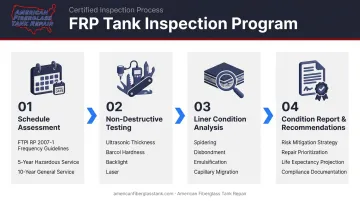
AFTR's inspection program, supervised by FTPI-certified inspectors, identifies spidering, disbondment, emulsification, capillary migration, floor stress cracking, shell distortion, and UV degradation. The program delivers a detailed condition report with prioritized recommendations, giving operators a documented baseline for maintenance decisions and regulatory compliance.
2. Timely Repair of Identified Defects
An inspection report only protects an asset when its findings are acted on. When lining degradation is identified, repair using compatible resin and laminate systems — matched to the stored product and operating temperature — restores containment integrity and extends service life.
AFTR works with custom-blended isophthalic and terephthalic polyester, vinylester, and epoxy resins, paired with over 45 fiberglass mat, chopped strand, Nexus, Harlar, and carbon veil laminates. Material selection is product-specific and temperature-specific — not generic. For tanks that have been adapted to store a different substance than originally designed for, AFTR can specify new corrosion layer systems compatible with the new chemistry.
3. Environmental Controls and Product Compatibility Verification
Practical steps that extend service life without requiring intervention:
- Apply UV-protective coatings to above-ground tanks exposed to direct sunlight
- Confirm chemical compatibility before changing stored products — don't assume the existing liner handles the new substance
- Maintain ambient and product temperature within design limits
- Keep complete maintenance and inspection records for insurance compliance and regulatory documentation
Frequently Asked Questions
Which is better: steel or fiberglass oil tanks?
Steel costs less upfront but corrodes from the inside out and typically needs replacement within 15–20 years. Fiberglass costs more initially, resists corrosion, and carries manufacturer warranties of up to 30 years — making it the lower total-cost option for most industrial and long-term storage applications.
Can fiberglass be used for oil tanks?
Yes. FRP is a well-established material for petroleum and fuel storage, specifically engineered to resist petroleum products, fuels, and chemical additives. UL 1316 is the recognized standard for fiberglass-reinforced underground fuel storage tanks, explicitly listed under 40 CFR Part 280.
What is the lifespan of a fiberglass oil tank?
Leading manufacturers back FRP petroleum tanks with 30-year limited warranties against corrosion and structural failure. Actual service life varies based on stored substance, installation quality, UV exposure, and inspection consistency — with professionally maintained tanks frequently exceeding that benchmark.
Are fiberglass oil tanks double-walled?
FRP tanks are available in both single-wall and double-wall (secondary containment) configurations. Double-wall designs provide an outer containment layer that captures leaks before environmental contact. Federal regulations under 40 CFR Part 280 require secondary containment for new or replaced UST systems installed after April 11, 2016.
What factors can shorten the lifespan of a fiberglass oil tank?
The main risk factors include:
- Prolonged UV exposure without protective coating
- Storing substances outside the tank's chemical compatibility range
- Temperature extremes and poor installation practices
- Deferred inspections that allow internal liner degradation to go undetected
How often should a fiberglass oil tank be inspected?
FTPI RP 2007-1 recommends certified inspections every 5 years for hazardous substance service; tanks over 10,000 gallons in general service warrant inspection every 10 years at minimum. Aging tanks and those storing aggressive chemicals should be assessed more frequently using non-destructive testing methods, not visual inspection alone.
Conclusion
Fiberglass oil tanks earn their value through corrosion resistance, warranty-backed durability, and lifecycle cost efficiency. But those advantages only materialize when the tank receives consistent inspection and timely maintenance — they don't accrue automatically.
Tanks that reach 30-plus years of service almost always share one thing: a documented maintenance program. Those that fail at 20 typically don't. Skipping routine assessments doesn't preserve the investment — it quietly erodes it.
Operators who don't have a current, documented condition assessment for their fiberglass oil tanks — especially those approaching 15–20 years of service — should prioritize a professional inspection before a manageable defect becomes an unmanageable failure. Inspection and lining repair costs are a fraction of what remediation, regulatory penalties, and operational disruption add up to after a containment breach.
American Fiberglass Tank Repair has provided engineer-driven FRP tank inspections and repair services since 2003, working with industrial operators across all 50 states. If your tank is due for an assessment, contact AFTR at 877-427-0090 to schedule a condition evaluation.