So how long do fiberglass tanks actually last? The honest answer: it depends. The material itself is durable, but service life is shaped by chemistry, temperature, maintenance history, and decisions made at the time of fabrication. A tank storing potable water under stable conditions ages very differently from one holding concentrated acids in a chemical plant.
This guide covers the industry-accepted lifespan range, the factors that shorten or extend it, how FRP compares to other materials, the warning signs that demand attention, and what proactive maintenance actually looks like in practice.
Key Takeaways
- Most FRP tanks are engineered for 20–40 years of service life, with well-maintained tanks sometimes exceeding that range
- The internal corrosion liner degrades before the structural wall — making it the first component to monitor
- Chemical compatibility, operating temperature, resin type, and venting all affect lifespan
- Timely relining and regular professional inspection can extend service life well beyond original design expectations
How Long Do FRP Tanks Actually Last?
Most FRP tanks are engineered to deliver 20–40 years of service. Hudson Fiberglass cites an average life expectancy of 20–30 years, while manufacturers serving well-maintained installations report service lives exceeding 50 years with proper care.
That range isn't vague — it reflects real variation in how tanks are used. Tanks in aggressive chemical service or at elevated temperatures frequently fall toward the lower end. Tanks in milder applications with consistent maintenance can push well past the upper bound.
Why FRP Outlasts Many Alternatives
FRP's durability advantage over polyethylene and unprotected steel comes from how the material is built. Corrosion resistance is engineered into the laminate itself, not applied as a surface coating. FRP neither corrodes electrochemically nor leaches metals into stored product.
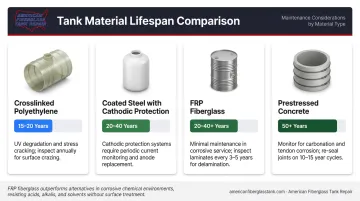
By comparison, crosslinked polyethylene tanks typically have a useful life of 15–20 years, according to polyethylene manufacturer Poly Processing. Steel tanks can match or exceed FRP when corrosion risk is low and cathodic protection is maintained, but in corrosive chemical environments, FRP holds a structural advantage.
Structural Life vs. Functional Life — A Critical Distinction
This is the most important concept for any FRP tank owner to understand: a tank's shell can remain structurally intact long after its internal corrosion liner has degraded.
A typical FRP tank wall is built in layers:
- Inner surface (~10–20 mils): resin-rich, forms the primary chemical contact surface
- Corrosion barrier (~100 mils): contains 20–30% chopped glass, protects the structural wall
- Structural laminate: 60–70% continuous filament winding, carries mechanical load
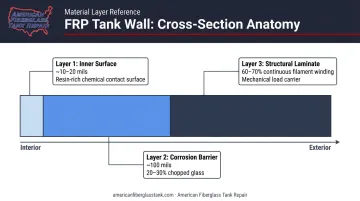
The liner — not the structural wall — wears out first. Once the liner fails, stored chemicals begin attacking the structural laminate directly. What was a manageable liner repair becomes a much more serious problem. Per TAPPI TIP 0402-28, corrosion barrier condition is the primary factor defining projected service life for in-service FRP equipment.
Application Type Matters
Lifespan expectations should be calibrated to the service environment. A tank storing potable water at ambient temperature is fundamentally different from one handling 37% hydrochloric acid at elevated temperature. Resin selection during fabrication is tailored to the specific use case:
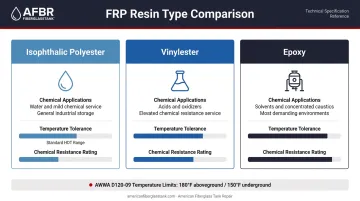
- Isophthalic polyester: standard choice for water and mild chemical service
- Vinylester or epoxy: required for aggressive chemical duty such as acids and oxidizers
Getting that resin match right at fabrication sets the ceiling for service life — but even well-specified tanks eventually need liner inspection and repair to stay there.
Key Factors That Affect FRP Tank Lifespan
Chemical Compatibility and Resin Selection
FRP tanks are built with a resin-rich inner barrier specifically formulated to resist the stored substance. When a tank stores chemicals outside its design parameters, or when the original resin was selected without proper engineering review, that barrier degrades faster than expected.
Resin type is not interchangeable:
- Isophthalic polyester: suitable for water and mild chemical service
- Vinylester: handles more aggressive chemicals, including many acids and oxidizers
- Epoxy: specified for the most demanding environments, including certain solvents and concentrated caustics
AFTR's field teams work with custom-blended isophthalic, terephthalic polyester, vinylester, and epoxy resins — each matched to the specific chemical, concentration, and operating temperature of the tank being serviced. Using the wrong resin for a given chemistry is one of the most common causes of premature liner failure.
Operating Temperature
Heat accelerates chemical attack on the inner liner. As temperature rises, stored chemicals permeate the resin barrier faster, causing blistering, delamination, and microcracking that compound over time.
Every resin system has a heat deflection temperature (HDT), the point at which the material begins to soften under load. Operating above that threshold dramatically shortens liner life. AWWA D120-09 limits aboveground FRP tank service to 180°F (82°C) and underground service to 150°F (66°C), with manufacturer consultation required for specific applications.
Improper Venting
One of the most commonly overlooked failure causes. FRP storage tanks must be vented so that internal pressure or vacuum does not exceed 1 psig, a limit specified in NOV Containment Solutions' installation guidance for fiberglass storage tanks. Exceed that threshold regularly and the laminate experiences cumulative fatigue stress it wasn't designed to sustain.
Both directions present risk:
- Overpressure: caused by liquid inflow, vapor inflow from failed regulators, or thermal expansion
- Vacuum: caused by liquid outflow or temperature drop pulling the tank walls inward
Blocked or undersized vents are a straightforward maintenance issue. Left unaddressed, they become a structural one.
UV Exposure and Environmental Conditions
Aboveground FRP tanks exposed to direct sunlight without UV-protective coatings will see the outer resin layer degrade at the molecular level: polymer carbon chains break down, leading to surface chalking, fiber blooming, and eventually microcracking. KTA-Tator's surface preparation guidance for FRP identifies UV degradation as a primary cause of exterior surface deterioration.
AFTR applies aliphatic UV-protective compounds to exterior surfaces as part of nozzle repair and restoration work, because exterior protection directly affects long-term structural integrity.
Installation and Handling Damage
FRP is more brittle than steel under impact. Cracks and delaminations from rough handling or improper installation may not be immediately visible, but they create stress concentration points that fail under service conditions. Proper bedding material, backfill, and anchoring during installation are essential — not optional.
FRP vs. Other Tank Materials: Lifespan at a Glance
| Material | Typical Service Life | Key Maintenance Consideration |
|---|---|---|
| FRP (fiberglass) | 20–40+ years | Internal liner inspection and relining |
| Crosslinked polyethylene | 15–20 years | UV resistance, structural capacity limits |
| Steel (coated/cathodic protection) | 20–40 years (with cathodic protection) | Corrosion protection inspection every 3 years |
| Prestressed concrete | 50+ years (per AWWA D110/ACI 372) | Chemical attack resistance varies by stored product |
FRP's advantage is strongest in corrosive chemical environments and humid conditions where steel corrodes rapidly without protection and polyethylene lacks structural capacity for larger vessel sizes. Steel remains competitive in applications where corrosion risk is low and structural demands are high — the right choice depends entirely on the stored product and operating environment.
That said, FRP's lifespan advantage only holds when the resin system was correctly specified for the service chemistry. A mismatched resin can cause liner failure within a few years — erasing any edge the material would otherwise provide.
Warning Signs Your FRP Tank Needs Professional Attention
Physical Indicators
Some warning signs are visible on the surface. Others aren't — and those are often more serious.
Visible signs requiring inspection:
- Blistering on interior surfaces
- Weeping or seepage at seams, nozzles, or fittings
- Fiber blooming on exterior surfaces (glass fibers visible through degraded resin)
- Discoloration, crazing, or surface pitting on the inner liner
- Loss of structural rigidity or visible deformation
What you can't see without testing:
- Subsurface delamination
- Capillary migration of product beneath the corrosion coat
- Wall thickness reduction from chemical permeation
AFTR's inspection program uses ultrasonic, laser, and high-intensity backlight testing methods because visual inspection alone misses the subsurface conditions that often precede catastrophic failure.
AFTR's inspections are supervised by Fiberglass Tank & Pipe Institute (FTPI) certified inspectors and include Barcol hardness testing of the interior liner. This provides an objective measure of resin cure and chemical degradation that surface inspection cannot replicate.
Operational Warning Signs
Physical degradation often announces itself operationally before it's visible:
- Unexpected product contamination or quality changes
- Unexplained product level changes (possible through-wall seepage)
- Unusual odors from a sealed tank
- Declining pressure integrity on pressurized systems
A fiberglass tank may pass a hydrostatic test today and fail three months from now. Containment breaches can occur before any operational warning sign appears. Instrument-based inspection — not just pressure testing — is what catches these failures before they happen.
How to Extend the Lifespan of Your FRP Tank
Establish a Regular Inspection Schedule
FT&V RP 2007-1 (the recommended practice for in-service inspection of aboveground atmospheric FRP tanks) requires trained external inspections every 5 years for hazardous-substance service. For larger tanks in other services, external inspection is required every 10 years — or when material stress evidence or leaks appear.
Those are minimums. Tanks storing aggressive chemicals or operating at elevated temperatures warrant more frequent inspection. AFTR offers both periodic scheduled inspections and one-time assessments, with programs designed to match inspection frequency to service severity.
Reline Before Degradation Reaches the Structural Laminate
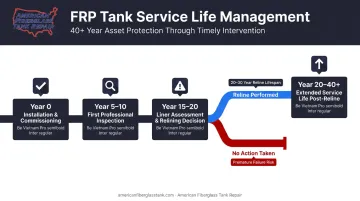
This is the single most cost-effective intervention available to FRP tank owners. When the inner liner is compromised but the structural wall remains intact, relining can extend service life significantly — a properly installed fiberglass reline can last 20–30 years and extend overall service life by 20+ years, according to PlasTech Services.
In most cases, even when a tank has breached its corrosion barrier, the structural body remains an ideal substrate for a new corrosion layer. Relining costs a fraction of a replacement vessel and avoids the long lead times that come with ordering new tanks.
The window for that option closes once product penetration reaches the structural laminate. Early detection through inspection is what keeps relining on the table.
Maintain and Verify Proper Venting
Vent lines should be:
- Correctly sized for the application from day one
- Kept clear of blockages (inspect as part of routine maintenance)
- Reviewed when process conditions change — flow rates, temperatures, and stored chemicals all affect vent sizing requirements
Protect the Exterior
- Apply UV-resistant coatings or gel coats on aboveground tanks
- Inspect for fiber blooming and impact damage during routine walkarounds
- Verify that tank foundations and support structures haven't settled in ways that create bending stress
Keep Documented Records
A tank without a maintenance history is a liability. Documented inspection records let engineers identify degradation trends, support regulatory compliance, and make informed repair-versus-replace decisions.
AFTR's inspection program produces detailed reports covering surface and structural conditions, with recommendations for next steps. That paper trail transforms reactive maintenance into a managed, defensible program.
Frequently Asked Questions
How long do fiberglass tanks last?
Most FRP tanks are designed for 20–40 years of service, with well-maintained tanks sometimes exceeding that range. Actual lifespan depends on service environment, chemical compatibility, maintenance history, and whether the internal corrosion liner is properly maintained or relined when needed.
Which water tanks last the longest?
Among common materials, FRP/GRP tanks and properly maintained prestressed concrete tanks generally offer the longest service lives for water storage. FRP tanks resist corrosion without coatings, don't leach metals, and can be relined to extend service life beyond their original design life.
Can a fiberglass tank be repaired to extend its life?
Yes. Internal relining, laminate repairs, and nozzle or fitting replacements can add many years of service life when performed before damage reaches the structural laminate. A professional assessment determines whether repair is cost-effective or the tank has degraded beyond that point.
What are the warning signs that an FRP tank is failing?
Visible signs include blistering, weeping at seams or fittings, fiber blooming on the exterior, and loss of structural rigidity. Product contamination or unexplained level changes can also indicate liner failure. Subsurface delamination and wall thinning often precede visible symptoms and require ultrasonic or backlight testing to detect.
How often should FRP tanks be inspected?
Professional inspections every 1–5 years depending on service severity, with more frequent intervals for tanks storing aggressive chemicals or operating at elevated temperatures. Visual inspection alone is insufficient — ultrasonic thickness measurement and backlight testing should be included in any professional program.
Does the type of resin affect how long an FRP tank lasts?
Yes, significantly. Vinylester and epoxy resins offer superior chemical resistance compared to standard polyester resins and are specified for more aggressive service environments. Using the wrong resin for the stored chemical is one of the most common causes of premature FRP tank failure.