Skip that structure, and the consequences compound quickly. Corrosion barrier degradation, osmotic blistering, nozzle failures, and stress cracking don't announce themselves — they develop quietly until a hydrostatic test fails, a fitting weeps, or a containment breach forces emergency response. At that point, you're not managing maintenance; you're managing a crisis.
This guide covers what preventive maintenance actually involves for FRP tanks, the warning signs that demand attention, and a practical inspection schedule you can apply immediately.
Key Takeaways
- Poor maintenance history is the leading cause of FRP tanks failing well before their design life
- The internal corrosion barrier is the most critical component — protect it before chemical permeation reaches the structural laminate
- Operator-level checks should run monthly; professional internal inspections every 1–2 years
- Blistering, fiber bloom, discoloration, and weeping at fittings are early failure warnings, not cosmetic issues
- Preventive maintenance costs a fraction of emergency repairs, unplanned downtime, or full tank replacement
Why FRP Tank Preventive Maintenance Matters
FRP tanks represent significant capital investment. A proactive maintenance program is the primary mechanism for protecting that investment — not just extending service life, but ensuring the tank performs as specified throughout its operational lifespan.
How the Corrosion Barrier Fails — and Why It's Hard to See
The internal corrosion barrier lining is where FRP tank performance lives or dies. AFTR's field teams have observed this consistently since 2003: even moderate concentrations of corrosive products gradually attack the interior corrosion barrier. The problem is that initial degradation is often invisible at the surface.
Chemical permeation can migrate under the corrosion coat through capillary action, a condition that visual inspection alone won't catch. That's why AFTR's inspection teams use ultrasonic, laser, and high-intensity backlight testing to assess what's happening inside the structural body, not just what the surface shows.
Common degradation mechanisms found during field assessments include:
- Spidering and disbondment — early-stage lining separation from the substrate
- Emulsification — resin breakdown from chemical attack
- Abrasion wear — mechanical erosion of the corrosion coat
- Floor stress cracking — laminate stress from settlement or loading
- Capillary migration — liquid product tracking beneath the corrosion coat before surface symptoms appear
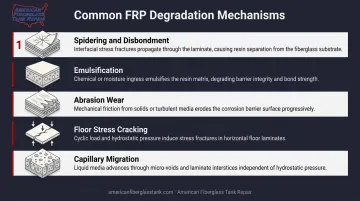
Once chemical permeation reaches the structural laminate, repair becomes more complex and costly. Catching degradation at the corrosion barrier stage keeps repair costs manageable — and keeps the structural laminate out of the equation entirely.
Safety, Compliance, and the Cost of Doing Nothing
Tanks storing chemicals, potable water, or wastewater carry real regulatory exposure when they fail. Key standards governing inspection and integrity for FRP storage include:
- EPA SPCC (40 CFR Part 112) — inspection and testing programs for oil-containing storage
- OSHA PSM (1910.119) — mechanical integrity requirements for covered chemical facilities
- AWWA D120 — thermosetting FRP tanks in water utility service
- ASTM D3299, D4097, and ASME RTP-1 — construction and material requirements
The U.S. Chemical Safety Board's investigation of the Freedom Industries release found no record of inspections on the chemical storage tanks involved — a direct line between deferred inspection and public-impact failure.
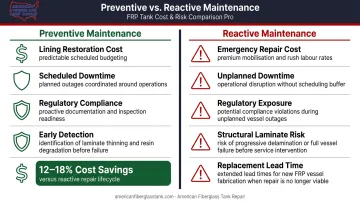
Regulatory risk is one exposure. Financial risk is the other. The U.S. Department of Energy's O&M Best Practices Guide documents preventive maintenance delivering 12–18% cost savings versus reactive maintenance across industrial facilities. For FRP tanks, a lining restoration is a fraction of full tank replacement — and it avoids the lead time, engineering review, secondary containment reconfiguration, and production loss that replacement entails.
Types of FRP Tank Maintenance
Effective maintenance programs combine preventive and corrective strategies — each serves a different purpose, and neither performs well without the other.
Preventive (Routine) Maintenance
Preventive maintenance is the foundation — scheduled tasks designed to catch degradation before it becomes damage. For FRP tanks, this includes:
- Exterior visual inspections for surface changes, fitting integrity, and foundation condition
- UV coating checks and reapplication on exterior surfaces
- Hardware torque verification and anchor/support inspection
- Vent and overflow pipe confirmation
- Operational log review for anomalies
Routine maintenance is sufficient for newer tanks in stable, low-corrosion service. Tanks storing aggressive chemicals — sodium hypochlorite, ferric chloride, HCl, sodium hydroxide — or operating in high-temperature or high-UV-exposure conditions need those routine checks supplemented by professional inspection on a defined schedule.
Corrective (Reactive) Maintenance
Even with solid preventive practices in place, problems surface. Corrective maintenance is triggered by discovered conditions: cracked laminate, blistering, leaking fittings, lining degradation, or hardware failure. Relying on reactive repairs alone leads to higher costs, longer downtime, and a narrower window to make effective repairs.
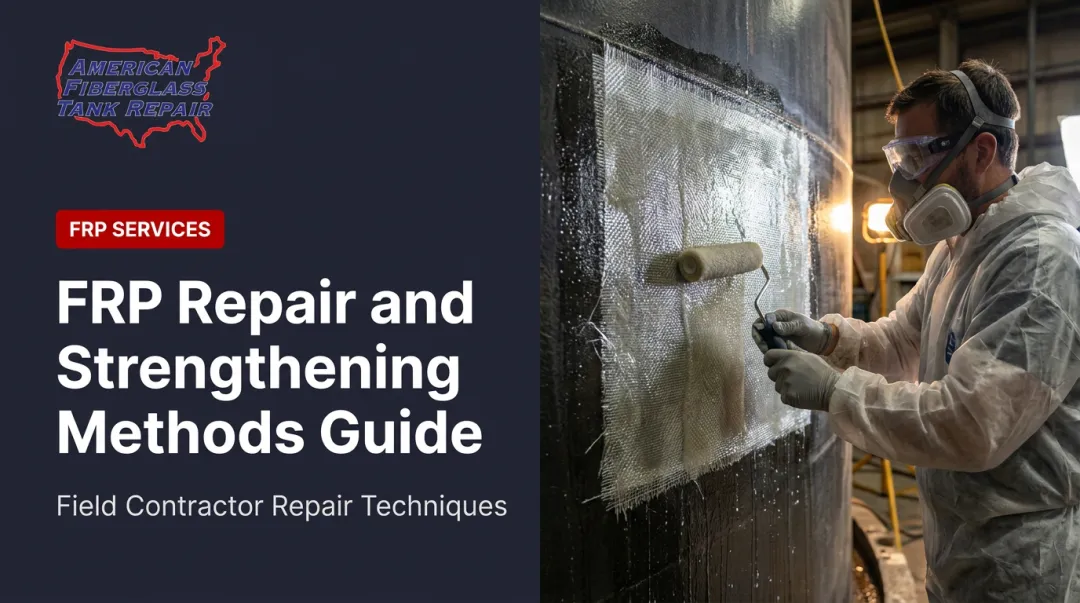
FRP repairs require certified technicians using resin systems matched to the stored chemical, concentration, and operating temperature. This isn't a DIY scenario. AFTR selects from over 45 laminate systems — custom-blended isophthalic and terephthalic polyester, vinylester, and epoxy resins — based on chemical compatibility and service requirements. The wrong resin system in a repair creates a new failure point.
Warning Signs Your FRP Tank Needs Attention
FRP tanks rarely fail without warning. The challenge is recognizing early indicators before they escalate.
Surface and Lining Deterioration
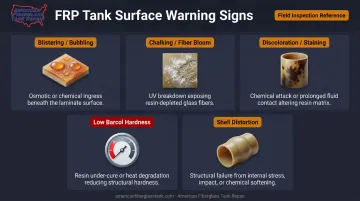
Watch for these specific conditions during routine walkarounds:
- Blistering or bubbling on interior surfaces — indicates osmotic pressure or active chemical attack beneath the lining
- Chalking or fiber bloom on the exterior — UV resin degradation exposing glass fibers; accelerates with continued UV exposure
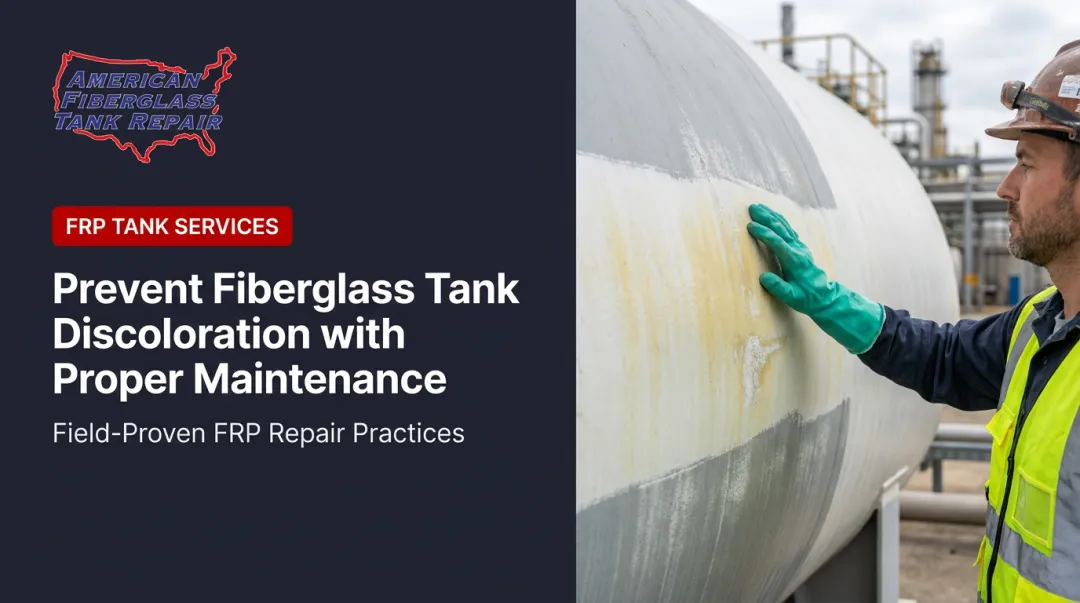
- Discoloration or staining on interior walls — chemical permeation into the laminate, especially around the floor and lower shell
- Low Barcol hardness readings — indicates resin under-cure or chemical-driven resin degradation
- Shell distortion — visible deformation suggesting structural stress or laminate compromise
On cracks: surface gel coat crazing differs from laminate cracking. Any crack that extends through the laminate, shows delamination, or is accompanied by weeping requires qualified FRP inspection immediately. If you can't confirm it's only gel coat depth, treat it as structural until a qualified inspector rules otherwise.
Structural and Hardware Indicators
Once surface conditions are documented, shift focus to hardware. Fittings, nozzles, and seams are stress concentration points — look for:
- Weeping or mineral deposits around connections — can indicate gasket failure or early laminate cracking at the nozzle interface
- Moisture staining patterns — track staining to its source; surface staining that originates at a fitting suggests more than a surface problem
- Foundation irregularities — uneven settling, anchor movement, or shifted supports
One consistently underappreciated issue: piping loads transferred directly into FRP nozzles. FRP nozzles are not designed to carry pipe weight, thermal expansion forces, or vibration loads. Connected piping should be independently supported so those forces don't transfer into the tank shell.
Nozzle-area cracking, gasket extrusion, or laminate separation around fittings often traces back to unsupported piping.
Operational Red Flags
Beyond physical indicators, operational behavior can signal deterioration that isn't yet visible. These changes suggest maintenance is overdue:
- Unexplained changes in stored fluid quality — discoloration or contamination
- Pressure fluctuations or venting anomalies
- Unusual odors at the tank exterior
- Recurring leaks at previously repaired areas (indicates underlying cause wasn't fully addressed)
FRP Tank Preventive Maintenance Schedule
Maintenance frequency isn't one-size-fits-all. A tank storing 35% HCl outdoors in temperature-cycling conditions needs more frequent attention than a water storage tank in a controlled indoor environment. Research on FRP tanks in aggressive acid service shows that chemical service conditions directly determine how quickly degradation progresses — chemistry and inspection history make blanket service-life claims unreliable at best.
The schedule below is anchored to FTPI/FT&V RP 2007-1, the primary recommended practice for in-service inspection of aboveground atmospheric FRP tanks, and reflects what a structured program looks like across each maintenance tier.
| Frequency | Tasks | Who Performs It |
|---|---|---|
| Monthly / Ongoing | Visual exterior walkdown: surface condition, fitting integrity, foundation, vents, overflow pipes; review operational logs for anomalies | Facility maintenance staff |
| Semi-Annual (every 6 months) | Detailed external inspection: UV coating condition, all hardware torque check, anchor and support inspection, exterior cleaning, comparison to prior findings | Trained maintenance technician or qualified contractor |
| Annual | Full professional inspection: ultrasonic thickness testing, tap testing for delamination, Barcol hardness checks, laser and high-intensity backlight testing, documented condition report | Certified FRP inspection specialist |
| Every 1–2 Years (Internal) | Full internal inspection after draining and cleaning: corrosion barrier condition, blistering, pitting, fiber exposure, floor stress cracking, structural laminate integrity assessment | Certified FRP inspector — increase frequency for aggressive chemical service or tanks over 10 years old |
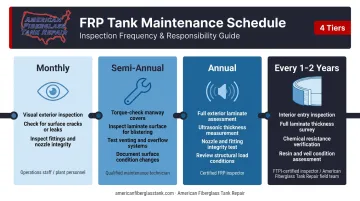
The annual and internal inspection tiers are where hidden degradation gets caught before it becomes structural damage. AFTR's FTPI-certified inspectors use ultrasonic, laser, and high-intensity backlight testing specifically to detect capillary migration beneath the corrosion coat — the kind of sub-surface failure that visual walkthroughs miss entirely.
Adjusting the Schedule
A few situations warrant moving to more frequent inspection tiers:
- Aggressive chemical service (sodium hypochlorite, ferric chloride, HCl, sodium hydroxide) — escalate to annual professional inspections and more frequent internal assessments
- Tanks 15+ years in service — default to annual professional inspections regardless of visible condition
- Any corrective repair event — schedule re-inspection within 90 days to confirm repair integrity and check for adjacent degradation
- SPCC-covered tanks or PSM facilities — confirm inspection frequency aligns with regulatory program requirements
FTPI RP 2007-1 specifies trained inspections every 5 years for hazardous-substance or SPCC-covered service, and every 10 years for certain tanks over 10,000 gallons in other service. Treat these as minimum thresholds for formal trained inspection, not substitutes for the annual professional assessment described above.
Conclusion
Preventive maintenance is the mechanism through which an FRP tank's design life actually gets realized. Without it, degradation that starts at the corrosion barrier advances into the structural laminate — undetected until the repair options narrow and costs escalate.
A structured program combining monthly operator-level checks with certified professional inspections protects capital investment, satisfies regulatory obligations, and keeps reactive failure costs off the table. For facilities ready to formalize that program, AFTR's Fiberglass Tank & Pipe Institute certified inspectors provide the documented baseline and ongoing assessments that turn a maintenance schedule into a long-term asset strategy.
Frequently Asked Questions
How long do FRP tanks last?
FRP tank service life depends on chemical service, resin system, temperature, UV exposure, and maintenance history. With consistent preventive maintenance, many tanks remain in reliable service for decades — neglected tanks in aggressive chemical service often fail well short of that.
How often should FRP tanks be inspected and cleaned?
Operator-level visual checks should occur monthly; semi-annual external inspections every six months; full professional inspections annually; and internal inspections every one to two years. Frequency increases for tanks in aggressive chemical service, high-usage environments, or tanks approaching 15+ years in operation.
What are signs that an FRP tank needs cleaning or maintenance?
Key indicators include blistering or bubbling on interior surfaces, chalking or fiber bloom on the exterior, discoloration of stored fluid, weeping or mineral deposits around fittings, hairline cracks in the laminate, and low Barcol hardness readings. Any of these warrants prompt professional assessment.
What is the API standard for tank maintenance?
API 653 covers carbon and low-alloy steel aboveground storage tanks — it does not apply to FRP tanks. FRP tanks are governed by standards including ASTM D3299 (filament-wound construction), ASTM D4097 (contact-molded construction), ASME RTP-1 (reinforced thermoset plastic equipment), AWWA D120 (water utility FRP tanks), and FTPI RP 2007-1 for in-service inspection.
Can FRP tanks be repaired instead of replaced?
Yes. When the structural laminate remains intact, lining degradation, laminate cracks, and nozzle failures can be professionally repaired using compatible resin and laminate systems — typically far below replacement cost and without the lead time a new vessel requires. The key is catching damage before it reaches the structural body.
What happens if FRP tank maintenance is neglected?
Neglected tanks experience accelerating corrosion barrier breakdown, osmotic blistering, stress cracking, and eventually through-wall failures. Emergency repairs, unplanned downtime, environmental spills, and regulatory exposure consistently cost more than a structured preventive maintenance program.