Introduction
FRP clarifiers are long-term capital assets — and they behave nothing like steel or concrete. Their composite laminate structure gives them outstanding corrosion resistance, but that same structure demands maintenance protocols specifically tailored to how FRP degrades.
Many operators default to inspection and repair practices borrowed from steel or concrete experience. That mismatch is expensive. FRP clarifiers fail from the inside out, through gradual liner hydrolysis, delamination, and osmotic blistering — damage that's invisible on a walkthrough until it's already structural.
The risks of neglect are predictable:
- Internal lining failure accelerating into structural damage
- Unplanned downtime and effluent quality violations
- Emergency repair bills that dwarf what scheduled rehabilitation would have cost
Under 40 CFR 122.41(e), NPDES permittees must properly operate and maintain all treatment systems and appurtenances — meaning liner condition isn't optional.
This guide covers FRP-specific failure modes, the three types of maintenance that protect clarifier longevity, warning signs operators should act on immediately, and a practical inspection schedule tied to service severity.
Key Takeaways
- FRP clarifiers degrade primarily through internal liner hydrolysis, delamination, and osmotic blistering — not corrosion the way steel fails
- Relining a degraded FRP clarifier typically costs a fraction of full vessel replacement cost
- Key warning signs: surface blistering, fiber exposure, declining effluent clarity, and weeping on the exterior shell
- Non-destructive testing (ultrasonic, backlight, acoustic tap) catches subsurface damage before it becomes a structural failure
- Monthly visual checks plus annual NDT inspections are the foundation of any sound FRP clarifier maintenance program
Why FRP Clarifier Maintenance Matters
FRP is corrosion-resistant — not maintenance-free. The distinction matters because operators who conflate the two tend to defer inspections until visible damage appears. By that point, what started as a surface liner issue has often progressed into the structural laminate.
The Liner Is Always Under Attack
The innermost resin-rich layer — typically 100 mils or less — is the only thing standing between your process fluid and the structural wall. In clarifier service, that layer faces continuous chemical exposure, biological loading, pH swings, and hydrogen sulfide formation. It degrades gradually, not suddenly, which is exactly why visual-only monitoring misses early deterioration.
The Financial Case for Proactive Care
One water industry trade source indicates FRP tank lining rehabilitation can cost as little as 20% of full vessel replacement — a figure repair contractors consistently observe across FRP infrastructure, though actual costs vary by vessel size and condition. The math favors planned rehabilitation: extending a clarifier's service life by five to ten years through periodic relining protects a capital investment that would cost far more to replace outright.
AFTR's approach since 2003 reflects exactly this principle. Relining an existing FRP asset avoids the long lead times that come with replacement, which is a real operational concern for large municipal tanks.
Regulatory Exposure
FRP clarifiers in municipal wastewater service directly affect effluent compliance. 40 CFR Part 133 sets secondary treatment limits including 85% BOD and TSS removal and a pH range of 6.0 to 9.0. When internal baffle failure or liner breach disrupts solids capture or hydraulic flow, those limits become difficult to meet. The consequences are avoidable, but only with a functioning maintenance program:
- Permit violations that trigger regulatory scrutiny
- Contamination events affecting downstream discharge quality
- Enforcement actions under Clean Water Act authority
Common FRP Clarifier Failure Modes
FRP clarifiers don't fail the way steel tanks rust or concrete structures crack. Their failure mechanisms are composite-specific, and each one follows a progression that non-destructive testing can interrupt.
Internal Corrosion Liner Degradation
The innermost resin-rich layer — usually isophthalic or vinylester resin — provides the primary chemical barrier. Prolonged exposure to acids, alkalis, hydrogen sulfide, and biological effluent drives hydrolysis: the resin matrix absorbs water, softens, and loses its chemical resistance. The surface may appear intact while the barrier is already compromised beneath.
Visible signs include:
- Surface yellowing or discoloration
- Localized softening under probe pressure
- Loss of Barcol hardness readings
Isophthalic and terephthalic polyester resins carry an additional limitation: they are generally not recommended for continuous service above approximately pH 10.5, making resin selection at original fabrication a long-term liability if process chemistry shifts over the clarifier's life.
Laminate Cracking and Delamination
Mechanical stress from clarifier drive mechanisms, sludge scraper arms, and thermal cycling creates micro-cracks in the FRP laminate layers. Water infiltration through those cracks breaks the inter-laminar bond, producing delamination — a progressive structural weakening that ASTM D2563 classifies as a primary visual defect category in glass-reinforced plastic laminates.
A section of laminate can appear fully sound while the bond beneath has already failed — there's no surface signal until the damage is advanced. Acoustic emission testing and ultrasonic methods can detect active delamination during tank loading cycles well before visible evidence appears.
Osmotic Blistering
Osmotic blistering occurs when water permeates the resin matrix and accumulates at interfaces within the laminate, forming pressurized blisters at or below the surface. It's particularly common in aging liners or tanks built with resins not rated for continuous water immersion.
Left unaddressed, blisters rupture and expose bare glass fibers to direct chemical attack. Damage accelerates sharply once fibers are exposed — far beyond the rate the original liner degradation would suggest. Blistering found during inspection warrants immediate repair scheduling, not a watch-and-wait approach.
Effluent System and Baffle Deterioration
FRP weirs, launders, and baffles face a different threat profile than the clarifier wall itself:
- UV degradation on exposed above-grade sections causes surface chalking and resin erosion
- Biological fouling masks surface damage during routine walkthroughs
- Constant water flow produces mechanical wear, particularly at weir notch edges
Baffle and weir damage directly affects hydraulic distribution within the clarifier. Uneven flow causes short-circuiting, reduces solids capture efficiency, and can push TSS above permit limits even when the clarifier shell is structurally sound.
Mechanical Wear at Connections and Penetrations
Drive vibration and sludge scraper torque transfer stress to FRP nozzle attachments, floor connections, and pipe penetrations. These stress concentrations create localized cracking that a wall-focused inspection will routinely miss.
Any FRP clarifier inspection must cover all penetrations, fittings, and mechanical connection points — not just the cylindrical wall.
Types of Maintenance for FRP Clarifiers
Effective FRP clarifier maintenance combines three approaches. Which combination you need depends on service chemistry, clarifier age, and how much operational risk you can absorb.
Preventive / Routine Maintenance
Routine maintenance for FRP clarifiers focuses on keeping the asset clean and catching surface-level anomalies early. Core tasks include:
- Weir and launder cleaning to remove biological fouling and algae that conceal surface damage
- Visual inspection of accessible laminate for blistering, discoloration, and fiber exposure
- Squeegee and scraper alignment checks to prevent mechanical contact with the FRP floor
- Effluent weir leveling verification to maintain balanced hydraulic distribution
For clarifiers under ten years old in moderate-duty service with no prior repair history, a well-executed preventive program sustains performance between formal inspections. As the liner ages or service chemistry becomes more aggressive, preventive maintenance alone is insufficient.
Condition-Based / Predictive Maintenance
Rather than relying purely on calendar schedules, condition-based maintenance uses non-destructive testing to assess actual laminate health. The three primary methods:
| NDT Method | What It Reveals |
|---|---|
| Ultrasonic thickness testing | Through-wall polymer damage, residual laminate thickness, corrosion barrier integrity |
| High-intensity backlight | Internal void formation, laminate translucency changes, subsurface anomalies |
| Acoustic tap testing | Rapid first-pass delamination screening; bond failure detection |
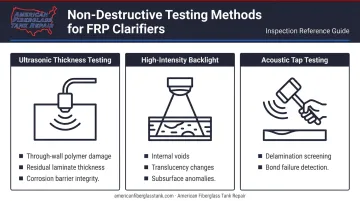
NDT findings should directly drive repair scope. A clarifier with early liner softening may need only surface rehabilitation, while measurable laminate thinning or deep blistering requires structural re-lamination. This distinction matters — it prevents both over-maintenance and dangerous under-investment in the same program.
AFTR's FTPI-certified inspectors apply all three methods across chemical, water, and wastewater clarifiers, producing condition reports that specify exactly which repair tier each zone requires.
Corrective / Reactive Maintenance
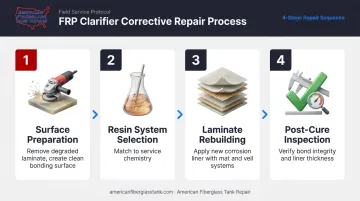
Corrective repair is triggered by failed NDT results, visible liner breach, active leakage, or performance degradation that routine maintenance can't resolve. The standard corrective process includes:
- Surface preparation — abrasive blasting or mechanical grinding to remove degraded laminate and create a clean bonding surface
- Resin system selection — matched to the service chemistry (vinylester for acids and alkalis, epoxy for solvents, isophthalic polyester for lower-aggression service within pH limits)
- Laminate rebuilding — applying new corrosion liner layers with appropriate mat and veil systems
- Post-cure inspection — verifying bond integrity and confirming liner thickness meets specification
Critical caution: FRP damage progresses non-linearly. A delaminated area covering a few square feet today can become a full structural failure within a single operating cycle under thermal or mechanical stress.
Early corrective action costs a fraction of what structural overhaul requires once damage has propagated.
Warning Signs Your FRP Clarifier Needs Attention
Most FRP clarifier problems give early warning — if you know what to look for. Catching these signals before they escalate separates a routine repair from a costly structural overhaul.
Visible Surface Changes
During routine walkthroughs, watch for:
- Surface blistering or bubbling on interior walls — pressurized osmotic blisters below the liner surface
- Chalky or white-gray discoloration — UV or chemical degradation of the outer resin coat
- White fibrous patches — resin erosion exposing bare glass fibers, indicating advanced liner loss
- Weeping or wet spots on the exterior shell — moisture migration through the laminate wall
Any fiber exposure requires immediate action — once bare glass contacts process chemistry, degradation accelerates fast.
Effluent Quality and Operational Changes
Operational signals often appear before visible surface damage:
- Declining effluent clarity or rising TSS in discharge samples
- Changes in settling behavior or increased carryover of suspended solids
- Unusual odors suggesting process chemical permeation through a compromised liner
- Hydraulic imbalances from baffle or weir damage
When these symptoms appear together, check clarifier condition first — process upsets and influent loading changes rarely explain all of them at once.
Mechanical Irregularities
Physical signs that the FRP structure itself may be under stress:
- Sludge scraper arms dragging or showing uneven floor contact
- Skimmer arms deviating from horizontal plane
- Unusual vibration at the drive connection point
- Visible deflection in the clarifier floor
Scraper drag is worth addressing immediately. Contact stress damages the FRP floor, which worsens the scraper geometry — and the problem compounds quickly. What starts as a dragging arm can become a full floor repair if left unaddressed.
FRP Clarifier Maintenance Schedule
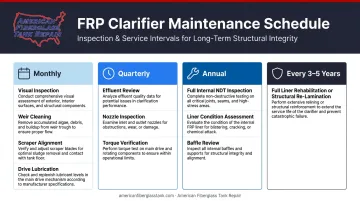
Maintenance frequency depends on service severity, operating hours, and clarifier age. The table below provides a general framework — not a one-size-fits-all prescription.
| Interval | Tasks |
|---|---|
| Monthly | Visual inspection of accessible laminate; weir and launder cleaning; squeegee/scraper alignment check; drive lubrication per OEM specs |
| Quarterly | Effluent quality parameter review; nozzle and penetration inspection for weeping; torque control operation verification |
| Annual | Full internal inspection after draining; NDT thickness testing and backlight inspection; corrosion liner condition assessment; baffle and weir structural review; documentation against baseline |
| Every 3–5 years (or as NDT indicates) | Full corrosion liner rehabilitation or structural re-lamination based on condition-based data |
High-Duty Service
Clarifiers treating acidic industrial wastewater, chemical process streams, or high-solids slurries should be inspected annually at minimum. For units operating under accelerated degradation conditions, biannual NDT assessments are recommended:
- pH extremes (acidic or caustic process streams)
- Elevated temperature service
- High-solids or abrasive slurry applications
- Any service history showing rapid liner wear at prior inspections
Lower-Duty Service
Units treating municipal water or low-corrosivity effluent can extend formal inspection intervals to 18–24 months. That flexibility holds only when:
- Monthly visual checks are being performed consistently
- No anomalies (weeping, discoloration, delamination) have been observed
- Effluent quality parameters remain within acceptable range
Any deviation from the above should trigger an earlier formal inspection rather than waiting out the extended interval.
Fitting inspections into operational windows is a practical constraint for most facilities. AFTR schedules inspection and maintenance programs around facility shutdowns, night shifts, and weekends — and field teams are positioned across all 50 states for rapid mobilization.
Conclusion
FRP clarifiers can deliver decades of reliable service, but only when maintained under FRP-specific protocols. A composite laminate that receives chemistry-appropriate maintenance, periodic NDT-based condition assessment, and timely corrective repair will far outlast one managed under steel or concrete assumptions.
The failure modes covered in this guide all share one characteristic: they're manageable when caught early and expensive when they aren't. That includes:
- Liner hydrolysis from sustained chemical exposure
- Delamination progressing inward from the corrosion barrier
- Osmotic blistering driven by moisture ingress
- Baffle deterioration from flow turbulence and resin degradation
The structured maintenance schedule presented here exists precisely to interrupt that progression before it reaches the structural laminate.
Protecting the capital investment in an FRP clarifier means committing to FRP-specific protocols. Routine cleaning and visual inspection, combined with periodic NDT and timely corrective repair, consistently delivers the lowest total cost of ownership. When inspection findings point to corrective action, engaging a contractor with certified FRP inspectors and chemistry-matched repair resins — rather than a general industrial maintenance crew — is what determines whether a repair holds for five years or five months.
Frequently Asked Questions
What is better, a clarifier or a flocculant?
They serve different functions and aren't interchangeable. Flocculants are chemical additives that aggregate suspended particles into settleable masses; a clarifier is the physical vessel where those masses settle out. Most treatment systems use both — flocculant improves clarifier efficiency rather than replacing it.
How long do FRP clarifiers last with proper maintenance?
Properly maintained FRP clarifiers commonly reach service lives of 20 to 30 years or more. Without proactive maintenance in chemically aggressive service, internal liner failure can occur much earlier — often within 10 to 15 years.
What are the most common FRP clarifier failure modes?
Internal corrosion liner degradation, laminate delamination, and osmotic blistering are the primary FRP-specific failure modes. All three are detectable through non-destructive inspection before they progress to structural failure.
Can FRP clarifier damage be repaired, or does the tank need to be replaced?
Most FRP clarifier damage — liner degradation, blistering, and delamination — is repairable using appropriate resin systems and laminate rebuilding techniques. Repair is far more cost-effective than full replacement in most cases.
How often should an FRP clarifier be inspected?
Monthly visual inspections by operations staff, combined with a formal internal NDT-based inspection annually. High-corrosivity service environments warrant more frequent formal assessments.
What causes internal corrosion lining failure in FRP clarifiers?
Liner failure typically stems from one of four causes:
- Prolonged chemical attack at pH extremes
- Hydrolysis of the resin matrix over time
- Resin selection at fabrication that doesn't match actual service chemistry
- Mechanical damage from scraper contact
All four gradually erode the protective inner layer.