The difference between a minor repair and a full tank replacement often comes down to timing. A tank storing sodium hypochlorite or ferric chloride that shows early surface cracking might need a targeted reline. That same tank, left uninspected for another two or three years, can progress to structural delamination — turning a manageable repair into a capital replacement event, extended downtime, and potential environmental liability.
EPA data on leaking storage tank cleanups shows average remediation costs ranging from $88,000 to over $400,000 depending on severity and location — and that's before factoring in regulatory penalties or production losses.
This article covers 7 specific warning signs that your FRP tank needs professional attention, organized by how they appear: visually on the surface, structurally within the laminate, and operationally during use.
TL;DR: 7 Warning Signs Your FRP Tank Needs Repair
- Surface crazing: Fine cracks or spider-web patterns in the gel coat or outer resin layer
- Blistering: Raised bubbles on the tank surface indicating a compromised corrosion barrier
- Surface degradation: Chalking, uneven fading, or brittle texture from UV or chemical attack
- Delamination: Soft spots or hollow sounds when tapping the tank wall
- Active leakage: Seepage, crystalline deposits, or staining around fittings, nozzles, or seams
- Volume or pressure loss: Unexplained drops in stored volume or unexpected pressure fluctuations
- Overdue inspection: Tank age over 10–15 years with no documented professional inspection
Visual and Surface Warning Signs (Signs 1–3)
Sign 1: Surface Cracking or Crazing
The gel coat (the resin-rich outer layer of an FRP tank) serves as the first line of defense against UV radiation, mechanical impact, and chemical exposure. When fine cracks or spider-web (craze) patterns appear, that barrier has begun to fail.
Surface cracking takes a few different forms. Fine crazing across a broad area typically signals UV degradation or thermal cycling. Concentrated cracks near fittings or the tank base are more likely caused by mechanical stress, over-pressurization, or chemical penetration that has already reached the corrosion barrier layers.
Why it matters beyond cosmetics: Once cracks form, moisture and stored chemicals can penetrate into the underlying laminate. A 2018 assessment of a 37,000-gallon FRP caustic tank documented exactly this progression : hairline cracks on interior surfaces allowed liquid past the corrosion barrier, where deposits dried, expanded, and drove further cracking and delamination.
Urgency guidance:
- Hairline craze cracks → schedule a professional inspection; monitor in the meantime
- Through-wall or propagating cracks → require immediate professional evaluation
- Cracks near nozzles or seams → do not assume they're superficial
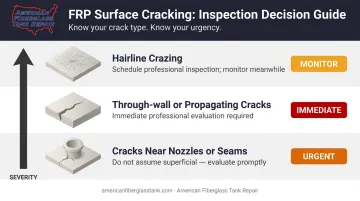
Surface-only inspection isn't sufficient to assess crack depth. AFTR's field teams use ultrasonic, laser, and high-intensity backlight testing to determine whether cracking has reached the structural laminate — a determination no visual check alone can make.
Sign 2: Blistering or Bubbling on the Tank Wall
Blistering appears as raised, bubble-like formations on the tank exterior or interior. The cause is typically trapped moisture, osmotic pressure, or off-gassing from chemical reactions occurring within the laminate layers.
TAPPI TIP 0402-28, a key industry guideline for inspecting used FRP equipment, identifies blistering as a formal inspection condition that oblique lighting or surface tapping can reveal.
The progression risk is what makes blistering serious. Small blisters grow as the laminate bond weakens beneath them. When they rupture, glass fibers become directly exposed to the stored chemical or ambient environment, accelerating both corrosion and structural thinning.
Blistering is also a signal that the corrosion barrier or inner liner may already be compromised, not just the gel coat. The City of Denton FRP caustic tank assessment documented blister-like formations alongside missing corrosion barrier material, exposed chopped fiberglass mat, deep cracks, and delamination — all in the same vessel.
Even a small cluster of blisters warrants hands-on professional evaluation, not a watch-and-wait approach.
Sign 3: Discoloration, Chalking, or UV Degradation
The signs of UV degradation and resin breakdown are usually visible to the naked eye: uneven fading, dark staining, a chalky or powdery residue, or areas where the resin has gone dull and brittle. These indicate oxidation driven by UV exposure, chemical attack, or both.
Research on GFRP composites exposed to UV radiation and moisture for 3,000 hours found reductions of up to 34% in bending strength, 28% in tensile strength, and 23% in compressive strength. That data comes from pultruded profiles, not storage tanks specifically, but the underlying degradation mechanism is the same: UV breaks down the polymer matrix, reducing flexibility before visible brittleness becomes obvious.
What to look for specifically:
- Widespread chalking across the exterior → long-term UV degradation; the surface resin has lost flexibility
- Localized dark staining near fittings or the tank base → possible chemical leaching or ground moisture intrusion
- Uniform surface dulling → oxidation of the resin surface layer
Discoloration that looks purely cosmetic can mask real structural vulnerability. A tank with brittle outer resin is more likely to crack under normal operational loads, with no impact or overpressure needed to trigger failure. Barcol hardness testing quantifies how much structural integrity remains in the laminate — and it's a standard part of AFTR's UV degradation assessment.
Structural Integrity Warning Signs (Signs 4–5)
Sign 4: Soft Spots or Hollow Sounds (Delamination)
Delamination is the separation of resin and glass fiber layers within the laminate wall. It can result from impact damage, improper curing during original fabrication, long-term vibration, or chemical attack that gradually weakens the fiber-resin bond.
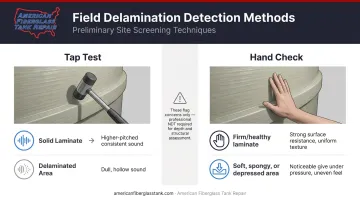
Two field detection methods operators can use:
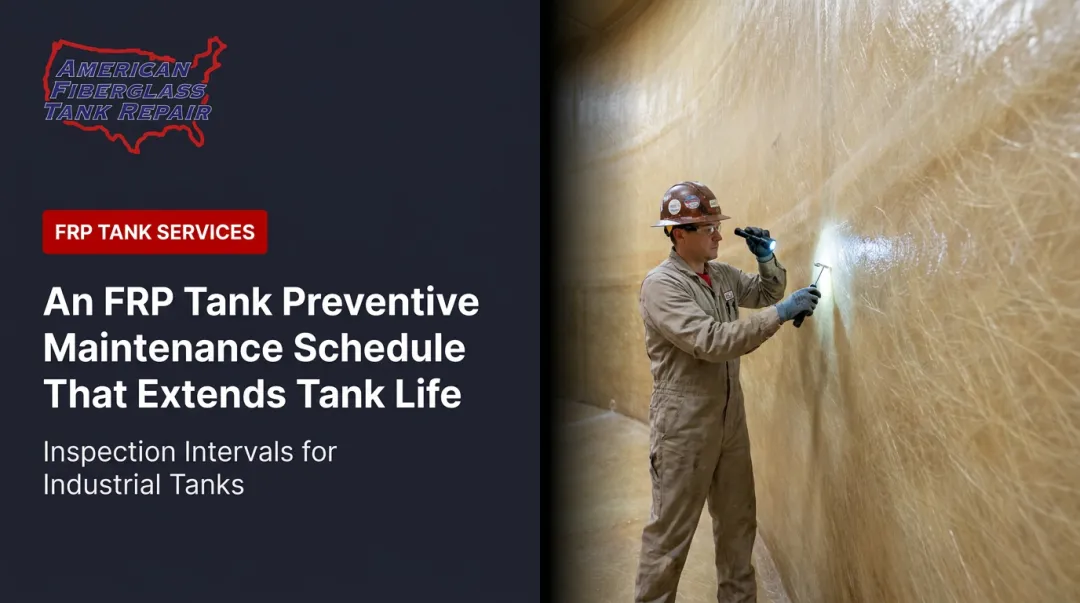
- Tap test — Systematically tap the tank wall with a mallet or coin. A solid, healthy laminate produces a consistent, higher-pitched sound. A delaminated area produces a dull, hollow sound that clearly differs from the surrounding wall.
- Hand check — Run a flat palm across the tank surface and feel for areas that are soft, spongy, or slightly depressed compared to the surrounding laminate.
These checks are useful for flagging areas of concern — but they cannot scope the depth or structural impact of delamination. That requires professional-grade non-destructive testing.
AFTR's FTPI-certified inspectors use ultrasonic thickness measurement, laser inspection, and high-intensity backlight testing together to assess what's happening inside the structural body of the tank — including capillary migration of stored liquid beneath the corrosion coat, which visual inspection alone will miss. Findings determine whether targeted laminate restoration is sufficient or whether full relining is the correct path.
ASTM E1067, the standard practice for acoustic emission examination of FRP tanks and vessels under pressure or vacuum, provides a framework for evaluating structural integrity in service — another method used when delamination is suspected in pressurized systems.
Sign 5: Leaks, Seepage, or Staining Around Fittings and Seams
The most common leak locations on FRP tanks are nozzles, flanges, threaded connections, seams, and base supports — anywhere fittings penetrate the laminate or sections are bonded together. These areas are vulnerable as seals age and the laminate around the penetration fatigues.
Visible evidence to watch for:
- Active drips or wet patches near fittings
- Crystalline or chalky white deposits on the exterior (residue left when stored liquid evaporates)
- Staining patterns running down the tank wall from a fitting
- Corrosion on nearby metal hardware, brackets, or piping flanges
The City of Denton FRP caustic tank assessment found a documented history of nozzle and drain valve leaks dating back to 2011, with the tank eventually losing between 200 and 250 gallons per day through the floor — what started as localized fitting seepage became a significant structural failure over several years of deferred action.
That progression isn't unusual. Liquid travels through the laminate via capillary action, causing progressive delamination well beyond the visible leak point. By the time exterior staining is obvious, internal damage may already spread several inches past what's visible. Prompt professional evaluation — not continued monitoring — is the right response.
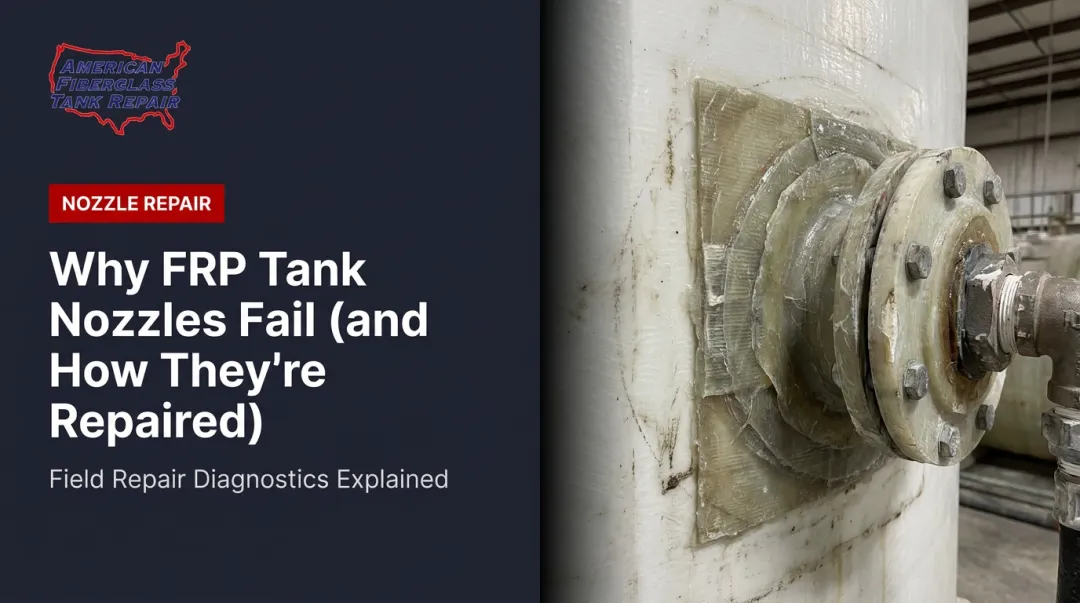
What repair looks like: AFTR's nozzle repair services address this directly: old nozzle assemblies are removed, the tank port is properly prepared and sealed to prevent weeping into the structural laminate, and new nozzles are laminated integral with the tank shell using resins matched to the stored chemical and service temperature.
Operational and Maintenance Warning Signs (Signs 6–7)
Sign 6: Unexplained Loss of Contents or Pressure Fluctuations
This sign is often the trickiest to catch because there's no obvious external leak to point to. The tank appears intact, but volume readings trend downward without explanation, pressure deviates from expected ranges, or flow rates through associated piping drop unexpectedly.
Internal micro-cracks or partial delamination can allow stored liquid to migrate between laminate layers or escape through the floor or wall without producing any visible external wet spot. For pressurized tanks, a measurable loss of vacuum or pressure integrity confirms that containment has been compromised, even when the exterior looks fine.
Recommended operating practice:
- Track input vs. output volumes on a routine basis against baseline records
- Log pressure readings and flag deviations from established ranges
- Any unexplained discrepancy should trigger professional inspection
AFTR uses ultrasonic, laser, and high-intensity backlight testing to locate internal breaches and capillary migration paths that visual inspection cannot find.
Hydrostatic testing confirms whether a vessel holds at a given moment, but a tank that passes today may not pass in three months. Instrument-based inspection is the only reliable method when unexplained losses are occurring.
Sign 7: Tank Age Over 10–15 Years Without Recent Professional Inspection
Age alone is a warning sign. Even well-maintained FRP tanks experience progressive resin degradation, fiber fatigue, and seal deterioration — most of it occurring inside the laminate where routine visual checks can't reach.
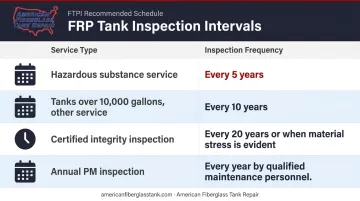
The Fiberglass Tank & Pipe Institute's inspection guidance recommends:
| Service Type | Certified External Inspection Frequency |
|---|---|
| Hazardous substance service | Every 5 years |
| Tanks >10,000 gallons, other service | Every 10 years |
| Certified integrity inspection | Every 20 years or when material stress is evident |
| Annual PM inspection | Every year by qualified maintenance personnel |
These intervals reflect real degradation timelines. A tank beyond 10–15 years with no formal non-destructive testing record carries significantly elevated failure risk — laminate fatigue and resin breakdown progress on their own schedule, regardless of how the tank looks from the outside.
AFTR's standard protocol for aging tanks with no prior inspection record includes interior and exterior visual inspection combined with ultrasonic, laser, and backlight testing across the entire vessel — establishing a condition baseline and identifying whether targeted repair, relining, or closer monitoring is needed.
Why Acting on These Warning Signs Fast Matters
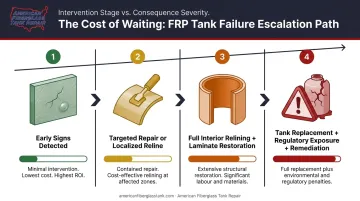
The cost-consequence relationship is straightforward: early-stage signs are manageable. Ignored signs become expensive problems.
Surface cracking or minor blistering can typically be addressed with targeted repair or localized relining. Delamination, active leaks, and structural distortion that develop because early signs were missed often require full interior relining, major laminate restoration, or tank replacement — along with extended downtime and potential regulatory exposure.
The regulatory stakes are real. Under EPA's RCRA tank regulations, a confirmed leak requires immediate shutdown, with stored product removed within 24 hours or the earliest practicable time. Facilities subject to SPCC requirements carry additional containment and spill prevention obligations.
A containment failure that reaches soil or groundwater can trigger:
- Mandatory site remediation
- Regulatory fines and enforcement action
- Significant reputational damage with customers and regulators
All of which cost far more than a planned relining.
When a warning sign does appear, response time matters — both for compliance and for keeping repair costs manageable. AFTR's inspection and repair services, led by Fiberglass Tank & Pipe Institute certified inspectors, cover all 50 U.S. states, Canada, Puerto Rico, and select international locations. Field crews work around customer schedules — shutdowns, night shifts, and weekends — so repair doesn't have to mean halting production. The goal in every case is to extend the tank's service life rather than default to a costly replacement.
Frequently Asked Questions
What is the life expectancy of a fiberglass tank?
FRP tanks are built to last several decades, though actual service life depends on the stored chemical, operating temperature, UV exposure, and liner condition. Proactive relining and inspection programs extend service life; deferred maintenance shortens it.
Can a fiberglass tank be repaired instead of replaced?
In most cases, yes. Even tanks with compromised corrosion barriers can be relined rather than replaced, provided the structural wall has sufficient integrity. AFTR takes a repair-first approach: in-place relining restores the corrosion barrier and extends service life at a fraction of replacement cost, with none of the lead time delays of ordering a new vessel.
How often should an FRP tank be professionally inspected?
FTPI guidance calls for certified external inspection every 5 years for hazardous service and every 10 years for non-hazardous service, with annual preventive maintenance checks regardless of service type. Any tank showing the warning signs described in this article should be evaluated sooner.
What is delamination in an FRP tank, and how serious is it?
Delamination is the separation of resin and glass fiber layers within the tank wall, creating structural voids that reduce load capacity and allow stored liquid to migrate through the laminate. It can often be addressed with targeted laminate restoration if caught early — advanced delamination across broad areas typically requires full relining.
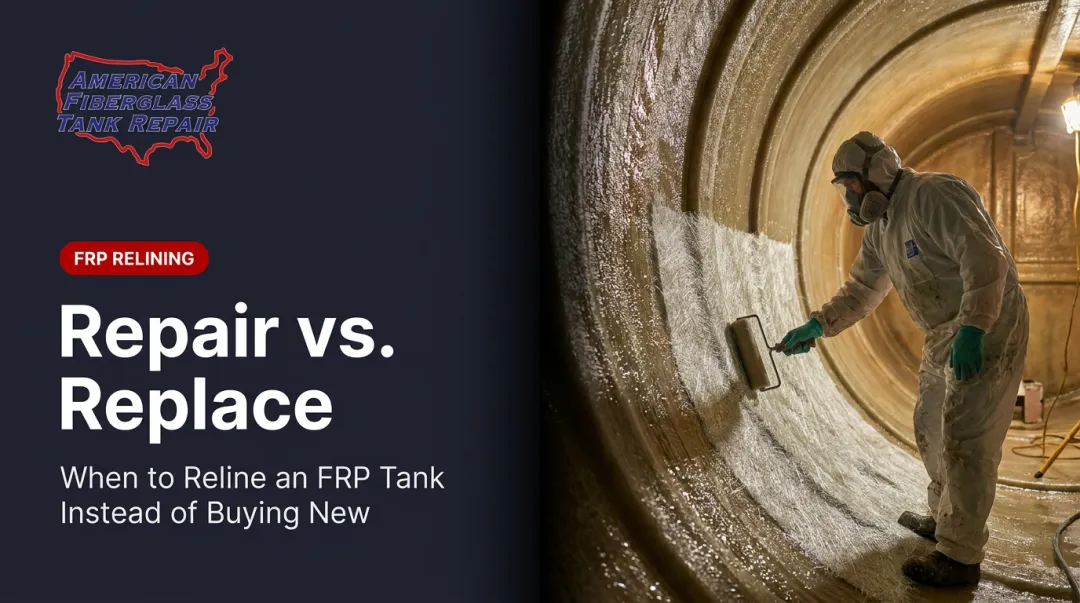
What is the difference between repairing and relining an FRP tank?
Repair addresses localized damage — specific cracks, fitting leaks, or isolated delamination zones. Relining restores the entire interior corrosion barrier with new fiber-reinforced composite layers using resins matched to the stored chemical and service temperature. Relining is used when the internal liner has degraded broadly, and it extends the tank's service life by many years.