Introduction
FRP tanks and vessels are designed for long service life in demanding environments — chemical plants, water treatment facilities, wastewater operations, and industrial storage. Built right, they can last decades. That longevity, though, depends on catching problems early.
Without timely repair and strengthening, even well-built FRP structures degrade. A compromised corrosion liner that isn't addressed will eventually become a structural failure — and structural failures don't get repaired cheaply. They get replaced.
The consequences of ignoring early damage are predictable: unplanned downtime, environmental liability, regulatory non-compliance, and repair costs that compound with every missed inspection cycle.
Compliance adds another layer of urgency. Under EPA SPCC requirements, aboveground containers must be inspected and tested on a regular schedule — and each material repair is itself a compliance event that needs to be documented.
This guide covers the four main FRP repair and strengthening methods, how to recognize when repair is needed, the technical factors that determine whether a repair lasts, and how to build an inspection schedule calibrated to actual service conditions.
Key Takeaways
- FRP tanks need repair when cracks, delamination, blistering, or chemical attack compromises the corrosion liner or structural wall
- Repair methods range from localized patching to full relining — the right choice depends on damage type, depth, and service environment
- Resin and laminate selection must match both the tank's original construction and its current operating chemistry; mismatches fail prematurely
- Early detection through routine inspection is the most cost-effective strategy for extending FRP service life by many years
Why FRP Repair and Strengthening Matters
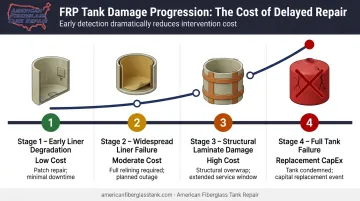
FRP's corrosion resistance comes from its resin chemistry — and that chemistry has limits. Tanks cycling between aggressive chemicals and elevated temperatures, storing oxidizers like sodium hypochlorite, or accumulating mineral deposits at the waterline will eventually see liner degradation. Early detection determines whether a repair stays affordable or escalates into a full replacement.
The Cost of Waiting
One trade industry source notes that FRP tank lining refurbishment can cost as little as 20% of full tank replacement. That ratio shifts sharply once damage progresses from liner to structural laminate — or once a containment failure forces an emergency response.
The financial gap between a planned repair during a scheduled shutdown versus an emergency repair or unplanned leak event includes:
- Lost production during unplanned downtime
- Emergency mobilization costs vs. scheduled field crew deployment
- Environmental remediation if containment is breached
- Regulatory penalties and compliance remediation costs
- Potential new-tank CapEx plus lead times for replacement vessels
AFTR's service philosophy centers on this reality: relining recovers tanks that would otherwise be condemned, typically at a fraction of new-tank capital expenditure and without the long lead times associated with replacement.
The Compliance Dimension
Tanks storing hazardous chemicals, potable water, or food-grade fluids operate under regulatory frameworks that treat containment integrity as a legal obligation, not just a maintenance preference:
- EPA SPCC (40 CFR 112.8): Requires regular integrity testing and inspection of aboveground containers; material repairs trigger additional inspection requirements
- RCRA (40 CFR Part 264/265 Subpart J): Mandates compatibility, secondary containment, and leak response protocols for hazardous waste tank systems
- NSF/ANSI 61: Covers health effects for drinking water system components
- FDA 21 CFR 177.2420: Governs cross-linked polyester resins in repeated food contact applications
A degraded FRP vessel carries compounding consequences: contamination risk, environmental liability, and active regulatory exposure — all of which a timely repair program can prevent.
Types of FRP Repair and Strengthening Methods
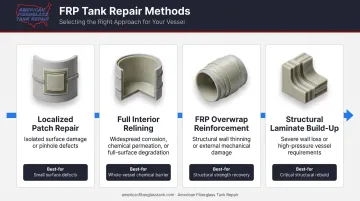
FRP repair is not one-size-fits-all. Method selection depends on where the damage is located (interior versus exterior), how deep and widespread the degradation is, whether structural integrity is compromised, and what the tank stores. Four main categories cover most situations.
Localized Patch Repair (Laminate Overlay)
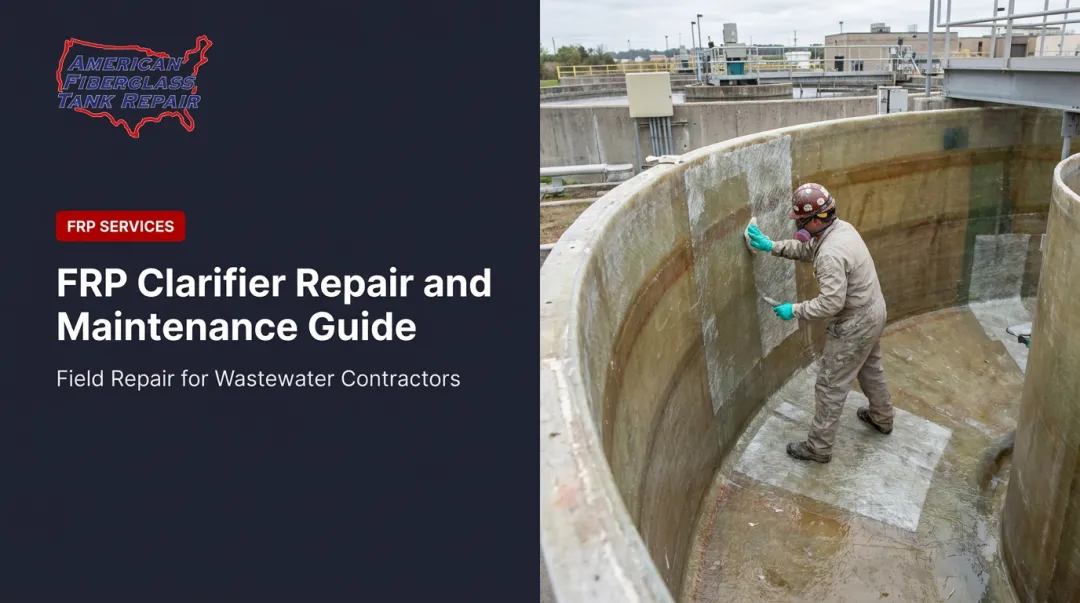
Patch repair targets discrete, bounded damage. The damaged area is prepared — contamination removed, surface mechanically abraded to expose clean, active laminate — and layers of reinforcement material (mat, woven roving, or veil) are applied with compatible resin to bond over the affected zone.
When patch repair is appropriate:
- Isolated cracks or crazing
- Pitting from localized chemical attack
- Minor impact damage
- Small, well-defined delaminations
- Isolated blistering with sound surrounding laminate
The critical constraint: patch repair only works when the surrounding laminate is structurally sound and the repair resin chemistry is matched to both the original construction and the current stored product. A patch applied over degraded laminate, or with incompatible resin, will fail at the bond interface.
As noted in NACE research on FRP repair, proper surface preparation is essential to obtain adequate adhesion — contamination is a leading cause of bond failure in laminate repairs.
Full Interior Relining
When the internal corrosion liner is extensively degraded across a large area — widespread crazing, chemical attack, aging, or loss of surface veil — patch repair isn't sufficient. Full interior relining restores the chemical barrier across the entire interior surface.
AFTR's relining process applies a multi-layer corrosion-barrier build using compatible glass media, veil systems, and application-specific polymer matrices. The structural body of the tank serves as the substrate; even when the corrosion barrier has been breached, if the structural laminate remains intact, it provides an ideal surface for fabricating a new corrosion layer.
Full relining is the right choice when:
- Liner failure is widespread rather than isolated
- A tank is approaching end of original liner life
- The stored chemical has changed, requiring a more resistant resin system
- Repair costs for multiple patches would approach the cost of a full reline
Relining also adapts tanks to new chemistries or temperature environments beyond their original specifications, typically at a fraction of replacement cost.
FRP Overwrap and Structural Wrap Reinforcement
Where wall thickness has been lost or a specific zone needs structural reinforcement, additional FRP layers are applied to the exterior (or interior) of vessel walls, pipes, or nozzle zones. The overwrap restores load-bearing capacity in the affected area without requiring full dismantling of the system.
Key considerations for overwrap:
- Bonding quality along wrap edges is critical — a properly bonded wrap can contain any leak that develops through the substrate
- Quality is highly workmanship-dependent; poor technique produces a wrap that looks adequate but lacks structural integrity
- Periodic inspection for bond integrity and thickness is needed after installation
- ASME PCC-2-2022 Part 4 covers nonmetallic composite repair systems for pressure equipment and piping
For pipe and vessel nozzle zones — common failure initiation points — overwrap can restore function with minimal downtime compared to component replacement.
Structural Strengthening (Additional Laminate Build-Up)
Structural strengthening goes beyond repair. It addresses situations where wall thickness has dropped below design minimum, service loads have increased, or modified service conditions demand greater laminate capacity than the original design provided.
Structural strengthening is warranted when:
- Wall thickness has dropped below design minimum
- Operating pressure, temperature, or chemical concentration has increased
- Service conditions have changed beyond the original design specification
- Load-bearing capacity needs to be verified and restored before continued use
An engineered assessment determines how many additional laminate plies are needed and in what orientation. That determination requires design data, current operating parameters, and qualified analysis — it cannot be made reliably in the field.
AFTR works with custom-blended isophthalic and terephthalic polyester, vinylester, and epoxy resins, paired with over 45 fiberglass mat, chopped strand, Nexus, Harlar, and carbon veil laminates. This range ensures the strengthening laminate matches both the structural requirement and the chemical environment. Resin selection follows the same verification logic as for repairs: chemical type, concentration, temperature, and exposure history tested under ASTM C581 protocols.
Signs Your FRP Tank Needs Repair or Strengthening
FRP damage progresses; it rarely appears catastrophically without earlier warning signs. Catching those signs early is what separates a scheduled patch repair from an emergency reline or tank condemnation.
External Visual and Physical Indicators
Routine walkarounds should look for:
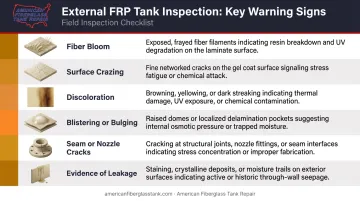
- Fiber bloom — dry, exposed fibers on the exterior surface indicate resin erosion or UV degradation
- Surface crazing or fine cracking — particularly around nozzles, seams, or fittings
- Discoloration — UV degradation on outdoor tanks, or staining suggesting seepage
- Blistering or bulging — deformation in the laminate wall indicates internal pressure from osmotic or chemical action
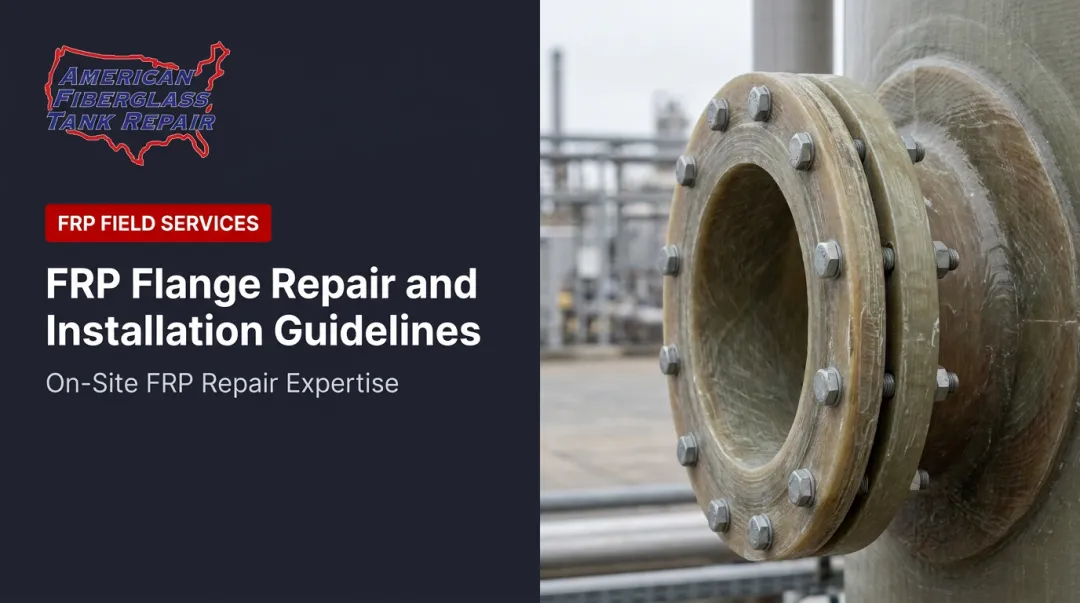
- Cracks at seams, nozzle connections, or structural attachments — these are common failure initiation points
- Evidence of leakage — staining, efflorescence, or seepage at fittings and penetrations
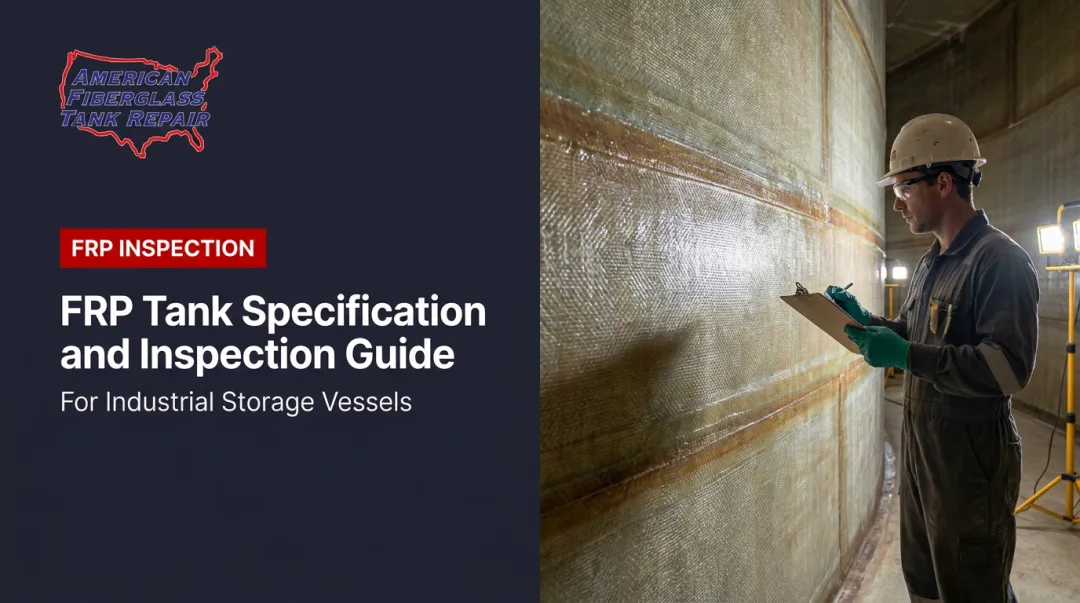
Barcol hardness testing (ASTM D2583) provides a field-level diagnostic for resin condition. A Barcol impressor measures indentation hardness of the cured laminate; low or inconsistent readings across the tank wall can indicate under-cured resin, chemical degradation, or resin matrix breakdown.
AFTR includes Barcol hardness testing as part of its standard external inspection protocol. Acceptable ranges vary by resin system — isophthalic polyester and vinylester each have different baseline hardness profiles — so readings should be interpreted against the tank's original resin specification.
Internal Inspection Indicators
Internal inspection is more revealing than external, and more critical. AFTR's internal inspection protocol covers:
- Corrosion liner condition — discoloration, chemical staining, or surface erosion
- Surface veil integrity — loss of the innermost protective layer exposes structural laminate to chemical contact
- Pits, cracks, or blisters on the interior surface
- Delamination between layers — separation visible as bubbling, lifting, or irregular surfaces
- Capillary migration — liquid product beneath the corrosion coat, detectable through ultrasonic, laser, and high-intensity backlight testing even when the surface appears intact
- Nozzle overlay condition — cracks or separation at pipe connections are a frequent failure initiation point
- Structural attachments — manways, lugs, and anchor points should show no cracking or separation from the shell
AFTR's certified inspectors produce detailed reports covering all four zones: interior corrosion coat, internal structural body, exterior shell, and nozzle interfaces. Each report gives plant operators a clear prioritization of what needs repair now versus what can be monitored through the next inspection cycle.
Age, History, and Operational Triggers
Not all inspection triggers are visual. These non-visual factors should prompt a formal inspection and repair evaluation:
- Tank approaching or exceeding 20 years of service
- Change in stored chemical type or concentration
- Temperature fluctuations outside the original design range
- Prior repairs that are now several years old, particularly in the same locations
- Accumulation of minerals or salts at the waterline or chemical splash zone
- Any documented repair event (also a regulatory trigger under SPCC)
Tanks that keep requiring re-repair in the same locations are flagging a deeper problem. That pattern points to either structural degradation that patches can't address, or a resin compatibility issue that only a full relining with an upgraded resin system will resolve. Once the root cause is identified, the repair method selection follows directly from it.
How to Execute an FRP Repair: Key Technical Considerations
The difference between a repair that lasts a decade and one that fails within a year usually comes down to three decisions made before any material is applied: surface preparation, resin selection, and information gathering.
Surface Preparation
The repair surface must be clean, dry, and mechanically active. That means:
- All tank contents fully removed and surfaces decontaminated
- Residues from mineral salts, chemical films, or biological growth completely eliminated
- Mechanical abrasion or grinding to expose a fresh laminate surface — not just a clean one
- Special handling for wet or chemically contaminated surfaces, which require specific preparation protocols before standard laminate application
NACE research confirms that proper surface preparation is essential to adequate adhesion in FRP laminate repairs. Bond failure at a contaminated interface is one of the most common reasons repairs fail prematurely.
Resin Selection
The repair resin must be compatible with two things simultaneously: the original tank construction and what the tank currently stores.
| Resin Type | Suitable For |
|---|---|
| Isophthalic/terephthalic polyester | Moderate chemical service, water, many dilute solutions |
| Vinylester | Aggressive chemical service, oxidizers, elevated temperatures |
| Epoxy | Extreme chemical resistance, high-temperature applications |
These categories are starting points, not specifications. Per AMPP guidance, resin and corrosion-barrier suitability must be verified by chemical type, concentration, operating temperature, and exposure history — ideally tested under ASTM C581 laboratory immersion protocols or against manufacturer chemical resistance data.
Information Gathering Before Repair
Before any repair specification is developed, facility operators should be prepared to provide:
- Chemical composition and concentration of tank contents
- Operating temperature ranges and any fluctuations
- Trace minerals, salts, or secondary chemicals present
- Original tank construction details — resin type, laminate schedule, fabrication standard
- Full history of prior repairs, including locations and materials used
This data directly determines method and material selection. AFTR's inspection engineers use it alongside ultrasonic, laser, and high-intensity backlight testing to develop repair specifications tied to actual tank condition.
FRP Tank Inspection and Repair Schedule
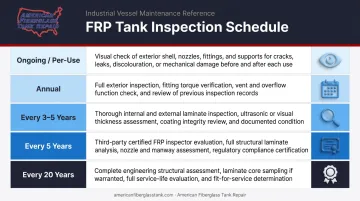
Inspection frequency should match service severity. A tank storing dilute water at stable temperatures doesn't need the same schedule as one cycling between ferric chloride and elevated temperatures. Age compounds the requirement; older tanks warrant more frequent assessment.
FT&V RP 2007-1, the industry recommended practice for in-service inspection of aboveground atmospheric FRP tanks, provides the benchmark framework:
| Frequency | Scope |
|---|---|
| Ongoing / per-use | Visual walkaround: leaks, staining, surface damage, hardware and fitting condition |
| Annual | Full external inspection: Barcol hardness readings, hardware, foundation, vents, nozzle condition, repair history review |
| Every 3–5 years (sooner for aggressive service) | Full internal inspection by qualified personnel: liner condition, veil integrity, Barcol at multiple levels, nozzle overlay assessment; consider ultrasonic thickness measurement for tanks with thinning history |
| Every 5 years | Certified external inspection for hazardous-substance service (per FT&V RP 2007-1) |
| Every 20 years | Certified integrity inspection for tanks over 10,000 gallons |
Shorten intervals when:
- A repair event has been documented
- Stored chemical or operating conditions have changed
- The tank is 15 or more years old
- The same area has required re-repair
AFTR offers both periodic scheduled inspection programs and one-time inspection events. Each is supervised by Fiberglass Tank & Pipe Institute certified inspectors who produce detailed reports covering surface and structural condition findings, with specific remediation recommendations. Catching deterioration before it progresses typically costs a fraction of an emergency repair or early tank replacement.
Conclusion
FRP tanks are built for long service — but that longevity depends on matching the right repair method to the actual damage. Patch repair handles localized issues. Full interior relining addresses widespread liner failure or chemical transitions. Overwrap restores structural capacity at nozzles and vessel walls. Engineered laminate build-up addresses compromised wall thickness and increased service loads.
Left unaddressed, early warning signs don't stay minor — they escalate into structural failures that take tanks offline and drive up costs significantly.
A structured inspection and repair program is capital protection, not an added cost. Done consistently, it:
- Extends asset life by years
- Prevents unplanned shutdowns and emergency mobilizations
- Keeps operations within regulatory boundaries
The right repair partner brings both the material depth — matched resins and laminates for the actual service environment — and the engineering judgment to specify the correct repair scope. AFTR has delivered engineer-driven FRP repair across all 50 states since 2003, working with custom-blended resins and over 45 laminate systems to match the specific chemical and mechanical demands of each vessel.
Frequently Asked Questions
What are the most common types of damage found in FRP tanks?
The most frequently encountered failure modes are corrosion liner degradation, surface crazing and cracking, delamination between laminate layers, blistering from osmotic or chemical pressure, and cracking at nozzle and fitting overlays. Internal inspection typically reveals more than external walkarounds, particularly for capillary migration of liquid beneath the corrosion coat.
Can an FRP tank be repaired while still in service, or does it need to be taken offline?
Most structural and all interior repairs require the tank to be taken offline, fully drained, cleaned, and prepared before work begins. Some minor external repairs may be possible with the tank in service, but any liner work requires interior access and a properly prepared surface.
How do I choose the right resin system for an FRP repair?
Resin selection is driven by what the tank stores: chemical type, concentration, operating temperature, and any trace contaminants. Polyester suits moderate service; vinylester handles most aggressive chemicals including oxidizers; epoxy is used for extreme chemical or temperature conditions. Compatibility should be verified against manufacturer chemical resistance data, not assumed by resin family alone.
How long does a properly executed FRP repair last?
A well-executed patch or full interior relining using compatible materials on a properly prepared substrate can add 10 or more years of useful service life. Longevity depends on continued compatibility with tank contents, adherence to operating parameters, and a routine inspection schedule.
What is the difference between FRP repair and FRP structural strengthening?
Repair addresses active damage (cracks, delamination, liner failure) to restore the tank to its original condition. Structural strengthening adds laminate material to increase or restore load-bearing capacity, typically when wall thickness has dropped below design minimum or when service loads have increased beyond the original specification.
When should an FRP tank be replaced rather than repaired?
Replacement becomes necessary when the structural wall has degraded beyond economical repair scope, when repair costs approach or exceed replacement cost, or when the tank cannot safely contain its contents even with strengthening applied. A formal engineering assessment, not a visual estimate, is the definitive basis for that decision.