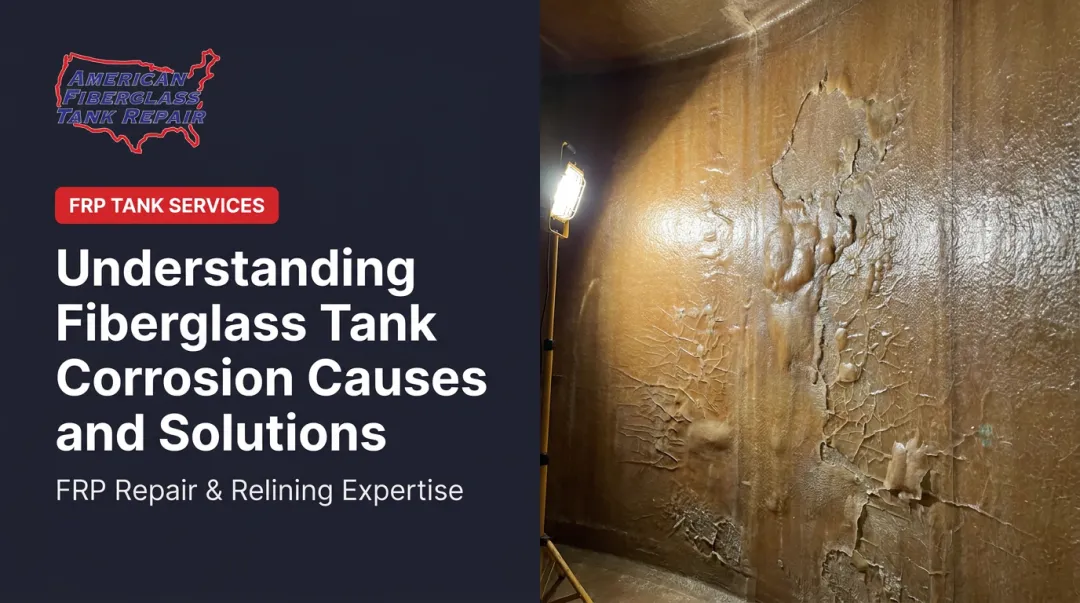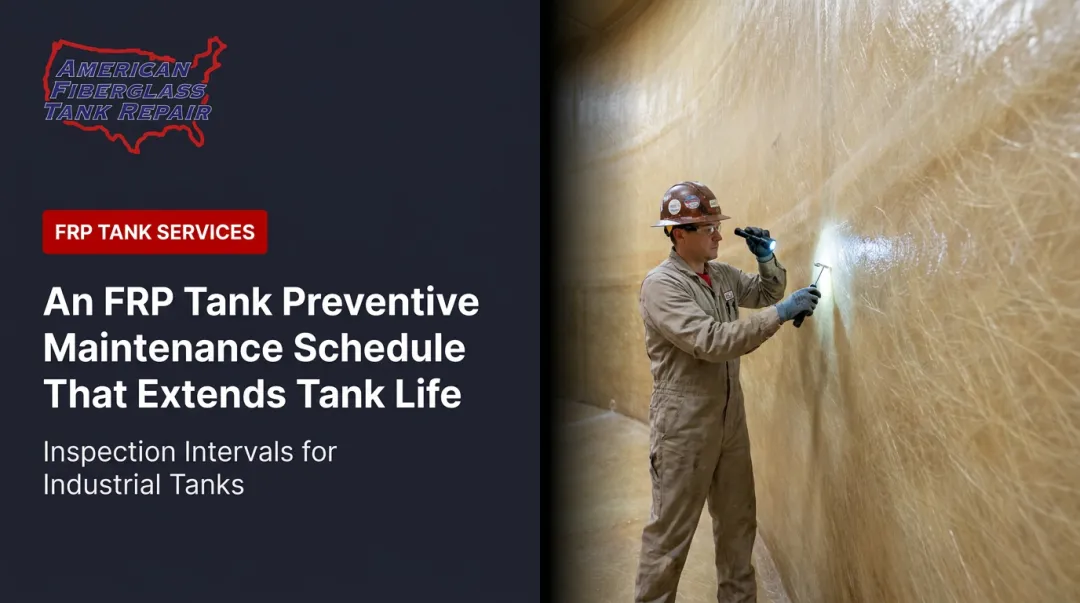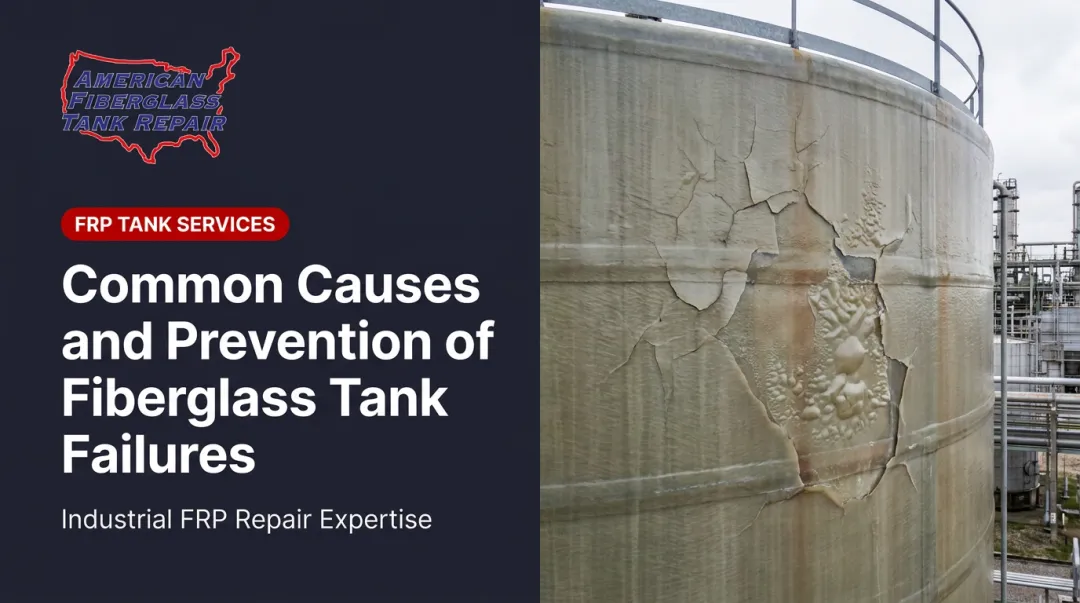
FRP tanks don't rust. Rust is an iron-oxide reaction, and fiberglass contains no iron. But the resin matrix and internal corrosion liner that give FRP tanks their chemical resistance are both vulnerable to attack. Chemical incompatibility, moisture permeation, microbial activity, and manufacturing weaknesses can all degrade an FRP tank from the inside out — sometimes years before any visible sign appears.
The good news: these failure mechanisms are well understood, and most are preventable. Knowing what causes FRP tank corrosion and blistering lets you take targeted action — protecting your investment, avoiding unplanned downtime, and keeping your operation in compliance.
Key Takeaways
- FRP tanks resist rust, but resin systems and corrosion liners can degrade through chemical attack, osmotic blistering, microbial activity, and manufacturing flaws
- The four primary causes: chemical incompatibility, osmotic water permeation, microbial conditions, and manufacturing defects or UV/thermal degradation
- Early warning signs — blistering, soft laminate, discoloration, product contamination — worsen fast once the liner is breached
- Liner repair caught early costs a fraction of full tank replacement
- Prevention requires correct resin selection, liner maintenance, water management, and scheduled professional inspections
Common Causes of FRP Tank Corrosion and Blistering
Corrosion and blistering are distinct failure mechanisms in FRP tanks — not interchangeable words for the same problem.
Corrosion in FRP refers to chemical degradation of the resin matrix and laminate structure. The stored chemical breaks down molecular bonds in the resin, softening and eventually destroying the material. Osmotic blistering is a separate process where moisture migrates through the laminate and collects in subsurface voids, building hydraulic pressure that pushes the surface outward into a visible blister. Both can — and often do — occur simultaneously.
In either case, the inner corrosion liner is the first line of defense. Once it's compromised, degradation of the structural laminate beneath accelerates quickly.
Chemical Incompatibility and Wrong Resin Selection
Different resin systems have fundamentally different chemical resistance profiles. Isophthalic polyester, for example, is rated to 150°F liquid service and is not recommended above pH 10.5. Bisphenol A epoxy vinyl ester systems can handle up to 200°F liquid service, and epoxy novolac vinyl ester pushes that to 215°F. These aren't minor differences — specifying the wrong resin for a given chemical can initiate degradation immediately upon contact.
The most common triggering scenario: a facility changes the chemical stored in an existing tank without verifying resin compatibility. A supplier increases acid concentration beyond the resin's rated limit. A process temperature creeps upward over time. Any of these conditions can push the stored chemical outside the resin's tolerance window.
A 2017 study published in Engineering Failure Analysis documented FRP tanks storing 35% hydrochloric acid that showed residual strength below 50 MPa after 24 years, with roof sections degrading to 10–25 MPa after just 20 years. The researchers estimated remaining service life below 20 years for current tanks in that service. That's what incompatible chemical exposure does at the structural level — and it's largely invisible until the damage is severe.
ASTM C581 is the standard practice for evaluating chemical resistance of thermosetting resins used in FRP structures. It measures changes in hardness, weight, thickness, appearance, and flexural properties after chemical exposure — and it's the basis for most published resin compatibility guides.
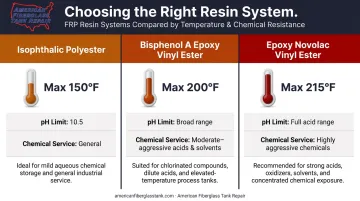
American Fiberglass Tank Repair (AFTR) works with custom-blended isophthalic and terephthalic polyester, vinylester, and epoxy resins, selecting each system based on the specific chemical, concentration, and operating temperature. When they're called in to reline a tank where the original resin was mismatched to the stored product, the repair typically involves replacing the entire corrosion barrier with a product-specific system compatible with the actual chemistry in service.
Osmotic Blistering from Water Permeation
Water molecules permeate through the laminate toward water-soluble substances trapped in subsurface voids — residual catalysts, impurities from manufacturing, or degraded resin byproducts. As water accumulates in these voids, osmotic pressure builds until it exceeds the laminate's bond strength, pushing the surface outward into a visible blister. The process starts small and invisible, often going undetected until blisters are already well-formed.
AMPP's guidance on osmotic blistering in immersion service notes that residual soluble salts above 3 µg/cm² can accelerate this process significantly in coating applications.
Conditions that increase blister risk in FRP tanks include:
- Manufacturing voids or entrapped air pockets in the laminate
- Pinholes or holidays in the inner corrosion liner
- A liner that has thinned through years of chemical exposure
- Prolonged contact with water, particularly at elevated temperatures
Tanks in water treatment or potable water storage are regularly exposed to the exact conditions that drive osmotic blistering: continuous water contact, temperature fluctuations, and long service intervals between inspections.
Microbial Activity and Its Role in Tank Degradation
Standing water at the bottom of a tank creates conditions that favor microbial growth. Sulfate-reducing bacteria (SRB) thrive in anaerobic environments and produce hydrogen sulfide as a metabolic byproduct. In wastewater environments, aerobic Thiobacillus bacteria can oxidize released H₂S into sulfuric acid, which attacks infrastructure surfaces aggressively. EPA's wastewater H₂S guidance documents this SRB/H₂S/sulfuric acid mechanism in detail.
The Fiberglass Tank & Pipe Institute notes that FRP resins themselves are not directly corroded by these microbes. The threat is the chemical environment they create — organic acids and corrosive metabolites that attack the inner liner surface and any exposed laminate, and the biofilm that traps moisture against the resin surface long after the tank should have dried.
Tanks most at risk include:
- Wastewater treatment tanks with persistent liquid accumulation at the bottom
- Tanks infrequently emptied or cleaned
- Biofuel storage tanks (biofuel blends increase water absorption and soluble organics)
- Water storage tanks with excessive water age or poor turnover
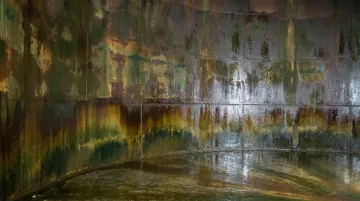
AFTR's field teams work regularly with wastewater treatment facilities on this type of liner deterioration — assessing the extent of microbial-driven damage and relining affected tanks to return them to rated chemical service.
Manufacturing Defects and Age-Related Laminate Degradation
Manufacturing vulnerabilities create weak points that become initiation sites for both corrosion and blistering — sometimes well before a tank reaches its expected service life.
Common manufacturing issues include:
- Insufficient corrosion liner thickness (the barrier should be 2.5–6.3 mm, with the innermost layer approximately 95% resin)
- Entrapped air voids in the laminate
- Incomplete resin cure leaving unreacted components
- Excessive glass-to-resin ratio in the corrosion liner
For above-ground tanks, UV exposure adds a separate degradation pathway. Research on vinyl ester resin specimens exposed to 4,000 hours of UV found up to 40% lower average strain-to-failure and up to 60% lower average specific toughness compared to unexposed specimens, along with increased carbonyl content from oxidative photodegradation. Surface crazing, chalking, and eventual resin erosion follow — and can reach structural layers beneath.
Repeated thermal cycling compounds UV damage by stressing fittings and laminate joints — common initiation points for cracking and delamination. Tanks without a UV-stabilized exterior gelcoat or protective coating are particularly vulnerable to this progression.
Warning Signs and Consequences of Delayed Action
Corrosion and blistering rarely appear without early indicators. The problem is that some of the most actionable signs are easy to dismiss — and some of the most dangerous are invisible without specialized testing.
Warning Signs to Watch For
Visible indicators:
- Surface blistering or bubbling on interior or exterior walls
- Laminate that feels soft, spongy, or flexible when pressed
- Interior discoloration, staining, or resin chalking
- Unusual odors or evidence of product contamination
- Weeping or seeping at fittings and seams
Subsurface indicators (require instrument testing):
- Laminate delamination visible at cut edges or fitting interfaces
- Wall thinning detectable only through ultrasonic testing
- Capillary migration of stored product beneath the corrosion coat
AFTR's FTPI-certified inspectors use ultrasonic testing, laser scanning, and high-intensity backlight methods to find what visual inspection misses — specifically capillary migration and internal voids that indicate stored product has already penetrated the corrosion barrier and begun infiltrating the structural layers.
A hydrostatic test only confirms containment at that exact moment. A tank can pass today and fail three months later.
Consequences of Delayed Action
Left unaddressed, degradation moves in a fixed sequence: liner breach, structural laminate attack, wall thinning, loss of load-bearing capacity, and ultimately catastrophic failure. The downstream consequences extend well beyond the tank itself:
- EPA regulatory exposure — SPCC rules require secondary containment for bulk chemical storage; a tank failure without it creates immediate liability
- Regulatory violations — particularly serious in chemical service and potable water applications
- Unplanned operational shutdown — with the multi-week downtime that emergency tank replacement requires
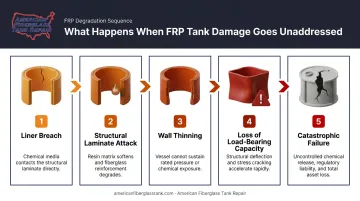
Relining a compromised tank recovers vessels that would otherwise be condemned — at a fraction of new-tank capital cost and without the long lead times for replacement vessels. Catching liner damage before it reaches the structural laminate is the difference between a planned relining job and an emergency replacement.
How to Prevent FRP Tank Corrosion and Blistering
Most FRP tank failures are preventable. They stem from lapses in specification, maintenance, or monitoring — all of which can be addressed.
Specify the Correct Resin System
Before selecting or relining a tank, confirm resin type and corrosion liner thickness against the stored chemical's identity, concentration, and operating temperature. Use the resin manufacturer's corrosion resistance tables and cross-reference with ASTM C581 to screen candidates.
Ashland's Derakane product line, for example, publishes specific temperature limits for dozens of chemicals: 1–15% HCl is rated to 80°C for certain vinylester formulations, 0.5% NaOH to 80°C, and 2% sodium hypochlorite to 65°C.
This verification step must be repeated any time the stored chemical changes, even if the tank shows no visible damage. Incompatibility damage can begin immediately upon contact.
Maintain and Inspect the Internal Corrosion Liner
The corrosion barrier is the tank's primary defense. It must be maintained at its original specified thickness — any thinning, pinhole, or holiday creates an entry point for moisture and chemical attack that will expand over time.
AFTR's inspection program covers the full tank: interior corrosion coat, structural body, exterior shell, and nozzle interfaces. These methods detect:
- Laminate voids and blistering not visible from the surface
- Wall thinning through ultrasonic measurement
- Capillary migration of product beneath the corrosion coat via high-intensity backlight testing
- Delamination and disbondment at structural layers
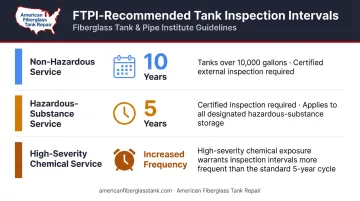
FTPI's inspection interval recommendations provide a starting framework: certified external inspection every 10 years for tanks over 10,000 gallons in non-hazardous service, and every 5 years in hazardous-substance service. High-severity chemical service warrants more frequent evaluation.
Control Water Accumulation and Protect Against UV
For MIC risk reduction:
- Establish regular drainage and bottom cleaning protocols
- Design in recirculation or agitation for tanks in continuous service
- Implement proper venting to reduce condensation in vapor spaces
- Consider microbiological testing for water, wastewater, and biofuel storage applications
For above-ground tanks facing UV and thermal risk:
- Apply a UV-stabilized exterior gelcoat or protective coating at installation
- Inspect the exterior surface annually for crazing, chalking, or resin erosion
- Evaluate insulation for tanks subject to wide temperature swings, particularly at fittings and laminate joints
Tips for Long-Term FRP Tank Protection
A few practices compound the value of all the prevention measures above:
- Establish a formal inspection schedule calibrated to service severity. Chemical service tanks warrant shorter intervals than water storage. Document all findings, repairs, and resin system changes in a tank service log — trends over time are more informative than any single inspection.
- Train maintenance personnel on basic visual indicators: surface blistering, discoloration, soft spots, weeping at fittings. Operators who recognize early signs can trigger professional inspection before damage progresses to the structural laminate.
- Use qualified FRP repair specialists for any liner work. Improper materials or inadequate surface preparation can trap moisture and accelerate the very degradation they're meant to stop.
Facilities managing multiple FRP vessels across chemical, water, and wastewater operations benefit from structured maintenance programs — like those AFTR provides — where repair materials are matched to the specific chemical in service.
Conclusion
Every case of FRP tank corrosion or blistering traces back to a specific, preventable cause. The most common culprits are:
- Chemical incompatibility between stored media and the liner resin
- Moisture ingress through surface cracks or degraded barrier coats
- Microbial activity accelerating corrosion from the inside out
- Manufacturing defects such as voids, delamination, or insufficient cure
- UV and thermal degradation wearing down the outer laminate over time
Each of these failure modes can be addressed through proper tank specification and consistent maintenance.
Addressing these issues proactively costs far less — in time, money, and downtime — than managing a structural failure after the fact. Facilities that treat FRP tank integrity as an ongoing discipline maintain regulatory compliance and avoid the operational disruption that comes with an unexpected failure.
Frequently Asked Questions
Do fiberglass tanks corrode or rust?
FRP tanks do not rust — rust is an iron-oxide reaction, and fiberglass contains no iron. However, the resin matrix and inner corrosion liner can degrade through chemical attack, osmotic blistering, and microbial-influenced conditions, making them susceptible to failure without proper maintenance.
How long will a fiberglass tank last?
A well-specified and properly maintained FRP tank can last 30–40 years or more in water service. Tanks storing aggressive chemicals like bleach may see 10–20 years, while incompatible chemical exposure or neglected liners can reduce service life to under 3 years.
Can fiberglass tanks and piping be repaired?
Yes, in most cases. Corrosion liner damage, blistering, delamination, and structural thinning can all be addressed by qualified FRP specialists using compatible resin systems and laminates. Even tanks that have breached their corrosion barrier can often be relined when the structural laminate remains intact.
What is osmotic blistering in an FRP tank?
Osmotic blistering occurs when water permeates the laminate, accumulates in subsurface voids, and builds hydraulic pressure that pushes the surface outward into a visible blister. It's a distinct mechanism from chemical corrosion but frequently occurs alongside it once the inner liner is compromised.
What are the early warning signs of FRP tank corrosion?
Key indicators include visible surface blistering, laminate that feels soft or spongy, interior discoloration or staining, weeping at fittings, and product contamination. Wall thinning often precedes visible signs, making periodic ultrasonic inspection critical for detecting damage before it reaches the structural laminate.
Which resin type offers the best chemical resistance for FRP tanks?
Vinylester resins generally outperform isophthalic polyester across a broad range of aggressive chemicals, while epoxy resins perform best in highly alkaline environments. The right choice depends on the specific chemical, its concentration, and operating temperature — verify against the resin manufacturer's published corrosion resistance data before specifying or relining.