The problem is that premature failures do occur, and the consequences are rarely minor. A through-wall breach in a chemical storage tank can trigger regulatory reporting, facility shutdowns, environmental remediation costs, and liability exposure that dwarfs any repair budget.
What makes these failures frustrating is that most are not random. They trace back to a handful of specific, identifiable causes — and the damage typically begins long before any visible sign appears. Understanding those causes is the most practical step a facility can take toward protecting its FRP investment.
Key Takeaways
- Five specific failure causes consistently cut FRP tank lifespan short — and most are avoidable with the right knowledge.
- The most dangerous damage starts invisibly — inside the laminate, at joints, or beneath the surface coating.
- Most premature failures are preventable with correct material selection, qualified repairs, and a consistent inspection schedule.
- Catching warning signs early dramatically reduces repair costs and eliminates catastrophic risk.
The 5 Real Causes of Premature Fiberglass Tank Failure
Fiberglass is inherently strong and corrosion-resistant, but in-service FRP tanks fail for specific, traceable reasons. Most catastrophic failures build over months or years, driven by one or more of these five causes.
Cause 1: Corrosion Barrier Breakdown from Chemical Attack
The inner resin-rich corrosion liner is the tank's first line of defense. It sits between the stored chemical and the structural laminate, designed to resist chemical penetration before it reaches the structural layers.
When a tank stores chemicals outside the resin's rated tolerance — wrong concentration, elevated temperature, or a different chemical than the liner was specified for — the liner begins to degrade. The progression typically looks like this:
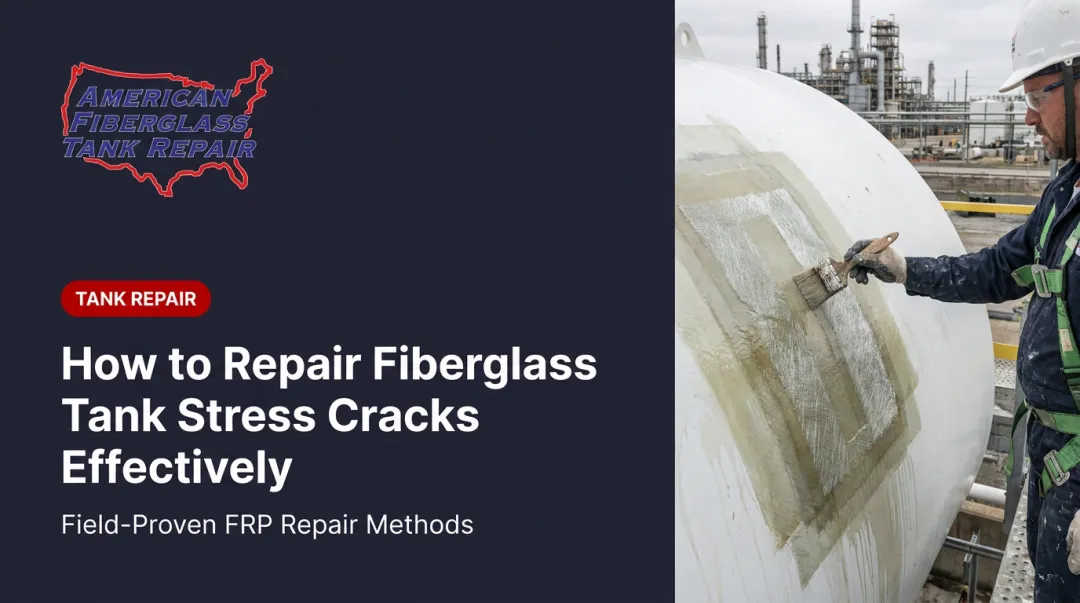
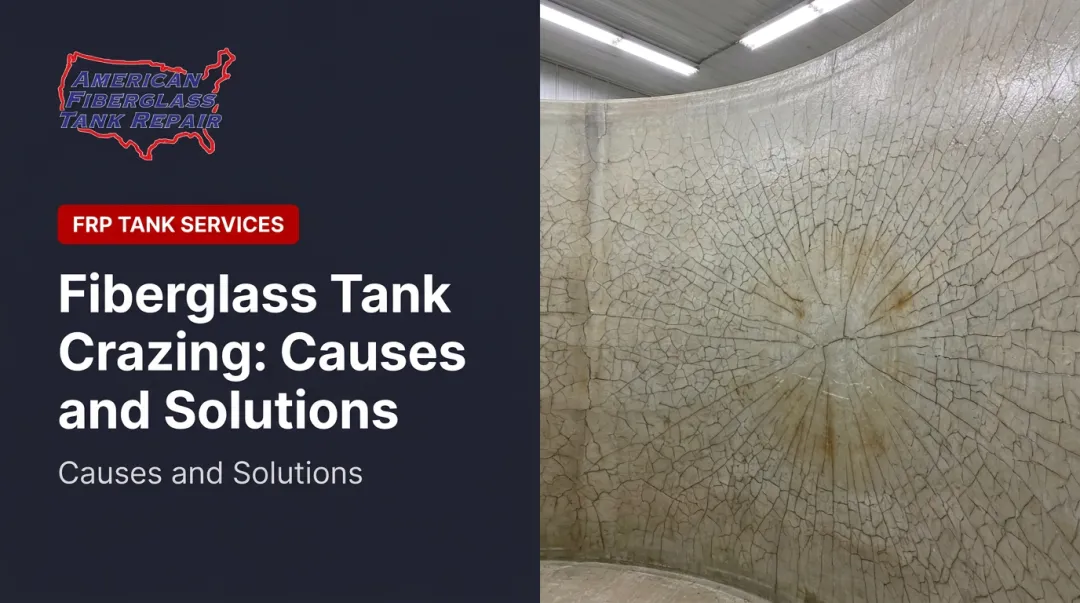
- Micro-cracking forms in the resin matrix, invisible to the naked eye but already allowing chemical ingress
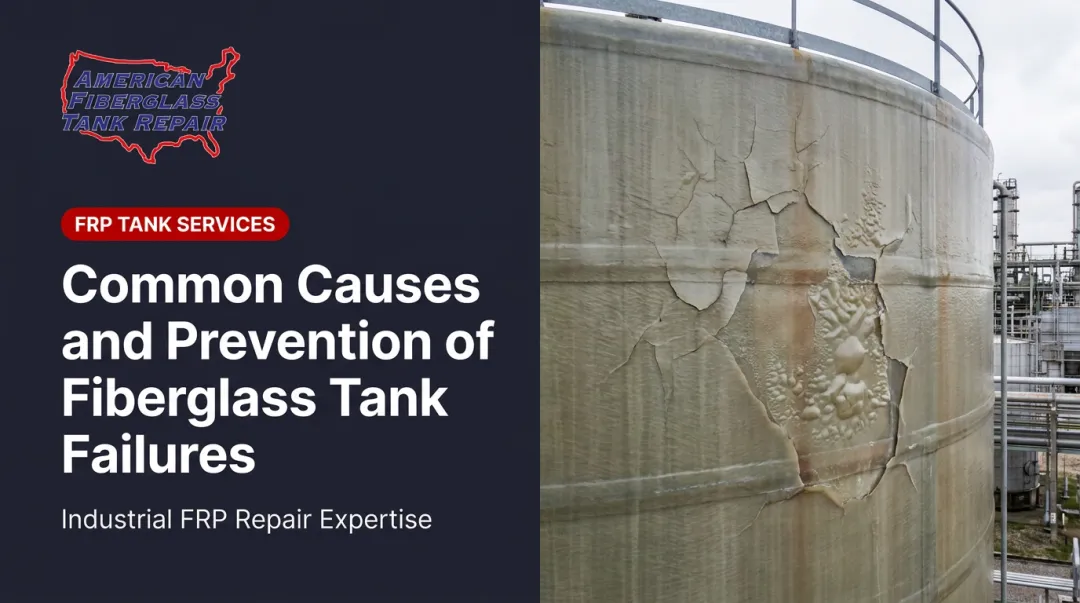
- Blistering and delamination develop as the chemical works into the laminate layers
- Structural laminate exposure occurs as the corrosion barrier is fully compromised
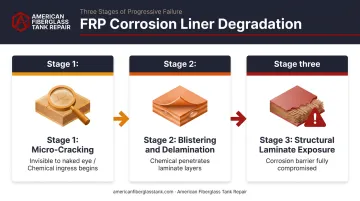
Research published in Engineering Failure Analysis on GFRP tanks storing 35% hydrochloric acid found that HCl diffused into the FRP, corroded the matrix-glass interface, and created voids in both the chemical-resistant and reinforced layers. Estimated service lifetime for that application was 15 to 20 years — but that assumes the resin was correctly specified from the start.
Resin selection depends on the specific chemical, its concentration, its specific gravity, and operating temperature. ASTM D3299 and ASTM D4097 both address corrosion-resistant FRP tank design, but they establish a framework, not a substitute, for chemical-specific compatibility verification.
Common triggers AFTR's field teams observe:
- Concentration increases beyond the resin's original design threshold
- Temperature fluctuations that exceed rated limits for the liner resin
- Stored chemical changes without re-evaluating resin compatibility
Sodium hypochlorite is among the most aggressive chemicals commonly stored in FRP vessels. AFTR has refurbished hundreds of tanks storing NaOCl, NaOH, ferric chloride, and HCl, and corrosion barrier degradation from chemical incompatibility or temperature excursion is a recurring finding.
Cause 2: Manufacturing Defects That Were Never Caught
Not every tank leaves the factory in perfect condition. Air voids, dry fiber patches, resin-starved zones, and inconsistent laminate thickness are fabrication defects that create internal weak points: concentrated stress locations that perform fine at delivery but eventually crack or delaminate under cyclic service loads.
These defects are not always detectable through standard visual inspection at installation. Without a post-installation baseline using non-destructive testing (NDT) methods, they have no opportunity to be identified and addressed before they become failure points.
The Fiberglass Tank & Pipe Institute (FTPI) has noted that manufacturing defects, overheating, or processing problems can reduce the integrity of an FRP tank interior over time. The challenge is that this degradation is typically silent. The tank shows no outward signs until a threshold is crossed.
AFTR's inspection teams use ultrasonic testing, laser methods, and high-intensity backlight examination to assess what's happening inside the structural body of the tank, not just at the surface. This combination detects disbondment, resin-starved zones, and capillary migration of liquid product beneath the corrosion coat.
All of these conditions can originate with manufacturing defects that were never caught at installation.
Hydrostatic testing limitation: A tank that passes a hydrostatic test at installation may fail three months later. Hydrostatic testing only confirms the tank can hold liquid at that moment. It reveals nothing about internal laminate quality or early-stage degradation.
Cause 3: Improper Repairs and Unauthorized Modifications
Field repairs made with incompatible resins, incorrect laminate schedules, or without proper surface preparation don't just fail to fix the problem. They often make it worse.
A poorly bonded patch will peel under stress. A repair made with the wrong resin creates a new stress concentration point at the patch boundary. And an improper repair can mask underlying damage, leaving a structurally compromised area beneath a surface that looks repaired.
Unauthorized nozzle additions and structural modifications carry a similar risk. Any fitting added without engineering review introduces a stress concentration into the tank shell. If load transfer wasn't accounted for in the modification design, fatigue cracking at the nozzle junction is a likely outcome.
Improper repairs are among the most common findings in AFTR's field inspections, particularly in tanks that have changed ownership or been serviced by general contractors without FRP-specific qualifications.
The compromised area is frequently larger than what's visible on the surface, meaning the scope of remediation is greater than it would have been had the repair never been attempted.
What qualified repair requires:
- Resin formulation matched to the stored chemical, concentration, and temperature
- Correct laminate schedule applied in the proper sequence
- Surface preparation that achieves adequate adhesion to the existing laminate
- Curing conditions that meet resin manufacturer specifications
- Engineering review for any structural modification or nozzle addition
FTPI guidelines call for qualified inspectors to have either an engineering degree with one year of FRP experience, or a high school education with three years of FRP manufacturing, repair, or inspection experience. General maintenance contractors without FRP-specific qualifications rarely meet either standard.
Cause 4: Physical Stress from Settlement, Uplift, and External Loading
FRP tanks are engineered for defined load conditions. When in-service loads exceed that design envelope, the tank absorbs stress it was never intended to handle, and that stress concentrates at specific, repeatable locations.
Common sources of unplanned physical stress:
- Uneven foundation settlement that creates differential loading across the tank bottom
- Hydraulic uplift in high-water-table areas for buried or below-grade tanks
- Hard-piped connections that transfer thermal expansion and external piping loads directly into the tank shell
- Vacuum conditions or over-pressurization beyond design limits
- Anchor systems that create point loads rather than distributing force across the tank structure
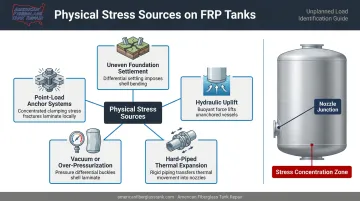
These stresses typically manifest first at nozzle junctions, at the knuckle between the shell and the bottom, and at anchor attachment points. These are the same locations AFTR's inspection teams prioritize during structural assessments.
Fatigue cracking in these areas develops gradually under cyclic loading. The tank may show no visible distress for years before reaching a failure threshold, which is exactly why these stress mechanisms are easy to miss without periodic NDT inspection focused on high-stress structural zones.
One practical, often-overlooked fix: flexible couplings on all pipe connections. Rigid connections transfer piping loads directly into the tank shell. Flexible couplings break that load path.
Cause 5: Deferred Maintenance and the Absence of a Scheduled Inspection Program
Every other cause on this list becomes a failure when deferred maintenance gives it time to progress unchecked.
A small corrosion liner defect at year two is a repair. The same defect at year ten, still uninspected, may be a through-wall breach. A hairline crack at a fitting junction is a targeted repair early on, and a structural failure if left unaddressed through multiple operating cycles.
Many facilities run FRP tanks on a "run to fail" basis with no documented inspection history. This eliminates the possibility of planned, low-cost interventions and creates regulatory exposure when failure does occur.
EPA's SPCC rule requires regular integrity testing and frequent visual inspection for above-ground bulk storage containers. Inspection and testing records must be kept for at least three years, with formal reports recommended for the life of the container.
Facilities without inspection records have no degradation trend data, no documentation baseline, and no defensible position in a regulatory or liability situation.
FTPI's recommended practice (FT&V RP 2007-1) establishes inspection intervals of every five years for hazardous-substance service, and every ten years for tanks over 10,000 gallons in other service, as a minimum. For tanks storing aggressive chemicals, more frequent assessment is prudent.
What Happens When These Causes Go Unaddressed
Left unaddressed, any of these five causes escalates into consequences that reach far beyond the tank itself:
- Chemical releases trigger regulatory reporting requirements and potential fines
- Facility shutdowns create unplanned production losses that typically exceed repair costs by a wide margin
- Environmental remediation following a soil or groundwater contamination event can run into the hundreds of thousands of dollars
- Safety exposure from structural failure or chemical release puts personnel at direct risk
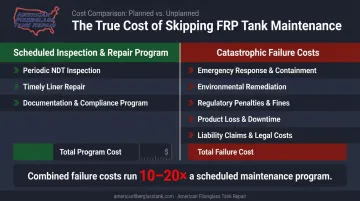
A failed tank carries costs well beyond replacement: emergency response, environmental cleanup, regulatory penalties, product loss, and liability claims all stack on top. That combined total routinely runs 10–20× what a scheduled inspection and repair program would have cost.
Warning Signs Your Fiberglass Tank May Be Approaching Failure
Most failure mechanisms originate below the surface, but observable warning signs appear well before total failure. Any of the following warrant immediate professional evaluation:
Surface and Exterior Indicators
- Surface crazing or fine crack networks, particularly near fittings, base joints, or the lower shell
- Chalky or discolored surface texture suggesting resin degradation or UV damage
- Shell distortion, visible bulging, or out-of-roundness
Signs of Active Liquid Migration
- Weeping, staining, or mineral deposits on the tank wall
- Soft or spongy areas when the tank wall is pressed — indicating liquid has migrated into the laminate
- New odors in the tank vicinity without an obvious external source
Structural Stress Indicators
- Unusual noises under pressure or vacuum cycles
- Cracks appearing at nozzle junctions or anchor attachment points
- Any visible gap or separation at fittings or base joints
AFTR's inspection teams look for spidering, disbondment, emulsification, floor stress cracking, and shell distortion: conditions that precede visible surface symptoms by months or years. When damage becomes visible from outside, the underlying laminate has usually been deteriorating well before any external sign appeared — which is why scheduled inspection matters more than waiting for something obvious to show up.
How to Prevent Premature Fiberglass Tank Failure
Prevention is a sequence of decisions made at design, procurement, installation, and in-service stages — not a single action. Each stage either reduces or compounds failure risk.
Verify Resin and Lining Compatibility Before Commissioning and After Any Process Change
The corrosion liner resin — isophthalic polyester, vinyl ester, or epoxy — must be specifically selected against the stored chemical, its concentration range, and its operating temperature. Not just the general chemical family.
Key compatibility thresholds to know:
- Isophthalic polyester resins are not recommended where pH exceeds 10.5
- High-crosslink-density vinyl ester resins can handle liquid temperatures up to 215°F
- Epoxy vinyl ester resins provide resistance to strong acids and bases but require careful evaluation for oxidizing chemicals
Any change in stored chemical, concentration, or operating temperature is a trigger to re-evaluate compatibility. This step is routinely skipped — and it frequently initiates corrosion barrier failure.
Require a Post-Installation Baseline Inspection Using Non-Destructive Testing
A baseline inspection immediately after installation documents the tank's actual condition, captures any manufacturing defects present at delivery, and establishes the benchmark against which all future inspections measure degradation. Without a baseline, there is no way to distinguish normal aging from accelerated damage during later assessments.
Catching a manufacturing defect at installation costs a fraction of addressing structural damage years later.
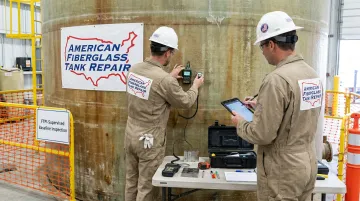
AFTR conducts comprehensive baseline inspections using ultrasonic thickness testing, high-intensity backlight, and laser methods — supervised by FTPI-certified inspectors — that reveal subsurface conditions including laminate quality and any early-stage capillary migration (moisture movement through micro-gaps in the laminate).
Use Only Qualified, Certified Professionals for Any Repair or Modification
FRP repair requires specific resin formulation knowledge, surface preparation expertise, correct laminate sequencing, and curing condition management. General contractors cannot reliably meet these requirements. AFTR's field projects follow the same laminate protocols used in tank manufacturing shops, using custom-blended resins selected for the specific stored chemical and temperature.
Any structural modification — adding nozzles, changing anchor systems, increasing supports — requires a separate engineering review to confirm that load transfer and stress concentration remain within design limits.
Establish a Documented, Scheduled Inspection and Maintenance Program
A structured program should include:
- Regular visual inspection at defined intervals
- Periodic NDT by certified inspectors (ultrasonic, backlight, laser)
- Written documentation of all findings, repairs, and resin specifications
- Defined thresholds that trigger repair action before structural involvement
AFTR offers both periodic scheduled programs and one-time inspection surveys, with detailed reports covering interior corrosion coat condition, structural body assessment, exterior shell evaluation, and nozzle interface integrity. All work is supervised by FTPI-certified inspectors.
A scheduled program shifts maintenance from a reactive cost to a planned budget item. It also builds the inspection record that protects tank owners in regulatory and liability situations.
Tips for Long-Term FRP Tank Reliability
Most premature FRP tank failures are preventable. The causes covered above — chemical incompatibility, improper installation, deferred maintenance — share a common thread: they worsen silently until intervention becomes expensive. These practices keep problems visible and manageable.
- Schedule ultrasonic wall thickness measurements at regular intervals to track degradation trends over time, not just point-in-time snapshots
- Keep a written inspection log for every tank — baseline readings, inspection dates, findings, repairs, and resin/lining specifications
- Use flexible couplings on all pipe connections to prevent external piping loads and thermal expansion forces from transferring stress into the tank shell
- Train operations staff to recognize early warning signs: surface crazing, weeping at fittings, and shell discoloration should be flagged for professional evaluation — not dismissed as normal aging
Conclusion
Premature FRP tank failure follows a pattern. The five causes covered in this article are specific and identifiable, and nearly all of them are preventable through informed material selection, quality fabrication, qualified repairs, and consistent inspection.
Proactive maintenance costs a fraction of emergency response, environmental remediation, or full tank replacement. Facilities that invest in regular professional inspection and timely repair consistently reach — and often exceed — the full designed service life of their FRP assets.
The pattern holds across industries:
- Inspect on schedule before minor corrosion coat degradation becomes structural damage
- Repair with matched materials so chemistry and laminate construction hold long-term
- Document everything so each inspection builds on the last
If your facility operates FRP tanks without a documented inspection history, that's the place to start. A baseline assessment establishes where things stand today and replaces reactive firefighting with a repeatable maintenance program.
Frequently Asked Questions
How long do FRP tanks last?
Well-maintained FRP tanks typically last 20–30+ years under normal service conditions. Tanks storing aggressive chemicals like 35% HCl have documented service lifetimes of 15–20 years even under correct specifications. Without routine inspection and timely repairs, failures occur well before either threshold.
What is the most common cause of premature fiberglass tank failure?
Corrosion barrier degradation — driven by chemical incompatibility, concentration changes, or temperature exceedances — is the most frequently identified root cause in field failure investigations. Sodium hypochlorite is among the most aggressive chemicals AFTR encounters in FRP vessels, followed by sodium hydroxide, ferric chloride, and HCl.
Can a fiberglass tank be repaired after it starts showing damage?
Many forms of FRP damage — corrosion liner erosion, localized delamination, and cracking — are repairable when caught early. Even after the corrosion barrier is breached, the structural laminate often remains sound enough to accept a new corrosion layer, making relining a viable alternative to full replacement.
How often should fiberglass tanks be inspected?
The Fiberglass Tank & Pipe Institute (FTPI) recommends trained external inspections every five years for hazardous-substance service and every ten years for larger tanks in other service. Annual visual inspections supplemented by periodic NDT are a solid baseline, with increased frequency for tanks storing aggressive chemicals.
What makes an improper repair worse than the original damage?
Repairs made with incompatible resins or incorrect laminate schedules fail to bond to the existing laminate, create new stress concentration points at the patch boundary, and can mask underlying damage. The result is a tank that appears repaired but is structurally weaker at the repair location than before the attempt.
Do buried or underground fiberglass tanks face different failure risks?
Underground FRP tanks are protected from UV exposure and external physical impact, but face distinct risks from soil settlement, hydrostatic uplift in high-water-table areas, and potential external chemical exposure from contaminated groundwater. EPA regulations also require release detection monitoring at least every 30 days for underground storage tank systems.