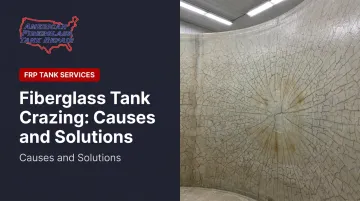
That spiderweb pattern of fine surface cracks may look like a cosmetic issue. It often isn't. Crazing can signal that the resin matrix is breaking down, and without identifying the root cause, what starts as surface micro-cracking can progress to chemical permeation, delamination, and eventual structural failure.
Research on FRP tank degradation estimates the service life of FRP tanks storing 35% HCl at less than 20 years — and that's with proper resin selection. Crazing that accelerates chemical attack can shorten that window considerably.
Key Takeaways
- Crazing is a network of micro-voids or hairline cracks confined to the resin surface layer — distinct from through-wall cracking
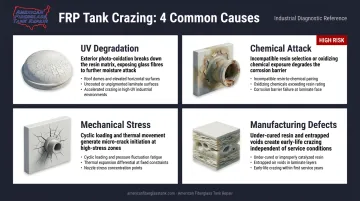
- The four primary causes: UV degradation, chemical attack on the corrosion barrier, mechanical/structural stress, and manufacturing or curing defects
- Ignored crazing lets stored chemicals reach the structural laminate, causing delamination and containment failure
- Warning signs include surface dulling, yellowing, and visible spiderweb crack patterns on the exterior or interior liner
- Prevention requires correct resin selection, UV protection, proper installation, and regular professional inspections
Common Causes of Fiberglass Tank Crazing
Crazing in FRP is defined by ASTM D883 as "apparent fine cracks at or under the surface" — meaning the glass fiber reinforcement is typically unaffected at first. It's the resin matrix that fails first, developing micro-voids that compromise the surface layer's integrity before the structural laminate is touched.
Crazing rarely has a single cause. It develops when one or more stress conditions exceed the resin system's tolerance — and identifying the specific cause determines both the repair approach and the most effective prevention strategy. Four conditions account for the majority of cases.
UV Degradation
Prolonged UV exposure photo-oxidizes the organic resin matrix on exterior surfaces. Peer-reviewed weathering research confirms that UV exposure causes resin chalking and surface cracking in FRP materials — a process that strips gloss, yellows the surface, and eventually opens micro-cracks.
Highest-risk areas:
- Tank roof domes and flat tops
- Upper sidewalls on outdoor tanks
- Any uncoated surface without a UV-inhibiting gel coat or surface veil
Standard FRP resins without UV inhibitors are especially susceptible. A UV-stable surface veil — such as a Nexus veil incorporated into the outer laminate layer — significantly slows this degradation.
Chemical Attack on the Corrosion Barrier
The corrosion barrier is typically 2.5 to 6.3 mm thick, consisting of a resin-rich inner layer backed by chopped-strand-mat laminate. When the stored chemical is incompatible with the resin system, that barrier softens, loses tensile strength, and develops micro-cracks under the hydraulic pressure of the stored fluid.
Oxidizing chemicals like sodium hypochlorite are particularly aggressive. Interplastic's resin data explicitly cautions that isophthalic polyester resins are not recommended for oxidizing compounds, while vinyl ester systems — such as Ashland's Derakane formulations — offer excellent resistance to sodium hypochlorite and similar chlorinated solutions.
Using the wrong resin for the chemical service accelerates crazing and corrosion barrier failure.
Mechanical and Structural Stress
Repetitive tensile stress causes fatigue crazing, concentrated at stress points like nozzle connections, bottom knuckles, and seams. Common mechanical stressors include:
- Cyclic fill/empty loading
- Thermal expansion and contraction
- Over-pressurization or vacuum conditions
- Improperly spaced saddle supports
ASTM D3299 explicitly calls for special design consideration for tanks subject to cyclic loading, large temperature swings, and service conditions beyond standard atmospheric pressure. Thermal cycling is especially problematic for tanks storing heated chemicals or those in outdoor environments with large day/night temperature differentials.
Manufacturing Defects and Improper Cure
A resin-rich surface layer with insufficient glass fiber reinforcement, air voids, dry spots, or under-cured resin creates built-in stress concentrators that initiate crazing earlier in the tank's life. Barcol hardness testing (per ASTM D2583) is the standard field method for assessing resin cure state — and under-cured resin has a lower glass transition temperature, making it more susceptible to both thermal and chemical attack.
This category of crazing tends to appear within the first few years of service rather than after decades of use — a key diagnostic clue that the root cause is fabrication rather than service environment.
What Happens If Crazing Is Left Unaddressed
Surface crazing creates micro-voids in the corrosion barrier. Once those voids are present, stored chemicals begin permeating past the barrier into the structural laminate layers. From there, the progression accelerates:
- Resin degradation — Barcol hardness drops as the structural laminate absorbs chemical
- Delamination — Layers separate as the resin-fiber bond breaks down
- Through-cracking — Micro-voids coalesce into discrete fractures
- Containment failure — Chemical release, with potential regulatory, safety, and environmental consequences
Ashland's Derakane guidance confirms this directly: for strongly diffusing media like HCl, thicker and better-cured linings provide higher diffusion resistance and longer life expectancy. Thin or degraded barriers offer little resistance once crazing opens the surface.
The EPA's guidance on liquid storage tank rupture hazards describes the real-world consequences of tank failures — chemical spills, emergency shutdowns, and the regulatory and safety implications that follow. Targeted repair of early-stage crazing costs a fraction of emergency response, containment, and regulatory remediation combined.
Catching crazing before it reaches that point comes down to knowing what to look for. These observable indicators warrant immediate professional inspection:
Warning Signs You're About to Experience Serious Damage
- Yellowing, chalking, or gloss loss on the gel coat or interior liner — particularly in UV-exposed or chemically active zones
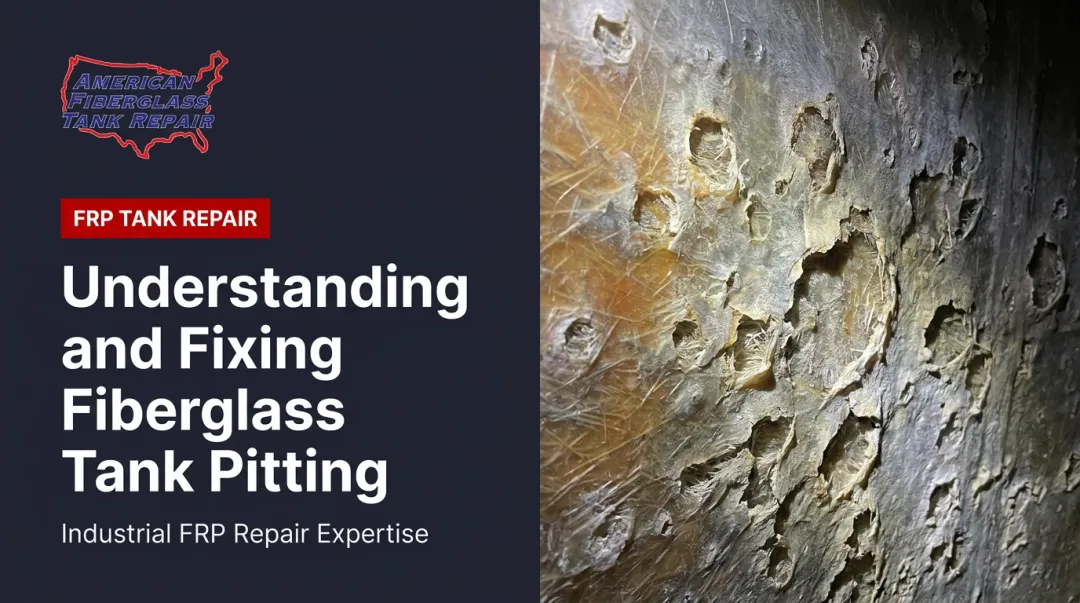
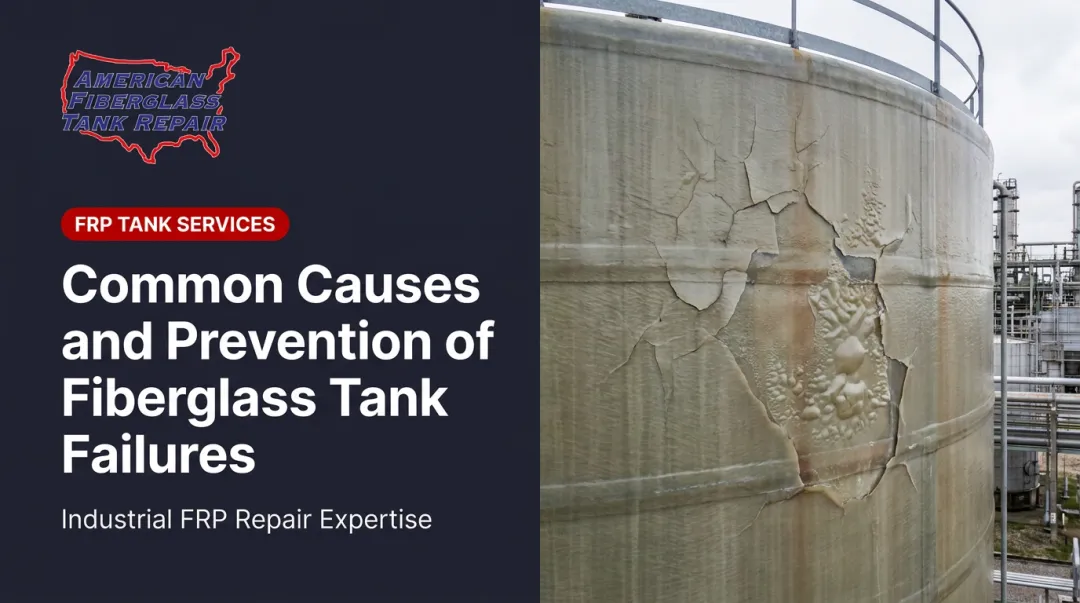
- Map-cracking on the roof dome or corrosion barrier surface; unlike surface scratches, these form network patterns clustered at stress points
- Soft spots or hollow sounds when tap-tested — delaminated areas adjacent to craze zones mean resin degradation has already moved below the surface
How to Assess and Repair Fiberglass Tank Crazing
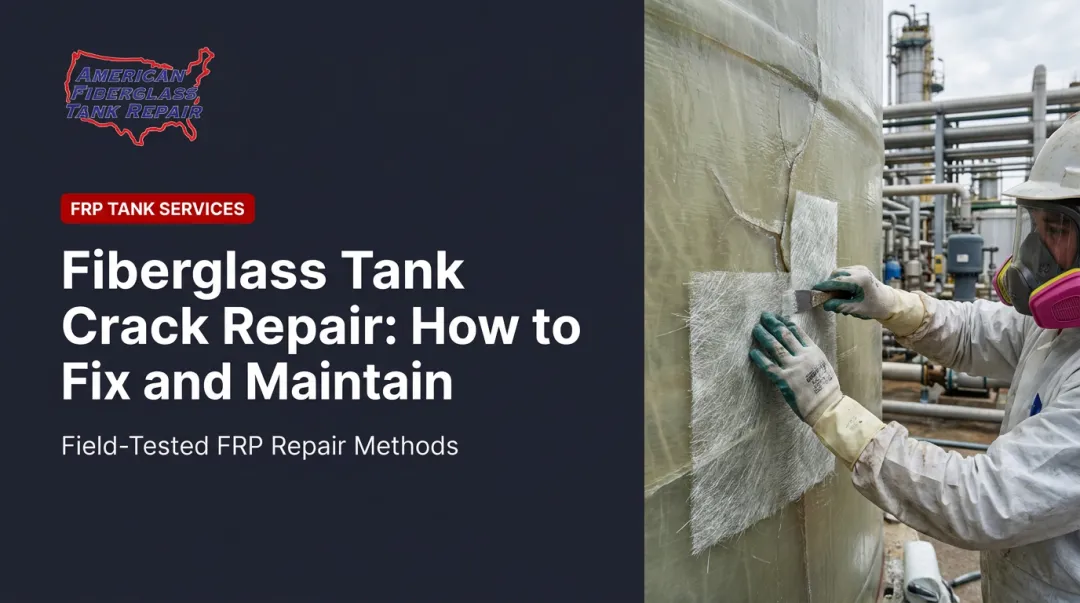
Unlike polyethylene or steel tanks, FRP tanks with crazing can often be repaired rather than replaced, provided the structural laminate layers remain intact. That determination cannot be made by visual inspection alone.
Assessment Methods
Professional assessment uses three primary non-destructive methods:
- Ultrasonic thickness testing (per ASTM E797) — Measures laminate thickness and detects degradation behind visible craze zones
- High-intensity backlight inspection — Reveals sub-surface voids and laminate separation not visible under normal lighting
- Barcol hardness testing (per ASTM D2583) — Assesses resin cure state; low readings in craze zones indicate chemical softening of the structural layer
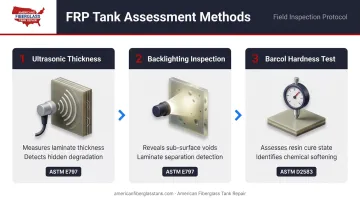
AFTR's Fiberglass Tank & Pipe Institute certified inspectors use exactly this combination — ultrasonic, laser, and high-intensity backlight testing — to determine whether crazing is cosmetic or has compromised the structural laminate. Their process specifically checks for capillary migration of liquid product beneath the corrosion coat, which is the critical threshold between surface repair and structural intervention.
Repair Options
Surface-level repair (cosmetic crazing):
- Abrade the degraded resin-rich surface to remove compromised material
- Solvent-wipe clean and verify Barcol hardness in adjacent areas
- Apply compatible new corrosion barrier coat — isophthalic, vinyl ester, or epoxy matched to the chemical service
- Finish with UV-stable surface veil for any exterior repairs
Structural repair (chemical permeation into laminate):
- Grind out compromised layers to sound material confirmed by hardness testing
- Build up new hand lay-up laminate plies using compatible resin and appropriate glass media
- Re-establish a fresh corrosion barrier using a resin system that matches or exceeds the chemical resistance of the original
- Conduct post-cure inspection before return to service
Resin and laminate selection across both repair types depends on four factors: stored chemical, operating temperature, existing laminate condition, and the required chemical resistance grade. For reference, AFTR draws from custom-blended isophthalic and terephthalic polyester, vinyl ester, and epoxy resin systems alongside more than 45 fiberglass mat, chopped strand, Nexus, Harlar, and carbon veil laminates to match those variables precisely.
When repair isn't sufficient: Even the best material selection cannot salvage a tank when the damage is too extensive. If ultrasonic testing shows crazing has compromised the full structural wall thickness, or delamination extends well beyond localized craze zones, full tank relining or replacement should be evaluated. That determination requires engineer-reviewed findings — not a field visual alone.
How to Prevent Fiberglass Tank Crazing
Prevention combines decisions made at procurement with operational discipline maintained throughout the tank's service life.
Select the Right Resin System for the Chemical Service
This is the single most impactful prevention step. The resin system must be chemically compatible with the stored substance at the actual operating concentration and temperature — not just the generic chemical name.
Key guidance:
- Isophthalic polyester resins are not suitable for oxidizing compounds like sodium hypochlorite
- Vinyl ester systems provide superior resistance for chlorinated oxidizers, concentrated acids, and aggressive solvents
- Epoxy systems are preferred for certain caustic and solvent services
- Consult resin manufacturer compatibility guides (Ashland Derakane, Interplastic CoREZYN) and design to standards like ASTM D3299 or ASME RTP-1
Barrier thickness is directly proportional to service life. Ashland's guidance is clear: thicker barriers are warranted for aggressive oxidizers — specify accordingly at fabrication, not after the first inspection.
Apply UV Protection on Exterior Surfaces
For outdoor or UV-exposed tanks:
- Specify a UV-inhibiting pigmented gel coat at fabrication
- Incorporate UV-stable surface veils (Nexus or C-glass) into the outer laminate layer
- Apply aliphatic UV-resistant topcoats to tanks already in service without adequate protection
Focus attention on roof domes and upper sidewalls. UV-protective coatings degrade over time and should be inspected and refreshed as part of routine maintenance.
Ensure Proper Support, Installation, and Operating Conditions
- Install tanks on properly spaced saddle supports per manufacturer design
- Never exceed rated pressure or apply vacuum beyond design parameters
- Ensure anchor systems don't impose point loads on the tank shell
- Maintain operating temperatures within the resin system's rated service range — this is especially critical for tanks holding heated chemicals
Schedule Regular Professional Inspections
Industry standards support a comprehensive FRP tank inspection every 2–5 years depending on chemical service aggressiveness. Tanks storing sodium hypochlorite and other oxidizers warrant shorter intervals. Inspections should cover:
- Exterior visual check for UV crazing and surface degradation
- Interior corrosion barrier evaluation for chemical attack
- Non-destructive testing (ultrasonic, backlight) for subsurface laminate integrity
Surface-level crazing typically requires localized repair — a manageable cost. Once chemical permeation reaches the structural laminate, the remediation shifts to full relining or section replacement, which is significantly more disruptive and expensive.
Long-Term Maintenance Best Practices
A proactive monitoring program doesn't require significant resources — it requires consistency.
- Conduct biannual visual walk-arounds between formal inspections, checking for new crazing, discoloration, or surface changes. Document findings with dated photographs to track progression over time.
- Maintain a tank service log recording chemical concentrations, temperature ranges, fill/drain cycles, and product changes — so inspectors can correlate operating conditions with observed degradation patterns.
- Train operations staff to recognize early crazing indicators: surface dulling, localized spiderweb patterns, or changes in surface texture. Catching these signs early almost always means a manageable repair. Waiting until the laminate is permeated means a far more expensive one.
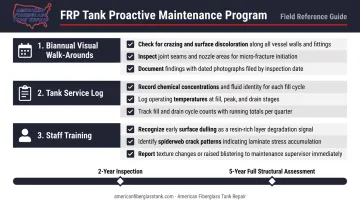
When these habits are in place, crazing rarely becomes a structural emergency. Correct resin selection at procurement, consistent UV protection, operation within design parameters, and scheduled professional inspections are what separate tanks that last 30+ years from those that fail prematurely.
Frequently Asked Questions
What causes acrylic crazing?
Acrylic (PMMA) crazing requires two conditions: residual stress and solvent or cleaner exposure. Common triggers include acetone, IPA, and stress concentrations at heat-bent or bonded seams. FRP crazing is different — it stems from UV degradation, chemical attack on the resin matrix, structural stress, or manufacturing defects, not surface chemical contact alone.
Can fiberglass tank crazing be repaired?
In most cases, yes. If the structural laminate layers are intact, FRP crazing can be repaired by abrading the degraded surface and applying compatible new resin layers. Full relining may be required if chemical permeation has reached the structural wall. A laminate assessment should always precede any repair decision.
What is the difference between crazing and cracking in a fiberglass tank?
Crazing is a network of micro-voids confined to or near the surface resin layer — not detectable by touch and still capable of supporting structural load. Cracking refers to discrete, through-thickness fractures that compromise containment directly. Crazing can progress to cracking if left unaddressed.
How do I know if crazing in my fiberglass tank is serious?
Surface dulling, spiderweb crack patterns, or soft/hollow-sounding areas adjacent to craze zones are warning signs worth escalating. Only non-destructive testing — ultrasonic thickness measurement and high-intensity backlight inspection — can confirm whether chemical permeation has reached the structural laminate.
How often should fiberglass tanks be inspected for crazing?
Most standards support comprehensive FRP tank inspections every 5 years, with 2-year intervals for tanks storing aggressive oxidizers like sodium hypochlorite. Biannual visual walk-arounds should supplement formal inspections to catch crazing between scheduled assessment cycles.
Does UV exposure cause crazing on the outside of fiberglass tanks?
Yes. UV photo-oxidizes the organic resin in the outer laminate layer, causing chalking, yellowing, and eventual micro-cracking. This is most common on uncoated roof domes and outdoor surfaces. UV-inhibiting gel coats, surface veils, or field-applied UV-resistant topcoats effectively prevent this degradation when properly maintained.