Introduction
FRP tanks are specified precisely because they resist corrosion. Yet corrosion-related damage in FRP tanks is a routine finding during professional inspections across chemical plants, water treatment facilities, and wastewater operations — not because fiberglass fails, but because the corrosion barrier protecting it does.
FRP tank corrosion doesn't attack the glass fiber structure. It attacks the internal resin-rich corrosion barrier — typically a 0.100 to 0.120-inch layer of resin surface veil backed by chopped strand mat — that sits between the stored chemical and the structural laminate. Once that barrier is compromised, liner thinning, through-wall permeation, and containment failure follow in sequence.
Identifying root causes early avoids unplanned shutdowns, contamination events, regulatory violations, and the significant cost of emergency repair or full tank replacement. This article covers the main corrosion causes, how to recognize early warning signs, and the prevention and control strategies that keep FRP tanks in service for their full useful life.
Key Takeaways
- FRP tank corrosion targets the internal resin liner, not the glass fiber structure
- Root causes include chemical incompatibility, sludge buildup, UV/thermal exposure, and manufacturing defects
- Warning signs like surface crazing, soft spots, discoloration, and unusual odors appear before structural damage occurs
- Prevention combines correct resin selection, scheduled non-destructive inspections, and active solids management
- Proactive liner repair is a fraction of the cost of full tank replacement
Common Causes of Fiberglass Tank Corrosion
The corrosion barrier is the tank's first and primary line of defense. When it fails, the structural laminate — which provides the tank's mechanical strength — becomes exposed to chemical attack. Each failure mode below has a distinct mechanism, and recognizing them early determines whether a tank gets repaired or replaced.
Chemical Incompatibility and Incorrect Resin Selection
Every resin system has defined chemical resistance limits. When the wrong resin is specified for the stored chemical, the liner absorbs the fluid, swells, softens, and eventually dissolves. This is the most preventable cause of FRP tank failure.
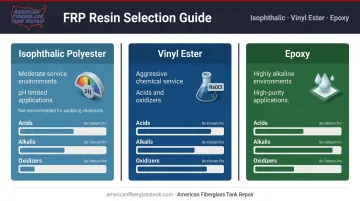
The three primary resin families and their typical service ranges:
- Isophthalic polyester — suitable for moderate corrosion service; generally not recommended above pH 10.5 or for oxidizing compounds, according to Interplastic's corrosion resin comparison guide
- Vinyl ester — combines epoxy-level alkali resistance with strong resistance to acids and oxidizers; the standard choice for aggressive chemical service including sodium hypochlorite
- Epoxy — preferred for highly alkaline environments and high-purity applications
Chemical mixtures add another layer of complexity. Ashland's Derakane resin selection guide specifically warns that chemical blends can be more aggressive than individual constituents due to synergistic effects — meaning a tank properly rated for Chemical A and Chemical B separately may still be at risk when both are present.
AFTR works with custom-blended isophthalic, terephthalic polyester, vinyl ester, and epoxy resins, selecting materials based on the specific chemical, its concentration, and operating temperature for each repair and relining engagement.
Sludge and Sediment Buildup
Solids that settle out of solution — mineral scale, process residues, chemical byproducts — accumulate on the tank floor and lower walls. The real risk is the concentrated chemical environment that forms beneath the settled layer, where fluid remains in prolonged, trapped contact with the liner surface.
Tanks most at risk:
- Low-agitation or stagnant storage configurations
- Tanks left idle for extended periods without flushing
- Chemical service with naturally high solids content
This localized attack can progress faster than general liner degradation because the concentrated chemistry may exceed what the resin was rated for, even though the bulk fluid concentration is within specification.
UV Degradation and Thermal Cycling
Above-ground tanks face two distinct environmental degradation mechanisms that are often underestimated.
UV exposure causes surface oxidation and photo-degradation in FRP resins. Research published in Polymers found that UV exposure can change FRP surface color to yellow or deep yellow within 30 days, a visible indicator of underlying resin breakdown. Surface chalking and embrittlement follow. The microcracks that develop become moisture intrusion pathways that weaken the laminate beneath.
Thermal cycling is a structural problem rooted in material physics. Glass fibers and polymer matrices expand and contract at different rates. Repeated temperature swings — seasonal outdoor changes, hot fill cycles, cold ambient conditions — concentrate strain at the fiber-matrix interface, initiating microcracking and delamination over time. ASTM D3299 flags service temperatures above 180°F (82°C) as requiring special design consideration for filament-wound FRP tanks.
For UV-exposed tanks, AFTR applies exterior coatings including aliphatic compounds specifically selected for UV protection — not all gel coat formulations provide meaningful UV resistance.
Mechanical Damage and Manufacturing Defects
Impact events during shipping, installation, or operation can crack the liner without leaving visible outer damage. A dropped tool, forklift contact, or installation stress can create a compromised zone that allows chemical ingress long before it's noticed.
Manufacturing defects present a subtler risk. Air voids, incomplete resin cure, and inconsistent liner thickness create localized weak spots invisible to the naked eye — often undetected until a chemical breach forces the issue.
Visual inspection alone won't catch either problem. AFTR's field teams use non-destructive methods to identify subsurface anomalies before they progress:
- Ultrasonic thickness testing to detect laminate thinning and voids
- High-intensity backlight inspection to reveal delamination and resin defects
- Laser testing for precise dimensional and structural evaluation
What Happens When Corrosion Goes Unaddressed
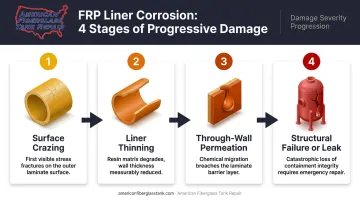
Liner degradation follows a predictable progression. Surface crazing and minor softening are early-stage findings. Left unaddressed, they advance to liner thinning, then to through-wall permeation, then to leaks or structural failure. Each stage compounds the cost and complexity of intervention.
Beyond repair costs, the downstream consequences include:
- Chemical releases trigger EPA SPCC enforcement under 40 CFR Part 112, exposing operators to fines and mandatory reporting
- Resin breakdown products leach into stored fluid — a critical failure mode in water treatment and food processing applications
- Tank failure disrupts every downstream process that depends on that vessel, rarely at a convenient time
- Hazardous chemical containment breaches generate cleanup costs and regulatory penalties that routinely dwarf the price of proactive maintenance
AFTR has observed consistently across field work since 2003 that even after a tank breaches its corrosion barrier, the structural laminate typically remains intact — intact enough to serve as a substrate for a new corrosion layer. That distinction matters operationally: a tank caught at that stage gets relined on a planned schedule, not replaced under emergency conditions.
Warning Signs of Serious Corrosion Damage
Most of these indicators appear well before catastrophic failure. Any single one warrants a professional assessment.
Interior visual signs:
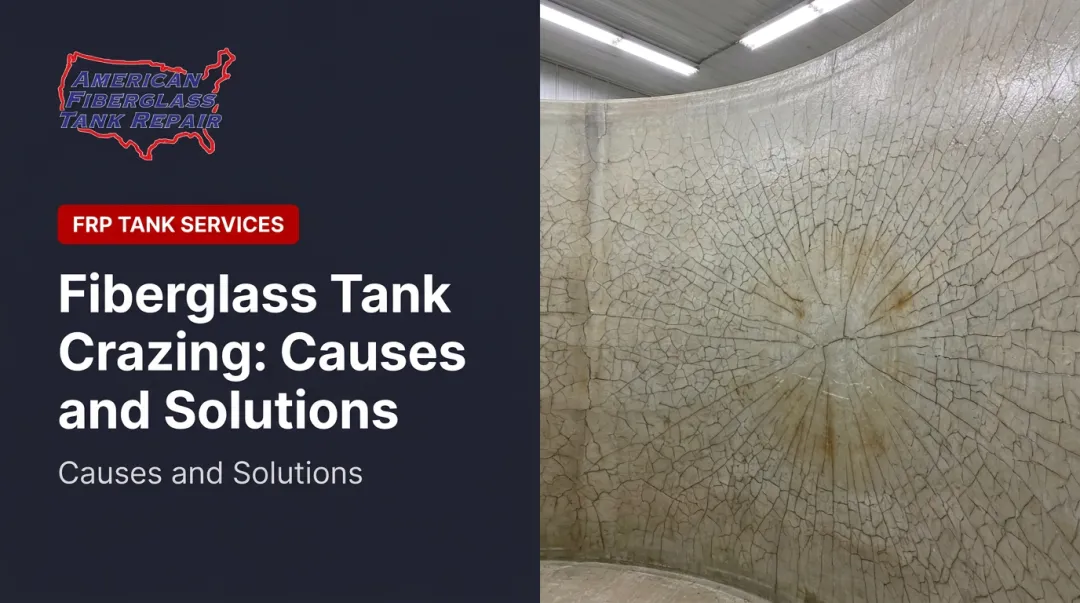
- Surface crazing or micro-cracking patterns on the liner
- Discoloration, staining, or color changes on the inner surface
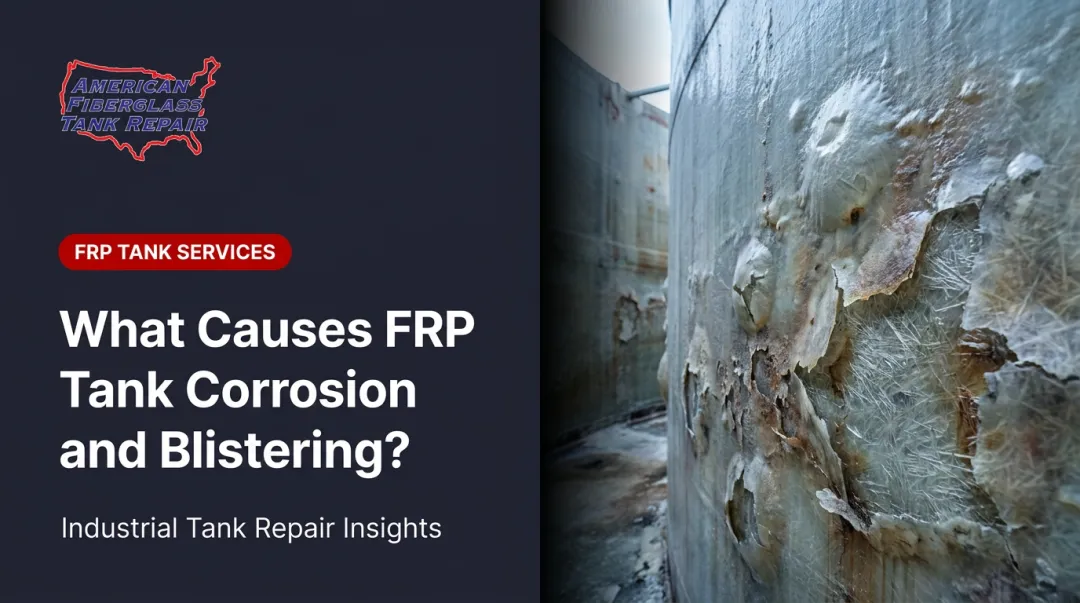
- Blistering or bubble formation beneath the liner
Exterior visual signs:
- Chalking or surface dullness on the outer shell
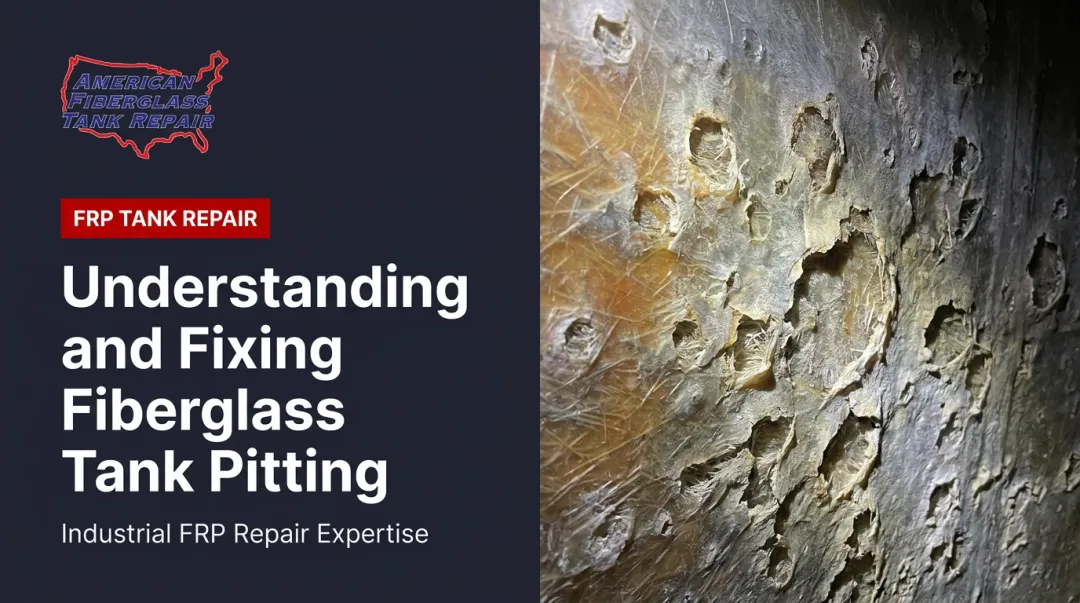
- Visible fiber exposure where the resin has eroded
- Seepage or weeping at the tank wall or base
Tactile and structural signs:
- Soft or spongy areas when pressing on the interior wall — indicates resin saturation or delamination
- Floor stress cracking detectable during internal inspection
Operational signs:
- Unexplained changes in stored fluid chemistry, color, or odor
- Outlet blockage or flow restriction from settled solids
- Unexplained performance decline without a clear mechanical cause
When these signs appear, the next step is a structured inspection to determine how far damage has progressed. AFTR's inspection process examines for spidering, disbondment, abrasion wear, emulsification, low Barcol hardness, floor stress cracking, shell distortion, and UV degradation — each of which corresponds to specific failure mechanisms that dictate the appropriate repair approach.
How to Prevent Fiberglass Tank Corrosion
Prevention works at two levels: decisions at the design or procurement stage, and practices maintained throughout the tank's service life. Both are required — skipping either layer leaves gaps that chemical exposure will eventually find.
Proper Resin and Liner Selection
Before procurement — or after any change in stored chemical — conduct a formal compatibility review that matches the stored substance (concentration, temperature, and exposure duration) to the appropriate resin system.
The review should reference manufacturer chemical resistance data, not general resin category assumptions. Sodium hypochlorite storage, for example, is technically accepted in FRP tanks but highly demanding — resin type, cure system, surfacing veil, and laminate construction all affect service life, as documented in WEFTEC research on NaOCl storage.
The correct resin system prevents liner breakdown from the outset by not reacting with the stored fluid under normal operating conditions.
Scheduled Non-Destructive Inspections
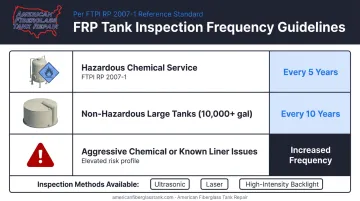
Establish a routine inspection schedule and stick to it. General guidelines:
- Every 5 years for hazardous-substance service (FTPI RP 2007-1)
- Every 10 years for tanks over 10,000 gallons in non-hazardous service
- More frequently for aggressive chemical service or tanks with a known history of liner issues
Visual checks alone are not adequate. AFTR's FTPI-certified inspectors use ultrasonic, laser, and high-intensity backlight testing to determine not just what surfaces show, but what's occurring inside the structural body — including capillary migration of product beneath the corrosion coat.
This establishes a liner condition baseline and enables trend tracking across successive inspections, allowing targeted repair before integrity is compromised.
Active Solids Management
For tanks storing fluids with suspended solids:
- Design or retrofit agitation or recirculation systems to keep solids in suspension
- Establish regular cleaning intervals before sludge accumulates to problematic levels
- Avoid leaving tanks stagnant with settled residues for extended periods
Preventing solids from settling eliminates the concentrated-chemistry zones that drive localized liner attack at the tank floor and lower walls.
Timely Liner Repair
When inspections reveal early warning signs, act on them before chemical exposure reaches the structural laminate. Signs that warrant immediate repair include:
- Surface crazing or micro-cracking in the corrosion coat
- Measurable liner thinning via ultrasonic testing
- Soft spots indicating resin degradation beneath the surface
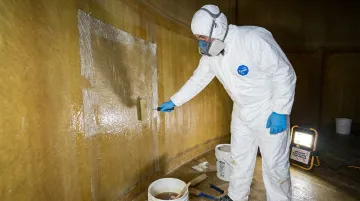
AFTR's corrosion lining repair services use custom-blended resins and over 45 fiberglass mat, chopped strand, Nexus, Harlar, and carbon veil laminates, selected to match the stored chemical and operating temperature. Early repair extends tank service life by many years, at a fraction of what full replacement would require.
Tips for Long-Term Corrosion Control
A sustainable prevention program goes beyond one-time fixes. These practices build a durable foundation:
- Monthly visual walkthroughs — check exterior surfaces for chalking, discoloration, or seepage; document findings
- Formal internal inspections on a defined schedule — scheduled by chemical aggressiveness, not fixed calendar intervals
- Staff training — operations and maintenance personnel should recognize early corrosion indicators and know when to escalate from monitoring to intervention
- Tank documentation — maintain records of resin specification, chemical service history, inspection dates, and all repairs performed; this enables trend analysis and more accurate service-life estimates
- UV protection for exposed tanks — specify UV-resistant gel coats or aliphatic exterior coatings at procurement or during the next refurbishment cycle; coating formulation selection directly affects long-term performance
AFTR provides detailed inspection reports after every assessment — covering interior corrosion coat condition, structural body findings, nozzle interfaces, and specific remediation recommendations — giving facility managers the records needed to track degradation trends, justify capital decisions, and plan maintenance proactively.
Conclusion
Fiberglass tank corrosion has well-understood causes: chemical incompatibility, sludge accumulation, UV and thermal degradation, and manufacturing or mechanical defects. None are inevitable. Each one responds to the right resin selection, structured inspection schedules, and sound day-to-day operating practices.
The takeaways for any facility managing FRP storage come down to a few consistent principles:
- Match resin chemistry to stored media before installation — and reassess when chemistry changes
- Inspect on a fixed schedule, not only when something looks wrong
- Address minor corrosion findings early; laminate damage compounds over time
- Document inspection results to track degradation trends across tank service life
Decades of field work produce one consistent finding: proactive maintenance costs a fraction of emergency repair or full tank replacement. Facility managers who build corrosion prevention into their maintenance calendar protect their capital investment, stay ahead of regulatory compliance requirements, and avoid costly operational downtime. AFTR's periodic maintenance and inspection programs are built around exactly this approach — helping industrial operators extend FRP vessel service life well beyond what reactive repair alone can achieve.
Frequently Asked Questions
Do fiberglass tanks need corrosion protection?
Yes. While FRP tanks are more corrosion-resistant than steel, their internal resin liners still require active protection through proper resin selection, routine inspection, and timely maintenance. This is especially true in aggressive chemical service environments where liner degradation can progress faster than anticipated.
What are the most common early signs of fiberglass tank liner corrosion?
Watch for these early warning signs:
- Surface crazing or discoloration on the inner liner
- Soft or spongy wall areas when pressed
- Exterior chalking or exposed fibers
- Blistering beneath the liner surface
Any of these findings warrants a professional inspection.
Can a corroded fiberglass tank be repaired instead of replaced?
Yes, provided corrosion hasn't reached the structural laminate. Compatible resin patch repairs and veil coat applications can restore the corrosion barrier and extend service life by many years, making repair a cost-effective alternative to full replacement.
How often should fiberglass tanks be inspected for corrosion damage?
FTPI RP 2007-1 recommends every five years for hazardous-substance service. Tanks storing aggressive chemicals may warrant more frequent intervals. Inspections should use non-destructive methods, with ultrasonic thickness testing being particularly effective at detecting liner thinning that visual checks miss.
What resin type provides the best corrosion resistance for aggressive chemical storage?
Vinyl ester resins offer the broadest resistance to aggressive acids, oxidizers, and solvents. Epoxy resins perform better in highly alkaline or high-purity environments. The correct choice depends on the specific chemical, its concentration, and operating temperature rather than resin category alone.
How does sludge buildup cause fiberglass tank corrosion?
Settled solids create a concentrated chemical environment at the tank floor that remains in prolonged contact with the liner — conditions more aggressive than the bulk fluid. Recirculation systems that keep solids in suspension and regular cleaning intervals are the primary preventive measures.