The problem is that "the right conditions" require active management. FRP tanks fail more often than they should, and nearly every failure has a root cause that was identifiable — and preventable — well before the tank gave out.
This article covers the most common failure causes, what happens when warning signs go ignored, how to recognize early indicators of trouble, and the prevention strategies that consistently extend tank service life.
Key Takeaways
- FRP tank failures trace back to chemical incompatibility, UV damage, poor installation, or neglected internal linings
- Ignoring failure risks leads to leaks, environmental liability, unplanned downtime, and emergency repair costs far exceeding planned maintenance
- Prevention starts at resin selection and runs through installation, scheduled inspections, and proactive lining maintenance
- Early warning signs — surface crazing, seepage near fittings, interior blistering — are visible before catastrophic failure occurs
- A structured inspection and maintenance program is the single highest-return investment for FRP tank operators
Common Causes of Fiberglass Tank Failures
FRP tanks rarely fail from a single dramatic event. Degradation typically follows a chain of compounding issues tied to material selection, environmental exposure, installation quality, and maintenance habits. Understanding where that chain starts is the first step toward breaking it.
Chemical Attack and Resin Incompatibility
The resin system is the tank's primary chemical barrier. When the resin type doesn't match the stored substance, the barrier begins to fail — first slowly, then faster as each failure point compounds the next.
Different resins offer very different levels of chemical resistance. Orthophthalic polyester resins have limited resistance to many industrial chemicals. Isophthalic and terephthalic polyester resins handle moderate chemical service but, according to Reichhold's DION corrosion guide, are not recommended for alkaline service above pH 10.5. Vinylester and epoxy resins provide the broadest resistance — covering aggressive acids, alkalis, and oxidizers.
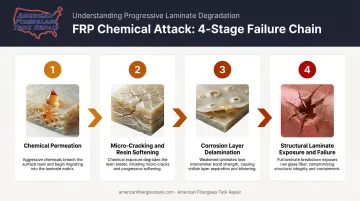
Mismatching resin to chemical leads to:
- Permeation of the stored chemical through the corrosion liner
- Micro-cracking as the resin softens or becomes brittle
- Delamination of the corrosion layer from the structural laminate
- Eventual structural laminate exposure and failure
Sodium hypochlorite is a particularly high-risk service. It's widely used in water treatment, but research presented at WEFTEC identifies it as a demanding application that requires a brominated epoxy vinylester resin with specific cure systems, along with C-glass or ECR-glass corrosion liners, to perform reliably. A standard polyester resin in hypochlorite service degrades significantly faster.
Hydrochloric acid at high concentrations presents similar risks. A 2017 academic study of eight FRP chemical tanks in 35% HCl service found severe degradation patterns and noted that HCl service has been associated with serious tank accidents.
At AFTR, resin selection is treated as a technical decision made on a tank-by-tank basis. The company works with custom blended isophthalic, terephthalic polyester, vinylester, and epoxy resins — matched to the specific chemical, concentration, and operating temperature of each application.
UV Exposure and Environmental Weathering
Outdoor FRP tanks face a different but equally persistent threat: ultraviolet radiation breaking down the outer resin layer over time. The process is gradual and easy to overlook until the damage becomes structural.
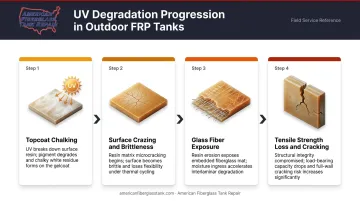
UV degradation follows a predictable sequence:
- The exterior resin-rich topcoat loses integrity and begins to chalk
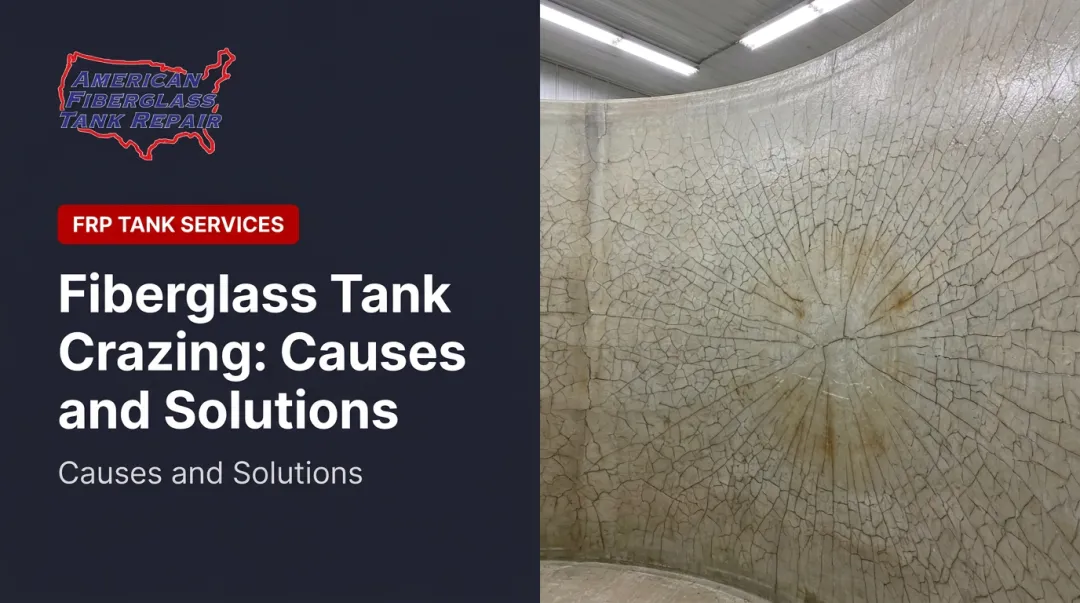
- Surface crazing develops as the resin becomes brittle
- Glass fibers become exposed at the surface
- Tensile strength decreases, making the tank susceptible to cracking under normal operating loads
AWWA D120-19 treats exterior UV protection as a specification requirement — not an afterthought — specifying whether UV absorbers should be added to the resin and whether the exterior should be pigmented or coated for outdoor service.
Temperature cycling compounds the problem. FRP expands and contracts with temperature changes, and repeated thermal cycling creates stress at fittings, seams, and nozzles.
High humidity and airborne chemical fumes accelerate surface resin breakdown further. Tanks in coastal chemical facilities or high-altitude outdoor environments face UV intensity, temperature swings, and atmospheric chemical exposure all at once — a combination that shortens service life considerably faster than any single factor alone.
Mechanical Stress, Impact Damage, and Poor Installation
FRP's rigidity is an asset in normal service — and a liability when loads aren't distributed correctly. Unlike more ductile materials, FRP cannot flex to absorb impact or uneven loading. Stress concentrations develop instead, leading to surface cracks and seam failures.
Poor installation dramatically amplifies this risk. Specific installation failures that create mechanical stress problems include:
- Uneven or undersized foundations — differential settlement adds bending stress to the tank shell that it was never designed to carry
- Inadequate anchoring — wind and vibration create fatigue cracks at fittings and nozzles over time; NOV's installation guidance states anchoring is required where buoyancy conditions exist because flotation can cause catastrophic failure
- Improper field nozzle modifications — penetrations added without engineered reinforcement create stress concentrations at the tank wall that worsen under operating pressure
Xerxes installation documentation requires approved backfill support rather than setting tanks directly on concrete, timber, or native soil — a requirement that reflects how seriously foundation conditions affect structural outcome.
Internal Lining Degradation and Neglected Maintenance
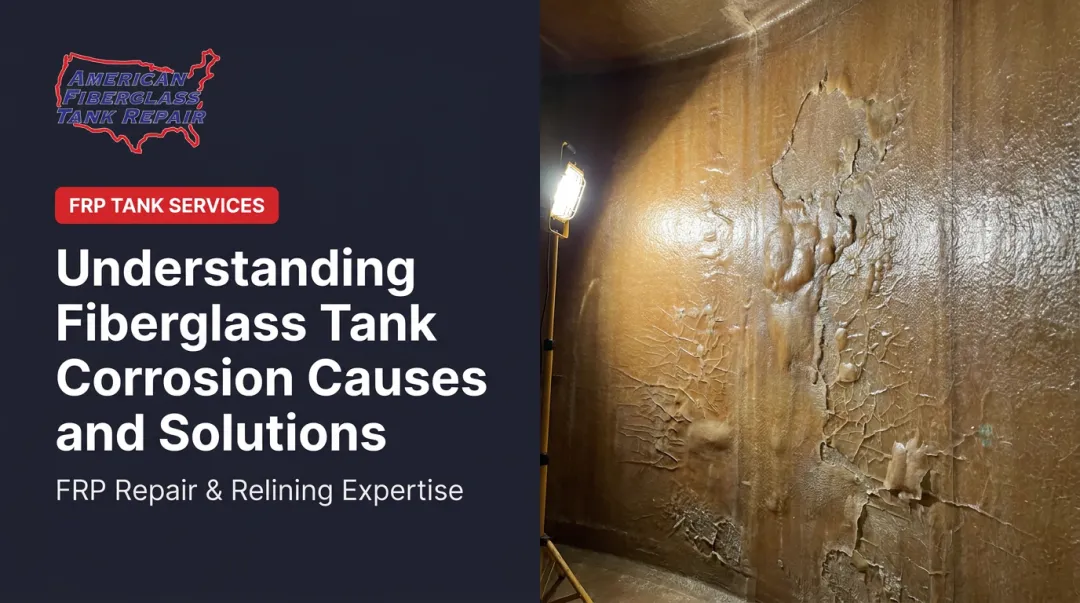
The interior corrosion lining is what actually keeps the stored chemical away from the structural laminate. Once it's compromised, the structural glass and resin take the chemical exposure directly — and degrade much faster.
The neglected-maintenance failure pattern is consistent across field experience:
- Minor blistering or resin erosion develops in the corrosion liner
- Without inspection, the damage goes undetected
- Hairline cracks allow the stored chemical to migrate beneath the liner
- The structural laminate absorbs chemical exposure
- What was a minor lining repair becomes a structural repair — or tank retirement
AFTR's inspection work shows that containment breaches can occur before any visible surface indicators appear. Capillary migration of liquid product beneath the corrosion coat is only detectable through instrument-based testing, not visual inspection alone.
What Happens When Fiberglass Tank Failures Are Ignored
Deferred maintenance on FRP tanks doesn't save money — it shifts costs forward while adding new ones. The DOE's Operations and Maintenance Best Practices Guide estimates preventive maintenance delivers 12–18% cost savings compared to reactive maintenance. For FRP tanks, the gap is often larger.
The operational and financial consequences of ignoring failure risks:
- Unplanned downtime — tank-related outages halt production processes that depend on chemical or water storage, with no lead time to schedule recovery
- Emergency repair premiums — emergency service typically carries higher mobilization and labor costs than scheduled work; the repair itself is also more complex when damage is advanced
- Environmental contamination — a tank leak can mean soil and groundwater contamination, cleanup costs, and regulatory scrutiny
- Regulatory liability — EPA SPCC requirements under 40 CFR Part 112 apply to aboveground storage above 1,320 gallons aggregate; a single discharge over 1,000 gallons triggers mandatory reporting and financial penalties
- Premature tank replacement — the worst outcome; replacing a tank that could have been relined costs multiples of what proactive maintenance would have
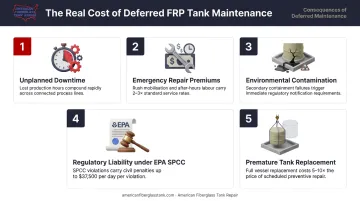
For water treatment and chemical facilities, a single tank failure can trigger violations under both AWWA standards and EPA regulations at the same time. That dual exposure — regulatory penalties layered on top of repair and remediation costs — is exactly what a scheduled inspection program is designed to prevent.
Warning Signs Your Fiberglass Tank Is Approaching Failure
These indicators are visible before catastrophic failure. Knowing what to look for during routine walkarounds makes the difference between catching damage early and facing an unplanned shutdown.
Exterior signals:
- Surface crazing or cracking near fittings, seams, and the tank base
- Chalky white discoloration on the exterior surface — indicates UV resin loss
- Visible glass fiber texture on the tank wall — means the resin-rich surface layer is gone
- Weeping, seepage, or mineral deposit buildup around nozzles, fittings, and manway seals
Structural signals:
- Unusual deflection, bulging, or out-of-round tank geometry
- Discoloration or staining on exterior walls suggesting internal seepage through the laminate
- Soft spots detectable during exterior tapping inspection
When exterior and structural checks are clear, interior inspection often reveals what's hidden — particularly in tanks handling aggressive chemicals or high-temperature service.
Interior signals:
- Blistering in the corrosion liner
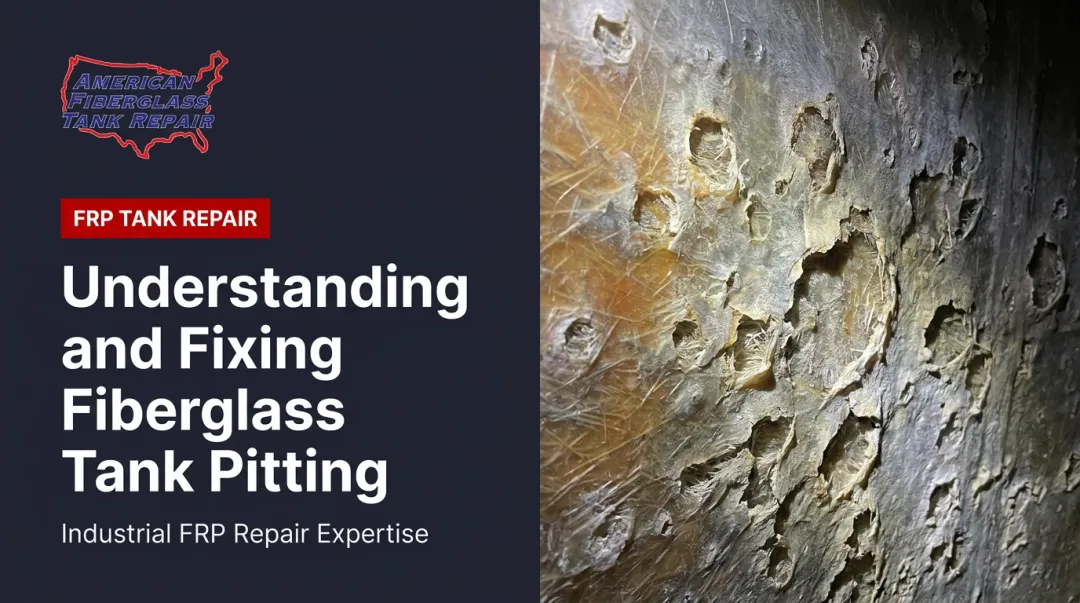
- Resin erosion or depletion in high-exposure zones
- Discoloration, staining, or micro-cracking in the corrosion barrier
Catching any of these signals early — before they compound — is what separates a routine repair from a full tank replacement. A scheduled inspection program gives you that window.
How to Prevent Fiberglass Tank Failures
Prevention is a lifecycle discipline, not a one-time event. It starts at resin specification, continues through installation, and is sustained by ongoing inspection and lining maintenance.
Verify Resin Compatibility at the Design Stage
Before specifying or accepting a tank, identify:
- The exact chemical to be stored
- Its concentration range across normal operations
- Operating temperature range, including maximum excursions
- Any planned changes in service chemistry
Use ASTM C581 (updated 2026) for immersion-based chemical resistance evaluation. Published resin-maker resistance tables — Ashland's Derakane guide and Reichhold's DION guide — both provide chemical, concentration, and temperature limits for epoxy vinylester and polyester resin families.
This step matters most at initial procurement, when repurposing a tank for a different chemical, and when increasing concentration levels of stored substances.
AFTR's field work includes adapting existing tanks to new chemistries they were not originally designed for, using product-specific corrosion layer systems that allow transitions between stored products when resin compatibility is confirmed.
Schedule Regular Professional Inspections
Visual inspection has real limits. A hydrostatic test only confirms containment at that moment; it reveals nothing about capillary migration beneath the corrosion coat or laminate thinning that will cause failure three months from now.
A thorough FRP tank inspection covers:
- Visual assessment of interior and exterior surfaces, nozzles, and interfaces
- Ultrasonic thickness testing for laminate thinning not visible at the surface
- High-intensity backlight inspection to identify delamination and voids in the structural laminate
- Laser testing for subsurface condition assessment
- Barcol hardness measurements evaluating resin cure and chemical degradation
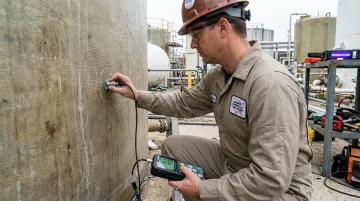
AFTR's inspections are supervised by Fiberglass Tank & Pipe Institute (FTPI) certified inspectors and use all three instrument methods, specifically to detect conditions like capillary migration of liquid product beneath the corrosion coat, which visual inspection cannot find.
FTPI's RP 2007-1 recommended practice requires trained external inspections at 5-year intervals for tanks in hazardous substance service, and before any service change to a dissimilar stored material. For tanks handling aggressive oxidizers like sodium hypochlorite, or operating in harsh outdoor environments, more frequent inspections are warranted. Document all findings to track degradation trends over time.
Ensure Proper Installation and Foundation Support
The tank base must be:
- Level and structurally adequate for full loaded weight
- Designed to distribute load evenly across the tank bottom
- Free of gravel, uncompacted fill, or point-load contact under large tanks
- Anchored per site conditions to resist wind, seismic, and buoyancy forces
Improper field modifications are a leading cause of stress concentration failures. Any time a nozzle or fitting is added after initial installation, the penetration must be engineered and reinforced to match the service environment, not just cut in and patched. AFTR's field crews perform nozzle relocations, resizing, and additions using structurally sound protocols with resins matched to the stored product, because field-improvised modifications create the stress concentrations that fail first.
Maintain and Repair the Internal Corrosion Lining Proactively
Clean the interior before inspection, identify any blistering, erosion, or micro-cracking in the corrosion barrier, and apply compatible resin repairs before the structural laminate is exposed.
AFTR uses over 45 laminate types, including carbon veil, Nexus veil, Harlar, and chopped strand. Resin systems are selected for the specific chemical and temperature environment. For sodium hypochlorite service, the lining uses materials rated for oxidizing chemical contact. The same approach applies to HCl, NaOH, ferric chloride, and other aggressive stored products.
Relining costs a fraction of new-tank capital, avoids the multi-week downtime that replacement requires, and extends service life by many years. When AFTR's inspections find that a tank has breached its corrosion barrier but structural integrity is still intact, the existing shell becomes the substrate for a new corrosion layer, adding years of service life without replacement.
Tips for Long-Term Prevention and Control
Long-term FRP tank integrity comes from consistent day-to-day habits built into operations — not just reactive responses when problems appear:
- Log every inspection finding, thickness measurement, and repair in a documented record — this identifies degradation trends over time, supports warranty claims, and backs up audits and regulatory compliance reviews
- Train operations staff to spot early warning signs on routine walkarounds: surface chalking, seepage staining, and unusual odors near fittings are all visible before they escalate; establish a clear escalation path so concerns reach the right people quickly
- Reapply UV-protective topcoats on outdoor tanks on the manufacturer's recommended cycle — resin-rich exterior coatings with UV absorbers protect structural glass fibers from weathering; AFTR applies aliphatic UV-protective compounds as part of exterior nozzle and tank work
- Reassess chemical compatibility before any process change — concentration increases, new additives, or temperature shifts can push stored chemicals outside the resin system's original design envelope; a professional review beforehand costs far less than an incompatibility failure after
Conclusion
FRP tank failures follow predictable patterns. Chemical incompatibility, environmental degradation, installation errors, and neglected linings are all identifiable — and all correctable — before they reach the point of catastrophic failure.
Operators who invest in scheduled inspections, correct resin selection, and routine lining maintenance consistently get more service life from their FRP assets, reduce unplanned downtime, and protect their regulatory standing. When issues do surface, catching them during a scheduled inspection costs a fraction of emergency repair or replacement.
That's the practical case for a structured maintenance program — not as an insurance policy, but as standard operating practice for any facility running FRP storage.
Frequently Asked Questions
What is the most common cause of fiberglass tank failure?
Chemical attack from mismatched resin selection and neglected internal lining maintenance are the leading causes. The stored chemical slowly degrades the corrosion barrier, and without inspections, that damage progresses into structural laminate failure — turning what could have been a minor repair into full-section replacement.
How long should a fiberglass tank last with proper maintenance?
Well-maintained FRP tanks can remain in service for decades. ACMA has documented six GFRP tanks in corrosive leachate service surviving more than 35 years with annual inspections and maintenance. Tanks without inspection programs or with incorrect resin selections often fail well before reaching that potential.
How can you tell if a fiberglass tank is beginning to fail?
Key early indicators include exterior chalking or crazing, visible glass fiber texture on the tank wall, seepage or staining near fittings and nozzles, interior blistering during internal inspection, and any bulging or deformation of the tank shell.
How often should fiberglass tanks be professionally inspected?
At minimum, annually for tanks in chemical or water treatment service — with increased frequency for tanks handling aggressive oxidizers. The Fiberglass Tank & Pipe Institute's RP 2007-1 requires trained inspections at 5-year intervals for hazardous-substance service, and before any change in stored material.
Can a fiberglass tank be repaired after it starts to fail?
Many FRP tank failures — including lining erosion, surface cracking, and localized delamination — can be successfully repaired when caught early. In most cases, the structural laminate remains intact even after the corrosion barrier is breached, giving repair crews a sound substrate for a new corrosion lining.
What resin type is best for chemically aggressive storage applications?
Vinylester resins offer the broadest chemical resistance for aggressive applications including oxidizing acids and sodium hypochlorite. Isophthalic and terephthalic polyester resins handle moderate chemical service but have concentration and pH limits. The right choice depends on the specific chemical, its concentration, and operating temperature — consult a qualified FRP specialist before selecting a resin for a new or replacement lining.