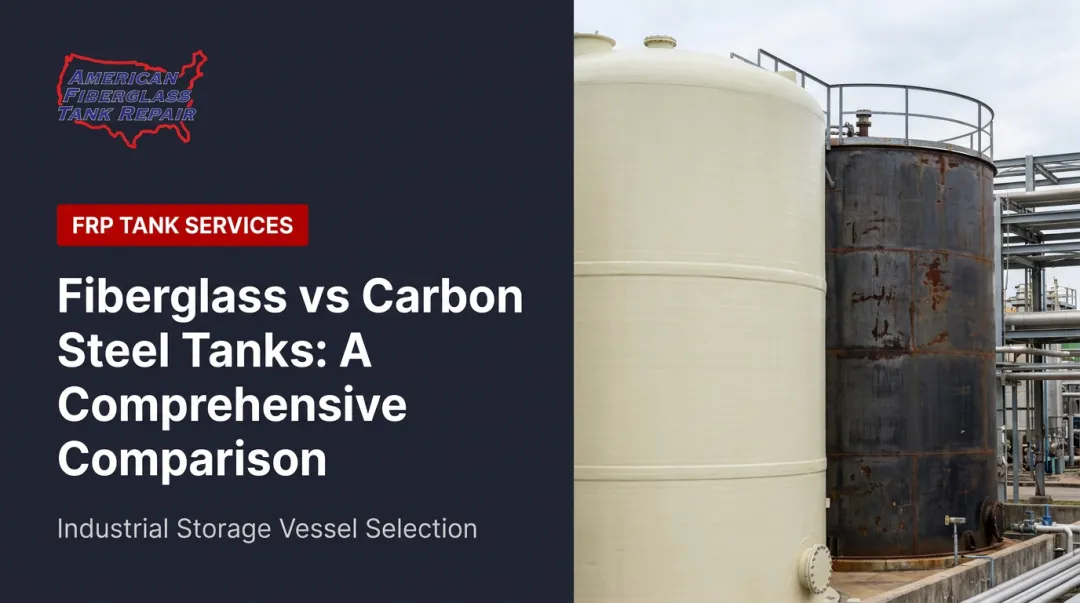
FRP and steel tanks dominate industrial liquid storage, but they respond to corrosive chemicals, moisture, and time in fundamentally different ways. Selecting based on purchase price alone consistently leads to a higher total cost of ownership — the maintenance burden, relining cycles, and premature replacements that never appeared in the original capital estimate.
This article breaks down the core differences in corrosion resistance, lifespan, maintenance requirements, and total cost — with clear guidance on which material belongs in which application.
Key Takeaways
- FRP tanks are inherently corrosion-resistant; steel requires coatings, linings, or cathodic protection to handle the same environments
- Steel demands periodic recoating, relining, and corrosion inspection; FRP's maintenance burden is much lower by comparison
- A well-maintained FRP tank can last 30–50 years; steel typically reaches 20–40+ years with consistent corrosion management
- FRP suits chemical storage, waterworks, and wastewater best; steel is the better fit for high-pressure, high-temperature, or very large-capacity applications
- Corrosion management over the asset's full lifespan — not the purchase price — typically drives the larger cost difference between the two materials
FRP vs. Steel Storage Tanks: Quick Comparison
| Factor | FRP | Steel |
|---|---|---|
| Upfront Cost | Moderate to higher depending on resin and size | Lower upfront; rises significantly with required coatings, linings, and cathodic protection |
| Corrosion Resistance | Inherent — no rust, no chemical degradation with correct resin | Susceptible without ongoing protection; even coated tanks require regular inspection |
| Lifespan | 30–50 years with proper maintenance | 20–40+ years with consistent corrosion management |
| Maintenance | Low routine maintenance; periodic professional inspection required | Higher ongoing cost — recoating, relining, and corrosion inspection are essential |
| Best Applications | Chemical storage · Potable water · Waterworks · Wastewater · Food processing | High-pressure fluids · Large-capacity bulk storage · High-temperature processes · API/ASME code applications |
What Is an FRP Storage Tank?
FRP (Fiberglass Reinforced Plastic) is a composite material combining glass fiber reinforcement with a polymer resin matrix. The resin type — isophthalic polyester, terephthalic polyester, vinylester, or epoxy — is selected based on the specific chemical being stored, its concentration, and operating temperature. That selection determines the tank's corrosion resistance profile. FRP tanks don't rust. The resin matrix resists attack from a broad range of acids, bases, and oxidizing chemicals without requiring secondary protection systems.
How FRP Tanks Are Built
Two primary construction methods govern FRP tank fabrication:
- Filament winding: glass fiber is wound under tension over a rotating mandrel, producing tanks with high structural consistency; governed by ASTM D3299-24
- Hand lay-up (contact molding): layers are applied manually using rollers and molds; governed by ASTM D4097-19
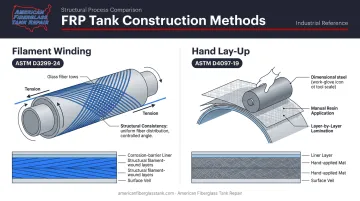
Construction quality matters most at the internal corrosion barrier — a multi-layer composite lining that forms the primary defense against chemical attack. This barrier typically consists of a resin-rich inner surface (reinforced with surfacing veils) over several millimeters of chopped strand mat, selected for compatibility with the stored chemical.
When this barrier degrades through delamination, stress cracking, or capillary migration of liquid beneath the lining, the stored chemical begins attacking the structural body of the tank.
AFTR's inspection teams routinely identify failure modes that originate in this barrier: spidering, disbondment, emulsification, floor stress cracking, and low Barcol hardness readings. Many of these conditions are invisible to the naked eye, which is why professional instrument inspection is essential.
Where FRP Tanks Dominate
Industries that standardize on FRP include:
- Chemical processing plants
- Municipal waterworks
- Water and wastewater treatment facilities
- Food and beverage manufacturing
- Any application where direct metal-to-liquid contact would cause corrosion
For water industry applications, AWWA D120-19 governs FRP tank design, and NSF/ANSI 61 certification applies where tanks contact drinking water or treatment chemicals.
The global fiberglass tanks market reflects this adoption — valued at USD $2.21 billion in 2025 and forecast to reach $3.74 billion by 2035, a 5.4% CAGR, driven largely by chemical and water treatment applications.
FRP Use Cases: Aggressive Chemical Storage
FRP is the standard choice for storing:
- Sodium hypochlorite (NaOCl): one of the most aggressive disinfection chemicals handled in water and wastewater treatment
- Ferric chloride (FeCl₃): used as a flocculant in wastewater treatment; highly corrosive to unprotected metal
- Sodium hydroxide (NaOH / caustic soda): common in chemical processing; attacks steel without sustained lining protection
- Hydrochloric acid (HCl): industrial cleaning and pH adjustment; rapidly degrades uncoated steel
AFTR has relined hundreds of tanks storing these chemicals across chemical plants, water utilities, and wastewater facilities. Resin selection must match the specific chemical, concentration, and temperature; an incompatible resin system is one of the leading causes of premature FRP tank failure.
What Is a Steel Storage Tank?
Steel storage tanks are fabricated metal vessels designed for bulk liquid storage. Two types are relevant to industrial applications:
- Carbon/mild steel — used with protective coatings, internal linings, or cathodic protection systems
- Stainless steel — applied where hygiene, aesthetics, or specific corrosion resistance is required
Steel's Core Advantages
Steel holds clear advantages over FRP in several industrial applications:
- High tensile strength and structural integrity for pressurized service
- Suitability for high-temperature process applications
- Scalability to very large capacities (tanks exceeding one million gallons are routinely fabricated in steel)
- Compliance with API 12F, API 12D, and ASME Section VIII — codes that govern oil and gas production vessels, pressure equipment, and field-erected tanks
The Corrosion Problem
Steel's fundamental limitation is corrosion vulnerability. Without sustained investment in protective systems — internal linings, external coatings, or cathodic protection (governed by API RP 651 for aboveground petroleum tanks) — steel tanks corrode from the inside out.
An EPA study of 42 diesel underground storage tank systems found 83% exhibited moderate or severe corrosion of internal metal components. Newer fuel formulations, biofuels, and ethanol-blended fuels are accelerating the problem — EPA notes corrosion appearing on internal components in diesel systems and in sumps for ethanol-blend systems.
This isn't just an aging infrastructure issue. Modern fuel chemistry is actively degrading steel tanks that were previously considered adequate.
When a lining fails inside a steel tank, the progression is rapid: the stored product contacts bare metal, corrosion accelerates, and the risk of contamination, leakage, and regulatory non-compliance rises quickly.
Steel Use Cases
Applications where steel remains the dominant choice:
- Crude oil and produced water storage in oil and gas operations (API 12F, API 12D)
- Large-scale bulk fuel storage
- High-pressure process vessels in chemical manufacturing (ASME Section VIII)
- Applications where API or ASME code compliance specifies steel construction
FRP vs. Steel: Which Is the Better Choice?
The answer depends almost entirely on the service environment.
Corrosion Is the Deciding Factor
In environments involving acids, chlorinated chemicals, saltwater, or biological agents — the standard conditions in waterworks, wastewater, and chemical plants — FRP's inherent corrosion resistance eliminates the root cause of failure. Steel requires sustained maintenance investment to manage the same risk.
The macro-level cost of this challenge is significant. AMPP cites the NACE IMPACT study estimating global corrosion costs at US$2.5 trillion annually — 3.4% of global GDP — with available corrosion-control practices capable of preventing 15–35% of that damage. Industrial tank operators choosing steel in corrosive service environments absorb a meaningful share of that cost.
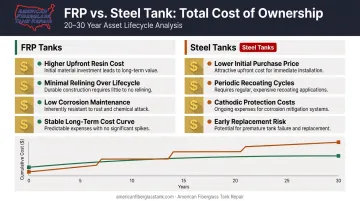
Total Cost of Ownership
FRP may carry higher resin costs upfront in some configurations, but the absence of relining cycles, coating applications, and corrosion-related emergency repairs makes it more economical over a 20–30 year asset lifecycle in corrosive service. Steel's lower initial price is frequently offset by:
- Periodic internal recoating and relining
- Cathodic protection system installation and maintenance
- Earlier-than-planned tank replacement when lining integrity fails
- Downtime costs during repairs and re-inspections
Clear Situational Guidance
Choose FRP when:
- Storing acids, bases, chlorinated chemicals, or oxidizing agents
- Operating water treatment, waterworks, or wastewater facilities
- Moisture and chemical exposure are constant operating conditions
- Avoiding recurring maintenance cycles is a priority
Choose steel when:
- Handling high-pressure or high-temperature fluids
- Requiring capacities beyond FRP's practical fabrication range
- Operating under API or ASME code requirements that specify steel
- Bulk fuel or crude oil storage is the primary application
The Hybrid Steel-FRP Scenario
Neither choice works in every situation, which is why some operators pursue a middle path. Steel tanks lined with FRP or epoxy-based coatings attempt to combine structural strength with chemical resistance — and they can perform well when specified correctly.
The tradeoff is ongoing. Linings require periodic inspection and eventual replacement, and when a lining fails, bare steel makes direct contact with aggressive chemicals. For facilities storing sodium hypochlorite, ferric chloride, or similar compounds, that failure window carries real consequence. A purpose-built FRP tank in the correct resin system eliminates the lining maintenance cycle from the start.
Extending Your FRP Tank's Lifespan Through Proper Maintenance
FRP's corrosion resistance is built-in, but it isn't maintenance-free. The internal corrosion barrier degrades over time — and how quickly depends on the chemical being stored, operating temperature, construction quality, and whether a structured inspection program is in place.
Common Causes of Premature FRP Failure
Most early FRP tank failures trace to one of these root causes:
- Resin incompatibility : using a resin system not rated for the stored chemical's concentration or temperature
- Mechanical damage to the corrosion barrier : impacts during installation, cleaning operations, or equipment falling into tanks
- UV degradation : outdoor tanks without a UV-resistant outer layer experience accelerated surface breakdown
- Neglected micro-cracking and delamination : early-stage damage that progresses into structural compromise without intervention
- Capillary migration : liquid product migrating beneath the corrosion coat without visible surface signs
AFTR notes that containment breaches can occur before any noticeable signs of trouble emerge. A tank can pass a hydrostatic test today and show serious internal degradation within months — which is why surface inspections alone are insufficient.
The Role of Professional Inspection
Instrument-based inspection detects what visual checks miss:
- Ultrasonic testing : identifies wall thinning, delamination, and subsurface voids
- High-intensity backlight testing : reveals resin-rich zones, structural inconsistencies, and laminate defects
- Laser inspection : detects dimensional changes and shell distortion
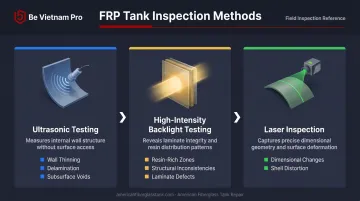
Together, these methods map the full condition of the tank's structural body — catching subsurface degradation that visual surveys and hydrostatic tests routinely miss. AFTR's inspection program, supervised by Fiberglass Tank & Pipe Institute (FTPI) certified inspectors, applies all three methods to identify degradation years before it escalates to failure.
Early detection converts a potential emergency replacement into a planned relining job — preserving the capital investment and avoiding multi-week operational downtime.
Practical Maintenance Guidance for FRP Operators
- Establish a regular inspection schedule — at minimum every 3–5 years for tanks in aggressive chemical service
- Document all repairs and lining conditions with dated inspection reports
- Use only compatible resin systems for any repairs — chemical incompatibility in the laminate accelerates failure
- Respond immediately to any signs of leaching, product discoloration, or unusual contamination that may indicate inner liner compromise
- For sodium hypochlorite, ferric chloride, and caustic tanks specifically, treat inspection intervals as a minimum, not a target
The repair-vs-replacement economics strongly favor proactive maintenance. Relining a tank with an intact structural body costs a fraction of full tank replacement — and extending service life by 10–20 years through targeted repairs directly protects the facility's original capital investment.
Conclusion
In corrosion-heavy environments — chemical processing, waterworks, and wastewater treatment — FRP consistently outperforms steel by eliminating the primary failure mechanism those applications impose. Steel remains the right choice for high-pressure, high-temperature, or very large-capacity applications where structural demands exceed what FRP can practically deliver.
That material advantage, however, doesn't manage itself. The 30–50 year lifespan potential FRP offers is achievable only with a proactive inspection and maintenance program. That resistance doesn't extend indefinitely to the internal lining — corrosion coat degradation, osmotic blistering, and stress cracking are all real failure paths in neglected vessels. Scheduled inspections, prompt response to early warning signs, and resin-matched repairs are what keep FRP tanks in service for their full intended life.
AFTR's field inspection teams — certified by the Fiberglass Tank & Pipe Institute — work with chemical plants, waterworks, and wastewater operators across the US to do exactly that: identify degradation before it becomes a replacement decision and execute repairs that restore the lining to original performance standards.
Frequently Asked Questions
Fiberglass vs. steel storage tanks: which is better for water storage?
FRP tanks are generally the preferred choice for potable water and water treatment applications. They're inherently corrosion-resistant, carry no rust contamination risk, and can comply with NSF/ANSI 61 standards for drinking water contact. Steel requires internal lining to prevent rust and water contamination, adding both upfront and maintenance costs.
How long will a fiberglass storage tank last?
A properly maintained FRP tank can last 30–50 years. Actual service life depends on resin type, the chemical stored, and UV exposure — and whether a regular inspection program catches liner degradation before it progresses into structural compromise.
Can steel storage tanks be relined to improve corrosion resistance?
Yes — steel tanks can be internally relined with epoxy or FRP-based coatings to extend service life in corrosive environments. However, these linings require periodic inspection and eventual replacement. They reduce corrosion risk but don't eliminate it, and lining failure can lead to rapid tank degradation.
What are the maintenance requirements for FRP storage tanks?
FRP tanks require less routine maintenance than steel but should undergo professional inspection every 3–5 years, or more frequently in aggressive chemical service. Inspections should use ultrasonic or backlight testing to detect delamination, liner wear, or stress cracking before they become structural issues.
Is fiberglass or steel cheaper for large-capacity storage tanks?
For very large capacities (roughly above 50,000–100,000 gallons), steel typically becomes more cost-effective to fabricate. FRP is more economical and practical at small to mid-range capacities. Total cost of ownership (including corrosion management and maintenance over the tank's full service life) should always be evaluated alongside purchase price.
What causes fiberglass tanks to fail prematurely?
Premature FRP tank failure most commonly traces back to four causes:
- Incompatible resin for the stored chemical
- Physical damage to the internal corrosion barrier during installation or cleaning
- UV degradation on unprotected outdoor tanks
- No regular inspection program to catch early-stage delamination or cracking