This scenario plays out constantly across chemical plants, waterworks, and wastewater facilities. The wrong call doesn't just affect the budget — it can trigger corrosion failures, regulatory exposure, product contamination, and unplanned shutdowns that cost far more than the tank itself.
Material selection is one of those decisions that looks straightforward until you factor in what the tank actually stores, how it operates, and who maintains it over a 20–30 year horizon.
Key Takeaways
- FRP tanks offer inherent corrosion resistance and lower lifecycle maintenance costs; best suited for chemical and water/wastewater applications
- Carbon steel tanks deliver superior structural strength for high-pressure, high-temperature, and large-scale non-corrosive storage applications
- Both materials can reach 25–40+ year service lives with the right maintenance and inspection programs in place
- For corrosive chemical service, the resin selection inside an FRP tank is as important as the material itself
- Regardless of material, deferred inspection is the leading cause of premature tank failure — not material choice
Fiberglass vs Carbon Steel Tanks: Quick Comparison
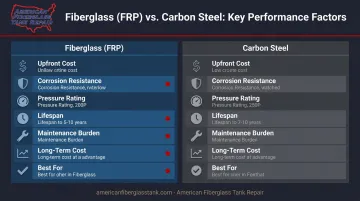
The table below summarizes how fiberglass (FRP) and carbon steel tanks compare across the factors that matter most to industrial buyers.
| Factor | Fiberglass (FRP) | Carbon Steel |
|---|---|---|
| Upfront Cost | Higher | Lower |
| Long-Term Cost | Lower (no recoating) | Higher (coatings, inspections, relining) |
| Corrosion Resistance | Inherent; no coatings needed | Requires protective coatings; vulnerable at welds |
| Pressure Rating | Atmospheric to 15 psig (ASME RTP-1) | High-pressure capable |
| Temperature Limits | Chemical/resin-specific | Handles extreme temperatures |
| Typical Lifespan | 25–40+ years with inspection | 25–40 years with coating maintenance |
| Maintenance Burden | Low routine; periodic certified inspection required | Regular coating inspection and recoating cycles |
| Best For | Corrosive chemicals, water/wastewater, chemical processing | Oil & gas, high-pressure vessels, non-corrosive bulk storage |
What Are Fiberglass Tanks?
Fiberglass Reinforced Plastic (FRP) tanks are storage vessels built from glass fiber layers bonded with a thermoset resin — typically polyester, vinylester, or epoxy. The result is a composite structure that combines structural integrity with inherent chemical resistance, without the corrosion vulnerability that defines metallic alternatives.
FRP became the material of choice for chemical and water treatment storage for a straightforward reason: the stored substance can't rust it. Unlike steel, there's no passive oxide layer to maintain, no protective coating to reapply, and weld zones don't become weak points where corrosion preferentially attacks.
Resin Selection: The Part Most Facilities Get Wrong
Choosing "fiberglass" isn't enough — the resin system is what determines whether the tank actually survives its chemical environment. Different resins handle different substances, concentrations, and temperatures in ways that aren't interchangeable.
- Isophthalic and terephthalic polyester resins — suitable for general chemical service and water storage
- Vinylester resins — preferred for aggressive chemicals including sodium hypochlorite and ferric chloride; higher resistance to oxidizers
- Epoxy resins — used in specialized applications requiring maximum chemical barrier performance
ASTM D3299-18 covers filament-wound FRP tanks using polyester or vinylester thermoset resin for above-ground atmospheric service with aggressive chemicals. Resin selection must be matched to the specific chemical, its concentration, and operating temperature — not picked generically.
At AFTR, resin selection for every repair and relining project is matched to the stored substance, chemical concentration, and anticipated operating temperature — because a mismatched resin system will fail years before a properly specified one.
The Corrosion Liner: What Actually Protects the Tank
The inner corrosion liner — the first few layers of the laminate — is the chemical barrier between the stored product and the structural wall. If it fails, the stored chemical begins migrating into the structural laminate. That process, known as capillary migration, can advance undetected until the structural wall is compromised.
Common liner failure modes AFTR's field inspectors encounter include:
- Spidering and surface crazing
- Disbondment and delamination
- Emulsification of the corrosion coat
- Floor stress cracking
- UV degradation on exterior laminates
- Low Barcol hardness readings indicating resin cure issues
Most of these conditions develop before any external sign of trouble appears — which is precisely why visual inspection alone isn't sufficient.
FRP Use Cases
FRP tanks are the preferred material in:
- Municipal water and wastewater treatment — chemical feed systems, clarifiers, potable water storage
- Chemical storage — sodium hypochlorite, ferric chloride, sodium hydroxide, hydrochloric acid
- Food and beverage processing — where non-reactive surfaces protect product purity
- Industrial facilities — any corrosive service application where carbon steel would require heavy protective coating systems
For waterworks, wastewater, and chemical processing facilities — the core segments AFTR serves — stored substances like sodium hypochlorite and ferric chloride would rapidly degrade uncoated carbon steel. FRP isn't just preferred here; it's frequently the only practical long-term solution.
What Are Carbon Steel Tanks?
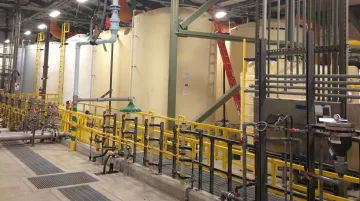
Carbon steel tanks are fabricated from iron-carbon alloy (typically under 2% carbon), valued for tensile strength, structural rigidity, and the ability to withstand pressures and temperatures that FRP cannot match. They're the standard in oil and gas, large-volume bulk storage, and pressurized process applications.
The core limitation is straightforward: carbon steel corrodes. Without intact protective coatings, degradation accelerates, particularly at welds, nozzles, and any area where the coating is damaged or thin.
The NACE IMPACT study estimated the global cost of corrosion at $2.5 trillion annually — 3.4% of 2013 global GDP — and noted that 15–35% of that cost could be avoided with available corrosion control practices. For storage tank operators, those costs manifest as coating cycles, inspection programs, lining repairs, and early vessel replacement.
Protective Coating Systems
Carbon steel tanks deployed in corrosive service rely entirely on coating integrity:
- Epoxy linings for chemical resistance
- Rubber linings for aggressive acids
- Phenolic coatings for high-temperature or solvent service
Coating failure at welds and penetrations accelerates localized corrosion dramatically. AWWA D102 covers coating and recoating steel tanks for potable water service, confirming that maintaining coating integrity is the entire corrosion control strategy for these vessels.
Carbon Steel Use Cases
Carbon steel remains the appropriate choice for:
- Upstream oil and gas — crude storage, produced water, fuel storage
- High-pressure process vessels — anywhere above 15 psig operating pressure
- Large-volume bulk storage of non-corrosive substances
- Extreme temperature applications — where FRP resin systems cannot maintain structural performance
- Facilities with established coating programs — where inspection cycles, lining repairs, and recoating are already built into operations
When carbon steel tanks store corrosive substances, operators typically add internal linings to compensate — introducing the same recurring maintenance costs that FRP avoids by design.
Fiberglass vs Carbon Steel: Which Tank Is Right for Your Application?
Choosing between FRP and carbon steel comes down to five practical factors: what is stored, at what pressure and temperature, in what environment, with what budget structure, and with what maintenance capabilities.
Chemical Compatibility Drives Most Decisions
For facilities handling corrosive substances, FRP's chemical resistance is built into the material. Carbon steel, even when lined, carries residual risk if the lining develops holidays, pinholes, or disbondment in contact with aggressive chemicals.
Substances where FRP is clearly preferred:
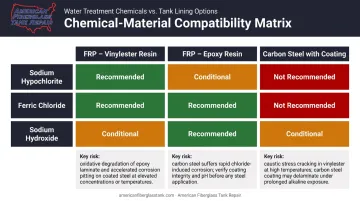
- Sodium hypochlorite (NaOCl) — widely accepted in water treatment; research from WEFTEC/Ashland/Diamond identifies brominated epoxy vinyl ester resin as the best-tested system for this aggressive oxidizer
- Ferric chloride (FeCl3) — standard in water treatment coagulation; documented FRP compatibility across resin types
- Sodium hydroxide (NaOH) — suitable in FRP with appropriate resin selection; carbon steel carries stress corrosion cracking risks at elevated concentrations and temperatures
Pressure and Temperature Define Steel's Territory
ASTM D3299-18 specifies FRP tanks for atmospheric service only. ASME RTP-1 extends the boundary to 0–15 psig for reinforced thermoset plastic equipment. Above that threshold, carbon steel pressure vessel codes apply.
Temperature limits are chemical and resin-specific, not universal. Resin supplier guides (Ashland Derakane, INEOS) provide maximum service temperatures by chemical, concentration, and resin family. When elevated temperatures combine with corrosive service, consult a materials engineer before specifying either material.
Lifecycle Cost: The Real Comparison
No authoritative public study provides a universal 20–30 year TCO comparison. Anyone claiming a precise percentage advantage for one material over the other is working from assumptions, not field data.
The defensible lifecycle framework looks like this:
| Cost Driver | FRP | Carbon Steel |
|---|---|---|
| Initial purchase | Higher | Lower |
| Protective coatings | Not required (proper resin selection) | Required; recoating cycles add recurring cost |
| Inspection program | Certified FRP inspection on 5–10 year intervals (FTPI guidance) | API/AWWA coating inspection programs |
| Relining/repair | Corrosion barrier repair if liner degrades | Recoating or relining if coating fails |
| Replacement risk | Lower in corrosive service with inspection | Higher if coating system neglected |
For a facility storing water treatment chemicals over 25 years, the recurring coating and recoating costs on carbon steel (plus higher corrosion risk when any coating cycle is deferred) typically make FRP the more economical choice over the full asset life.
Situational Decision Guide
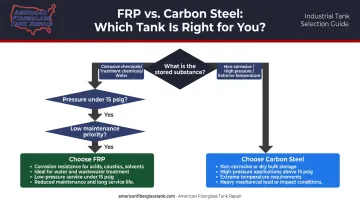
Choose FRP when:
- Stored substance is corrosive (acids, oxidizers, caustics, treatment chemicals)
- Operating pressure is atmospheric or low (under 15 psig)
- Low routine maintenance is a priority
- Application is water/wastewater treatment or chemical processing
Choose carbon steel when:
- High internal pressure or extreme temperatures are required
- Stored substance is non-corrosive and volume requirements are very large
- The facility has active coating maintenance programs already in place
- Mechanical impact resistance or structural flexibility is a design requirement
Conclusion
Neither material wins universally. Carbon steel belongs in high-pressure, high-temperature, and large-volume non-corrosive applications where its structural properties are genuinely needed. FRP belongs in corrosive chemical service, water treatment, and wastewater applications where chemical resistance needs to be built into the vessel — not applied as a coating that can degrade.
For most water and wastewater facilities, and nearly all chemical storage applications involving treatment chemicals, FRP delivers better long-term value through inherent corrosion resistance and lower maintenance burden — provided the resin is correctly specified and the tank is properly maintained.
That last part matters most. Whatever material a facility operates, the inspection and maintenance program behind it determines whether it achieves 20 years or 40 years of service life. For FRP tank operators, proactive inspection by certified professionals using ultrasonic, laser, and high-intensity backlight testing methods is the most reliable way to catch liner degradation, capillary migration, and structural issues before they become tank failures.
American Fiberglass Tank Repair has provided engineer-driven FRP tank inspection, repair, and relining services since 2003. With FTPI-certified inspectors, 24/7 emergency response, and field teams deployed across all 50 states, AFTR operates periodic inspection programs, full relining projects, and emergency repairs on customer schedules — including shutdowns, night shifts, and weekends. Contact AFTR to discuss what your tanks need.
Frequently Asked Questions
Which is better: fiberglass tank or carbon steel tank?
Neither is universally superior. FRP is the preferred choice for corrosive chemical service and water/wastewater treatment due to inherent corrosion resistance and lower maintenance burden. Carbon steel is better suited for high-pressure, high-temperature, or large-volume non-corrosive storage. Match the material to the stored substance, pressure rating, and operating environment — those three factors drive the decision.
What is the best material for a water storage tank?
For potable water and water treatment chemical storage, fiberglass (FRP) outperforms carbon steel in most applications. FRP resists corrosion from treatment chemicals like sodium hypochlorite and ferric chloride that would degrade uncoated carbon steel. NSF-compliant resin options are also available for drinking water contact applications.
How long do fiberglass tanks last compared to carbon steel tanks?
Both materials can achieve 25–40+ year service lives with proper maintenance. FRP sources cite 30–50 years when tanks are routinely inspected and relined; carbon steel above-ground tanks typically reach 25–40 years, with lifespan tied closely to coating integrity. For FRP, certified inspection programs are what determine whether a tank reaches or exceeds that range.
Can fiberglass tanks handle high-pressure or high-temperature applications?
FRP tanks are designed for atmospheric to low-pressure service — ASME RTP-1 sets the upper boundary at 15 psig. They are not appropriate for high-pressure service. Carbon steel is the correct material when pressure ratings or elevated structural temperature requirements dominate the design.
What kind of maintenance do fiberglass tanks require?
FRP requires no painting, coating, or corrosion treatment. Periodic professional inspection is still essential — covering the inner corrosion liner, laminate integrity, nozzle interfaces, and exterior shell. In chemical service especially, liner degradation can develop well before any visible signs appear.
How do I know if my fiberglass tank needs repair or inspection?
External warning signs include surface crazing, discoloration, soft spots, leaks, or unusual product odors. Internal damage — including capillary migration of stored liquid beneath the corrosion coat — often develops before it becomes visible. Schedule certified inspections proactively rather than waiting for visible failure.