The options on the table — FRP, epoxy, rubber, polyurethane, and HDPE — each have legitimate use cases. None is universally "best." This guide breaks down how they compare across the factors that actually matter in industrial and chemical storage applications, and where each material earns its place.
Key Takeaways
- FRP lining provides chemical-specific corrosion resistance, long service life, and structural reinforcement — the strongest choice for aggressive chemical service and aging tanks.
- Epoxy is the standard choice for potable water and food-grade environments requiring NSF/ANSI 61 certification.
- Rubber handles abrasion as well as chemical attack, making it the go-to for mining, slurry handling, and electroplating.
- Polyurethane suits applications requiring flexibility and moderate chemical resistance without structural reinforcement needs.
- Material selection hinges on stored chemical, concentration, temperature, substrate condition, regulatory requirements, and maintenance tolerance.
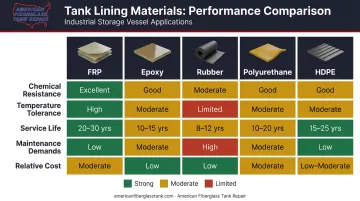
FRP vs. Other Tank Lining Materials: At a Glance
| Factor | FRP | Epoxy | Rubber | Polyurethane | HDPE |
|---|---|---|---|---|---|
| Chemical Resistance | Broad — resin selected to match specific chemical | Mild chemicals, potable water; novolac grades extend range | Moderate corrosive, abrasive media | Wider than standard epoxy | Lower-severity exposure only |
| Temperature Tolerance | Resin-dependent; vinylester extends heat resistance | Product-specific; novolac grades reach 350°F | Up to ~200°F standard; some formulations to 302°F | System-specific | Limited; ~100°F in design calculations |
| Service Life | May exceed 25 years on AST bottoms (NACE No. 10/SSPC-PA 6) | Product/condition-specific; no universal benchmark | Inspect every 3–5 years; formulation-dependent | System-specific | Limited data for bonded interior linings |
| Maintenance Demands | Periodic inspection; spot repair possible | Surface prep and recoating when degraded; blistering in aggressive service | Inspect 3–5 years; spot repair is difficult | Relatively low-maintenance | Liner replacement if damaged |
| Relative Cost | Higher upfront; strong long-term ROI | Lower upfront; more frequent reapplication | Moderate; application-intensive | Competitive mid-range | Lower initial; limited to less aggressive use |
A Note on Temperature and Service Life Data
These figures are formulation- and application-specific, not universal material maximums. Carboline's PLASITE 4550 novolac epoxy, for example, handles crude oil transport to 350°F and 98% sulfuric acid — performance levels a standard epoxy cannot match. The table reflects typical service ranges, not the outer limits of any specific product.
What Is FRP Tank Lining?
FRP lining is a composite system — glass fiber reinforcement embedded in a thermosetting resin — applied to the interior of an existing tank to create a seamless, chemically resistant barrier. This is distinct from an FRP tank itself: you're applying an FRP corrosion layer to the inside of a steel, concrete, or existing fiberglass vessel.
Resin Selection: The Critical Variable
The resin determines everything about chemical compatibility. According to Ashland's Derakane guide, corrosion-resistant FRP applications require chemical-specific resin selection — the table temperatures listed are highest known good-use temperatures, not absolute maximums.
In practice:
- Vinylester resins (e.g., Derakane 411 series) are preferred for strong acids, alkalis, and oxidizing chemicals like sodium hypochlorite
- Isophthalic polyester suits water service and mild chemical environments
- Epoxy vinyl ester extends resistance further for aggressive oxidizing or solvent-containing media
- Novolac vinyl ester handles the most demanding chemical service conditions
American Fiberglass Tank Repair (AFTR) selects resins based on the specific chemical stored, its concentration, and operating temperature. Their material library covers over 45 fiberglass mat, chopped strand, Nexus, Harlar, and carbon veil laminates — matched to the service condition, not pulled from generic stock.
Laminate Design: What's Actually in the Wall
Per Ashland's 2019 guide, a properly designed FRP corrosion barrier is typically 2.5 to 6.3 mm thick, structured in two distinct layers:
- Surface veil layer (0.3–0.8 mm, ~95% resin) — resin-rich layer reinforced with one or two surfacing veils for maximum chemical resistance at the media interface
- Secondary corrosion layer (2–6 mm, ~75% resin) — chopped-strand mat reinforcement providing structural backing to the corrosion liner
This multi-layer architecture is why FRP lining can also reinforce aging tank structures — bridging small perforations in steel tank bottoms, for example, while simultaneously restoring the corrosion barrier.
Where FRP Lining Can Fail
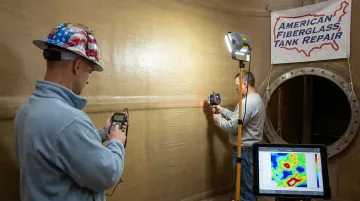
Even a well-engineered laminate will underperform if the resin is mismatched to the service condition or the installation is flawed. FRP linings can experience delamination, blistering, or chemical wicking under those circumstances. AFTR's inspection program targets subsurface conditions specifically — capillary migration of liquid product beneath the corrosion coat is a known failure mode that ultrasonic, laser, and high-intensity backlight testing can detect. These defects typically develop before any visible surface damage appears, so a visual check alone won't catch them in time.
Overview of Other Common Tank Lining Materials
Epoxy Coatings
Epoxy linings are two-part polymer systems that cure to a hard, smooth, impermeable surface. Their primary strengths:
- Excellent cleanability and corrosion resistance in mild chemical service
- Widely used in potable water storage — multiple formulations carry NSF/ANSI 61 certification, the governing health-effects standard for drinking-water system components
Tnemec's Series 20 Pota-Pox and Series 22 Epoxoline are established potable-water systems certified to NSF/ANSI/CAN 61.
Limitations: Standard epoxy can be brittle under mechanical impact and may blister or crack in high-chemical environments. Surface preparation before recoating adds cost and downtime. Specialty formulations push the range considerably further: Carboline's PLASITE 4550 novolac epoxy, for example, handles 98% sulfuric acid service.
Rubber Linings
Natural and synthetic rubber linings are vulcanized or adhered to tank interiors. Their real value is in applications where physical abrasion and chemical attack occur simultaneously — slurry tanks, mining equipment, plating baths, and similar environments.
- Suited for both fixed storage vessels and transport applications in chemical and mining service
- Abrasion-resistant formulations resist temperatures up to 200°F; some heat-resistant grades reach 302°F
- Recommended inspection interval: every 3 to 5 years for cracking, blistering, or lifting
Limitations: Sustained high temperatures soften rubber linings. Highly aggressive acids can cause cracking or delamination. Spot repair is more involved compared to FRP patching.
Polyurethane Coatings
Where rubber addresses abrasion and epoxy handles mild chemical service, polyurethane fills a different gap: flexibility under thermal cycling. These systems offer broader chemical compatibility than standard epoxy and resist cracking where temperature swings would stress a rigid coating. Tnemec's Series 406 Elasto-Shield, for example, is an aromatic polyurethane hybrid used in potable water tank interiors with resistance to chemicals, thermal shock, and abrasion.
Where they fall short: Polyurethane doesn't provide the structural reinforcement that a multi-layer FRP laminate system does. For tanks with existing corrosion damage or perforation risk, that structural gap matters.
HDPE Liners
HDPE liners are pre-formed or field-fabricated sheets used to line tank interiors. They install quickly and offer moderate chemical resistance for lower-severity applications.
Primary limitations:
- Petroleum products are not recommended — they permeate the material
- HDPE doesn't bond to the tank substrate the way a laminated FRP system does; resulting void spaces create permeation risks in aggressive service
- Typical service temperature is limited to around 100°F
FRP vs. the Rest: Which Lining Is Right for Your Application?
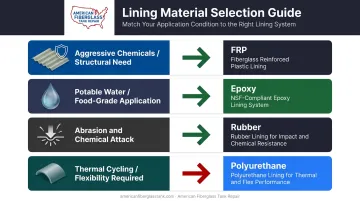
The selection decision comes down to a matrix of factors: the specific chemical and its concentration, operating temperature, existing tank condition and substrate, regulatory requirements, and how long you need the lining to last before the next maintenance window.
Situational Recommendations
Choose FRP lining when:
- Storing strong acids, alkalis, solvents, or oxidizing agents (HCl, NaOH, NaOCl, FeCl₃)
- Working with large-diameter or aging tanks that need structural reinforcement alongside corrosion protection
- Targeting 15–20+ year service life with minimal relining
- Operating in chemical processing, wastewater treatment, or industrial water systems where aggressive media is the norm
Choose epoxy when:
- The application involves potable water storage or food-grade environments requiring NSF/ANSI 61 certification
- The tank substrate is in good condition and needs a cost-effective refresher coating
- Maintenance windows are frequent enough to support periodic reapplication
Choose rubber when:
- Physical abrasion is as significant a threat as chemical attack — slurry handling, electroplating, or mining applications
- The operating temperature stays within the formulation's rated range
Choose polyurethane when:
- Flexibility and thermal cycling resistance matter more than structural reinforcement
- Chemical exposure is moderate and the existing tank structure is sound
Real-World Context: FRP in Wastewater and Chemical Storage
ACMA's 2024 technical presentation by INEOS Composites documents FRP use in wastewater treatment and chemical storage case histories, including sodium hypochlorite tank farm applications using epoxy vinyl ester resin systems. Sodium hypochlorite is one of the most aggressive chemicals handled in FRP storage — it attacks resins, degrades veils, and quickly exposes specification gaps in under-engineered systems.
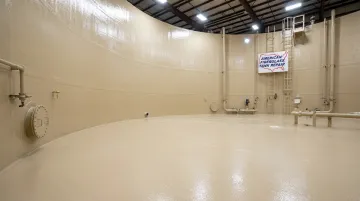
AFTR has refurbished hundreds of tanks storing NaOCl, NaOH, FeCl₃, and HCl in water, wastewater, and chemical processing facilities. In these applications, relining recovers tanks that would otherwise be condemned — typically at a fraction of new-tank cost and without the lead times of replacement vessels.
For operations managing FRP-lined tanks, a professional inspection by certified specialists (like AFTR's Fiberglass Tank & Pipe Institute certified inspectors) identifies whether an existing lining is still performing as designed or nearing the end of its service life. Their process uses ultrasonic, laser, and high-intensity backlight testing to detect subsurface conditions like capillary migration before they become full-scale failures.
Conclusion
FRP lining is not the right answer for every tank. Epoxy has a legitimate place in potable water systems. Rubber earns its keep in abrasive-service applications. Polyurethane serves facilities that need flexibility over structural reinforcement.
Where FRP stands apart is in combining aggressive chemical resistance, structural reinforcement, and resin customization into one system engineered to last. For chemical plants, wastewater facilities, and industrial operations storing corrosive media in large vessels, that combination justifies the higher upfront cost.
Start by defining your chemical service conditions and current tank condition — then match the lining material to those parameters. For operations already running FRP-lined vessels, the difference between a 10-year lining and a 25-year one often comes down to scheduled professional inspection and proactive maintenance before minor degradation becomes a structural failure.
Key decision factors to nail down before choosing a lining:
- Chemical compatibility with the specific media stored
- Required service life and acceptable maintenance intervals
- Whether structural reinforcement is needed alongside corrosion protection
- Budget for upfront installation vs. long-term replacement costs
Frequently Asked Questions
What material is used for tank lining?
The most common tank lining materials are FRP, epoxy, rubber, polyurethane, and HDPE. The best choice depends on the chemical stored, its concentration and temperature, and the existing tank's condition. Each application has a different answer.
Which is better: an HDPE tank or an FRP tank?
FRP tanks offer superior structural strength and chemical resistance for industrial and chemical storage, while HDPE suits lower-pressure, less aggressive applications. Note that this compares tank construction — an existing steel or concrete tank can receive FRP lining regardless of the original tank material.
What is the purpose of rubber lining?
Rubber lining protects tanks from abrasion, physical impact, and moderate chemical attack. It's preferred in slurry handling, mining, and electroplating applications where physical wear is a primary concern alongside corrosion, since a rigid coating would crack under repeated impact.
How long does FRP tank lining last?
NACE No. 10/SSPC-PA 6 states that the useful life of FRP linings applied to carbon steel aboveground storage tank bottoms may exceed 25 years. That figure depends on resin selection, installation quality, chemical service, and regular professional inspection; a consistent inspection program is what pushes service life toward that upper range.
Can FRP tank lining be repaired instead of replaced?
Yes. Localized delamination, blistering, or corrosion barrier breaches can often be addressed through targeted repair rather than full relining — provided the damage is caught early through routine inspection. Early detection is the key factor; widespread degradation typically requires a full relining to restore containment integrity.
What factors should I consider when choosing a tank lining material?
The primary factors are the type and concentration of chemicals stored, operating temperature, the condition and substrate of the existing tank, any regulatory requirements (such as NSF/ANSI 61 for potable water), and the maintenance interval you can realistically support. Defining those parameters upfront — ideally with an engineer-reviewed specification — is what prevents costly mismatches between lining chemistry and service conditions.