Fiberglass (FRP) and polyethylene tanks each serve legitimate roles across industrial, municipal, and commercial applications. But their differences in chemical resistance, structural performance, repairability, and total cost of ownership are significant enough to matter on every project.
This guide breaks down those differences clearly, so facility managers, waterworks operators, and industrial buyers can make a confident, well-informed decision.
Key Takeaways
- FRP tanks offer superior chemical resistance, structural strength, and multi-decade service history — ideal for industrial, chemical, and high-capacity applications
- Polyethylene tanks cost less upfront and install more easily — suited for lighter-duty, lower-demand environments
- Fiberglass tanks can be engineered for specific chemicals through resin selection; polyethylene offers no equivalent customization
- Damaged FRP tanks can be professionally re-lined and returned to service; polyethylene tanks typically require full replacement
- The right choice depends on chemical profile, operating temperature, capacity, and total lifecycle cost — not purchase price alone
Fiberglass Tank vs Plastic Tank: Quick Comparison
Here's a direct side-by-side look at the decision factors that matter most.
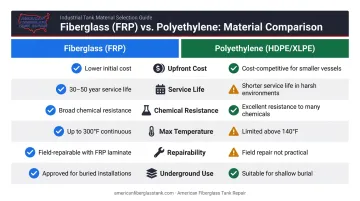
| Factor | Fiberglass (FRP) | Polyethylene (HDPE/XLPE) |
|---|---|---|
| Upfront Cost | Higher; labor-intensive manufacturing | Lower; simpler molding process |
| Total Cost of Ownership | Lower over time; repairable and long-lived | Higher long-term if full replacements needed |
| Composition | Glass fiber + thermosetting resin (polyester, vinylester, epoxy); filament wound or hand lay-up | HDPE or XLPE; rotationally molded, one-piece |
| Service Life | Multi-decade field history; FTPI documents 50+ years for underground FRP systems | Manufacturer benchmark: 15–20 years or longer, condition-dependent |
| Chemical Resistance | Excellent; customizable by resin selection | Good for common chemicals; limited at high temps or concentrations |
| Max Temperature | Resin/chemical specific; some epoxy vinyl ester systems to 200°F | Linear PE: 130°F max; XLPE: up to 150°F |
| Repairability | Can be re-lined and structurally restored by certified specialists | Difficult to repair; XLPE cannot be welded; most damage requires replacement |
| Underground Use | Well-documented; engineered for soil loads | Limited; unreinforced PE shows stress beyond elastic limits under seismic loads |
| Standards | ASTM D3299, ASTM D4097, AWWA D120 | ASTM D1998 |
What Is a Fiberglass Tank?
Fiberglass-reinforced plastic (FRP) tanks are composite vessels built from glass fiber reinforcement and thermosetting resin — typically isophthalic or terephthalic polyester, vinylester, or epoxy. They're manufactured through filament winding or hand lay-up processes, both governed by established ASTM standards (D3299 and D4097 respectively).
The glass fibers carry mechanical load while the resin provides the chemical barrier. This division of function is what delivers FRP's combination of tensile strength, corrosion resistance, and structural rigidity — consistently, across large vessels and aggressive service conditions.
Key Performance Characteristics
- Non-porous interior surface resists chemical penetration and limits product absorption into the laminate
- Structural rigidity handles soil loads for underground installations and hydrostatic pressure in large above-ground vessels
- Wide operating range across temperature and pressure conditions, depending on resin selection
- Engineered wall construction provides consistent, calculable strength — not dependent on molding uniformity
Resin Selection as a Core Differentiator
No other tank material offers the chemical customization that FRP does through resin selection. The resin system is chosen specifically for the chemical being stored, its concentration, and the operating temperature.
For example, Ashland's Derakane guide identifies Derakane 411 vinyl ester resin for sulfuric acid service up to 25% concentration at temperatures up to 100°C. Epoxy novolac vinyl ester systems like the Derakane 470 series are designed for exceptional thermal and chemical resistance, with some systems retaining physical properties up to 200°F.
Standard polyethylene offers no equivalent flexibility. An HDPE or XLPE tank's chemical resistance is fixed at manufacture — there's no field-adjustable equivalent to resin selection.
Design Flexibility
FRP tanks can be designed with features that molded plastic vessels simply can't accommodate:
- Integral slope bottoms for complete drainage
- Side-wall manways for access and inspection
- Custom nozzle placement and sizing
- Hold-down systems for wind and seismic load requirements
- Interior linings matched to specific service conditions
Use Cases for Fiberglass Tanks
FRP tanks dominate in environments where chemical compatibility, large capacity, and long service life are non-negotiable:
- Chemical storage: acids, alkalis, solvents, sodium hypochlorite, ferric chloride, sodium hydroxide
- Municipal water and wastewater treatment: chlorination, pH adjustment, and potable water storage
- Food and beverage processing: potable-water-compatible resin systems available
- Petroleum storage: underground UST applications with documented 50+ year field history
- Aerospace and defense: structural demands and chemical resistance requirements that eliminate most alternatives
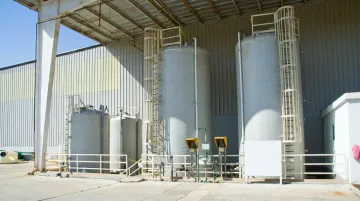
When an FRP tank is already in service, the economics shift. Repair and relining typically cost far less than replacement — and with the right materials, a restored corrosion barrier can add many years of service life. Certified specialists like American Fiberglass Tank Repair (AFTR) perform this work using custom-blended resins matched to the tank's original service conditions, protecting the capital investment without the disruption of full replacement.
What Is a Plastic Tank?
Polyethylene tanks are most commonly manufactured from high-density polyethylene (HDPE) or crosslinked polyethylene (XLPE) using rotational molding — a process that produces a seamless, one-piece vessel with no structural seams or weld points. ASTM D1998 covers flat-bottom, upright, cylindrical polyethylene tanks made by this process.
The seamless construction eliminates a common leak point present in multi-piece designs and ensures consistent wall thickness throughout the vessel.
Core Benefits
- Lowest upfront cost among tank material options
- Lightweight construction — significantly easier to transport and install without heavy equipment
- Good chemical resistance to many common chemicals at ambient temperatures
- XLPE outlasts linear PE — Poly Processing data shows XLPE lasts 30–40% longer than standard polyethylene
Key Limitations
Polyethylene tanks have meaningful constraints in demanding applications:
- Temperature ceiling is low: linear PE maxes out at 130°F; XLPE handles up to 150°F depending on stored material
- Expands and contracts with temperature swings, requiring flexible expansion joints at fittings to prevent stress and leaks
- UV degradation: outdoor installations are vulnerable unless UV stabilizers are fully integrated into the resin
- Repairs are limited — rotomolded PE has low surface energy that restricts adhesive bonding, and XLPE cannot be melted, ruling out conventional plastic welding
- Performs poorly under seismic loads — a 2025 peer-reviewed study found unreinforced PE tanks exceed their elastic stress limit, a concern for high-risk installations
Use Cases for Plastic Tanks
These limitations define where polyethylene tanks fit best — lower-demand environments with predictable conditions:
- Residential and light commercial water storage
- Agricultural water supply and irrigation
- Hard-to-access sites where lightweight handling eliminates the need for heavy equipment
- Budget-sensitive projects with standard water or dilute chemical applications
- Temporary or medium-term storage where upfront cost drives the decision
Fiberglass Tank vs Plastic Tank: Which Is Better?
The right tank material depends on what you're storing, how hot it gets, how large the vessel needs to be, and how long you need it to last. Five variables typically decide the outcome.
1. Chemical Compatibility and Concentration
When a facility stores aggressive chemicals — strong acids, oxidizers, concentrated alkalis, solvents — fiberglass with the correct resin system is the more reliable choice. Polyethylene handles many common chemicals adequately, but has documented limits with concentrated acids, strong oxidizers, and high-specific-gravity applications.
Sodium hypochlorite at 9–15% concentration, for example, requires a 1.9 specific gravity rating in Poly Processing's guidance. Sulfuric acid at 98% demands a 2.2 SG rating and an 11/15 rule limiting tank height to 15 feet. In some applications, polyethylene meets these constraints. In others, the right resin system in an FRP vessel is the safer and more durable choice.
2. Temperature Requirements
| Material | Maximum Temperature |
|---|---|
| Linear HDPE | 130°F |
| XLPE | Up to 150°F (material-dependent) |
| FRP (epoxy vinyl ester) | Up to 200°F (resin and chemical-specific) |
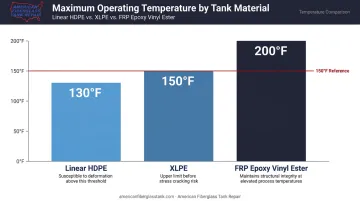
For elevated-temperature chemical storage, fiberglass pulls ahead — particularly when the combination of high temperature and aggressive chemistry would push polyethylene past its rated limits.
3. Structural and Capacity Needs
For large-capacity tanks, underground installations, and environments subject to seismic or wind loads, FRP's engineered wall construction and documented underground performance are clear advantages. Polyethylene tanks are well-suited for smaller, above-ground, lower-load applications.
4. Site Access and Installation Constraints
Polyethylene's lightweight construction is a real advantage at remote or hard-to-access sites. When heavy equipment isn't available and installation logistics are complex, a rotationally molded plastic tank is often the practical choice.
5. Repairability and Lifecycle Cost
Polyethylene tanks — particularly XLPE — are difficult or impractical to repair once structurally compromised. Most damage leads to full replacement. FRP tanks, when properly maintained and inspected, can be re-lined and restored by certified specialists, extending service life by many years. For industrial operators treating tanks as capital assets, that difference in repairability has real long-term cost implications.
The practical guidance:
- Fiberglass is the right call for aggressive chemicals, elevated temperatures, large-capacity or underground tanks, and facilities focused on long-term asset value
- Polyethylene fits lower-demand applications, simpler installations, tighter budgets, or short-to-medium-term storage of water and dilute chemicals
The Long-Term Case for Fiberglass: Repair vs. Replace
Repairability is fiberglass's most practical advantage over polyethylene. When an FRP tank's internal corrosion lining degrades, even after a corrosion barrier breach, the structural laminated body typically remains intact. That makes it a viable substrate for a new corrosion layer rather than an immediate replacement candidate.
Polyethylene doesn't offer this pathway. XLPE is a thermoset plastic that can't be melted or welded, and linear HDPE's low surface energy limits adhesive bonding. For most damaged polyethylene tanks, replacement is the only option.
What FRP Inspection Looks Like in Practice
AFTR's inspection program uses three primary methods to assess tank condition before problems escalate:
- Ultrasonic testing — detects conditions within the structural body of the tank, including capillary migration of liquid product beneath the corrosion coat
- High-intensity backlight — reveals surface and sub-surface lining conditions not visible to the eye
- Laser testing — provides precision assessment of structural and lining integrity
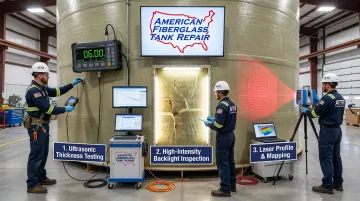
All inspections are supervised by Fiberglass Tank & Pipe Institute (FTPI) certified inspectors. FTPI's recommended practice calls for trained external inspections every 5 years for hazardous-substance service and every 10 years for larger tanks in other services.
Common defects AFTR identifies during inspections include spidering, disbondment, abrasion wear, emulsification, floor stress cracking, shell distortion, and UV degradation. Worth understanding: a tank may pass a hydrostatic test today and fail three months later, because capillary migration beneath the corrosion coat can progress without any visible surface signs.
Why Early Detection Changes the Math
When degradation is caught while the structural body is still intact, relining is straightforward. AFTR applies custom-blended resin systems — isophthalic polyester, terephthalic polyester, vinylester, or epoxy — matched to the specific chemical service and temperature exposure.
Combined with over 45 fiberglass mat, chopped strand, and veil laminates, the result is a restored corrosion barrier at a fraction of new-vessel cost. Once a tank reaches visible failure, that repair window no longer exists.
For facilities managing FRP tanks in chemical storage, water treatment, or wastewater applications, AFTR offers inspection, relining, nozzle modification, and emergency services across all 50 U.S. states, Canada, and Puerto Rico. Call 877-427-0090 to schedule an assessment before your next scheduled shutdown.
Conclusion
Fiberglass and polyethylene tanks serve different applications well. FRP wins on long-term performance, chemical compatibility, structural flexibility, and repairability in demanding industrial environments. Polyethylene wins on upfront cost and installation simplicity for lighter-duty uses. The decision depends on chemical profile, operating temperature, capacity requirements, and how the facility weighs upfront cost against long-term total cost of ownership.
For facilities where tank failure carries operational, environmental, or safety risk, the case for fiberglass — and for a proactive maintenance strategy that extends its service life — is direct. Facilities that invest in regular inspection and timely repairs routinely extend FRP tank service life well beyond initial design expectations — often by decades. That's where companies like American Fiberglass Tank Repair work with industrial operators to protect that long-term investment through engineer-driven inspection, relining, and repair programs.
Frequently Asked Questions
Fiberglass tank vs plastic tank: which is better?
Neither is universally better. Fiberglass excels in industrial, chemical, and high-demand applications where long service life, chemical compatibility, and structural strength are priorities. Polyethylene is the better fit for lower-demand, budget-sensitive, or easy-access installations with standard water or dilute chemical applications.
What is the healthiest water tank?
Both fiberglass and quality polyethylene tanks can be certified to NSF/ANSI/CAN 61 for drinking water contact, but certification is product-specific, not material-wide. FRP tanks with a non-porous interior perform well for long-term potable water storage. Confirm NSF certification for the specific product before installation.
How long does a fiberglass tank last compared to a plastic tank?
FRP tanks have a documented service life of 30–50+ years; major manufacturers have offered 30-year limited warranties, and FTPI cites 50+ years for underground petroleum systems. Polyethylene benchmarks run 15–20 years, with XLPE lasting 30–40% longer than linear PE. Unlike polyethylene, FRP service life can be actively extended through professional relining rather than full replacement.
Can fiberglass tanks be repaired?
Yes. FRP tanks can be re-lined and structurally restored by certified specialists even after corrosion barrier breaches, provided the structural laminate body remains intact. Early detection through professional inspection keeps repair viable and cost-effective. Scheduling periodic inspections before degradation reaches the structural layer is what preserves the option to repair rather than replace.
Are fiberglass tanks more expensive than plastic tanks?
Fiberglass carries a higher upfront cost due to more complex manufacturing. Over a full service life, total cost of ownership is typically lower: FRP tanks last longer and can be repaired rather than replaced, while polyethylene tanks require full replacement upon failure.
Which tank material is better for chemical storage?
Fiberglass is generally preferred for aggressive chemical storage because the resin system can be engineered to match the specific chemical, concentration, and temperature. XLPE polyethylene is competitive for certain chemicals at moderate conditions, but fiberglass offers broader chemical compatibility, higher temperature tolerance, and greater design flexibility for industrial applications.