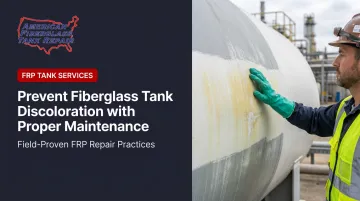
Discoloration is one of the earliest signals a tank sends when something is wrong. Facility managers often dismiss it as surface staining or normal weathering. That instinct is understandable, but frequently costly. What looks like fading or yellowing can indicate active UV degradation, chemical attack on the corrosion liner, or moisture infiltration that is quietly compromising the laminate beneath the surface.
This article covers the root causes of FRP tank discoloration, the maintenance practices that prevent it, warning signs that require professional assessment, and a practical inspection schedule aligned with industry guidance.
Key Takeaways
- Discoloration in FRP tanks is rarely cosmetic — it signals UV damage, chemical attack, or resin breakdown
- Different patterns (yellowing, chalking, staining, blistering) point to different causes and require different responses
- Routine cleaning, UV coating upkeep, and internal lining maintenance are the core prevention tools
- FTPI 2007-1 calls for monthly visual checks, annual preventive inspections, and certified external inspection every 5 years
- Cracking, blistering, or soft spots alongside discoloration require professional evaluation — not just cleaning
What Causes Fiberglass Tank Discoloration?
Discoloration is not a single condition. Each pattern has a distinct cause and a different implication for tank health. Knowing which one you're dealing with is the starting point for any maintenance decision.
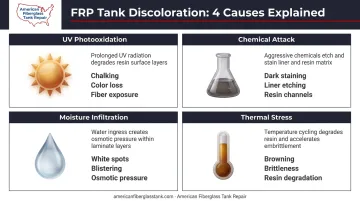
UV Exposure and Photooxidation
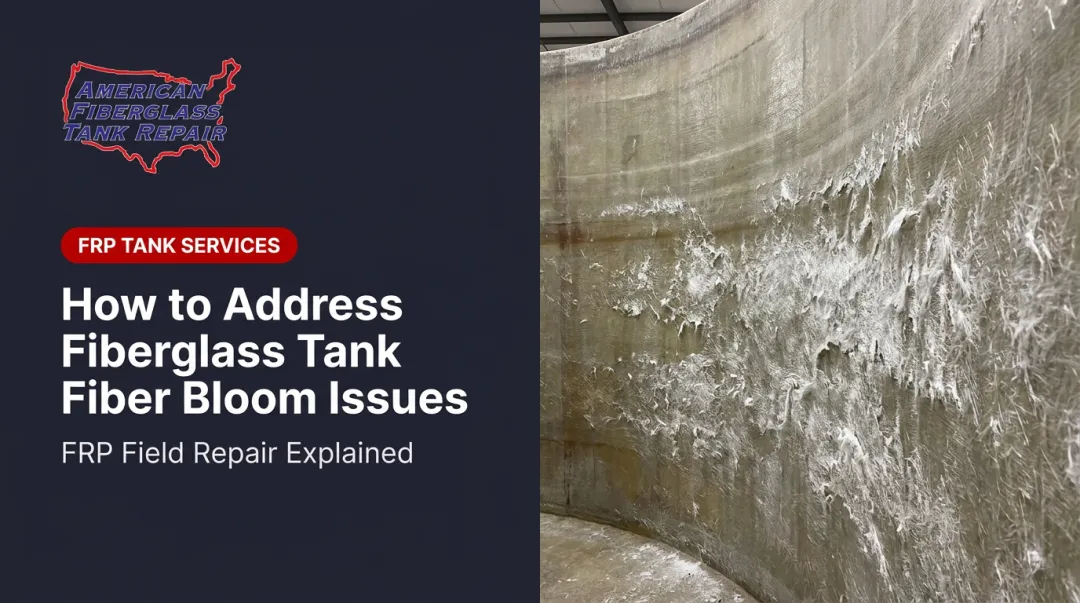
UV light degrades FRP resin at the molecular level by breaking carbon chains in the resin matrix. The visible result progresses from chalking and color loss to a rough, matte surface texture — and eventually, fiber exposure at the surface. This is most common on above-ground outdoor tanks with no UV-protective coating.
It is entirely preventable with properly maintained UV-resistant coatings. KTA-Tator notes that urethane coatings provide better UV resistance and color retention than epoxies, which tend to chalk and fade in sunlight.
Chemical Attack and Oxidation
FRP resins are organic polymers. Oxidizing agents including sodium hypochlorite, chlorine, and chlorine dioxide can reduce corrosion-barrier thickness and produce visually detectable changes — dark staining, surface etching, uneven liner coloration, or yellowish channels in the resin.
In a sodium hypochlorite tank inspection documented in 2022, inspectors identified light patches and squiggly discolored channels as resin degradation from chemical permeation into the corrosion barrier. This pattern is common in water treatment and chemical plant applications.
Moisture Infiltration and Osmotic Blistering
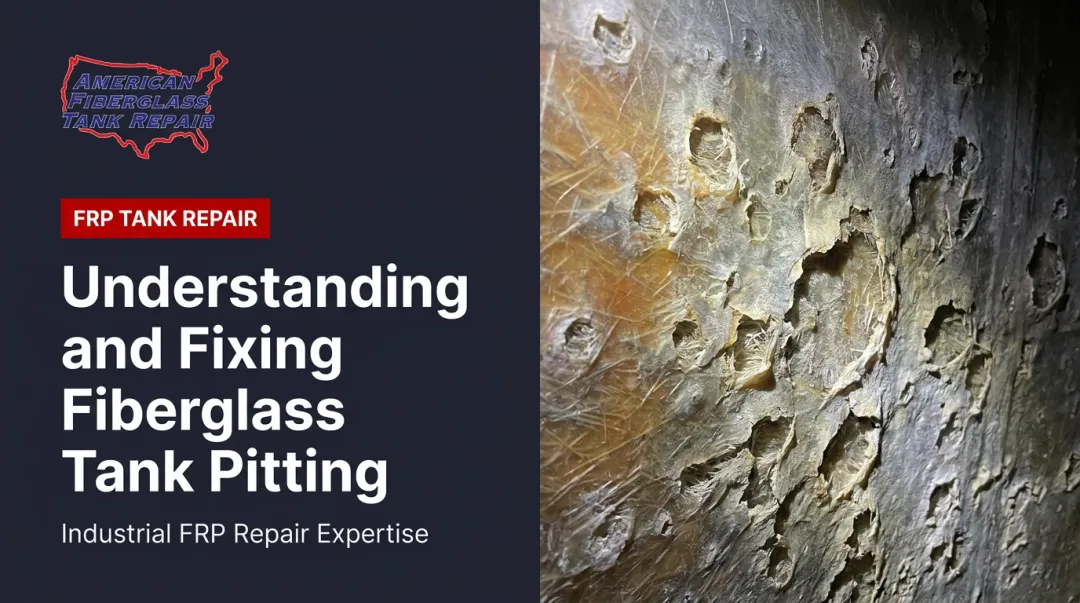
When a gel coat or corrosion liner is compromised, moisture can penetrate the polymer barrier. Osmotic pressure builds beneath the surface, producing white spots, bubbling, or raised discoloration. This is not surface contamination — it indicates active lining failure.
TAPPI TIP 0402-28 directs inspectors to determine whether blistering has reached the structural laminate, because that boundary marks the difference between a liner repair and a structural problem.
Thermal Stress and Resin Degradation
ASTM D4097-19 requires special design consideration for tanks with service temperatures exceeding 180°F (82°C). Prolonged operation beyond design temperature limits can produce brownish discoloration or surface brittleness. The specific appearance varies by resin type and chemical service, with no universal visual threshold — but any browning or brittleness in a tank running at elevated temperatures warrants immediate inspection.
Why Fiberglass Tank Maintenance Matters Beyond Appearances
Surface discoloration is often the first visible symptom of a deeper process. Ignoring it does not stop that process — it just delays the point at which the damage becomes more expensive to address.
From Surface to Structure
TAPPI TIP 0402-28 identifies corrosion-barrier integrity as the critical factor in determining the projected service life and repair timing of used FRP equipment. When oxidizing chemicals reduce corrosion-barrier thickness, the discoloration is not cosmetic — it represents material loss. Left unaddressed, that loss progresses from the barrier layer into the structural laminate, where repair becomes far more complex and costly.
Delamination — bond failure between resin and glass fiber layers — can follow, reducing load-bearing capacity and creating risk of sudden structural failure.
Compliance and Safety Exposure
Two federal frameworks create direct compliance exposure when tank condition deteriorates:
- EPA SPCC Bulk Storage Container Inspection: The SPCC requirements are designed to detect integrity and structural issues before a discharge occurs. Visible degradation in above-ground bulk storage containers can trigger integrity testing.
- OSHA Process Safety Management: The PSM standard applies mechanical integrity requirements to pressure vessels and storage tanks in covered processes involving highly hazardous chemicals. Lining failure in those applications is a compliance issue, not just an operational one.
Repair vs. Replacement
AFTR's field experience across hundreds of chemical storage tank projects reflects a clear pattern: even when a tank lining has experienced corrosion barrier failure, the structural vessel typically remains intact and serves as a sound substrate for relining. A planned relining job is far more cost-effective than emergency replacement — and avoids the lead-time delays that compound production losses when a tank goes down unexpectedly.
Maintenance Practices That Prevent Fiberglass Tank Discoloration
Prevention requires a layered approach. Cleaning, UV protection, lining maintenance, and professional inspection each address a different cause of discoloration.
Routine Cleaning and Surface Care
Regular cleaning removes mineral deposits, biological growth, and chemical residue that accelerate resin breakdown when left in contact with the surface.
Key guidelines:
- Use cleaning chemicals compatible with the tank's resin and corrosion-barrier system — incompatible products can strip the gel coat or accelerate the degradation they are meant to remove
- For surface preparation before coating, KTA-Tator recommends pressure washing up to 5,000 psi or detergent scrubbing, with mechanical abrasion limited to hand sanding or soft media (walnut shells, corn cob) to avoid damaging the FRP surface
- Rinse thoroughly after each cleaning cycle
- Inspect nozzle areas and seams during every cleaning — these are common points where staining first appears
UV Coating and Exterior Protection
Above-ground tanks in outdoor service need periodic reapplication of UV-resistant protective coatings to maintain UV degradation resistance. Urethane coatings offer better UV and color retention than epoxy formulations for exterior use.
Indicators that recoating is due:
- Visible chalking or powdering on the surface
- Color loss or significant fading
- Rough or fibrous texture (fiber exposure)
- Dull, matte appearance where gloss previously existed
Coating reapplication intervals should follow the coating manufacturer's specifications and observed surface condition — there is no universal fixed interval. In high-UV environments, supplemental shading structures can extend coating service life.
Corrosion Liner and Internal Lining Maintenance
The internal corrosion barrier is the primary defense against chemical-driven discoloration. When this barrier wears or degrades chemically, stored media permeates toward the structural laminate — producing the staining patterns visible from outside.
Liner repair or relamination restores this barrier before damage progresses. The resin system selected must match the stored media, concentration, and operating temperature — not just the original tank specification, particularly if chemistry has changed since installation.
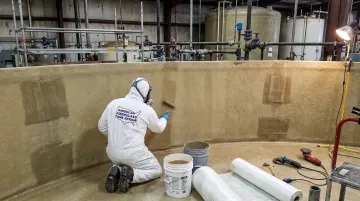
AFTR's field service teams perform liner repair and relamination using resins and laminates matched to the specific chemical service:
- Custom-blended isophthalic and terephthalic polyester, vinylester, and epoxy resins
- 45+ fiberglass mat, chopped strand, Nexus, Harlar, and carbon veil laminate options
- Product-specific resin and veil systems for aggressive chemistries: sodium hypochlorite, sodium hydroxide, ferric chloride, and HCl
All laminate selections follow tank-manufacturing protocols to ensure field repairs meet construction-grade standards — backed by hundreds of chemical storage tank projects completed since 2003.
Professional Inspection and Condition Assessment
Even with sound liner maintenance, routine visual checks have real limits. Wall thinning, subsurface delamination, and capillary migration of stored product under the corrosion coat are invisible to the naked eye — until they advance into visible structural failure.
AFTR's engineer-driven inspections use ultrasonic, laser, and high-intensity backlight testing to assess conditions inside the structural body of the tank, not just at the surface. These methods can detect:
- Capillary migration of liquid product beneath the corrosion coat
- Spidering, disbondment, and abrasion wear
- Floor stress cracking and shell distortion
- Low Barcol hardness (indicating resin cure issues or degradation)
- UV degradation patterns not yet visible to the naked eye
All inspections are supervised by Fiberglass Tank & Pipe Institute (FTPI) certified inspectors, with Customer Support Engineers developing protocols and interpreting findings. Inspection reports include both condition documentation and specific remediation recommendations — replacing guesswork with targeted action.
Warning Signs Your Fiberglass Tank Needs Immediate Attention
The following indicators move beyond routine discoloration into territory that requires professional evaluation, not just cleaning or recoating.
Visible Surface and Structural Indicators
Discoloration with blistering or bubbling: This combination points to active moisture infiltration or gas permeation through a failing liner. Per TAPPI TIP 0402-28, the critical question is whether blistering is confined to the corrosion barrier or has reached the structural laminate — only inspection can answer that.
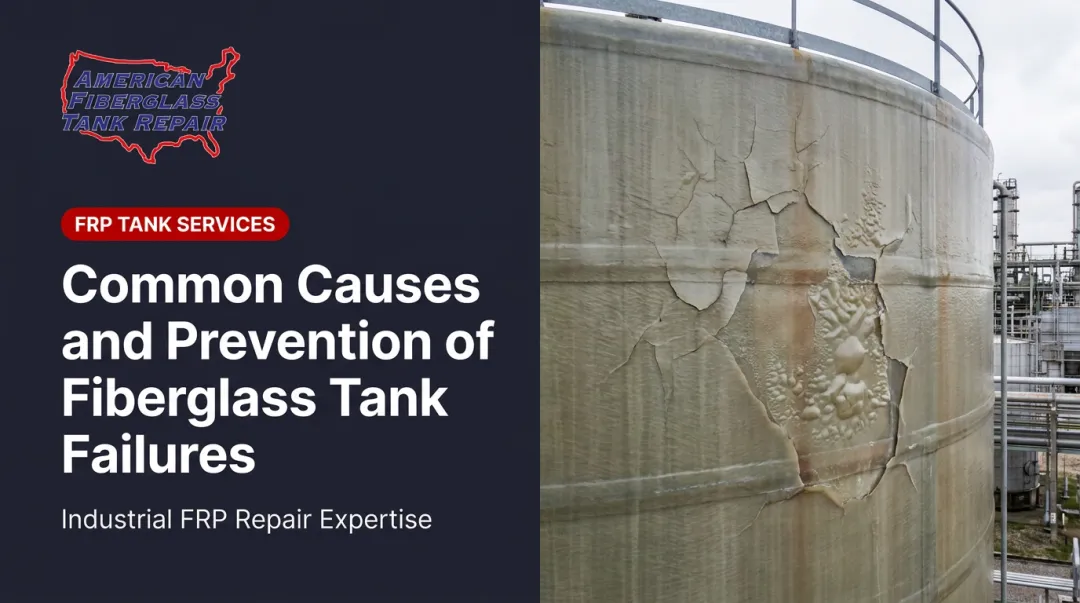
Crazing, spiderweb cracking, or surface fractures: Fine cracks in the resin-rich surface layer create pathways for chemicals and moisture to reach the structural laminate. Surface checking that looks cosmetic can compromise wall integrity faster than most operators expect.
Soft spots, hollow sound when tapped, or visible wall distortion: These are signs of delamination — breakdown of the bond between resin and glass fiber layers. TAPPI TIP 0402-28 identifies oblique lighting, tapping, and ultrasonic thickness measurement as detection methods. Delamination significantly reduces load-bearing capacity and can lead to sudden structural failure.
Operational and Maintenance Clues
- Recurring leaks at fittings or seams, crystalline deposits on the exterior, or unexplained loss of stored product — these indicate active breaches requiring immediate professional assessment
- Frequent gasket failures or increased cleaning requirements — indirect evidence of chemical permeation or liner degradation that leads to visible structural damage without intervention
- New discoloration appearing after a change in stored chemistry — FTPI 2007-1 specifically calls for inspection before switching to a dissimilar stored material; discoloration after a chemistry change warrants immediate inspection
When any of these conditions appear, response time matters. AFTR's emergency teams deploy from strategically positioned locations across North America, arriving with pre-loaded Service-Pack containers stocked with blended resins and laminates ready for immediate field repair.
Fiberglass Tank Maintenance Schedule
Maintenance frequency depends on stored media, UV exposure, operating temperature, tank age, and service history. Industrial chemical tanks require more attention than ambient-temperature water storage.
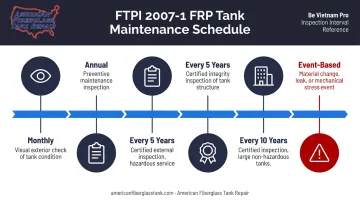
The schedule below follows FTPI 2007-1, the Fiberglass Tank & Pipe Institute's recommended practice for in-service inspection of aboveground atmospheric FRP tanks and vessels:
| Frequency | Activity |
|---|---|
| Monthly | Visual exterior inspection for leaks, staining, new discoloration at fittings and seams |
| Annual | Preventive maintenance inspection by personnel familiar with the equipment; full exterior check for UV degradation, coating condition, surface texture changes; nozzle and support inspection |
| Every 5 years | Certified or trained external inspection for tanks in hazardous substance service |
| Every 10 years | Certified or trained external inspection for tanks >10,000 gallons in non-hazardous service |
| 20-year milestone | Certified integrity inspection for hazardous service tanks or large non-hazardous service tanks |
| Event-based | Inspect if material stress is evident, leaks are detected, before changing stored material, or if tank is relocated |
Tanks in aggressive chemical service, outdoor UV-exposed environments, or those already showing early discoloration should follow the more frequent end of this schedule. For high-risk service conditions, monthly inspections are a starting point — not the maximum. Catching discoloration early is far less costly than responding to laminate degradation or liner failure after the fact.
Conclusion
Discoloration in a fiberglass tank is a maintenance signal. It points to UV degradation, chemical attack, or lining failure. Addressing the root cause early protects both the tank and the operational investment it represents. Surface fading recoated promptly stays a surface issue. Left unaddressed across two inspection cycles, that same fading can progress to delamination, liner failure, or a regulatory event.
Keeping a fiberglass tank in service long-term comes down to matching the maintenance program to the tank's actual conditions — the stored chemistry, UV exposure, and inspection history — rather than applying a generic schedule.
When discoloration signals something beyond routine surface wear, the next step is a structured assessment by inspectors who understand FRP chemistry and failure modes. AFTR's FTPI-certified inspection and repair teams work across all 50 states, Canada, Puerto Rico, and select international locations. Contact AFTR to develop a maintenance plan tailored to your tank's specific chemistry, environment, and service history.
Frequently Asked Questions
What does fiberglass damage look like?
Common signs include surface crazing or spiderweb cracking, discoloration or fading, blistering or bubbling, soft spots, and leaks around fittings. Some forms — including delamination and wall thinning — produce no visible surface symptoms and are only detectable through ultrasonic or backlight testing.
What causes discoloration in fiberglass tanks?
Four primary causes drive fiberglass tank discoloration:
- UV photooxidation — yellowing and chalking of exterior surfaces
- Chemical attack or oxidation — staining, darkening, or uneven liner color
- Moisture infiltration through a compromised liner — white spots and blistering
- Thermal stress from sustained operation above the resin's rated temperature — browning and brittleness
Can a discolored fiberglass tank be repaired or restored?
In most cases, yes. UV surface degradation can be addressed with recoating after proper surface preparation. Chemical- or moisture-driven discoloration typically requires liner repair or relamination using resin systems matched to the stored media. Catching it early keeps repair costs manageable — waiting often turns a liner fix into a full replacement.
Does discoloration affect the structural integrity of a fiberglass tank?
It depends on the cause. UV surface fading alone may not compromise the structural laminate. Discoloration linked to chemical attack, osmotic blistering, or visible cracking typically indicates corrosion barrier degradation that can reach the structural laminate if left uninspected.
How often should fiberglass tanks be inspected to prevent discoloration?
Per FTPI 2007-1, monthly visual inspections and annual preventive maintenance inspections are the baseline. Certified external inspection is recommended every 5 years for hazardous service tanks. Any tank showing discoloration or handling aggressive chemicals warrants inspection on the monthly-to-annual cycle, not the 5-year track.
What cleaning products are safe to use on fiberglass tanks?
Use cleaning products that are chemically compatible with the tank's resin and corrosion-barrier system. For exterior surface preparation, KTA-Tator recommends pressure washing or detergent scrubbing with mechanical abrasion limited to soft media. Avoid products that could attack or strip the gel coat or liner — verify compatibility before use.