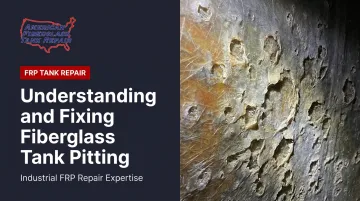
This article covers what fiberglass tank pitting actually looks like, what drives it, how to assess and repair it, and when relining or replacement becomes the better call.
Key Takeaways
- Pitting in FRP tanks appears as craters, rough patches, or eroded spots in the corrosion liner — distinct from cracking, crazing, or delamination
- Primary causes include chemical attack on an incompatible liner, manufacturing voids, UV degradation, physical abrasion, and osmotic blistering
- Surface and moderate pitting is repairable with grinding and resin patching; widespread or deep pitting requires full interior relining
- Barcol hardness, ultrasonic thickness, and high-intensity backlight testing must guide any repair decision
- FTPI RP 2007-1 recommends trained external inspections every 5 years for hazardous-substance service — don't wait for visible symptoms
What Is Fiberglass Tank Pitting?
ASTM D2563-08, the standard practice for classifying visual defects in glass-reinforced plastic laminates, treats pits and pinholes as their own defect category — separate from cracks, crazing, delamination, blisters, dry spots, and air bubbles. Misclassifying pitting as crazing or delamination leads to the wrong repair approach — and a liner that fails again.
In practical terms, FRP tank pitting is localized erosion or degradation of the corrosion-resistant liner or laminate surface. It presents as:
- Small craters or voids in the resin-rich inner surface
- Rough, eroded texture where the liner has softened or worn away
- Exposed glass fibers (sometimes called fiber blooming) in more advanced cases
- Discoloration or dull patches that differ from the surrounding liner
How It Differs from Metal Tank Pitting
Metal tank pitting is electrochemical — galvanic reactions drive localized corrosion. FRP pitting works differently: the resin matrix breaks down chemically, mechanically, or through moisture ingress. The glass fibers themselves don't corrode, but once the resin protecting them degrades, they become exposed and saturated, losing their reinforcing function.
The liner is the first line of defense. When pitting breaches it, the structural laminate behind it becomes vulnerable to the same chemical attack the liner was designed to absorb — which is why liner condition directly determines structural risk.
Why Early Detection Matters
Early-stage pitting is a maintenance issue. Late-stage pitting — where the structural laminate is involved — is a containment and safety issue. No industry standard defines a fixed timeline for how fast pitting progresses, which is why condition-based inspection matters more than waiting for a scheduled interval.
What Causes Pitting in Fiberglass Tanks?
Chemical Attack on the Corrosion Liner
This is the most common driver. When stored chemicals exceed the liner resin's rated compatibility — or when concentration or temperature creeps above design limits — the resin softens and erodes. A 2008 NACE study on sodium hypochlorite at 9–15% available chlorine found that resin type and cure chemistry measurably influenced surface attack — brominated epoxy vinyl ester with the right cure package showed the least damage, while certain cobalt/MEKP cure systems showed serious corrosion.
Specifying "vinyl ester" alone isn't enough. The full resin and cure system must be matched to the specific chemical, concentration, and temperature — verified through ASTM C581 compatibility testing.
Manufacturing Defects — Dry Spots and Voids
Incomplete resin wet-out during fabrication creates dry spots (zones where fiberglass is not fully impregnated). These areas absorb fluid, blister, and eventually pit. Without testing, they're often invisible — dormant for years before manifesting as surface damage.
UV Degradation
Above-ground tanks exposed to prolonged UV gradually lose surface veil integrity. The resin chalks, molecular chains break down, and glass fibers become exposed at the surface. Without UV-protective coatings and regular inspection, what starts as surface erosion can progress into structural territory.
Physical Impact and Abrasion
Mechanical wear from agitators, abrasive slurries, improper cleaning tools, and handling strips away liner surfaces over time. Common contributors include:
- Rotating agitators contacting liner walls
- Abrasive slurries with suspended solids
- Wire brushes or incompatible cleaning tools
- Rough handling during installation or maintenance
The resulting pits become entry points for chemical attack, creating a compounding failure mode that accelerates degradation.
Osmotic Blistering
When moisture permeates through a damaged or aging liner into the laminate, osmotic pressure builds around soluble constituents or unreacted materials. Subsurface blisters form, then rupture into pits. This accelerates in tanks with thin liners, damaged gelcoats, or those exposed to temperature cycling.
How to Assess and Repair Fiberglass Tank Pitting
Attempting a repair without a proper assessment is the most common and costly mistake. The depth and distribution of pitting determines everything — repair method, resin selection, and whether a spot fix is even appropriate.
Step 1: Inspect and Document
The tank must be emptied, cleaned, and ventilated according to confined space entry protocols before any interior inspection begins.
During the visual inspection, look for:
- Pit location, approximate diameter, and density
- Fiber blooming (exposed glass) or discoloration
- Chalking or rough texture on the liner surface
- Patterns suggesting chemical attack vs. mechanical wear
Supplemental testing fills in what visual inspection misses. AFTR's inspection process, supervised by Fiberglass Tank & Pipe Institute certified inspectors, employs ultrasonic, laser, and high-intensity backlight testing to detect conditions beyond the surface — including capillary migration of liquid product beneath the corrosion coat.
Barcol hardness testing is also performed; readings should be compared against the resin manufacturer's published full-cure hardness. Note: ASTM D2583 was withdrawn in 2022, so cure acceptance should follow the current resin data sheet or project specification, not a generic threshold.
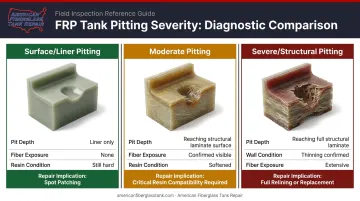
Step 2: Classify Pitting Severity
| Severity | Characteristics | Implication |
|---|---|---|
| Surface/Liner Pitting | Pits confined to corrosion liner, no fiber exposure, resin still hard | Repairable with spot patching |
| Moderate Pitting | Fiber exposure visible, resin softened in affected zones | Repair possible, but resin compatibility is critical |
| Severe/Structural Pitting | Pits reach structural laminate, possible wall thinning | Full relining or replacement evaluation required |
Step 3: Execute the Repair
For surface and moderate pitting:
- Grind or abrade the affected area to remove all degraded resin down to sound laminate
- Clean with solvent wipe to remove contamination and grinding dust
- Apply a compatible resin patch using hand layup with appropriate mat and veil
- Allow full cure per the resin manufacturer's specifications
- Apply a topcoat of corrosion-resistant liner resin matched to the stored chemical
Resin compatibility is non-negotiable. Isophthalic polyester, vinylester, and epoxy are not interchangeable — selection must reflect the specific chemical, concentration, and operating temperature.
When pitting is more widespread or has penetrated the structural laminate, spot repairs are no longer sufficient.
For severe or widespread pitting:
Full interior relining is required. The process involves:
- Abrading the existing liner down to sound substrate
- Assessing and addressing any compromised laminate
- Building up a new corrosion liner system with multiple layers of resin-saturated mat and veil
- Selecting resin and laminate materials matched to the specific chemical service
AFTR's field service teams perform full relining using custom-blended isophthalic, terephthalic polyester, vinylester, and epoxy resins alongside more than 45 mat and veil laminates. Field crews work around customer schedules, including shutdowns and night shifts.
Step 4: Validate the Repair
Before returning to service:
- Barcol hardness testing on the repaired area to confirm full cure (target per resin manufacturer's data sheet)
- Visual inspection under adequate lighting
- Ultrasonic thickness verification for reline work
- Chemical compatibility confirmation before refilling
Repair vs. Reline vs. Replace: Making the Right Call
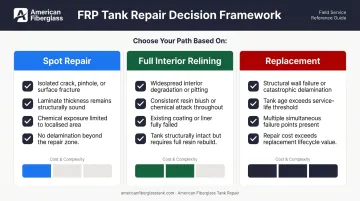
The right decision hinges on five factors: pitting severity, total affected area, tank age, structural laminate condition, and the cost of choosing wrong. Each path — spot repair, full relining, or replacement — has a clear set of conditions that justify it.
Spot repair is appropriate when:
- Pitting is localized to a small portion of the liner surface
- Pit depth stays within the corrosion liner with no structural involvement
- Ultrasonic testing confirms adequate wall thickness in unaffected areas
- The tank is relatively early in its service life
Full interior relining is appropriate when:
- Pitting is widespread or the liner shows generalized degradation
- The stored chemical has changed to a more aggressive service than the original liner was designed for
- The liner is approaching end of service life even where pitting hasn't fully formed
- Lead times or budget constraints make replacement impractical — relining adapts the vessel to current chemical service at a fraction of replacement cost
Replacement is warranted when:
- Ultrasonic testing reveals structural laminate thinning below safe design minimums
- Through-wall perforations exist
- Multiple compound failure modes are present (pitting combined with significant cracking and delamination)
- The tank has no maintenance history and has exceeded its design service life
A common misconception drives unnecessary replacements: even after significant liner failure, the structural laminate is often still sound and can serve as a solid substrate for a new corrosion layer. The structure — not the liner — is what determines whether replacement is actually required.
Preventing Fiberglass Tank Pitting
Pitting rarely appears without warning — it develops over months or years of avoidable exposure. Three practices consistently separate tanks that last decades from those that fail ahead of schedule:
Follow FTPI-Recommended Inspection Intervals
FTPI RP 2007-1 requires trained external inspections every 5 years for hazardous-substance service and every 10 years for tanks over 10,000 gallons in less aggressive service. For sodium hypochlorite, strong acids, and oxidizers, use the more conservative interval. Also inspect after any service change, detected leak, or visible stress — calendar intervals alone are insufficient.
AFTR offers both periodic inspection programs and one-time assessments, each producing a written condition report with recommended actions. Inspections include examination of the interior corrosion coat, structural body, exterior shell, and nozzles using ultrasonic, laser, and high-intensity backlight methods.
Select the Right Resin for Your Chemical Service
Resin selection — at manufacture or relining — is the most controllable factor in liner longevity. Each resin type covers a different range of chemical aggressiveness:
- Isophthalic polyester: suitable for moderate chemical service
- Vinylester: appropriate for stronger acids and oxidizers
- Epoxy: suited to the most aggressive environments
Verify compatibility using ASTM C581 data and manufacturer chemical resistance guides at the actual concentration and operating temperature — not just the chemical name.
Protect the Liner Through Daily Operations
- Avoid abrasive cleaning tools or pressure washing that damages the liner surface
- Monitor chemical concentration and temperature against design parameters
- Apply UV-resistant exterior coatings on above-ground tanks and inspect annually for surface veil breakdown
- Document all inspection and repair history — degradation trends are only visible over time
Frequently Asked Questions
What does pitting look like inside a fiberglass tank?
Pitting appears as small craters, eroded rough patches, exposed glass fibers, or discolored areas on the liner surface. Early-stage pitting can be subtle — similar in appearance to surface crazing — and may require Barcol hardness or backlight testing to accurately characterize.
Is fiberglass tank pitting dangerous?
Surface pitting confined to the liner is a warning sign, not an immediate hazard. The risk escalates when pitting reaches the structural laminate, compromising wall integrity and creating leak pathways for corrosive or hazardous contents. Have the tank assessed as soon as pitting is detected.
How long does a fiberglass tank pitting repair last?
A well-executed spot repair using a compatible resin can last 5–10 years or more — provided the root cause (chemical incompatibility, UV exposure, or abrasion) is also addressed. A full professional reline can extend tank service life by a decade or longer, depending on chemical service and operating conditions.
What causes pitting to accelerate in fiberglass tanks?
Chemical incompatibility is the most common accelerant — when stored media attacks a resin not rated for that service, the liner degrades faster than normal wear would cause. UV exposure on above-ground tanks, abrasive solids in suspension, and thermal cycling also speed up liner breakdown. Identifying the root cause before repair is critical to preventing recurrence.
How often should fiberglass tanks be inspected for pitting?
Every 5 years for hazardous-substance service; every 10 years for large tanks in less aggressive service, per FTPI RP 2007-1. The first inspection within 3–5 years of initial service establishes a baseline condition that makes subsequent assessments far more meaningful.
Can pitting be repaired without replacing the entire tank?
Yes. Localized pitting is repairable with surface grinding and compatible resin patching. Widespread pitting can often be addressed through full interior relining rather than tank replacement — provided the structural laminate remains intact, which is confirmed through ultrasonic testing.