Key Takeaways
- Fiberglass (FRP) USTs resist corrosion from petroleum, groundwater, and aggressive soils — no cathodic protection required
- Double-wall construction with interstitial monitoring is now the federal standard for new installations under EPA 40 CFR Part 280
- Internal lining condition — not the outer shell — determines long-term tank performance, especially with ethanol-blended fuels
- Properly installed and maintained fiberglass USTs can serve 30+ years with periodic inspection and timely lining repair
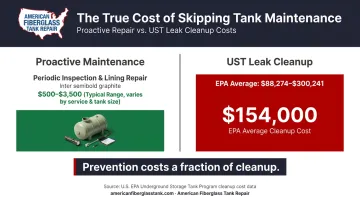
- Preventive inspection costs far less than the average UST cleanup — $154,000 or more per the EPA
What Are Fiberglass Underground Fuel Storage Tanks?
Fiberglass-reinforced plastic (FRP) is a composite material — glass fibers embedded in a polymer resin matrix. The combination delivers tensile strength alongside chemical resilience, which makes FRP well-suited for underground petroleum storage, where bare steel corrodes rapidly and fails.
Common applications include:
- Gas stations and fuel distribution terminals
- Fleet fueling facilities and fuel depots
- Industrial plants with on-site fuel storage
- Emergency generator fueling systems
Stored products span gasoline, diesel, aviation fuel, ethanol blends up to 100%, biodiesel blends, and oxygenated fuels containing MTBE and ETBE.
That chemical resistance matters because of how the industry got here. Before the mid-1980s, most USTs were bare steel — highly vulnerable to corrosion-driven leaks. When the EPA tightened underground storage regulations starting in 1988, operators needed a non-corroding alternative. Fiberglass filled that gap, and more than 200,000 fiberglass storage tanks have since been manufactured and shipped across North America.
Key Advantages of Fiberglass Underground Fuel Storage Tanks
Corrosion Resistance
FRP shells don't rust when exposed to petroleum products, groundwater, or corrosive soils. This eliminates the primary failure mode that plagued bare steel tanks. Federal regulations list FRP tanks as a separate compliance pathway from cathodically protected steel — meaning fiberglass USTs don't require cathodic protection systems, which cuts both installation and ongoing maintenance costs.
The external FRP shell resists corrosion, but the internal corrosion liner can degrade over time from chemical attack — especially with ethanol-blended fuels. Research from STI/SPFA documented cases of blistering, cracking, and delamination in FRP tanks attributed to ethanol storage.
The liner's condition ultimately determines whether a tank stays in service or fails ahead of schedule.
Lightweight Construction
Fiberglass tanks weigh considerably less than steel equivalents, simplifying transport and crane placement. A single-wall 10,000-gallon FRP tank weighs roughly 2,900–3,600 lbs depending on diameter. That weight advantage doesn't eliminate installation complexity — fiberglass USTs require specific handling and approved backfill (typically pea gravel or crushed stone). Sand and native soil backfill are prohibited by most manufacturers and void tank warranties.
Long Service Life
Mandrel-built fiberglass construction gives USTs strong resistance to soil pressure, hydrostatic loads, and ground movement when properly installed. Leading manufacturers back this with 30-year corrosion and structural warranties on double-wall models. Well-maintained tanks regularly exceed that threshold — but service life is contingent on inspection and timely lining repairs, not just construction quality.
Fuel Compatibility and the Ethanol Challenge
FRP tanks can be engineered with resin systems compatible with a wide range of stored products, including ethanol blends from 0–100%. Compatibility must be verified before any fuel switch, not after. EPA rules require UST owners to notify their implementing agency at least 30 days before switching to fuels containing:
- More than 10% ethanol
- More than 20% biodiesel
Owners must also demonstrate compatibility through manufacturer documentation or independent lab certification.
Selecting the wrong resin for an aggressive fuel blend leads to blistering, swelling, and delamination of the interior laminate. When relining or repairing a fiberglass UST, the resin system must be matched to the stored product and operating temperature — not just applied generically.
Environmental Protection
Properly maintained fiberglass USTs are engineered to prevent leaks that could contaminate surrounding soil and groundwater. Double-wall designs add a secondary containment layer with an interstitial space that can be continuously monitored — providing an early warning system before product ever reaches the environment.
Construction Types: Single-Wall vs. Double-Wall Fiberglass USTs
Single-Wall USTs
Single-wall tanks have one primary containment shell. They rely entirely on that shell's integrity — so internal lining condition and regular inspection are critical. Single-wall construction is typical in older installations; many states are actively phasing these out.
Double-Wall (Dual-Laminate) USTs
Double-wall tanks add a secondary outer shell around the primary tank, creating an interstitial space. Operators monitor that space for leaks through hydrostatic, vacuum, or electronic methods. If the inner wall develops a breach, the secondary shell contains the product while monitoring systems trigger an alarm — before any release reaches the surrounding soil.
Double-wall USTs are now the regulatory standard. Tanks and piping installed or replaced after April 11, 2016 must be secondarily contained under federal EPA rules. California went further — requiring closure of all single-walled USTs by December 31, 2025.
Capacity and Certification
Key specifications for commercial fiberglass USTs:
- Capacity range: 550 to 50,000 gallons
- Common diameters: 4, 6, 8, 10, and 12 feet
- Required certification: UL 1316 (Glass-Fiber-Reinforced Plastic Underground Storage Tanks for Petroleum Products, Alcohols, and Alcohol-Gasoline Mixtures) — tanks without this listing may not meet regulatory acceptance criteria for petroleum service
Installation Considerations
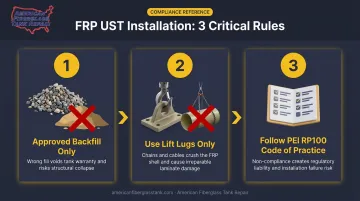
Three installation failures account for most FRP UST problems before a tank ever enters service:
- Use only pea gravel or clean crushed stone for backfill — sand and native soil void most manufacturer warranties.
- Lift tanks using the provided lift lugs only; chains or cables around the tank body cause structural cracks that cannot be patched on-site.
- Follow manufacturer instructions and a nationally recognized code of practice. The Petroleum Equipment Institute's PEI RP100 is the governing reference, covering excavation, backfill, anchoring, piping, release detection, and secondary containment.
When damage does occur, repairs must be performed by the manufacturer or a designated representative. Federal regulations at 40 CFR 280.33 cite FTPI T-95-02 as the recognized standard for FRP UST remanufacturing and repair — field improvisation is not an option under these rules.
EPA Regulations and Compliance Requirements
The federal regulatory framework for USTs lives in EPA 40 CFR Part 280. Key requirements include:
- Properly designed and constructed tanks
- Spill and overfill prevention equipment
- Release detection systems
- Corrosion protection (where applicable)
- Financial responsibility for corrective action
- Records maintenance and operator training
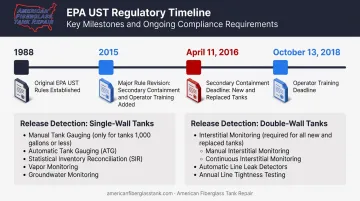
Release detection requirements vary by tank construction:
| Tank Type | Primary Release Detection Options |
|---|---|
| Single-wall | Automatic tank gauging, statistical inventory reconciliation, vapor monitoring, groundwater monitoring |
| Double-wall | Interstitial monitoring satisfies federal requirements when it can detect a leak through the inner wall in any portion containing product |
The 2015 EPA rule revisions — the first major update since 1988 — added secondary containment for new and replaced tanks, mandatory operator training, walkthrough inspections, and periodic equipment testing. Key deadlines: April 11, 2016 for secondary containment; October 13, 2018 for operator training.
Non-compliance has direct financial consequences. Under RCRA Section 9006, violations can result in civil penalties up to $10,000 per tank per day. States may impose requirements stricter than the federal baseline. Always check with your implementing agency.
Inspection, Maintenance, and Extending Tank Life
Why the Internal Lining Is the Critical Factor
The corrosion liner is the interior protective layer that shields the structural FRP laminate from stored fuel. Over time, chemical attack, thermal cycling, and mechanical wear degrade it. When the liner fails, fuel migrates into the structural body — accelerating deterioration and potentially triggering a release. Catching liner degradation early turns a planned relining job into a manageable repair. Missing it can mean tank replacement.
Common signs of internal degradation include spidering, disbondment, emulsification, low Barcol hardness readings (a measure of surface cure), and floor stress cracking. What's visible on the surface often underestimates what's occurring underneath.
Inspection Methods That Produce Reliable Results
Qualified inspectors use multiple methods to build a complete picture of tank condition:
- Ultrasonic thickness testing — measures laminate wall thickness to detect thinning or structural compromise
- High-intensity backlight testing — identifies pinholes and lining discontinuities not visible to the naked eye
- Remote video / visual internal inspection — documents surface conditions across the entire interior
- Internal diameter and deflection measurements — particularly important for FRP tanks to detect deformation
American Fiberglass Tank Repair's inspection programs are supervised by Fiberglass Tank & Pipe Institute certified inspectors. Beyond surface assessment, inspectors evaluate what's occurring within the structural body itself, including capillary migration of stored product beneath the corrosion coat. Inspectors deliver detailed reports with specific remediation recommendations for each finding.
Repair Interventions
The most common repair work on fiberglass USTs includes:
- Spot lining repairs — targeted repair of localized defects before they spread
- Structural laminate patches — addressing cracks or impact damage to the shell
- Full interior relining — new corrosion barrier fabricated over the original structural body using product-compatible resin and laminate systems
- Nozzle repairs and modifications — relocating, resizing, or blocking off fittings using structurally sound protocols
AFTR works with custom-blended isophthalic and terephthalic polyester, vinylester, and epoxy resins matched to the stored product, chemical concentration, and operating temperature — because resin selection during repair is as consequential as during original construction. Even when the corrosion barrier has been breached, the structural body often remains sound, making relining a viable alternative to full replacement.
The Cost Case for Proactive Maintenance
The EPA estimates the average UST cleanup costs $154,000, with some projects reaching significantly higher — a 2022 EPA study found average total cleanup project costs ranging from $88,274 to $300,241 across multiple states. Periodic inspections and preventive lining maintenance cost a fraction of that. Well-maintained fiberglass USTs routinely exceed their original design life, converting what could be a depreciating liability into a reliable, multi-decade asset.
Frequently Asked Questions
How much does a fiberglass fuel tank cost for a gas station?
Published pricing varies widely based on capacity, single-wall versus double-wall construction, compartment configuration, ethanol compatibility documentation, and local installation requirements. Common gas station tanks run 10,000–15,000 gallons; installation, permitting, approved backfill, release detection equipment, and site preparation add substantially to tank purchase cost. Contact a supplier directly for current, site-specific pricing.
Can you use fiberglass for a fuel tank?
Fiberglass (FRP) is widely used and EPA-approved for underground petroleum storage. The tank must be engineered with a resin system compatible with the specific fuel being stored, particularly for ethanol-blended fuels. UL 1316-listed tanks meet the required performance standards for petroleum and alcohol fuel service.
How much does a 10,000-gallon fiberglass tank weigh?
Single-wall 10,000-gallon FRP tanks typically weigh approximately 2,900–3,600 lbs depending on diameter. Double-wall models in the same capacity range from roughly 5,950–7,500 lbs. This affects crane selection and rigging requirements during installation.
How long do fiberglass underground fuel storage tanks last?
With proper installation, regular inspection, and timely lining repair, fiberglass USTs can remain in service for 30 years or longer, consistent with typical manufacturer warranties. Neglected tanks risk internal liner degradation well before structural end of life, often requiring relining or early retirement.
What is the difference between single-wall and double-wall fiberglass USTs?
Single-wall tanks rely solely on the primary shell for containment, while double-wall tanks add a secondary outer shell with an interstitial space for continuous leak monitoring. Double-wall construction is the federal EPA standard for new and replacement UST installations, with many states imposing further requirements.