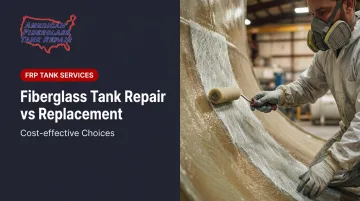
The stakes are higher for FRP tanks than most storage vessels. They're deployed across chemically aggressive environments—water treatment, chemical processing, wastewater—they're expensive to replace, and the total installed cost of a new tank often dwarfs the repair estimate by a wide margin. At the same time, not every damaged tank is worth saving.
This guide lays out how to evaluate the decision clearly, covering costs, downtime realities, damage types, and the conditions that genuinely warrant each path.
Key Takeaways
- Repair is typically the lower-cost option when the structural shell is intact—professional relining can restore a tank to like-new performance at a fraction of replacement cost
- Replacement becomes necessary when structural damage is widespread, chemical service has changed incompatibly, or the tank has exceeded its practical service life with documented wall degradation
- Factor in removal, rigging, lead times, piping modifications, and downtime losses before assuming replacement is straightforward—the total cost extends well beyond the purchase price
- Always get a certified inspection using ultrasonic, laser, and backlight methods before making the repair-or-replace call
- Neither option is universally superior; the right answer depends on tank condition, service history, and operational requirements
Repair vs. Replacement: Quick Comparison
| Factor | Repair/Relining | Full Replacement |
|---|---|---|
| Cost | Fraction of replacement; one trade source puts professional relining as low as 20% of replacement cost | A single municipal project—four FRP sodium hypochlorite tanks with piping—reached $1.1M; total installed costs include removal, rigging, piping, and recommissioning |
| Downtime | Hours to days for most repairs; relining jobs may extend to a week | Weeks to months when accounting for custom fabrication lead times, removal, and recommissioning |
| Best for | Localized damage, lining degradation, nozzle failures—when the structural shell passes thickness testing | Widespread structural failure, chemically incompatible laminate, end-of-service-life tanks |
| Lifecycle Impact | Properly executed relining restores the internal corrosion barrier; documented projects show 15–20+ year service life extensions | Full service life reset with modern materials, but ROI timeline is much longer |
| Compliance | Maintains existing regulatory approvals; no new permitting triggered | May require new environmental permits, especially for underground storage tanks (USTs) under 40 CFR Part 280 |
What Fiberglass Tank Repair Actually Involves
"Repair" in the FRP world covers far more ground than patching a crack. Knowing the full range of repair types is what keeps a scope accurate — and avoids costly surprises mid-project.
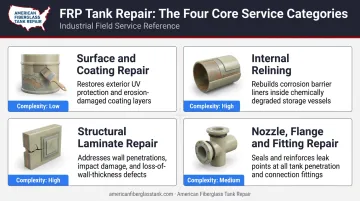
The Four Main Repair Types
Surface and coating repair addresses UV degradation, surface erosion, and minor crazing on the exterior. It's the least invasive repair category and appropriate for tanks that haven't sustained chemical or structural damage.
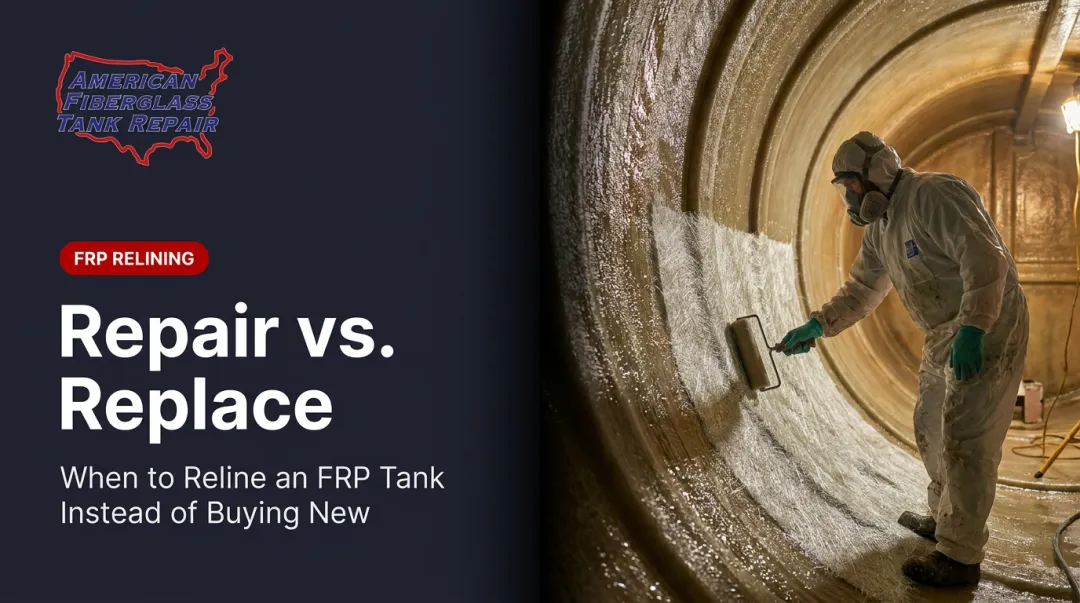
Internal relining is the workhorse of industrial FRP repair. When the interior corrosion barrier has degraded from chemical exposure — blistering, disbondment, emulsification — relining restores the barrier before stored product permeates the structural wall. Even when a tank's lining shows visible breaches, the underlying structural shell often remains intact, making it an ideal substrate for a new corrosion layer.
This is the most common and highest-value repair for industrial tanks.
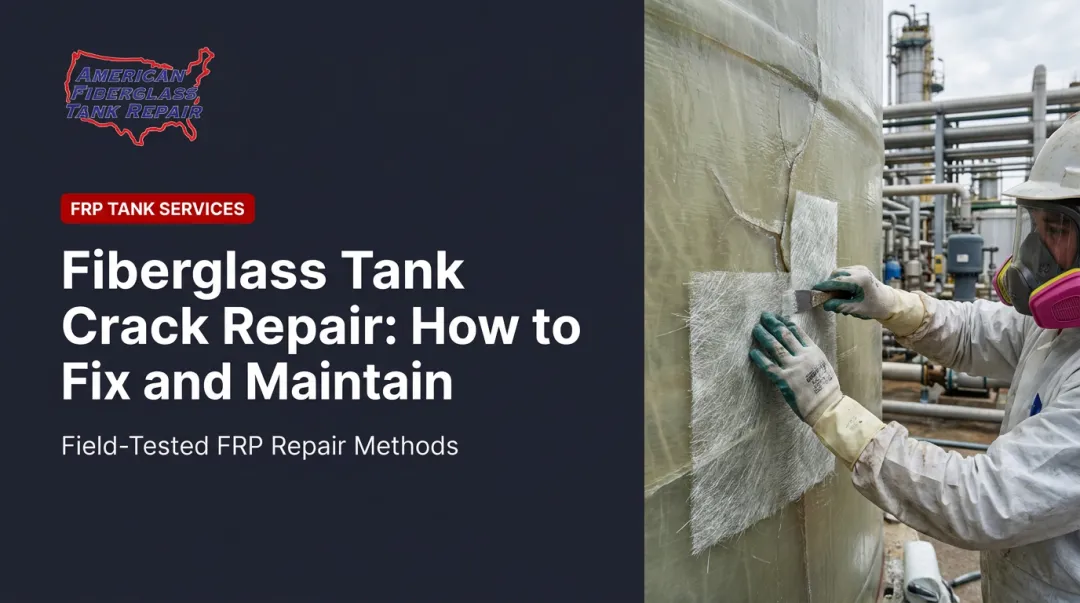
Structural laminate repair addresses damage that has penetrated beyond the corrosion barrier into the structural wall — cracks, delamination, impact damage from forklift strikes or equipment falls. AFTR's field teams regularly handle these scenarios, including tanks that have been struck by forklifts or tipped on their sides.
Nozzle, flange, and fitting repair targets leak points at penetrations, which are among the most common failure locations. Fittings are subject to differential movement and chemical attack at the interface between the fitting material and the tank wall.
When Repair Is the Right Call
Repair makes clear sense when:
- The tank is under 20 years old and the structural shell passes thickness testing
- Damage is localized rather than distributed throughout the vessel
- The chemical service hasn't changed since the original laminate was specified
- The same areas haven't been repaired multiple times already
- Wall thinning is isolated, not uniform throughout the shell
Tanks that are properly maintained and repaired with chemically matched materials can realistically serve 30+ years. The Fiberglass Tank & Pipe Institute documents that fiberglass underground storage tanks have a 50+ year service history with 30-year limited warranties typical from manufacturers — evidence that FRP vessels have genuine longevity when maintained correctly.
Why Material Selection Determines Repair Outcomes
A repair is only as durable as the materials used. Generic patch materials that aren't chemically matched to the stored product can fail prematurely — sometimes within months for aggressive chemicals.
Resin selection must account for the specific chemical, concentration, and operating temperature. For sodium hypochlorite — one of the most aggressive chemicals stored in FRP vessels — the choice of resin family, cure method, surfacing veil, and laminate system directly determines service life.
AFTR uses custom-blended isophthalic and terephthalic polyester, vinylester, and epoxy resins matched to each tank's service requirements, combined with over 45 laminate options including mat, chopped strand, Nexus, Harlar, and carbon veils. Nozzle materials and installation laminates are each specified to the stored chemical and its operating temperature.
The Inspection-First Principle
No repair scope should be finalized without a thorough pre-repair inspection. AFTR's certified inspectors use ultrasonic thickness testing, laser testing, and high-intensity backlight methods to determine not just what the surfaces show — but what's happening inside the structural body, including capillary migration of liquid product beneath the corrosion coat.
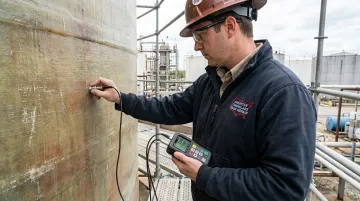
Key indicators inspectors evaluate include:
- Spidering and disbondment
- Emulsification and Barcol hardness levels
- Floor stress cracking and shell distortion
A hydrostatic test alone only confirms whether a tank holds liquid at that specific moment. It won't reveal early-stage laminate degradation that could cause failure within months.
What Replacement Actually Costs—and When It's Necessary
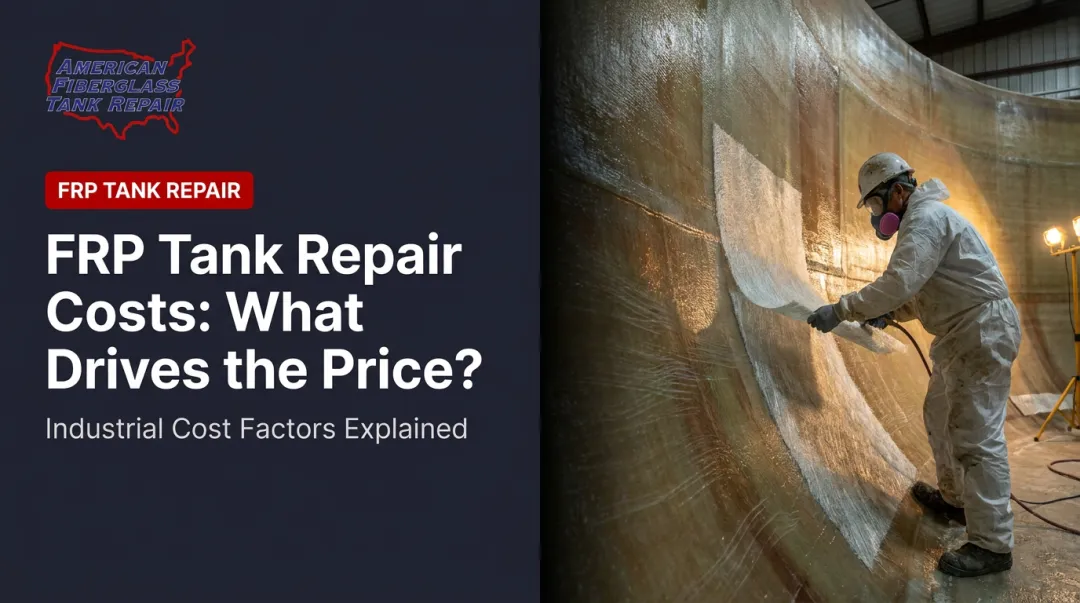
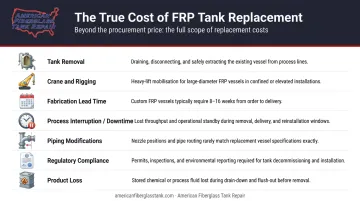
Full replacement is rarely just "buy a new tank." Replacement costs extend well beyond the procurement price—and underestimating them skews the repair-vs-replace comparison from the start.
The Hidden Cost Stack
Most facility managers underestimate replacement costs because they focus on the tank procurement price. The real total includes:
- Tank removal: Draining, cleaning, disconnecting piping, physically removing the vessel—which may require cutting it apart if it can't be moved intact
- Crane and rigging: For large aboveground tanks; excavation and backfill for underground tanks
- Fabrication lead time: Custom FRP vessels are built to order; lead times can extend weeks to months depending on size and specifications
- Process interruption: Temporary storage, rerouted processes, or partial shutdowns while the new tank is fabricated and installed
- Piping modifications: New tanks rarely match the exact nozzle configuration of the old vessel
- Regulatory compliance: Replacing an underground storage tank after April 11, 2016 requires secondary containment and interstitial monitoring under federal UST regulations—triggering a compliance event, not just a maintenance event
- Product loss: Contents of the failed tank that cannot be recovered
A published project for West Basin Municipal Water District shows four replacement FRP sodium hypochlorite tanks with interconnecting piping totaling $1.1M. That's the scale of investment replacement can represent at the municipal level—before factoring in downtime losses.
When Replacement Is the Right Call
Some tanks need to be replaced. The conditions that warrant it:
- Wall thickness is critically reduced throughout the shell—not just in localized areas
- The same failure points have been repaired multiple times, indicating systemic failure
- The chemical service has changed and the existing laminate is incompatible with no viable relining solution
- The tank has exceeded 25–30 years of service with documented widespread structural degradation
- The vessel has sustained irreversible structural compromise—severe full-wall delamination, distorted or collapsed walls
Replacement is also appropriate when a facility process upgrade requires a fundamentally different tank geometry, capacity, or nozzle configuration that can't be achieved through modification of the existing vessel.
Capital Planning Context
Not every replacement decision is condition-driven. Budget cycles, insurance mandates, or regulatory timelines sometimes force the issue regardless of tank health.
In those cases, a professional condition assessment serves a different purpose. It either documents the structural deterioration that justifies replacement, or it demonstrates that the tank can continue in service with repair—potentially deferring a major capital expenditure by years.
How to Make the Right Call: A Decision Framework
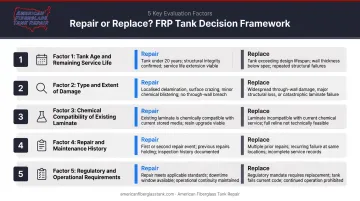
The repair-or-replace decision shouldn't be a gut call. It's a structured evaluation across five factors.
The Five-Factor Evaluation
- Tank age and remaining service life potential — Under 20 years with no systemic history: repair candidate. At or beyond 25–30 years with distributed wall loss: evaluate for replacement.
- Type and extent of damage — Localized corrosion barrier failure with intact structural wall: reline. Widespread full-wall delamination or structural collapse: replace.
- Chemical compatibility of existing laminate — Service unchanged: repair using matched resins. Chemical service changed incompatibly: replacement or full re-engineering required.
- Repair and maintenance history — First or second repair in different areas: repair. Repeated failures in the same locations: investigate systemic cause; replacement may be appropriate.
- Regulatory and operational requirements — UST replacement triggers new permitting; repair maintains existing approvals.
Avoiding the False Economy Trap
Two opposite mistakes are equally costly:
- Patch-and-hope on a compromised shell: Surface-level repairs on a structurally failed tank buy months, not years — and the money spent won't hold.
- Replacing a tank that qualifies for relining: Unnecessary capital expenditure when professional relining could restore it for significantly less — often 30–50% of replacement cost.
The only way to avoid both traps is an honest structural assessment — not a visual guess. AFTR's Fiberglass Tank & Pipe Institute certified inspectors use engineer-driven evaluations with ultrasonic, laser, and backlight methods to determine what the tank actually needs.
The resulting report gives facility managers documented evidence (wall thickness readings, laminate condition findings, structural integrity data) to justify either decision to stakeholders, insurers, and regulators. That documentation matters when the call involves significant capital or regulatory exposure.
Real-World Context: When Relining Is the Answer
AFTR has refurbished hundreds of FRP tanks storing aggressive chemicals including sodium hypochlorite, sodium hydroxide, and ferric chloride at wastewater treatment facilities and chemical plants. The recurring scenario: internal lining shows clear degradation from chemical exposure, the facility has received a replacement quote, and the inspection finding changes the picture entirely.
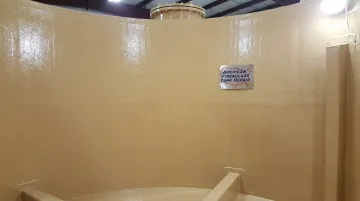
When the structural shell is intact despite visible corrosion barrier failure, the tank is an ideal relining candidate. A professionally applied vinylester or epoxy lining—matched to the stored chemical and temperature—restores the corrosion barrier to like-new condition. Relining delivers three concrete advantages over replacement:
- Eliminates full replacement cost and new tank fabrication lead times
- Avoids the extended downtime associated with installation of a new vessel
- Maintains the existing tank footprint without triggering new permitting requirements
The practical takeaway: if a tank's shell passes ultrasonic thickness testing and the damage is confined to the corrosion barrier or specific structural areas, relining is the cost-effective path. The inspection is what establishes that with certainty—not assumption.
Facilities managing aging FRP tanks can contact AFTR at americanfiberglasstank.com or call 877-427-0090 for an engineer-driven inspection and repair assessment before committing to a costly replacement.
Conclusion
The right choice between repair and replacement comes down to four factors: structural condition, service history, chemical environment, and operational constraints. There's no universal answer — but there is a defensible one, if the evaluation is grounded in actual inspection data rather than assumption.
For most industrial FRP tanks with localized lining degradation or corrosion barrier failure, professional relining delivers significant cost savings and a meaningful extension of service life. For tanks with systemic structural failure, widespread wall loss, or incompatible chemical service, replacement is the responsible call.
The most important step before committing to either path: commission a professional inspection. Accurate wall thickness data, laminate condition findings, and a structural assessment from a Fiberglass Tank & Pipe Institute certified inspector — like those at AFTR — convert a high-stakes judgment call into a documented, defensible decision that protects the capital budget and keeps the facility running without unplanned downtime.
Frequently Asked Questions
Frequently Asked Questions
Is fiberglass tank repair expensive?
Professional FRP tank repair and relining is significantly less expensive than full replacement—one industry source estimates professional relining can cost as little as 20% of replacement cost. Exact costs vary by damage type, tank size, and chemical service, but relining or structural patching is a fraction of the total installed cost of a new tank.
What is the life expectancy of a fiberglass underground storage tank?
Fiberglass USTs are built for long service: manufacturers typically provide 30-year limited warranties, and the Fiberglass Tank & Pipe Institute documents a 50+ year service history for fiberglass underground petroleum storage tanks. Professional relining can extend service life by additional decades beyond that baseline.
What are the signs that a fiberglass tank needs repair?
Key indicators include visible internal lining discoloration, surface blistering or delamination, spidering, crystal buildup at fittings, floor stress cracking, shell distortion, or a failed ultrasonic thickness test. Capillary migration of stored product beneath the corrosion coat—detectable only through instrument testing—is one of the most important early warning signs.
When should you replace a fiberglass tank instead of repairing it?
Replacement is appropriate when wall thickness is critically and uniformly reduced throughout the shell, the same failure points have been repaired multiple times, chemical service has changed beyond the existing laminate's compatibility, or the tank has exceeded 25–30 years with documented structural degradation throughout—not just in isolated areas.
How long does a professional fiberglass tank repair last?
A properly executed repair using chemically compatible resins and laminates can deliver corrosion barrier performance comparable to a new tank, provided the structural shell was sound at repair time and routine inspections continue. The key factor determining longevity is resin selection matched to the specific chemical service and operating temperature.
What does a professional fiberglass tank inspection involve?
A certified inspection combines visual assessment with instrument-based testing — ultrasonic wall thickness measurement, laser testing, and high-intensity backlight methods — covering the interior corrosion coat, structural body, exterior shell, and all nozzle interfaces. Inspectors check for spidering, disbondment, emulsification, Barcol hardness, and capillary migration, delivering a documented report that supports a defensible repair-or-replace decision.