The problem facility managers run into isn't just the cost itself. It's going in blind. Facilities that skip a professional assessment often underscope the work, choose a patch when a full reline is needed, or get caught off guard by mobilization and compliance testing costs that weren't in the initial estimate.
This article covers the cost ranges by repair type, the key variables that drive pricing, what a professional repair quote actually includes, and how to budget accurately before committing to a repair approach.
Key Takeaways
- FRP tank repair costs range from a few hundred dollars for minor surface patches to $45,000+ for major chemical tank restoration—actual cost depends heavily on damage extent, tank size, and resin requirements
- The biggest cost drivers are damage type and severity, tank size, resin system selection, site access, and post-repair compliance testing
- Repeated patch repairs on a deteriorating lining often cost more over 5–7 years than one full restoration
- A professional inspection—ultrasonic, laser, or high-intensity backlight—is the most reliable starting point for accurate repair budgeting
How Much Does FRP Tank Repair Cost?
FRP tank repair doesn't have a fixed price. Costs shift widely based on the nature of the damage, tank size, the resin system required, and whether the job is a targeted patch or a complete internal restoration.
Facilities that misread the scope commonly run into the same problems:
- Underbudgeting and delaying repairs until damage worsens
- Selecting a patch when a full reline is actually warranted
- Getting blindsided by surface prep and mobilization costs not captured in the original quote
Basic Surface and Crack Repairs
What's typically included:
- Surface grinding and prep
- Compatible resin patch or surface coat over minor cracks, pinholes, or early-stage delamination
- Localized application on smaller surface areas where the structural laminate remains intact
Best for: Tanks with isolated surface-level damage where underlying structure is sound—early stress cracking, minor corrosion barrier breaches, or pinhole formation in otherwise healthy laminates.
Minor surface repairs for small industrial tanks can run from a few hundred to a few thousand dollars, but this range shifts quickly once surface prep labor and mobilization are factored in. No authoritative public benchmark exists for this tier—treat any estimate as project-specific.
Mid-Range Structural and Lining Repairs
What's typically included:
- Internal lining repair or partial relining
- Nozzle and fitting repair or replacement
- Multiple layers of mat and resin for localized structural laminate repair
- Ultrasonic thickness testing to confirm repair boundaries
Ideal when: Tanks with more extensive corrosion barrier degradation, chemical attack on internal surfaces, or failed fittings. Common in chemical storage and water treatment applications.
A real-world benchmark: Tulsa's Water & Sewer Department awarded a 2021 bid for fiberglass bulk chemical tank repair at $45,468 for a 14-ft diameter × 16-ft tall sodium hydroxide FRP tank. That scope included nozzle and manway replacement, full corrosion barrier removal and rebuild with specified resin, and hydrostatic leak testing. This is a single project example, not a market range—but it anchors what mid-to-major repairs look like on a real industrial chemical tank.
Full Lining Restoration and Major Structural Repair
What's typically included:
- Complete removal of degraded interior corrosion liner
- Structural laminate reinforcement across large surface areas
- Custom resin system application (vinylester or epoxy for aggressive chemical service)
- Full inspection and return-to-service testing
Best for: Large industrial tanks with widespread lining failure, tanks storing aggressive chemicals, or vessels with long-term strategic value where a full restoration extends service life by many additional years.
For context, the City of Mesa's 2023 fiberglass tank maintenance program covered approximately 88 chemical tanks ranging from 3,000 to 88,000 gallons. That program carried an annual contract value of $400,000—a program-level figure, not a per-tank cost, but one that illustrates the budget scale required for serious FRP maintenance across a large facility. Understanding what drives costs at each tier is what separates an accurate repair budget from an expensive surprise.
Key Factors That Drive FRP Tank Repair Costs
Repair pricing reflects a combination of technical, logistical, and compliance-related variables. Understanding each one helps facilities anticipate costs and compare quotes accurately.
Type and Extent of Damage
Damage type directly determines the repair method, material volume, and labor hours:
- Surface crazing or minor pinholes → surface prep and spot resin application
- Corrosion barrier degradation → partial or full corrosion coat removal and rebuild
- Structural delamination → multi-layer laminate repair with structural reinforcement
- Through-wall cracking or nozzle failure → structural repair plus fitting replacement
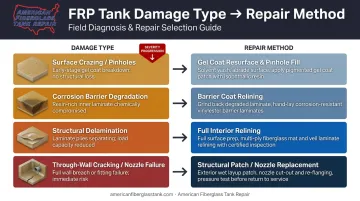
Hidden delamination is a particularly common scope-expander. Ultrasonic and high-intensity backlight testing — methods AFTR's FTPI-certified inspectors use routinely — can reveal capillary migration of liquid product beneath the corrosion coat that visual inspection won't catch.
When this is discovered mid-repair, the scope and cost change significantly.
Tank Size and Capacity
Larger tanks multiply nearly every cost line:
- More resin and laminate material
- More labor hours for surface prep and application
- Confined space entry protocols for large-diameter vessels
- Scaffolding or specialized access equipment
A repair on a 50,000-gallon vessel can cost several times more than the equivalent work on a 5,000-gallon tank. Tank geometry adds another variable — vertical vessels with complex nozzle configurations or irregular shapes require more custom laminate work than straightforward cylindrical designs.
Resin and Material Selection
Once tank size determines the volume of material needed, resin selection determines the cost per unit. Not all resin systems perform equally in aggressive chemical environments:
| Resin Type | Typical Use Case | Relative Cost |
|---|---|---|
| Orthophthalic polyester | General-purpose, mild environments | Lowest |
| Isophthalic/terephthalic polyester | Improved chemical resistance | Moderate |
| Vinylester | Strong acids, bleach, alkalis | Higher |
| Epoxy | Highly corrosive, specialty service | Highest |
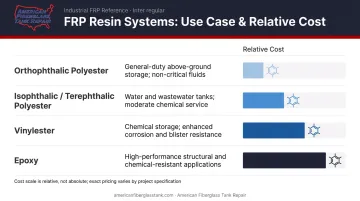
Using a cheaper resin to cut upfront cost routinely leads to premature liner failure. Chemical compatibility has to drive the selection. AFTR matches resin type to each tank's stored chemical, concentration, and operating temperature — drawing from custom-blended isophthalic and terephthalic polyester, vinylester, and epoxy resins, along with over 45 fiberglass mat, chopped strand, Nexus, Harlar, and carbon veil laminates.
Site Access and Mobilization
Tanks in difficult locations carry real cost premiums:
- Below-grade or confined installations require specialized access equipment
- Permit-required confined space entry under OSHA 1910.146 adds atmospheric testing, ventilation, communications equipment, and trained entry/rescue teams
- Remote locations require travel, equipment transport, and setup time
Mobilization costs aren't always broken out in initial quotes — but they're real. AFTR deploys using Service-Pack shipping containers pre-loaded with resins and laminates, enabling rapid mobilization across all 50 states. For remote or emergency situations, this pre-staged approach reduces lead time, though mobilization costs still factor into total project pricing.
Regulatory and Compliance Requirements
Regulated industries add mandatory cost layers that can't be skipped:
- Drinking water systems must comply with NSF/ANSI 61 requirements for materials in contact with potable water
- Chemical storage tanks often require certified post-repair testing — Barcol hardness, acetone sensitivity, and hydrostatic leak testing (as the Tulsa IFB required)
- Food processing facilities may require documentation of material compatibility and cure verification
These requirements add cost, but they also produce documentation that confirms structural integrity and keeps facility operators out of regulatory exposure. Skipping them in the name of cost savings typically creates larger liability downstream.
What's Included in a Professional FRP Tank Repair Quote
The total cost of an FRP tank repair extends well beyond materials and hands-on labor. A detailed quote typically breaks down into five distinct components:
1. Pre-repair inspection and damage assessment A proper repair starts with scoping the actual extent of damage — not just what's visible on the surface. Professional inspection using ultrasonic, laser, and high-intensity backlight testing prevents costly mid-repair scope changes when hidden damage surfaces after work begins.
AFTR's inspections are supervised by FTPI-certified inspectors and include detailed written reports with recommended actions — a separate line item that pays for itself by avoiding surprises.
2. Surface preparation Grinding, solvent cleaning, and surface profiling are critical to repair bond quality. This step often represents a substantial share of total labor cost, and shortcuts here cause bond failures that render the repair worthless.
3. Materials Resin system, laminate type (chopped strand mat, woven roving, Nexus veil, Harlar veil, carbon veil), and coverage area all affect material costs. Custom-blended resins formulated for specific chemical resistance cost more than standard off-the-shelf systems.
4. Labor and application FRP laminate application is a skilled trade. Labor rates vary by region, project complexity, and whether confined space certification is required. On large-scale restoration projects, labor typically accounts for 50–70% of total project cost.
5. Post-repair testing and documentation Returning a tank to service in regulated environments requires verification testing. Depending on the application, this may include:
- Spark testing for lining continuity
- Barcol hardness testing to confirm cure
- Ultrasonic wall thickness confirmation
- Hydrostatic pressure testing for structural integrity
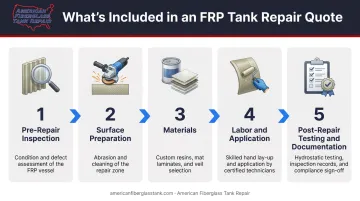
These steps confirm the repair holds and satisfy compliance documentation requirements before the tank returns to service.
Patch Repair vs. Full Lining Restoration: Understanding the Cost Difference
Two facilities may describe "fixing a fiberglass tank" but mean completely different things. That gap in definition matters — choosing the wrong approach based on upfront cost alone is one of the most expensive mistakes a facility can make.
How They Compare
| Factor | Patch Repair | Full Lining Restoration |
|---|---|---|
| Upfront cost | Lower | Higher |
| Addresses ongoing chemical degradation | No | Yes |
| Extends service life significantly | Limited | Yes—many additional years |
| Appropriate for | Isolated, early-stage damage | Widespread degradation |
| Risk of repeat repair cycle | High | Low |
The Repair Cycle Problem
A patch addresses localized damage. It does not stop ongoing chemical degradation of the surrounding lining. Facilities that patch a deteriorating corrosion barrier repeatedly often find themselves spending more over 5–7 years than a single full restoration would have cost when degradation first became extensive.
When a fiberglass tank's corrosion barrier has been breached but the structural laminate body remains intact, that intact structure serves as an ideal substrate for a new corrosion layer. Waiting until structural damage is also present closes that window, leaving replacement as the only viable option.
Quick decision guide:
- Choose patch repair when damage is isolated, the surrounding laminate is structurally sound, and degradation hasn't yet spread
- Choose full lining restoration when chemical attack is ongoing, degradation covers a broad area, or the tank has long-term operational value that justifies the upfront investment
How to Estimate the Right Budget for FRP Tank Repair
Accurate budgeting starts with a thorough damage assessment, and that requires more than a visual walkthrough.
Facilities that estimate repair costs without professional testing routinely under-scope the work. A tank that looks like a simple patch job on the surface can show significant capillary migration and hidden delamination under ultrasonic testing.
Getting the assessment right before committing to a repair budget prevents both overpaying for unnecessary work and underfunding repairs that need more scope.
AFTR's engineer-driven inspection process uses ultrasonic, laser, and high-intensity backlight testing, supervised by FTPI-certified inspectors. The resulting condition reports give facility managers a reliable baseline for budgeting and a clear basis for deciding between targeted repair and full restoration.
Key factors to work through when building a repair budget:
- Older tanks may carry accumulated degradation that a single inspection cycle hasn't fully captured
- Aggressive chemicals (sodium hypochlorite, sodium hydroxide, ferric chloride, HCl) require higher-cost resin systems and closer material specification
- Post-repair testing and documentation are non-negotiable in drinking water, food processing, and chemical storage — budget accordingly
- Emergency and expedited repairs carry premium pricing compared to planned maintenance windows
- Tanks with 20+ years of remaining strategic value often justify the higher upfront cost of full restoration
Practical steps before committing to a repair budget:
- Get a professional inspection with instrument testing
- Source quotes from FRP-specialist contractors, not general industrial contractors
- Confirm quotes include a detailed scope with material specifications (resin type, laminate system, layer count)
- Ask about post-repair warranty or performance guarantee terms
Frequently Asked Questions
How expensive is fiberglass repair?
Costs vary widely based on damage severity, tank size, resin requirements, and access conditions. Minor surface patches can run a few hundred to a few thousand dollars; major chemical tank restoration projects reach $45,000 or more, per public bid records. Project-specific assessment is the only reliable way to pin down a number.
Can you patch a fiberglass tank?
Yes, FRP tanks can be patched for localized damage using compatible resin and laminate materials. Patching is only appropriate when the surrounding structural laminate is sound. When degradation is widespread or chemical attack is ongoing across the interior surface, patching doesn't address the root problem and more comprehensive repair is needed.
How long will a fiberglass tank last?
Well-maintained FRP tanks can last 30–50 years or more depending on the chemical environment, UV exposure, and inspection frequency. Industry sources including Picon FRP and TTI Envir cite 35–50 years for chemical service tanks with regular inspection and timely relining. Proactive repair programs are the primary factor separating 20-year tanks from 50-year ones.
What is the difference between patching and relining an FRP tank?
Patching addresses isolated, localized damage at a specific area. Relining involves removing and replacing the entire interior corrosion barrier across the full tank surface. Relining costs more upfront but is appropriate when degradation is widespread—it extends service life by many years rather than delaying a recurring problem.
How do I know if my FRP tank needs repair or full replacement?
If the structural laminate is sound and only the corrosion barrier has failed, relining is typically the right call. Extensive structural damage may make replacement more cost-effective. Ultrasonic wall thickness testing, evaluated against FTPI RP 2007-1 criteria, is the most reliable way to make that call.
Does the type of chemical stored affect FRP tank repair costs?
Yes. Tanks storing aggressive chemicals like sodium hypochlorite, sodium hydroxide, ferric chloride, or hydrochloric acid require vinylester or epoxy resin systems, which cost more than standard polyester. Using an incompatible resin to cut upfront cost leads to premature lining failure and a more expensive repair cycle down the line.