FRP and titanium tanks both deliver strong corrosion resistance, but they serve fundamentally different operational needs and budgets. FRP dominates broad industrial and chemical storage applications. Titanium occupies a narrow, high-stakes niche where even premium resins can't compete.
This guide breaks down the real differences — composition, chemical resistance, cost drivers, repairability, and which material makes sense for your specific application.
Key Takeaways
- FRP tanks offer corrosion resistance, light weight, and custom resin options at significantly lower cost than titanium
- Titanium excels only in highly oxidizing or ultra-aggressive chemical environments (wet chlorine, concentrated nitric acid) where FRP resins would degrade
- FRP tanks can be re-lined and repaired in the field; titanium repairs require costly, specialized welding
- For most chemical storage, water treatment, and industrial processing work, FRP is the practical choice
- Both materials deliver multi-decade service life when matched to the right application
FRP vs. Titanium Tanks: Quick Comparison
Here's a side-by-side view of the key decision factors before getting into the details:
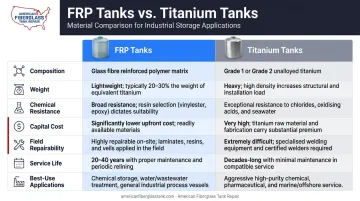
| Factor | FRP Tanks | Titanium Tanks |
|---|---|---|
| Composition | Glass fiber + thermoset resin (polyester, vinylester, or epoxy) | Commercially pure titanium (Grade 1–4) or alloy (Ti-6Al-4V) |
| Weight | ~75% lighter than steel | Heavier than FRP; lighter than steel |
| Chemical resistance | Wide range of acids, alkalis, salts, solvents — resin-dependent | Exceptional vs. oxidizing acids, chlorinated media; not HF |
| Capital cost | Significantly lower | Very high — raw titanium sponge alone runs $13/kg (USGS 2024) before fabrication |
| Field repairability | Re-linable, patchable, structurally reinforceable | Requires inert gas shielding, ASME IX certified welders |
| Service life | 20–40+ years with maintenance | Long theoretical lifespan; replacement often preferable to repair |
| Best for | Chemical plants, water/wastewater, industrial processing | Pharma, semiconductor, highly oxidizing media |
Cost
No published head-to-head tank price multiplier exists, but titanium's cost drivers stack up quickly. USGS Mineral Commodity Summaries 2025 puts 2024 titanium sponge at $13/kg — before any fabrication touches it.
Beyond raw material, titanium vessels carry additional cost layers:
- Welding atmosphere control: Inert gas shielding required throughout the entire weld zone
- Certified labor: Welders must hold ASME Section IX qualification
- Fabrication complexity: Titanium work requires specialized tooling and contamination controls
FRP pricing varies by resin type (isophthalic polyester, vinylester, or epoxy) and vessel size, but even at the large-tank scale, the capital cost gap between the two materials remains wide.
Chemical Resistance
FRP's chemical compatibility depends entirely on resin selection. Ashland's Derakane epoxy vinyl ester resin guide documents resistance ratings by chemical, concentration, and temperature — including limitations (marked as "NR" for not recommended and "LS" for limited service up to 40°C/100°F). Titanium performs exceptionally against chlorinated solutions and oxidizing acids, but hydrofluoric acid attacks it even at very dilute concentrations.
What Is an FRP Tank?
FRP (Fiberglass Reinforced Plastic) tanks are composite vessels built in two functional zones: a resin-rich inner corrosion liner and a structural glass fiber shell. The inner liner — typically 2.5 to 6.3 mm (100–250 mil) thick — consists of a ~95% resin surfacing veil layer followed by a ~75% resin chopped-strand mat layer, per Ashland's construction specifications. The structural laminate behind it provides the strength and stiffness to hold the vessel's shape under load.
Tanks are manufactured through filament winding, hand lay-up, or contact molding, with ASTM D3299-24 now governing both filament-wound and contact-molded cylindrical corrosion-resistant tanks for above-ground atmospheric service.
Why FRP Works for Chemical Storage
Several properties make FRP the standard material for corrosive chemical storage across industries:
- Corrosion resistance to most acids, alkalis, salts, and oxidizers, without the weight penalty or cost of exotic metals
- Non-conductive — eliminates electrical shock hazards in wet process environments
- High strength-to-weight ratio — FRP generally weighs about 75% less than steel, reducing crane requirements, foundation specs, and installation cost
- Thermal insulation — naturally limits heat transfer, relevant for temperature-sensitive chemicals
- Custom fabrication — available in vertical, horizontal, dual-wall, and open-top configurations; factory-built up to 60,000 gallons
Resin Selection: The Critical Variable
Resin choice determines what a tank can safely store. The main systems:
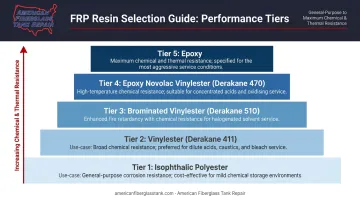
- Isophthalic polyester — general-purpose service, moderate chemical resistance
- Vinylester (e.g., Derakane 411) — broad acid, alkali, and solvent resistance; the most common choice for aggressive chemical storage
- Epoxy novolac vinylester (e.g., Derakane 470) — elevated thermal and chemical resistance, including oxidizing environments and chlorine
- Brominated vinylester (e.g., Derakane 510) — fire-retardant; suited for chlorine and bleach environments
- Epoxy — used where maximum chemical and temperature performance is required
Matching the right resin to the stored chemical requires both material knowledge and hands-on field experience. AFTR's repair and relining work uses custom-blended isophthalic, terephthalic polyester, vinylester, and epoxy resins matched to the specific chemical, concentration, and operating temperature of each tank. With over 45 fiberglass mat, chopped strand, Nexus, Harlar, and carbon veil laminates on hand, technicians engineer the full corrosion barrier system rather than selecting a resin type off a generic chart.
FRP Limitations (Honest Assessment)
Three limitations require proactive management:
- UV degradation without protective coatings or gel coat on exterior surfaces
- Delamination risk if the inner liner is breached and chemical wicking occurs beneath the corrosion coat
- Impact brittleness — FRP doesn't absorb sharp mechanical impact the way steel does
Proactive inspection addresses all three. AFTR's FTPI-certified inspectors use ultrasonic, laser, and high-intensity backlight testing to detect capillary migration, disbondment, and liner degradation before structural failure occurs. When caught early, most issues are repaired in the field rather than requiring full tank replacement.
FRP Use Cases
FRP tanks dominate in:
- Chemical storage — sodium hypochlorite, hydrochloric acid, sodium hydroxide, ferric chloride, sulfuric acid (at lower concentrations)
- Water and wastewater treatment — including NSF/ANSI 61 certified resin options for potable contact
- Industrial processing — pulp and paper, food and beverage, mining, petrochemical
- Agricultural and municipal applications — bulk storage of treatment chemicals
What Is a Titanium Tank?
Titanium tanks are fabricated from commercially pure titanium (Grades 1–4, each with 99% minimum titanium content) or titanium alloys such as Ti-6Al-4V. The material is specified for corrosion resistance in a narrow set of aggressive chemical environments where most other tank materials — including high-performance FRP resins — cannot hold up long-term.
Grade selection depends on the application:
- Grade 2 — most common for chemical process vessels; balances corrosion resistance with weldability
- Grade 1 — maximum corrosion resistance, lower tensile strength
- Ti-6Al-4V — reserved for structural applications requiring higher strength
Where Titanium Genuinely Excels
Titanium's corrosion advantage over FRP is real but specific:
- Wet chlorine gas and chlorinated solutions — titanium maintains very low corrosion rates where FRP liners may degrade over time
- Oxidizing acids — high resistance to nitric acid, perchloric acid, and chromic acid across broad temperature and concentration ranges
- Seawater and high-chloride environments — essentially immune to pitting corrosion
- Biocompatibility — non-reactive with pharmaceutical compounds, making it suitable for API production and sterile environments
Titanium's Operational Limitations
The case for titanium narrows significantly when operational realities are factored in:
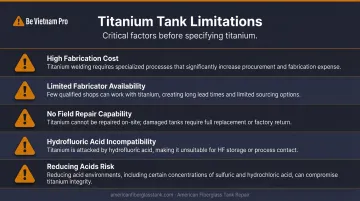
- High fabrication cost — titanium welding requires inert gas shielding at both the weld face and root side, plus ASME Section IX certified welders
- Limited fabricator availability — very few shops have the certification and equipment for titanium vessel work
- Virtually no field repair capability — damaged titanium tanks are difficult to repair on-site; replacement is often the practical outcome
- Hydrofluoric acid incompatibility — HF attacks titanium even at very low concentrations, and fluoride solutions below pH 7 are not recommended
- Reducing acids — concentrated sulfuric acid and hydrochloric acid can attack titanium without oxidizing inhibitors present
Titanium Use Cases
The genuine justification for titanium is narrow:
- Pharmaceutical API production requiring strict contamination control
- Semiconductor wet bench processing with ultra-high-purity chemistry
- Aerospace component chemical processing
- Concentrated nitric acid, chromic acid, or wet chlorine storage where even vinylester or epoxy FRP liners are incompatible
- Processes with zero contamination tolerance where capital cost is secondary to material purity requirements
FRP vs. Titanium: Which Is the Better Choice?
The short answer: they're not competing for the same jobs. But when your application sits near the boundary, the decision framework matters.
Chemical Compatibility: Where the Lines Are Drawn
FRP with vinylester or epoxy novolac resin covers the large majority of industrial chemical storage reliably. AFTR routinely handles sodium hypochlorite, sodium hydroxide, ferric chloride, and hydrochloric acid in FRP vessels — chemicals that would challenge lesser resin systems but are well within vinylester and epoxy performance ranges when properly specified.
Titanium's advantage over FRP applies specifically to:
- Wet chlorine gas at elevated temperatures
- Concentrated nitric acid and other strong oxidizing acids
- Ultra-high-purity pharmaceutical or semiconductor chemistries where any trace leaching is unacceptable
Important caveat: Even within titanium's preferred territory, dual-laminate FRP constructions — which combine an FRP structural shell with a thermoplastic inner liner — can sometimes compete by providing a chemically inert inner surface where standard resin alone would fall short.
Total Cost of Ownership
No authoritative lifecycle cost comparison between equivalent FRP and titanium vessels has been published, but the cost drivers are well documented:
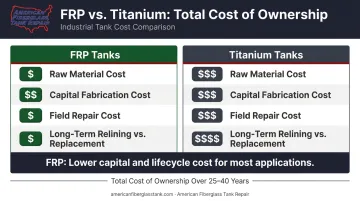
- Titanium raw material starts at $13/kg for sponge, before plate rolling, welding, and ASME certification
- FRP tanks have significantly lower capital costs and can be re-lined — rather than replaced — when the corrosion barrier degrades
- FRP service life of 25–40+ years is achievable with proper maintenance, per manufacturer data
- Titanium repair requires ASME IX certified welders with full inert gas shielding infrastructure — a cost that makes field repair economically difficult and often impractical
When an FRP tank's inner liner is breached, the structural shell typically remains intact, providing a solid substrate for a new corrosion layer. AFTR treats this as a planned relining event rather than a replacement, recovering tanks that would otherwise be condemned at a fraction of new-vessel capital cost.
Installation and Design Flexibility
FRP's lighter weight (roughly 75% less than steel) reduces installation complexity:
- Reduced crane and rigging requirements
- Lower structural support and foundation specifications
- Easier transport to remote or space-constrained sites
Custom fabrication is more accessible with FRP as well: vertical, horizontal, dual-wall, and open-top configurations are readily available in a wide size range. Titanium fabrication is constrained by the limited number of qualified shops and the cost of specialized equipment.
Situational Recommendations
Choose FRP when:
- Storing acids, caustics, bleach, salts, or solvents within established resin compatibility ranges
- Operating water treatment, wastewater, or industrial processing systems
- Repairability and long-term relining capability matter to your maintenance plan
- Budget requires capital efficiency over a 20–40 year asset life
Choose titanium when:
- Storing highly oxidizing media (concentrated nitric acid, wet chlorine) that exceeds premium FRP resin compatibility
- Contamination tolerance is near zero (pharmaceutical API, semiconductor manufacturing)
- Budget can absorb the significant capital and repair cost premium
- Application genuinely cannot be served by dual-laminate FRP or specialty resin construction
Conclusion
FRP and titanium solve different problems at very different price points. FRP handles the vast majority of industrial chemical storage, water treatment, and processing applications — offering reliable corrosion resistance, design flexibility, and service lives of 30 years or more. Titanium serves a specific, high-stakes niche where oxidizing chemistry or purity requirements rule FRP out entirely.
For most facilities, the smarter long-term investment is a properly specified FRP tank paired with a proactive inspection and relining program. That combination delivers lower lifecycle costs than oversized metal vessels — and avoids the premature failures that come with reactive-only maintenance.
If your facility relies on FRP tanks for chemical storage or water treatment, AFTR's engineer-driven inspection, relining, and repair services — backed by FTPI-certified inspectors and over 45 resin and laminate options — help protect that investment and extend service life well beyond reactive maintenance.
Frequently Asked Questions
Which tank is best for water storage?
FRP tanks are widely used for potable and process water storage, with NSF/ANSI 61 certified resin options available for direct contact with drinking water. Titanium is rarely justified for water storage — water chemistry is far too mild to require it, and the capital cost premium offers no recoverable value.
What is the difference between an FRP tank and a poly tank?
FRP tanks are rigid glass fiber and thermoset resin composites, offering higher structural strength and better resistance to aggressive chemicals. Poly (polyethylene) tanks are rotationally molded thermoplastics: seamless and lower cost, but with more limited chemical and temperature resistance than vinylester or epoxy FRP.
Is titanium better than FRP for chemical storage?
Titanium outperforms FRP only in a narrow set of highly oxidizing or ultra-corrosive chemical environments. For the vast majority of industrial chemical storage applications, properly specified FRP tanks deliver comparable or sufficient chemical resistance at a significantly lower capital and lifecycle cost.
How long do FRP tanks last compared to titanium tanks?
FRP tanks typically last 25–40 years or more with proper maintenance and timely lining repair, per manufacturer data. Titanium's documented lifespan is longer on paper, but field repair is expensive and technically demanding. Both materials deliver multi-decade service when correctly specified and maintained.
Can FRP tanks be repaired if the inner liner is damaged?
Yes. FRP tanks can be re-lined, patched, and structurally reinforced in the field by certified technicians using compatible resin and laminate systems. Even when the corrosion barrier is breached, the structural shell typically remains intact and serviceable as a substrate for a new lining.
What chemicals can FRP tanks NOT safely store?
FRP chemical compatibility depends on resin type, but generally FRP should not be used with highly concentrated oxidizing acids (concentrated nitric acid, fuming sulfuric acid) or strong organic solvents without a specific engineering review of the resin system. A qualified engineer should evaluate whether titanium, dual-laminate FRP, or a specialty alloy is the right substitute for that specific chemistry.