For facilities handling corrosive gases like HCl, H₂S, SO₂, or NH₃, the stakes are high. Material failure in a scrubber system doesn't just mean a repair call — it means unplanned downtime, compliance exposure, and potentially a vessel that's corroded beyond repair within a few years of installation. EPA has documented exactly this outcome: a 304 stainless steel scrubber removed from service after just two months due to severe corrosion attacking all internal surfaces.
This article breaks down the key differences between FRP and metal scrubbers across corrosion resistance, temperature tolerance, maintenance burden, cost, and real-world fit.
Key Takeaways
- FRP scrubbers outperform metal in wet, acidic, chloride-bearing exhaust streams — the most common industrial scrubbing environments
- Metal scrubbers hold the advantage at high temperatures and under extreme structural or pressure loads
- Resin selection (polyester vs. vinyl ester vs. epoxy) determines real-world performance — the FRP category alone tells you little
- Neither material wins universally; match your choice to exhaust chemistry and operating conditions
- For most chemical, wastewater, and industrial applications, FRP carries significantly lower long-term maintenance costs
FRP Scrubber vs Metal Scrubber: Quick Comparison
| Attribute | FRP Scrubber | Metal Scrubber (Steel/SS) |
|---|---|---|
| Material Composition | Glass fiber + thermoset resin (polyester, vinyl ester, epoxy) | Carbon steel, SS304, SS316, or alloy |
| Corrosion Resistance | Excellent across pH 2–13; no passive film to breach | Relies on passive film or coatings; vulnerable to chloride pitting |
| Temperature Tolerance | Up to ~80–93°C (resin-dependent); quench required for hotter streams | Handles sustained high-temperature and extreme heat scenarios |
| Weight | Lighter than equivalent steel; simplifies installation and retrofits | Heavier; may require additional structural support |
| Upfront Cost | Comparable to or slightly above SS; lower than high-alloy metals | Carbon steel lowest upfront; SS316 and alloys higher |
| Long-Term Maintenance | Low — no recoating, no weld inspection, smooth non-fouling surfaces | Higher in corrosive service — recoating, weld inspection, corrosion repairs |
| Typical Service Life | 15–20+ years in corrosive gas service with proper maintenance | 3–10 years in acid-gas service depending on grade and conditions |
| Best-Fit Applications | Chemical, wastewater, pharma, electroplating, semiconductor | High-temp exhaust, high-pressure systems, non-corrosive ventilation |
The right choice depends on three variables: exhaust chemistry, operating temperature, and how you weigh upfront cost against long-term maintenance exposure. A facility running ambient-temperature acid gas scrubbing has different constraints than a foundry managing 300°C kiln exhaust. Those differences drive the decision.
What Is an FRP Scrubber?
FRP (Fiber Reinforced Plastic) is a composite material combining glass fiber reinforcement with a thermosetting resin — typically polyester, vinyl ester, or epoxy. The resulting structure is chemically inert, corrosion-resistant, and structurally sound without relying on a protective coating or passive film to maintain its integrity.
In air pollution control applications, an FRP scrubber draws in contaminated process exhaust, exposes it to a scrubbing liquid matched to the target pollutant, and neutralizes gases — HCl, H₂S, SO₂, NH₃, acid mists — before clean air exits. The scrubbing liquid contacts the gas stream across packing media, trays, or through venturi contact, depending on the configuration.
Why FRP Works in Corrosive Service
The material advantages translate directly to operational performance:
- Chemical inertness across a wide pH range — the resin matrix doesn't react with acids, alkalis, or chlorides
- No passive film — unlike stainless steel, FRP doesn't depend on a thin chromium oxide layer that chlorides can breach
- Thermal cycling resistance — FRP doesn't crack or delaminate under repeated temperature fluctuations common in process exhaust
- Smooth internal surfaces — resist scale buildup and fouling without chemical treatment
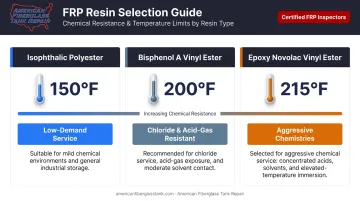
Resin selection directly determines chemical resistance limits and service life. Interplastic's CoREZYN guide puts isophthalic polyester at a liquid temperature limit of 150°F, bisphenol A vinyl ester at 200°F, and epoxy novolac vinyl ester at 215°F — each with distinct chemical resistance profiles. Vinyl ester and epoxy vinyl ester resins are the standard specification for aggressive acid-gas service, while isophthalic polyester suits less demanding environments.
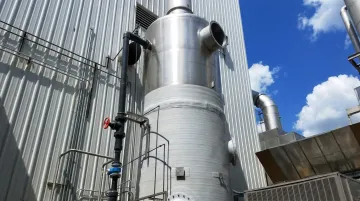
FRP scrubbers are most commonly built in packed bed/tower configurations, though crossflow, venturi, and tray tower designs are all well-established. Across all configurations, FRP is the dominant construction material where the exhaust stream is wet, acidic, or halogen-bearing.
Where FRP Scrubbers Are Specified
Industries where FRP is the standard material choice:
- Chemical processing — HCl, SO₂, NH₃, and acid mist exhaust
- Wastewater treatment — H₂S odor control (where H₂S converts to sulfuric acid on moist surfaces)
- Electroplating and metal finishing — acid fume and chrome scrubbing
- Pharmaceutical manufacturing — solvent and acid exhaust
- Semiconductor facilities — acid gas scrubber systems
- Food and beverage — odor and fume control
American Fiberglass Tank Repair (AFTR) has worked across these sectors since 2003, providing FRP scrubber and neutralizer repair, ductwork relining, and vessel inspection for municipal and industrial wastewater treatment plants. Their field teams frequently extend the service life of scrubber vessels and connected ductwork that would otherwise require full replacement — completing repairs in place to keep systems online.
What Is a Metal Scrubber?
Metal scrubbers are constructed from carbon steel, SS304, SS316/316L, or higher alloys. Metal offers high structural strength, handles elevated temperatures without material limitation, and typically costs less upfront — particularly in carbon steel designs.
The problem in corrosive-gas service is that wet, acidic exhaust is precisely the environment where uncoated steel fails fastest.
Where Metal Struggles
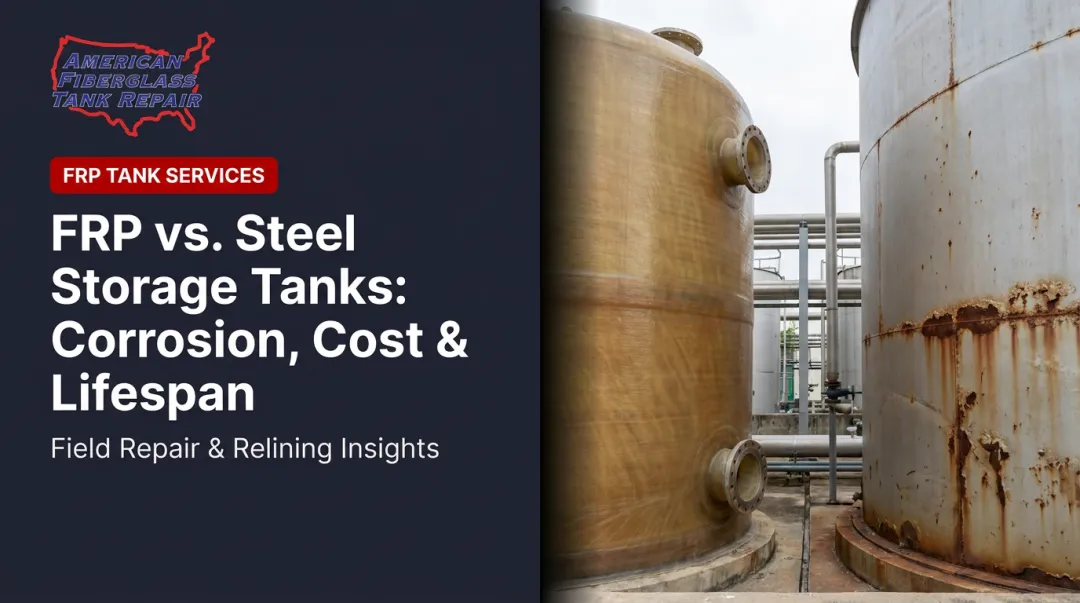
Stainless steel's corrosion resistance depends on a chromium oxide passive film — and that film has a known vulnerability. A 2025 peer-reviewed study of 316L confirms that chloride ions penetrate and destroy the passive oxide layer, and that 316L is not immune to pitting above 50 ppm chlorides. In acid-gas scrubbing with HCl, H₂S, or halogenated exhaust, those conditions are routine — not exceptional.
AMPP has documented rapid pitting corrosion on a Type 316 gas scrubber where salt accumulated at the vessel surface. These aren't edge failures — they're predictable outcomes of putting unsuitable stainless in chloride acid-gas service.
Where Metal Scrubbers Make Sense
Metal remains the right specification in specific scenarios:
- Exhaust temperatures above 80–93°C, where FRP requires resin-specific validation to remain viable
- High-pressure systems that demand structural integrity beyond FRP's practical limits
- Inlet quench sections handling incoming hot gas — CECO's quench systems, for example, specify 316 SST, AL6XN, and Hastelloy C276 before flow reaches the downstream FRP absorber
- Dry ventilation service with no chemical attack risk
- Very large diameter vessels where structural demands exceed FRP engineering constraints
In practice, many installations combine both materials: metal in the hot quench section, FRP downstream once the gas reaches saturated wet conditions. This hybrid approach is well-established among scrubber manufacturers and reflects what each material actually does well.
FRP vs Metal Scrubber: Key Differences Explained
Corrosion Resistance
FRP's thermoset resin matrix — particularly vinyl ester and epoxy vinyl ester — creates an inert polymer structure with no passive film to compromise. Ashland's technical documentation notes that FRP built with epoxy vinyl ester resin offers chemical resistance comparable to nickel alloys in flue gas desulfurization service, largely unaffected by the chloride and sulfite trace elements that drive stainless pitting and stress-corrosion cracking.
H₂S applications illustrate why this matters. Anaerobic bacteria convert sulfate to sulfide, H₂S is released, and sulfur-oxidizing bacteria convert it to sulfuric acid on moist surfaces. EPA wastewater research documents concrete pipe wall loss of up to 5.9 inches in severe H₂S environments — a corrosion rate that defeats unprotected carbon steel and compromises SS304 quickly. FRP or dual-laminate construction is the appropriate response.
Weight and Installation
FRP is meaningfully lighter than equivalent steel construction, which reduces structural support requirements and simplifies installation — particularly relevant when retrofitting scrubbers into existing facilities or integrating with FRP ductwork systems. Lighter vessels also reduce crane requirements and rigging complexity on rooftop or elevated equipment installations.
AFTR field teams note this weight advantage when assessing scrubber vessel replacement options for wastewater plants, where the ability to handle components with lighter equipment reduces project cost and schedule.
Temperature Tolerance
Metal holds a genuine advantage here. FRP temperature ratings are resin-dependent, and the ceiling matters when specifying for hot gas streams:
- Isophthalic polyester: ~150°F liquid temperature maximum
- Epoxy novolac vinyl ester: extends to ~215°F
- Advanced FRP resin systems: rated higher, but streams consistently above ~80–93°C still warrant a quench stage before the FRP absorber — or a metal construction review
Metal scrubbers — particularly SS316 and higher alloys — handle sustained high-temperature operation without this constraint, making them the right specification for foundry exhaust, cement kiln off-gas, and similar high-heat applications.
Maintenance and Repairability
The maintenance picture diverges sharply in long-term corrosive service:
FRP scrubbers:
- Smooth, non-reactive internal surfaces resist fouling and scale
- No recoating program required
- No weld seam inspection for corrosion
- Field laminate repairs are practical for localized damage
- AFTR can repair and reline scrubber vessels in place, extending service life without vessel replacement
Metal scrubbers in acid-gas service:
- Regular weld seam inspection required — weld heat-affected zones are preferential corrosion sites
- Periodic recoating or relining programs add recurring cost
- Localized pitting can require section replacement or off-site repair
- Coating failure can be sudden, creating unplanned downtime
Cost: Upfront vs. Total Cost of Ownership
Carbon steel carries the lowest upfront fabrication cost. FRP is comparable to or slightly above SS316 on initial equipment cost, with high-alloy metals higher still.
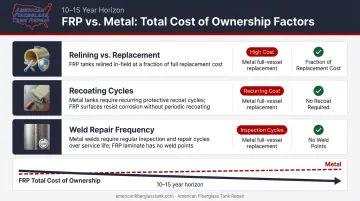
Over time in corrosive service, that initial gap reverses. EPA's Control Cost Manual estimates annual wet scrubber maintenance at 1.5% of total capital investment and puts acid gas scrubber equipment life at 20–30 years for well-maintained systems. The cost lever is avoiding vessel repair or replacement events — corrosion-driven rebuilds in metal service are typically the largest single cost differentiator over a 10–15 year horizon.
Three cost factors that shift total ownership costs toward FRP:
- Relining vs. replacement: Restoring an FRP vessel's corrosion barrier through relining costs a fraction of vessel replacement and avoids long lead times for new equipment
- Recoating cycles: Metal scrubbers in acid-gas service accumulate recurring recoating costs that FRP vessels don't carry
- Weld repair frequency: Heat-affected zones in metal vessels are preferential corrosion sites requiring periodic inspection and repair
Customizability and Design Flexibility
Both materials support a range of scrubber configurations. FRP's advantage is resin selection — the laminate can be engineered to the specific chemical environment, with vinyl ester for chloride acid service, epoxy for higher-temperature or more aggressive chemistries, and polyester for lower-demand applications.
AFTR works with over 45 fiberglass mat, chopped strand, Nexus, Harlar, and carbon veil laminates alongside custom-blended polyester, vinyl ester, and epoxy resins. That breadth allows repair and relining work matched precisely to the original chemical service — or reconfigured when a vessel moves to a different chemistry or temperature range.
Which Scrubber Material Is Right for Your Facility?
Decision Framework
Choose FRP when:
- Exhaust stream contains corrosive gases (HCl, H₂S, SO₂, NH₃, chlorine, acid mist)
- Operating temperature stays within the selected resin's rated range (typically below 80–93°C)
- Long-term maintenance cost matters more than initial equipment price
- Facility handles chemicals, wastewater, pharmaceuticals, or food processing
- You're integrating with FRP ductwork or replacing a corroded metal vessel
Choose metal when:
- Exhaust temperatures consistently exceed FRP's service limit
- System pressure or structural requirements go beyond FRP's practical engineering range
- The quench zone needs to handle hot combustion gas before downstream scrubbing
- Operating environment is non-corrosive and structural load dominates
Consider a hybrid design when both apply — metal in the hot inlet/quench section, FRP for the absorber body downstream.
The Weld Seam Problem
A common pattern in the field: a facility selects a carbon steel or SS304 scrubber due to lower upfront cost. Within a few years, weld seam corrosion appears — the heat-affected zone adjacent to welds is more susceptible to localized attack than the base metal. Recoating buys time, but the cycle repeats. Eventually, the accumulated repair cost exceeds what an FRP vessel would have cost originally.
EPA's documented case of a 304 SS scrubber failing after two months is an extreme example, but the underlying mechanism — chloride attack on the passive film, concentrated at weld seams and crevices — is the same one that drives slower failures in less aggressive service.
Protecting Your FRP Investment
Whether you're selecting a new scrubber or operating an existing FRP air pollution control system, long-term performance depends on the condition of the internal corrosion lining.
Laminate degradation — spidering, disbondment, corrosion coat erosion, capillary migration of liquid product beneath the liner — typically develops gradually and is detectable well before catastrophic failure. The key is knowing what to look for, and when.
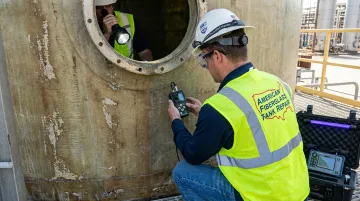
That's where professional inspection makes the difference. AFTR's FTPI-certified inspectors use ultrasonic, laser, and high-intensity backlight testing to evaluate corrosion coat condition, structural laminate integrity, and nozzle interfaces on FRP scrubber vessels. Early detection converts a potential vessel condemnation into a planned relining project — adding years of service life at a fraction of replacement cost.
If your facility operates FRP scrubbers, neutralizers, or associated ductwork, contact AFTR to schedule a vessel assessment and get ahead of liner issues before they become unplanned outages.
Frequently Asked Questions
What is an FRP scrubber?
An FRP scrubber is an air pollution control device built from glass fiber-reinforced thermoset resin, used to remove corrosive gases, acid mists, and fumes from industrial exhaust streams. It's the preferred construction material in chemically aggressive applications because the resin matrix provides chemical inertness without relying on coatings or passive films.
Is FRP stronger than steel?
FRP has a high strength-to-weight ratio and outperforms steel in corrosive environments, but steel has greater absolute tensile and structural strength. For acid-gas scrubbing where chemical resistance determines service life, FRP is the better long-term choice.
What are the two types of scrubbers?
Industrial scrubbers are broadly classified as wet scrubbers (using liquid to absorb and neutralize pollutants) and dry scrubbers (using dry sorbent materials). Both types can be built from FRP or metal — the choice is driven by exhaust chemistry and temperature, not the scrubber type itself.
How long do FRP scrubbers last compared to metal scrubbers?
Properly maintained FRP scrubbers typically achieve 15–20+ years in corrosive gas service. Metal scrubbers in acid-gas service (carbon steel and SS304 in particular) often need repair or replacement much sooner, depending on chloride concentration, pH, and temperature. The EPA has documented stainless scrubber failures occurring within months in severe service.
What chemicals can FRP scrubbers handle?
FRP scrubbers are rated for HCl, H₂S, SO₂, NH₃, HF, chlorine, acid mists, and alkaline scrubbing solutions, among others. The specific resin (polyester, vinyl ester, or epoxy) must be matched to the target chemical environment and concentration during the design or relining phase.
When should you choose a metal scrubber over FRP?
Metal is the right choice for sustained high-temperature exhaust above 80–93°C, high-pressure systems, inlet quench sections handling hot combustion gas, non-corrosive ventilation applications, or very large-diameter vessels where structural requirements exceed FRP's practical engineering range.