The challenge is that PE isn't like steel or fiberglass. Standard adhesives bead off the surface the same way water does, and a poorly executed repair can fail faster than the original crack spread. Getting it right requires understanding why the crack appeared, choosing the correct repair method for the damage type, and knowing when a repair buys you time versus when it's time to replace.
This guide walks through all of it — from crack assessment to step-by-step repair methods, plus a clear framework for the repair-versus-replace decision.
Key Takeaways
- PE tanks crack from overtightened fittings, UV degradation, thermal stress, impact, or age-related brittleness
- Polyethylene's surface energy of roughly 31 dyne/cm means standard adhesives won't bond — mechanical roughening and flame treatment are required
- Plastic welding with stainless steel mesh reinforcement is the most durable repair method; NSF-approved polyurethane sealant with fabric reinforcement is the best flexible alternative
- Small, accessible cracks on newer tanks are good DIY candidates
- Large through-wall failures, widespread crazing, or regulated potable water tanks typically require professional assessment or replacement
What Is a Polyethylene Water Tank?
Polyethylene water tanks are thermoplastic vessels manufactured through rotational molding — a process that produces a single-piece, seamless construction with no joints or welds in the original structure. ASTM D1998-21 defines the standard for upright PE storage tanks from 500 gallons and up, covering materials, dimensions, wall thickness requirements, and construction methods.
The seamless design is part of what makes PE tanks strong under normal operating conditions. Standard material properties include:
- Corrosion resistance across a wide range of stored fluids
- UV-stabilized formulations for outdoor installations
- FDA-compliant grades suitable for potable water storage
- No internal joints or welds to corrode or crack under pressure
Those same properties create a real challenge when repairs become necessary. As Henkel's plastics bonding research documents, polyethylene and HDPE have a surface energy of approximately 31 dyne/cm — meaning conventional adhesives simply can't wet or grip the surface without specific preparation. That low surface energy is what drives every repair decision covered below.
Why Polyethylene Water Tanks Crack
PE tank cracking follows predictable patterns. Identifying the root cause before attempting any repair determines whether the fix holds for years or fails within a season — so each cause category below points to a specific diagnostic sign to check first.
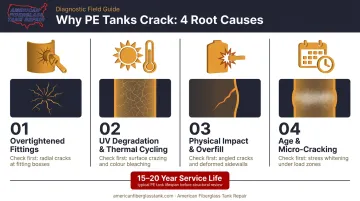
Overtightened or Failing Fittings
Norwesco's installation guidance specifically warns against overtightening bulkhead fittings, recommending hand-tight plus no more than ¼ to ½ turn. Pipe thread fittings create radial expansion stress in the tank wall, and because PE is relatively soft, that stress can propagate as hairline cracks that may not appear for months or years after installation.
Rigid piping connected directly to tank fittings compounds this — Norwesco explicitly states that flexible connections are required to accommodate thermal expansion and contraction. A rigid pipe that can't move transfers every vibration and thermal load directly into the fitting zone.
UV Degradation and Thermal Cycling
Norwesco's above-ground tank guidance notes that UV exposure detrimentally affects PE tank life, and that sun-exposed domes commonly show fine fissures or crazing that can intensify into structural stress cracks. Tanks without UV-stabilized resin are particularly vulnerable.
Thermal cycling accelerates this. HDPE has a coefficient of linear thermal expansion of 7.0 × 10⁻⁵ in/in/°F — enough movement over seasonal temperature swings to widen micro-cracks incrementally if the tank is rigidly restrained.
Physical Impact and Structural Stress
Two distinct mechanical forces drive this failure mode:
- Impact damage — dropped equipment, shifting loads, or vehicle contact fractures the wall and typically creates cracks that angle inward at the impact point
- Overfilling — internal pressure from excess fill ruptures along existing stress concentration points, particularly fitting zones and UV-weakened areas
Age and Undetected Micro-Cracking
Poly Processing's service life data puts PE tank life expectancy at 15 to 20 years, depending on application and operating conditions. Early warning signs — stress whitening, surface crazing, discoloration near fittings — are often missed until a full leak develops. At the first sign of crazing or stress whitening, inspect fitting torque and UV exposure history before selecting a repair method.
How to Repair a Polyethylene Water Tank Crack
The single biggest mistake in PE tank repair is skipping surface preparation. Without mechanical roughening and heat treatment, no repair method holds reliably. Every approach below depends on this.
Step 1: Assess the Crack and Prepare the Tank
Drain the tank completely and allow the repair area to dry fully, since moisture under a weld or sealant causes immediate bond failure.
Examine the crack carefully and document:
- Total length and approximate depth (surface vs. through-wall)
- Whether crack edges are aligned or displaced
- Proximity to fittings, seams, or other stress points
- Any surrounding surface crazing or stress whitening
Once assessed, remove the mechanical stress riser at each crack tip. Poly Processing's repair guidance recommends routing or drilling the damaged area into a smooth circular or oval shape — sharp crack tips concentrate stress and drive further propagation under load.
Step 2: Surface Preparation — Non-Negotiable
This step determines whether your repair succeeds or peels off under the first load cycle.
- Clean the area with mild soap and water; rinse thoroughly
- Sand aggressively with 60–80 grit sandpaper, extending at least 2 inches beyond the crack in all directions. The surface should look visibly dull and roughened
- Remove all sanding dust completely
- Apply flame treatment: briefly pass a propane torch over the sanded area in smooth, continuous passes. The goal is a light surface change in sheen that indicates oxidation of the PE surface chemistry; the surface will stop beading water. Keep the torch moving at all times — aim for a subtle sheen change, not melting or bubbling.
Both MasterBond's surface preparation guidance and Henkel's plastics bonding research confirm that mechanical roughening plus flame oxidation is the correct approach for activating PE surfaces before bonding.
Step 3A: Plastic Welding with Mesh Reinforcement
Best for: Cracks with separation or displacement, structural cracks in thicker-wall tanks, situations where maximum durability is needed.
Plastic welding is the strongest repair method for linear PE and mirrors how PE tanks are manufactured. Poly Processing's repair documentation identifies thermal welding using PE-compatible filler rod as the best-supported approach for rotomolded PE parts.
Process:
- Use a purpose-built plastic welding iron, not a soldering iron, which can overheat and worsen the damage. Follow the tool manufacturer's settings for PE.
- For cracks with any separation, use the iron tip to form a shallow V-groove along the crack line to create a clean weld channel
- Cut a piece of stainless steel mesh about 1 inch wide and 1 inch longer than the crack; Polyvance confirms stainless reinforcing mesh is appropriate for high-stress thermoplastic repairs
- Soften the surface with the iron and press the mesh into the plastic, working in small stages on curved surfaces
- Apply PE filler rod in layers over the mesh, pre-softening each strip before pressing down with the iron
- Build up to match or slightly exceed wall thickness, tapering edges outward at least 5 wall-thicknesses wide
- Allow to cool completely before sanding smooth
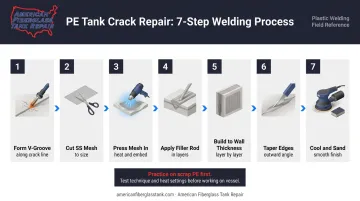
Practice on scrap PE material first. Overheating is the most common error, and it creates more damage than it fixes.
If welding isn't practical for your situation, the sealant-based method below is the better fit.
Step 3B: Polyurethane Sealant with Fabric Reinforcement
Best for: Thin-wall tanks, large repair areas, outdoor tanks subject to ongoing thermal cycling, situations where some wall flex is expected.
This method works well where movement and flexing are part of the operating environment. For any tank storing potable or process water, use only an NSF/ANSI/CAN 61-certified polyurethane sealant. NSF 61 covers health effects and leaching from materials in contact with drinking water. Confirm the specific product's potable approval before purchasing.
Process:
- Apply a base coat of sealant over the fully prepared and flame-treated area
- Lay 2–3 overlapping layers of acrylic canvas or similar flexible cloth, pressing each layer fully into the wet sealant before adding the next coat
- Finish with a top coat of sealant covering all fabric edges
- Do not use alcohol-based cleaners before application, as alcohol inhibits polyurethane curing
- Allow full cure of at least 5–7 days in warm, humid conditions before returning to service
Step 4: Test and Validate
After full cure, refill the tank slowly and inspect the repair area for seeping, surface discoloration, or re-cracking at the prepared crack tip zones. Monitor for 24–48 hours before returning to normal operating pressure and flow conditions.
Fix or Replace? How to Decide
PE repair is a temporary-to-medium-term solution, not a permanent fix. The decision should weigh crack severity, tank age, contents, regulatory requirements, and the cost of a second failure.
| Scenario | Repair? | Replace? |
|---|---|---|
| Small crack (<6 in), aligned edges, newer tank, non-potable | Yes: weld or sealant repair | If same crack recurs within one season |
| Stress crack around an overtightened fitting | Install properly sized bolted bulkhead fitting to bypass damaged zone | If multiple fittings show radial cracking |
| Large through-wall failure or widespread crazing | Emergency stop; plan replacement | Yes, especially with UV-induced brittleness |
| Industrial/municipal potable water, regulated setting | Minor cracks with NSF-approved materials after professional inspection | If structural compromise, liner failure, or NSF-compliant repair not achievable |
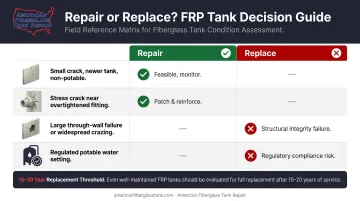
On age: Poly Processing puts PE tank life expectancy at 15 to 20 years. A cracked tank approaching that range warrants a replacement analysis, not automatic patching.
On regulated applications: The Illinois EPA requires water storage tank inspections at least every 5 years, or more frequently depending on local conditions. For industrial or municipal tanks, a professional inspection by certified tank specialists can determine whether repair is viable or replacement is the responsible choice. Facilities managing both PE and FRP vessels should note these are separate material disciplines — each requiring specialists trained in that specific construction type.
Common Mistakes and Preventive Maintenance
Common Mistakes
- Skip flame treatment and rely on sanding alone, and even high-quality sealants will peel under flex or load. Mechanical roughening changes surface texture; flame treatment changes surface chemistry. Both steps are required.
- Repair a damp surface and you'll get immediate bond failure — moisture under a weld creates steam, moisture under sealant destroys adhesion. The surface must be completely dry before any repair begins.
- Use standard epoxy without reinforcement and it will fail quickly on PE. If epoxy is your only option, choose a flexible formulation (G-Flex-type) with fiberglass cloth reinforcement and proper flame treatment — but plastic welding remains the stronger structural choice.
These mistakes are almost always preventable. The maintenance practices below address the same failure points before they become active cracks.
Preventive Maintenance
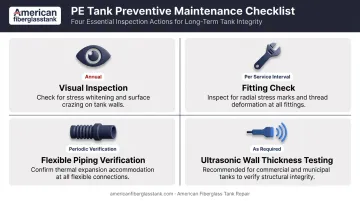
- Conduct annual visual inspections of all exposed surfaces — pay specific attention to stress whitening, surface crazing on sun-exposed domes, and discoloration near fitting collars and the tank base.
- Check all inlet/outlet fittings annually; look for radial stress marks around collars and replace any fittings showing thread deformation before cracking develops.
- Verify that all connected piping uses flexible joints to accommodate thermal expansion — rigid hard-piping is the most common source of repeat failures.
- For commercial and municipal tanks, schedule periodic inspections that include ultrasonic wall thickness testing to catch hidden thinning or internal degradation not visible from the surface.
Frequently Asked Questions
Can potable water tanks be repaired?
Yes — minor cracks and pitting in potable water tanks can often be repaired using NSF 61-certified materials. Any repair product that contacts the stored water must carry specific potable water approval for that contact use, and regulatory compliance should be confirmed before returning the tank to service.
How long do polyethylene water tanks last?
Quality rotationally molded PE tanks typically have a service life of 15 to 20 years, though UV exposure, operating temperatures, and maintenance quality all affect that range. Routine annual inspection consistently extends useful life.
What is the best adhesive or sealant for repairing a polyethylene tank?
NSF-approved polyurethane sealant with fabric reinforcement is the best adhesive-based option, particularly for flexible or exterior applications. Plastic welding with stainless mesh reinforcement is the stronger structural method for most cracks where wall integrity matters.
Can you repair a polyethylene water tank with epoxy?
Standard epoxy performs poorly on PE without both surface preparation and reinforcement. Flexible epoxy formulations (G-Flex-type) combined with fiberglass cloth and flame surface treatment can achieve acceptable bond strength, though results depend heavily on proper surface prep.
How do I stop a crack from spreading before I can make a full repair?
Routing or drilling the crack tip into a smooth oval shape removes the sharp stress riser that drives propagation. Applying a temporary bead of polyurethane sealant over the crack can slow water loss while a permanent repair is planned.
When is a cracked polyethylene tank too damaged to repair?
A tank is past reliable repair when it shows multiple cracks, widespread surface crazing, UV-induced brittleness across large areas, seam separation, large through-wall failures, or when the material no longer holds a weld or bond after multiple attempts.