Introduction
Tank size is one of the most consequential decisions in any FRP storage system, and one of the most commonly misunderstood. Specifying a tank by gallon capacity alone leaves critical dimensional questions unanswered — diameter, height, laminate thickness — each of which determines structural performance, foundation loading, transport feasibility, and long-term serviceability.
For procurement engineers, plant managers, and facilities teams, understanding how FRP tank sizes work is essential before any purchase order is written or installation begins. That means knowing what governs sizing decisions, how specifications get verified, and where errors create lasting problems.
This article covers the full dimensional framework of industrial FRP tanks — standard size ranges, governing standards, and the technical variables that separate a well-specified tank from an expensive mistake.
Key Takeaways
- Industrial FRP tanks range from roughly 500 gallons to 50,000+ gallons for shop-fabricated units, with custom field-erected tanks reaching far beyond that
- "Tank size" encompasses diameter, tangential height, head geometry, and wall thickness — gallon capacity alone doesn't define the vessel
- Over-the-road transport limits practical shop-built diameters to roughly 14–16 feet; larger vessels require permits, field assembly, or barge delivery
- Wall thickness is a calculated output of diameter, operating pressure, and fluid density, and it increases meaningfully as tanks get larger
- Specifying gallon capacity alone leaves multiple valid dimensional configurations on the table, each with different structural demands and site footprint requirements
What Tank Size Represents in Industrial FRP System Design
In structural terms, "tank size" is never a single value. A complete size specification requires four interdependent parameters:
- Nominal internal diameter — governs hoop stress and laminate requirements
- Tangential (straight-side) height — sets usable shell volume independent of head geometry
- Overall height — includes top and bottom head contributions
- Wall laminate thickness — a calculated output, not an arbitrary selection
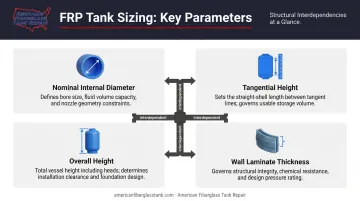
Tank size functions as three things simultaneously: a process input (what volume does the system require?), a structural constraint (diameter directly drives hoop stress), and a physical constraint (footprint, foundation load, transport envelope). All three must be resolved before fabrication begins. Unlike steel tanks, which can sometimes be field-modified, changing the diameter or height of a monolithic FRP vessel after manufacture is not an option.
The L/D Ratio and Why It Matters
The height-to-diameter ratio (often called L/D or H/D) is a derived characteristic that affects structural efficiency, mixing performance, and site fit. According to The Chemical Engineer's rules of thumb for tanks and vessels, the aspect ratio for process tanks is typically 1:1 to 1.5:1, with taller vessels up to approximately 4:1 used where process requirements — such as extended gas contact time or heat transfer — demand it.
For mixing applications, an L/D close to 1:1 is generally sufficient, while ratios below 0.6 should be avoided.
Two tanks with identical gallon ratings but different L/D ratios will have different diameters, different wall thicknesses, different foundation footprints, and different structural designs. Specifying only gallons leaves all four of those variables unresolved — which means the fabricator, not the engineer, ends up making the design decisions.
Real-World Dimensional Tolerances
ASTM D-3299 governs filament-wound FRP tanks and includes dimensional tolerances for manufactured vessels. Per published manufacturer specifications consistent with the standard, the tolerance on nominal diameter — including out-of-roundness — is ±1%, with measurements taken on the vertical tank. On a 10-foot diameter vessel, that's a ±1.2-inch variance.
Over time, corrosion liner degradation compounds this. A tank whose liner has failed may maintain its external geometry while losing usable internal volume and simultaneously exposing the structural laminate to the stored fluid. This is why dimensional compliance at manufacture is only part of the picture — periodic inspection is what confirms a tank still performs to its original specification.
Standard Industrial FRP Tank Size Ranges
Small and Mid-Range Industrial Tanks
Shop-fabricated FRP tanks in the 500–5,000 gallon range represent the most common category for:
- Chemical dosing and day tanks
- Industrial process vessels
- Food and beverage storage
- On-site potable water systems
Typical diameters in this range run 4–6 feet, with height combinations selected to achieve the required L/D ratio. These dimensions fall well within standard over-the-road transport envelopes, so logistics pose no special constraints. Fiberglass Tank Solutions lists underground holding tanks from 500 to 50,000 gallons in 4- to 12-foot diameters, illustrating how this range spans both small and mid-size applications.
Large Industrial and Municipal Tanks
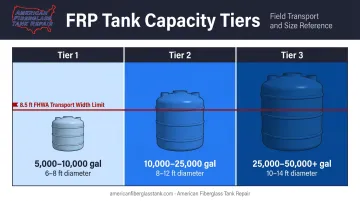
The 5,000–50,000+ gallon range serves water treatment, wastewater, bulk chemical storage, and fire suppression applications. Common diameter increments in this category:
| Approximate Capacity | Typical Diameter Range |
|---|---|
| 5,000–10,000 gal | 6–8 ft |
| 10,000–25,000 gal | 8–12 ft |
| 25,000–50,000+ gal | 10–14 ft |
A 21,000-gallon (500 bbl) FRP tank, for example, is available in several diameter-height combinations: 12 ft × 25 ft sidewall, 14 ft × 18 ft 6 in. sidewall, or 15 ft 6 in. × 14 ft 11 in. sidewall, depending on the manufacturer and L/D ratio selected.
Transport becomes a real constraint at this scale. The FHWA federal maximum width for commercial motor vehicles on the National Network is 102 inches (8.5 feet). Tanks wider than this require state oversize/overweight permits, specialized transport arrangements, or alternative delivery methods.
Diamond Fiberglass notes that large-diameter shop-built tanks (up to 21 ft 6 in.) may be shipped to customer sites by barge — one example of how logistics planning shapes tank selection at this size.
NOV Fiber Glass Systems publishes shop-fabricated FRP tanks up to 21 ft 6 in. internal diameter. Above that threshold, field-wound construction begins at 16 ft and extends to 120 ft diameter — an entirely separate construction method with its own structural engineering requirements.
Custom and Very Large Tanks
FRP tanks exceeding 100,000 gallons require custom engineering, project-specific structural calculations, and typically field fabrication or modular assembly. At this scale, multiple smaller tanks often make more practical sense than a single oversized vessel.
Real-world installations support this approach:
- A Toronto college installed three 35,000-gallon fiberglass tanks for supplemental fire protection — distributing capacity across vessels rather than relying on a single oversized unit
- Milwaukee County Greenhouses deployed four 20,000-gallon FRP tanks to collect rainwater from a 60,000-square-foot glass roof, using a multi-tank configuration for both capacity and redundancy
Technical Variables That Define FRP Tank Sizing
Wall Thickness and Laminate Schedule
Wall thickness is not a fixed specification — it's a calculated output. The governing relationship is straightforward: in a cylindrical vessel, hoop stress equals pressure × radius ÷ wall thickness. As diameter increases at constant pressure and allowable stress, required wall thickness increases proportionally.
This means:
- Two tanks with the same gallon capacity but different diameters will have different wall thicknesses and different material costs
- Larger-diameter tanks are heavier and impose greater foundation loads
- As diameter grows, laminate thickness requirements can make large FRP pressure vessels impractical
Those thickness calculations depend heavily on material selection. For repair and relining work, AFTR draws on over 45 fiberglass mat, chopped strand, Nexus, Harlar, and carbon veil laminates with custom-blended isophthalic, terephthalic, vinylester, and epoxy resins — each combination chosen to match the stored chemical, operating temperature, and structural demands of that specific vessel.
Head Geometry and Bottom Configuration
The bottom configuration affects both drainage performance and structural loads on the shell:
- Flat bottom — standard for large vertical storage tanks; maximizes usable volume per unit height
- Dished bottom — common in atmospheric process vessels; moderate drainage improvement
- Cone bottom — directs liquid to a central outlet for complete drainage; used where solids settle or complete discharge is required
- Sloped floor — a practical compromise between flat and cone configurations
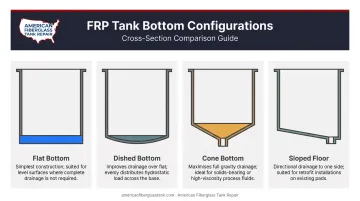
Selecting a cone bottom adds height for a given storage volume and changes the stress distribution at the shell-to-bottom junction. These geometry choices must be made during design, not retrofit after fabrication.
Operating Pressure and Temperature Limits
FRP tanks are primarily designed for atmospheric or low-pressure service. The applicable standards set clear boundaries:
| Standard | Application | Pressure Limit |
|---|---|---|
| ASME RTP-1 (2025) | Reinforced thermoset plastic vessels | ≤15 psig (internal and external) |
| ASTM D-3299 | Filament-wound FRP tanks | Atmospheric |
| AWWA D-120 | Water storage tanks | Atmospheric |
As design pressure increases, required wall thickness grows rapidly with diameter. This is why large-diameter FRP pressure vessels are rarely practical above modest pressures. Engineers specifying FRP for pressurized applications should verify that the size-pressure combination falls within the feasible range before finalizing design.
How FRP Tank Size Is Specified, Documented, and Field-Verified
A complete FRP tank specification should reference the applicable standard and capture:
- Nominal internal diameter and tangential height
- Overall height (including head geometry)
- Design pressure and temperature
- Fluid type, specific gravity, and concentration
- Applicable standard: ASTM D-3299 (filament wound), ASTM D-4097 (contact molded), or AWWA D-120 (water service)
Nameplate dimensions must be cross-checked against fabrication shop drawings before installation — and again during field verification.
Field Verification Methods
Confirming as-built dimensions against specification requires more than a tape measure:
- Dimensional survey — diameter and height measurements using laser measurement tools for precision
- Ultrasonic thickness testing — verifies wall laminate thickness at multiple locations and detects internal degradation invisible from the surface
- High-intensity backlight testing — reveals subsurface laminate anomalies and corrosion coat voids
- Barcol hardness testing: confirms laminate cure quality throughout the shell
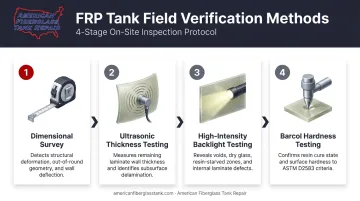
AFTR's inspection services apply all three instrument-based methods — ultrasonic, laser, and high-intensity backlight testing — under the supervision of Fiberglass Tank & Pipe Institute certified inspectors. Each inspection covers the interior corrosion coat, internal body, exterior shell, and nozzle interfaces, with a detailed report delivered outlining findings and remediation steps.
This assessment matters most before any capacity increase or process change on an existing tank. A vessel that looks serviceable from the outside may have liner failure, laminate degradation, or wall thinning that affects its actual structural rating — none of which a visual inspection alone will catch.
Consequences of Poor Sizing and Common Misconceptions
Undersizing
Undersizing is usually discovered at commissioning, when corrective options are limited. Consequences include:
- Inadequate process retention time in water and wastewater applications
- Overflow or spill risk for chemical storage
- Inability to meet fire suppression reserve requirements
- Excessive cycling that accelerates wear on pumps, valves, and level controls
Oversizing
Oversizing carries its own costs, and not just capital expenditure. EPA guidance on finished drinking water storage tanks identifies excessive water age, inadequate mixing, sediment accumulation, microbial growth, and low disinfectant residual as direct consequences of oversized or poorly turned-over storage. Oversized tanks also impose unnecessary foundation loads and, in chemical service, expose more internal surface area to corrosive products.
The Capacity-Only Misconception
Specifying a tank solely by gallon capacity is the most common sizing error. A 10,000-gallon FRP tank can be configured as an 8-foot-diameter vessel at one height or a 10-foot-diameter vessel at a shorter height. Each configuration carries different wall thicknesses, foundation requirements, laminate costs, and transport logistics.
Gallon capacity is necessary but never sufficient as the sole specification parameter.
The "Still Looks Fine" Misconception
Assuming an aging tank still holds its rated capacity and structural integrity without inspection is a risk that grows with every passing inspection cycle. Corrosion liner failure allows stored product to migrate into the structural laminate through capillary action — a condition that ultrasonic and backlight testing can detect, but external visual inspection cannot. A tank can pass a hydrostatic test one week and fail containment three months later if internal degradation isn't caught early.
That's why regular inspection by qualified inspectors — such as AFTR's FTPI-certified teams — is what confirms whether an aging vessel still performs within its original design ratings. Visual checks alone won't catch liner degradation before it becomes a containment failure.
Frequently Asked Questions
What are standard FRP tank sizes?
Shop-fabricated industrial FRP tanks typically range from roughly 500 gallons to 50,000+ gallons, with standard diameters running approximately 4 to 14 feet. Custom and field-fabricated designs extend well beyond these limits for large municipal or industrial applications.
What are the dimensions of a 21,000-gallon FRP tank?
A 21,000-gallon (500 bbl) FRP tank typically comes in combinations such as 12 ft × 25 ft, 14 ft × 18 ft 6 in., or 15 ft 6 in. × 14 ft 11 in. sidewall — with exact dimensions varying by L/D ratio, manufacturer standards, and site constraints.
What is the maximum size FRP tank that can be shop-fabricated?
Over-the-road transport limits practical shop-built diameters to around 16 feet; beyond that, field-wound construction is standard. Some manufacturers ship larger shop-built vessels by barge, with published diameters reaching approximately 21 ft 6 in. internal diameter.
How does tank diameter affect wall thickness?
As diameter increases, hoop stress in the tank wall increases proportionally, requiring a thicker laminate to maintain structural safety. Two tanks with identical gallon capacities but different diameters will have different wall thicknesses, different material costs, and different weight profiles.
Can an existing FRP tank be upsized after installation?
No. Monolithic FRP tanks cannot be resized after fabrication. Feasible modifications are limited to nozzle additions, fitting changes, and internal lining repairs. If capacity requirements have changed, an engineering assessment should determine whether a new tank or supplemental vessel is needed.
Can an aging FRP tank still be at its rated capacity after years of service?
Rated capacity cannot be assumed without verification. Corrosion liner degradation, laminate wall thinning, and internal structural damage can compromise a tank's structural integrity even when it appears externally intact. Independent assessment — including ultrasonic and backlight testing — is required to confirm current operating condition.