That's what makes proactive thickness testing non-negotiable. A tank storing sodium hypochlorite or ferric chloride isn't just a storage vessel; it's a pressure boundary between aggressive chemistry and your facility, your workforce, and the surrounding environment.
This article covers the three primary fiberglass tank thickness testing methods — Ultrasonic Testing, Laser Testing, and High Intensity Backlight Testing — along with why regular inspections matter, how a professional inspection unfolds step by step, and what standards govern FRP tank integrity across water treatment, chemical processing, and wastewater applications.
Key Takeaways
- Fiberglass tank thickness testing is NDT that measures laminate wall integrity without taking a tank out of service
- Wall thinning from chemical corrosion, erosion, UV degradation, and mechanical stress is often invisible until damage is severe
- The three primary methods — Ultrasonic Testing (UT), Laser Testing, and High Intensity Backlight Testing — each target different defect types
- Most FRP tanks require comprehensive inspection every 5 years; aggressive chemical service may warrant more frequent assessment
- Early detection converts potential tank replacements into planned, targeted repairs that cost far less and cause far less downtime
What Is Fiberglass Tank Thickness Testing?
Fiberglass tank thickness testing is a category of non-destructive testing (NDT) that measures remaining wall thickness at multiple points across an FRP vessel — without cutting into, draining, or damaging it — to confirm the tank meets structural and safety specifications.
The Layered Construction Problem
Understanding why thickness testing is more complex on FRP than on steel comes down to how how these tanks are built. A typical FRP tank consists of:
- Inner resin-rich corrosion barrier — the chemical defense layer, resin-saturated glass fiber on the process-contact surface
- Interior chopped strand layer — transition zone between the corrosion barrier and structural laminate
- Structural filament-wound layer — the load-bearing wall that determines pressure and weight capacity
- Exterior coat — UV-protective finish layer
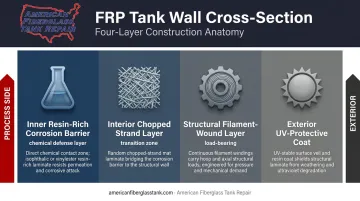
Each of these layers can degrade at a different rate depending on what the tank stores. A sodium hypochlorite tank may show rapid corrosion barrier deterioration while the structural layer remains intact — or the reverse. That variability is why a single spot-check at the manway or shell midpoint can miss critical degradation — complete thickness mapping across all zones is the only way to catch it.
Where This Testing Applies
FRP thickness testing is used across several scenarios:
- Quality control post-fabrication, before a new tank enters service
- Periodic in-service inspections throughout the tank's operating life
- Post-repair validation to confirm laminate was restored to specification
- Regulatory compliance documentation under ASTM D3299, ASTM D4097, ASME RTP-1, and AWWA D-120 — as well as the Fiberglass Tank & Pipe Institute's RP 2007-1 for aboveground atmospheric FRP tanks
Why Fiberglass Tank Thickness Testing Is Critical
Steel corrodes visibly — rust bleeds through paint and surface pitting is obvious. FRP doesn't work that way. Aggressive chemicals penetrate the resin matrix chemically, dissolving the binder that holds glass fibers together from the inside out. The exterior can look completely normal while the corrosion barrier is already compromised.
Research on tanks used for 35% HCl storage found that residual flexural strength can fall below 50 MPa after 24 years, with strength loss driven by HCl diffusion into reinforced layers. Only systematic thickness testing can quantify this degradation before it becomes a failure event.
Risks That Regular Testing Prevents
| Risk | Consequence Without Testing |
|---|---|
| Structural failure | Walls below minimum thickness cannot safely hold product weight or internal pressure |
| Environmental contamination | Chemical or wastewater leaks create serious regulatory liability under EPA and state programs |
| Unplanned downtime | Emergency shutdowns are forced; proactive testing allows planned repair on your schedule |
| Failed inspections and fines | Regulatory bodies require documented tank integrity — testing provides that evidence |
| Shortened asset lifespan | Undetected thin spots accelerate overall degradation across the laminate |
The Cost Argument
The FTPI's recommended practice was developed specifically to minimize maintenance costs, ensure regulatory compliance, and reduce system failures. Catching a degraded corrosion barrier early means a targeted relining job. Missing it means emergency containment, possible environmental reporting, and potentially a full tank replacement on an uncontrolled timeline.
These financial risks map directly onto regulatory obligations that apply to most industrial tank operators:
- Pennsylvania AST rules (25 Pa. Code § 245.552) require initial inspection within 5 years of installation, then within one-quarter of corrosion-rate life (5-year maximum interval)
- EPA's RMP rule (40 CFR 68.73) requires inspection frequencies consistent with recognized good engineering practices
- OSHA's PSM standard sets the same expectation — and for FRP tanks, FTPI RP 2007-1 is that recognized practice
Fiberglass Tank Thickness Testing Methods
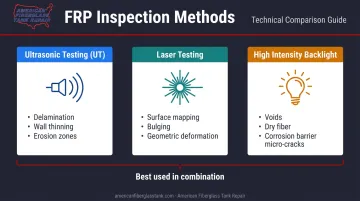
Three methods dominate professional FRP inspection programs. The right choice depends on defect type, tank geometry, access conditions, and inspection goals — and the strongest inspections use all three in combination.
Ultrasonic Testing (UT)
Ultrasonic testing sends a high-frequency sound pulse through the tank wall from the exterior. The echo return time from the inner wall surface directly calculates wall thickness. This single-sided access means the tank doesn't need to be entered or emptied for basic UT scanning.
FRP requires a different approach than steel UT. According to Evident Scientific's NDT guidance, low-frequency transducers — typically 0.5 MHz, 1 MHz, or 2.25 MHz — suit fiberglass because higher frequencies scatter excessively through the inhomogeneous laminate. That scattering creates background noise that an untrained operator can easily misread as a real defect signal, or worse, miss an actual defect against the noise floor.
UT is particularly effective for detecting:
- Delamination and disbonding within the laminate layers
- Corrosion barrier thinning from chemical attack
- Erosion zones from abrasive contents or turbulent flow
- Wall thickness variations across the structural laminate
Laser Testing
Laser-based methods map the outer wall profile of an FRP tank with high geometric precision. By comparing the scan result against original design dimensions, inspectors can identify bulging, surface irregularities, localized wall deformation, and areas where thinning has caused measurable geometric change.
Laser testing is especially practical for large-diameter or complex-geometry tanks where contact methods would be slow and labor-intensive. It functions well as a screening tool: the laser scan identifies areas of geometric concern, and UT then quantifies actual wall thickness at those flagged locations.
This combination, laser for surface mapping and UT for subsurface depth measurement, gives inspectors both a spatial picture of tank deformation and precise laminate thickness data. AFTR's certified inspectors deploy all three methods together to cross-validate findings — a critical step when inspection data will drive repair or retirement decisions.
High Intensity Backlight Testing
High Intensity Backlight (HIB) testing positions a powerful light source on one side of the tank wall while an inspector examines the transmission pattern through the laminate from the opposite side. Where the laminate is properly consolidated, light transmission appears consistent.
Where voids, delaminations, dry fiber areas, or resin-poor zones exist, the light pattern changes. Bright spots or irregular transmission flag the defect location precisely.
HIB testing is best applied to the corrosion barrier and interior liner layers, where early-stage degradation is most consequential. Micro-cracks and resin starvation in the corrosion barrier are the first indicators of chemical penetration toward the structural layer — catching them through HIB before they progress gives facility operators time to plan a targeted repair rather than respond to a failure.
The method requires good access and controlled ambient lighting to be effective, and depending on tank configuration, internal access may be necessary for certain assessments.
How Fiberglass Tank Thickness Testing Works – Step by Step
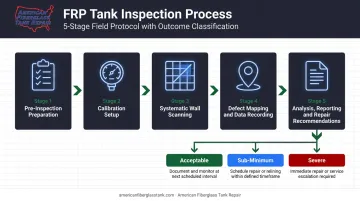
A professional FRP thickness inspection follows a structured sequence. Each step builds on the last — skipping any one of them compromises the reliability of the whole assessment.
Step 1 – Pre-Inspection Preparation
Before any instrument touches the tank, inspectors review:
- Original design specifications (minimum design thickness, laminate schedule, resin type)
- Chemical service history and any previous inspection records
- Safe access conditions — chemical clearance, air quality for confined space entry
A test-point grid is then established covering the full shell, floor, roof, nozzle areas, and seams. Without this documentation, findings from one inspection cycle can't be meaningfully compared to the next — which is one of the most common oversights in FRP inspection programs.
Step 2 – Calibration Setup
Every UT instrument must be calibrated to the specific fiberglass laminate being tested. This means programming the correct speed of sound for the resin/glass combination — ideally using a reference standard of known thickness from the same material type.
A miscalibrated gauge on fiberglass produces systematically wrong readings. On thick structural laminates, that error can flag compliant material as defective, or worse, pass material that is below minimum specification.
Step 3 – Systematic Wall Scanning
Inspectors move across the tank surface in a defined grid, recording thickness at set intervals and flagging any reading below the minimum acceptable value. Using ultrasonic, laser, and HIB methods in combination allows cross-validation of findings. Defects that UT detects ambiguously against laminate background noise can be confirmed by HIB examination of the same area.
Step 4 – Defect Mapping and Data Recording
All readings and anomalies are documented with precise location references: elevation, orientation, distance from nozzles or seams. The output is a thickness map of the entire vessel.
This documentation serves two purposes:
- Provides a defensible record for regulatory compliance
- Establishes a baseline for degradation rate tracking across inspection cycles — which is how service-life projections are calculated
Step 5 – Analysis, Reporting, and Repair Recommendations
Inspection results are compared against minimum design thickness requirements and applicable standards. Findings drive a tiered response:
- Acceptable readings — logged and flagged for baseline comparison at next inspection
- Sub-minimum readings — repair recommendation issued with a priority ranking
- Severe wall loss — immediate remediation or engineering fitness-for-service assessment required
AFTR's inspection reports detail existing surface and structural conditions alongside actionable repair recommendations. With FTPI-certified inspectors supervising interpretation, findings are accurate, documented to industry standards, and directly connected to AFTR's repair and relining capabilities — so clients receive a complete remediation path, not just a list of numbers.
How AFTR Can Help
American Fiberglass Tank Repair (AFTR) has specialized exclusively in FRP tank inspection and repair since 2003. Every service — from corrosion barrier assessment to structural repair and relining — is built around the full lifecycle of fiberglass vessels, not general NDT or steel tank work.
AFTR combines Ultrasonic, Laser, and High Intensity Backlight testing to detect more defect types than any single method alone. Inspections are supervised by Fiberglass Tank & Pipe Institute certified inspectors, and findings connect directly to AFTR's repair capabilities.
When an inspection identifies under-thickness areas, the same organization that found them can reline, repair, or structurally reinforce the vessel.
What sets AFTR's inspection program apart:
- Service coverage across all 50 states, Canada, Puerto Rico, and select international locations
- Scheduling flexibility including shutdowns, night shifts, and weekends
- Strategically positioned field service teams for rapid response deployment
- Detailed inspection reports with surface and structural condition findings and repair recommendations
- FTPI-certified inspector oversight ensuring findings are defensible for regulatory compliance
- Direct connection to repair and relining services — one company from inspection through remediation
These capabilities serve a wide range of industries: chemical plants, water and wastewater treatment facilities, pulp and paper operations, and industrial process facilities — including tanks storing sodium hypochlorite, sodium hydroxide, ferric chloride, hydrochloric acid, and potable water.
Contact AFTR at 877-427-0090 to discuss your tank inspection needs.
Frequently Asked Questions
Frequently Asked Questions
How often should fiberglass tank thickness testing be performed?
Most FRP tanks in hazardous-substance service should be inspected every 5 years — the interval supported by FTPI's recommended practice and codified in regulations such as Pennsylvania's 25 Pa. Code § 245.552. Tanks storing aggressive chemicals may warrant shorter intervals based on service history and observed degradation rate.
What causes fiberglass tank walls to thin over time?
The primary mechanisms are chemical attack on the resin matrix (particularly in the corrosion barrier), erosion from abrasive contents or turbulent flow, UV degradation on the exterior surface, and physical or mechanical damage. None of these typically show visible exterior symptoms until damage is already advanced.
Can fiberglass tank thickness be tested without draining the tank?
Ultrasonic and laser testing are typically performed from the exterior while the tank remains in service, making them minimally disruptive to operations. High Intensity Backlight testing may require internal access depending on tank configuration and the laminate layer under evaluation.
How does ultrasonic testing differ on fiberglass versus steel?
Fiberglass requires lower test frequencies, typically 0.5 to 2.25 MHz, because the inhomogeneous laminate scatters sound more than steel does. Interpreting those signals also requires specific training — background scatter noise can mask real defect signals when the operator lacks experience with composite materials.
What happens if a thickness test reveals areas below minimum specification?
Findings below minimum design thickness trigger a repair or remediation assessment. Depending on severity, the response may range from targeted laminate repair to full interior relining or an engineering fitness-for-service evaluation. Catching thinning early typically allows less invasive, less costly repairs than responding after a structural failure.
What standards govern fiberglass tank thickness and inspection requirements?
The primary standards are:
- ASTM D3299 / D4097 — filament-wound and contact-molded FRP tanks
- ASME RTP-1 — corrosion-resistant reinforced thermoset plastic equipment
- AWWA D-120 — fiberglass tanks for water service
- FTPI RP 2007-1 — in-service inspection procedures
Which standards apply depends on the tank's service type, contents, and jurisdiction.