Wall thickness isn't just a design specification. It's a live indicator of how much service life remains in the tank. When it drops below acceptable limits, the consequences aren't theoretical: a 5,700-gallon FRP tank at Surpass Chemical collapsed during filling, releasing approximately 5,000 gallons of acid — a failure traced to inadequate design and inspection controls.
This article covers what an FRP tank wall is actually made of, what thickness specs govern construction and in-service fitness, what causes walls to thin, how thickness is measured without taking the tank offline, and what to do when readings fall short.
Key Takeaways
- FRP tank walls have two distinct zones: a corrosion barrier (inner liner) and a structural laminate — each with separate minimum thickness requirements
- The corrosion barrier is typically 2.5 to 6.3 mm (100 to 250 mils) thick and is the layer most vulnerable to chemical attack
- Chemical degradation, hydrolysis, osmotic blistering, and thermal cycling are the primary causes of wall thinning — damage that rarely shows on the exterior
- Ultrasonic thickness testing (UTT) measures wall thickness from the exterior while the tank stays in service
- When readings fall below design minimums, act: continued operation without professional inspection and repair puts the vessel — and the operation — at risk
The Anatomy of an FRP Tank Wall
Unlike steel or polyethylene tanks, which have essentially uniform wall profiles, a fiberglass tank wall is a composite laminate. Each layer serves a different function, and thickness measurements only make sense when you know which layer you're reading.
The Corrosion Barrier (Inner Liner)
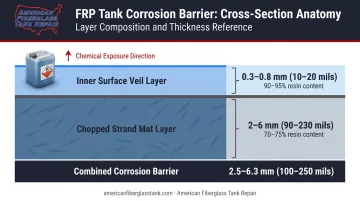
The corrosion barrier is the innermost zone — the only layer in direct contact with the stored chemical. It typically consists of two sub-layers:
- Inner surface veil layer: Approximately 0.3 to 0.8 mm (10 to 20 mils) thick, roughly 90–95% resin reinforced by one or two synthetic surfacing veils
- Chopped strand mat layer: Approximately 2 to 6 mm (90 to 230 mils) thick at around 70–75% resin content
Together, these bring the total corrosion barrier to 2.5 to 6.3 mm (100 to 250 mils), the range cited in Derakane and Hetron resin fabrication guidance for corrosion-resistant FRP construction.
Veil selection affects both chemical resistance and final thickness. Standard polyester veils suit most service environments, but hydrofluoric acid, certain alkaline services, and other highly aggressive chemistries require synthetic or carbon veils. Each veil ply contributes roughly 0.3 mm to final thickness, so veil choice directly influences the measurable wall dimension.
This is a detail repair teams must account for when specifying replacement laminates — particularly when matching the original laminate schedule matters for structural and chemical compatibility.
The Structural Laminate
The structural laminate is the outer zone. It carries hydrostatic load, resists pressure and vacuum, and provides the mechanical stiffness that keeps the tank in shape under service conditions. For cylindrical tanks, it is commonly filament wound at manufacturer-specified angles with unidirectional reinforcement, interspersed with chopped strand glass layers.
A key limitation for inspectors: the transition between the structural laminate and the corrosion barrier is generally not reliably detectable by standard ultrasonic thickness testing. UTT returns a total wall reading. Determining which portion of that reading represents a healthy corrosion barrier requires additional methods, which is why layer-specific interpretation depends on certified inspection expertise.
Wall Thickness Standards and What They Actually Require
Several standards govern FRP tank construction. The key documents:
| Standard | Scope | Status |
|---|---|---|
| ASTM C582-23 | Contact-molded RTP laminates for corrosion-resistant equipment | Active (updated April 2023) |
| ASME RTP-1-2025 | Stationary reinforced thermoset plastic vessels up to 15 psig | Current edition |
| NBS PS 15-69 | Voluntary product standard for FRP tanks and pipe | Foundational; adopted by reference in some specs |
| AWWA D120-19 | Thermosetting FRP tanks for water supply | Reaffirmed 2025 |
ASTM C582 and ASME RTP-1 publish their clause-level minimums as controlled standard text, which requires purchase to cite precisely. Without that purchase, 100 mils (2.5 mm) is a widely cited corrosion barrier benchmark, supported by Derakane/Hetron resin guidance and by NBS PS 15-69's interior layer construction values. Some services require more: the Derakane chemical resistance guide specifies a 200 mil (5 mm) corrosion barrier for certain hydrochloric acid services with dissolved organics.
Construction Method Affects Thickness
- Filament winding generally produces more consistent, verifiable thickness than hand lay-up, with more predictable structural laminate geometry
- Hand lay-up (contact-molded) construction has higher variability, which makes inspection and baseline documentation more important
Design Thickness vs. In-Service Minimum
A tank may be originally designed with a 5 mm corrosion barrier but have an acceptable in-service minimum of 2.5 mm. Operating below that minimum threshold — not below the original design thickness — is the actual trigger for corrective action.
Total structural wall thickness varies considerably. The key design parameters:
- Tank diameter — larger diameters require thicker walls to resist hoop stress
- Tank height — taller tanks face higher hydrostatic pressure at the lower sidewall
- Design pressure — pressurized vessels require additional structural laminate
- Applicable standard — AWWA, ASME, and ASTM each carry different requirements
There is no reliable single thickness number for a "typical" 10,000-gallon FRP tank without knowing all four parameters.
What Causes FRP Tank Walls to Thin
Wall thinning in FRP tanks is rarely sudden and rarely visible. It progresses through several overlapping mechanisms:
Chemical attack is the primary cause. Aggressive acids, bases, and oxidizers degrade the resin matrix from the inside out, softening or dissolving the inner liner. The damage often remains invisible externally until ultrasonic thickness testing (UTT) reveals how far degradation has progressed.
Peer-reviewed research on glass fiber reinforced polymer durability shows that alkaline solutions can cause more severe property loss than acidic environments at elevated temperatures. That's a counter-intuitive finding for operators who assume acid service is always the higher-risk scenario.
Hydrolysis and osmotic blistering work differently. Water and certain chemicals permeate the resin matrix, break down the glass-resin bond, and create localized delamination. The resulting blisters physically separate layers, reducing effective barrier thickness even when the surface looks intact.
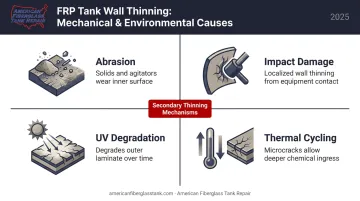
Mechanical and environmental factors contribute incrementally:
- Abrasion from solids or agitators wears the inner surface
- Impact damage from equipment thins the wall locally
- UV degradation on exterior surfaces degrades the outer laminate
- Thermal cycling — repeated heating and cooling — opens microcracks that allow chemical ingress deeper into the wall
Don't wait for visible damage before testing. By the time discoloration, fiber exposure, or blistering appears, serious liner degradation has usually already occurred.
How FRP Tank Wall Thickness Is Measured
Measuring FRP wall thickness requires a different approach than measuring steel. FRP is a multilayer, anisotropic composite — internal laminate interfaces can create false reflections, and an untrained operator interpreting a single UTT reading may be measuring the wrong interface entirely.
Ultrasonic Thickness Testing (UTT)
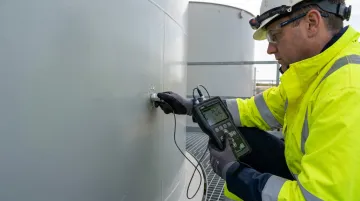
UTT is the standard non-destructive method for measuring FRP wall thickness from the exterior while the tank remains in service — no confined space entry, no draining required. The instrument transmits a sound wave through the wall and calculates thickness from return time.
Two calibration requirements are essential:
- Velocity setting must match the specific resin system being tested. Using an incorrect velocity produces inaccurate readings across the entire measurement campaign.
- Probe frequency selection matters: Evident Scientific's application guidance recommends a 2.25 MHz transducer for most fiberglass sections in the 1.25–12.5 mm range, with lower-frequency probes for thicker sections.
UTT is best used for total wall trending and screening. It does not automatically confirm corrosion barrier health — as UTComp's FRP assessment guidance notes, standard UTT may read total wall thickness rather than barrier condition, which is why additional methods are needed when the liner is the suspected failure point.
High Intensity Backlight Testing
High intensity backlight testing uses a powerful light source positioned against the exterior tank wall in a darkened environment. The inspector observes light transmission through the laminate to detect delamination, voids, fiber separation, and thin spots. It's particularly effective for identifying gross structural anomalies — including subsurface defects that UTT may not characterize fully.
AFTR's certified inspection teams use this method as part of a combined assessment approach alongside UTT and visual inspection.
Barcol Hardness Testing
Beyond geometry-based methods, assessing liner condition also requires evaluating chemical state. Barcol hardness doesn't measure thickness — it measures surface cure and chemical condition of the inner liner.
Expected ranges by resin system (per Derakane fabrication guidance):
- Derakane 411/441: ~30
- Derakane 470: ~40
- Derakane 510: ~35
- Derakane 8084: ~25
A reading significantly below the nominal range for the resin indicates chemical softening or degradation — often before measurable thinning occurs. An unusually high reading can indicate brittleness and cracking risk. Either extreme warrants engineering review.
When Internal Inspection Is Required
External NDT methods provide valuable screening data, but they can't replace a complete internal inspection for fully characterizing liner condition. Visual assessment of cracks, blistering, resin degradation, fiber exposure, and floor stress cracking requires tank entry.
Per FTPI RP 2007-1, most FRP tanks in chemical service follow 5-year internal inspection cycles for hazardous-substance service and 10-year cycles for nonhazardous service over 10,000 gallons. AFTR's FTPI-certified inspectors supervise these entries and combine multiple testing methods to deliver a complete condition assessment.
Warning Signs and What to Do Next
Warning Signs Your FRP Tank Wall Thickness Is Compromised
Don't wait for a confirmed reading before taking action. These observations warrant immediate thickness testing:
- Visible blistering, crazing, or surface softening on the inner wall
- Discoloration, resin degradation, or exposed glass fibers at the tank interior
- New leaks or seepage, especially near fittings or seams
- Audible crackling under load or during filling
- Out-of-round deformation of the tank body
- Unexplained changes in weight, pressure retention, or external surface condition on in-service tanks
Any of these signs warrants external UTT as a minimum first step — not visual monitoring and a note in the maintenance log.
What to Do When Thickness Falls Below Acceptable Limits
Two paths forward: repair or replacement.
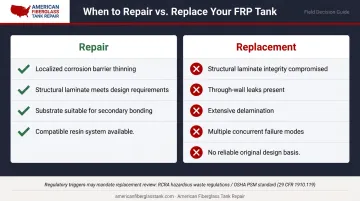
Repair is the right choice when:
- Thinning is localized to the corrosion barrier
- The structural laminate still meets design requirements
- The substrate can be prepared for secondary bonding
- The new resin system is chemically compatible with the stored product
A qualified reline using compatible resin and laminate systems can restore the corrosion barrier and extend service life significantly at a fraction of replacement cost. AFTR's field teams execute these relines using custom-blended isophthalic polyester, terephthalic polyester, vinylester, or epoxy systems selected to match the stored chemical.
When damage runs deeper than the corrosion barrier alone, repair may not be enough.
Replacement becomes the appropriate recommendation when:
- Structural laminate integrity is compromised
- Through-wall leaks are present
- Delamination is extensive
- Multiple concurrent failure modes exist
- The tank has no reliable original design basis
Regulatory obligations clarify the decision. Under 40 CFR 264.196, RCRA hazardous-waste tank systems found leaking or unfit for use must be removed from service immediately. Under 29 CFR 1910.119(j), OSHA PSM-covered process equipment deficiencies must be corrected before further use. Delaying after below-minimum readings are confirmed creates chemical release risk, regulatory liability, and emergency downtime, all of which consistently cost more than a planned repair.
AFTR's field teams operate across all 50 states with 24/7 emergency response and pre-positioned Service-Pack equipment containers — so when a confirmed reading requires action, response time is measured in hours, not weeks.
Frequently Asked Questions
How thick is a GRP tank lining?
A GRP (glass reinforced plastic) tank lining — the corrosion barrier — is typically 2.5 to 6.3 mm (100 to 250 mils) thick in total. It consists of a resin-rich inner veil layer and a chopped strand mat layer. Exact thickness depends on the chemical service, design standard, and original fabrication specification.
What is the minimum acceptable wall thickness for a fiberglass tank?
The widely cited benchmark for minimum in-service corrosion barrier thickness is 2.5 mm (100 mils) for most chemical service applications, referenced in Derakane/Hetron resin guidance and aligned with NBS PS 15-69 construction values. ASTM C582-23 and ASME RTP-1-2025 define current standard requirements. Some chemical services require a thicker barrier at the design stage.
Can fiberglass tank wall thickness be measured without emptying the tank?
Yes. Ultrasonic thickness testing (UTT) and high intensity backlight testing both measure wall condition from the exterior with no confined space entry required. However, a complete internal inspection to assess liner condition — including cracks, blisters, and fiber exposure — still requires draining and entering the tank.
How often should fiberglass tank wall thickness be tested?
FTPI RP 2007-1 recommends internal inspections every 5 years for hazardous-substance service and every 10 years for nonhazardous tanks over 10,000 gallons. External UTT can and should be conducted more frequently — particularly for highly aggressive chemical service or when early warning signs appear.
What causes fiberglass tank walls to thin over time?
Chemical attack on the resin liner is the most common and consequential cause, followed by hydrolysis and osmotic blistering, mechanical abrasion from solids or agitators, and UV or thermal degradation. Thinning from chemical attack often progresses without visible external indicators until the tank has already lost significant barrier thickness.
What happens if a fiberglass tank wall becomes too thin?
A corrosion barrier below minimum thickness allows chemical penetration into the structural laminate, leading to delamination, structural failure, and potential catastrophic release of stored contents. For regulated chemical service, this also triggers immediate regulatory obligations under RCRA and OSHA PSM rules. Prompt inspection followed by repair or replacement is required.