Introduction
An FRP mixing tank is a vessel constructed from fiberglass reinforced plastic designed to blend, dissolve, or react liquid materials in industrial settings. Choosing the wrong one carries real consequences — consequences that often don't surface until significant damage is already done.
For facility engineers, plant managers, and procurement teams at chemical plants, water treatment facilities, and food processing operations, the stakes are real. Select the wrong resin system and the corrosion barrier begins degrading within months. Miss a developing lining failure and the first sign of trouble might be product contamination or an unplanned shutdown.
That risk is one reason demand keeps climbing. FRP vessels represent a growing market projected to reach $1.6 billion by 2027, driven largely by industries that need corrosion resistance that metal simply can't match over the long term. This article covers what makes FRP mixing tanks work, how they're built, and what separates a tank that performs for decades from one that fails ahead of schedule.
Key Takeaways
- FRP mixing tanks combine a corrosion-resistant composite vessel with mechanical agitation to blend, dissolve, or react liquid chemicals
- They outperform metal tanks in corrosive service — no rust, no metallic contamination, no coating failure
- Resin selection is the most critical decision: polyester, vinyl ester, and epoxy serve different chemical environments
- Performance hinges on agitator design, tank geometry, and the integrity of the internal corrosion barrier
- Internal lining degradation is the primary failure mode — and it won't show on the exterior until serious damage has occurred
What Is an FRP Mixing Tank?
FRP — Fiber Reinforced Plastic — is a composite material combining a polymer resin matrix with glass fiber reinforcement. The result is a lightweight, structurally strong material that resists a wide range of chemicals without reacting. The terms FRP and GRP (Glass Reinforced Plastic) refer to the same material class; ACMA recognizes both, along with GFRP and RP, as accepted industry terminology.
Mixing Tank vs. Storage Tank
A storage tank holds liquid passively. A mixing tank actively works it — an agitator, impeller, or stirrer continuously moves the contents to blend, dissolve suspended solids, or drive a chemical reaction. That distinction matters structurally.
Constant agitation creates mechanical stress on the tank wall, nozzle penetrations, and the corrosion barrier lining that static storage never generates. The tank is never at rest.
That means any weakness in construction (inadequate lining thickness, poorly laminated penetrations, undersized agitator support) surfaces faster under mixing service than under storage conditions.
FRP vs. Metal Mixing Tanks
Those structural demands make material selection critical. FRP and metal tanks behave very differently under corrosive mixing service:
- No substrate corrosion risk — FRP is non-reactive at the structural level when the correct resin system is specified; there's no underlying metal waiting to corrode if the liner is compromised
- Significantly lighter — FRP laminates have a density of 85–125 lb/ft³ versus 490 lb/ft³ for AISI A36 carbon steel (roughly one-quarter the weight for equivalent volume), per ACMA data
- No reliance on coatings — steel and stainless steel tanks in corrosive service depend on applied coatings or liners that can fail; FRP tanks resist chemicals at the laminate level
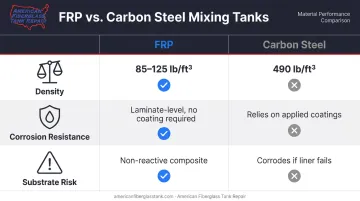
That weight difference has real consequences when specifying large-capacity mixing tanks, particularly for elevated or skid-mounted installations.
Why FRP Mixing Tanks Are Used in Industrial Applications
The primary driver is chemistry. Many industrial mixing processes involve acids, caustic solutions, oxidizers, and bleach solutions that steadily degrade steel or stainless steel walls. FRP eliminates that corrosion failure mode entirely, provided the right resin is matched to the process fluid.
Weight and Installation Advantages
Large-capacity FRP mixing tanks are substantially easier to transport and install than equivalent steel vessels. At roughly one-quarter the density of carbon steel, a 10,000-gallon FRP tank can often be positioned without the crane infrastructure required for a steel equivalent. Structural support requirements are also reduced.
Lifecycle Cost
Upfront cost for FRP mixing tanks is often comparable to carbon steel alternatives and competitive with stainless in many configurations. The long-term value comes from what you don't spend: no painting, no corrosion treatment, no ongoing coating program.
An ACMA/INEOS wastewater case study documents an FRP installation still in service after 25 years with no maintenance required — a service record that would be difficult to match with an unlined carbon steel vessel in comparable chemical service.
Regulatory and Contamination Considerations
Water treatment and food processing operations face specific constraints that favor FRP:
- AWWA D120 covers thermosetting FRP tanks for water supply; NSF/ANSI/CAN 61 evaluates contaminants imparted to drinking water from system components
- FDA 21 CFR 177.2420 permits cross-linked polyester resins for repeated food contact use, subject to composition limits
- FRP is widely accepted for sodium hypochlorite storage and dosing in water treatment — a service environment that attacks most metals
The smooth, non-porous interior surface of a properly maintained FRP vessel also reduces bacterial adhesion and simplifies cleaning, which matters in food, pharmaceutical, and potable water applications.
How an FRP Mixing Tank Works
An FRP mixing tank functions by enclosing the process liquid in a chemically resistant composite vessel while a mechanical agitation system continuously moves the contents. The tank body protects the process; the agitator drives the mixing outcome.
Structural Construction
A properly engineered FRP mixing tank wall is built in distinct layers:
- Corrosion barrier (innermost): A resin-rich layer, typically 100–250 mils (2.5–6.3 mm) thick per Ashland's Derakane design guidance, using chopped strand mat and a surface veil — such as Nexus or carbon veil — for chemical resistance
- Structural laminate: Woven roving and chopped strand mat layers behind the corrosion barrier provide mechanical strength and wall integrity
- Exterior: May include a UV-resistant finish layer for aboveground installations
The corrosion barrier is the most critical layer in mixing service — it sits in constant direct contact with the process fluid. Any compromise — blistering, erosion, delamination — directly exposes the structural laminate to chemical attack.
Resin system selection determines the tank's chemical compatibility ceiling:
| Resin Type | Typical Service |
|---|---|
| Isophthalic/terephthalic polyester | Moderate chemical service, dilute acids, water |
| Vinyl ester (epoxy vinyl ester) | Oxidizing chemicals, concentrated acids, bleach solutions |
| Brominated epoxy vinyl ester | Sodium hypochlorite service |
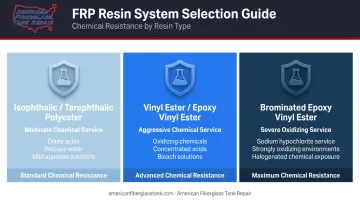
For sodium hypochlorite specifically, WEFTEC research recommends brominated epoxy vinyl ester with a BPO/DMA/TBPB cure system. When American Fiberglass Tank Repair evaluates a mixing tank for relining, resin selection is driven by the stored chemical, its concentration, and operating temperature — not a generic specification.
The Mixing Mechanism
Wall construction sets the chemical boundary; the agitator determines whether mixing actually happens. Agitator type is specified based on the mixing objective and fluid properties:
- Turbine impellers: Efficient for low-viscosity blending and chemical reaction
- Paddle and anchor impellers: Better suited for high-viscosity fluids where turbine-driven motion dies out before reaching the full tank volume — as documented by AIChE's analysis of difficult mixing problems
- Baffles: Interior baffles are available on FRP mixing tanks (Diamond Fiberglass confirms this) to improve flow patterns and mixing uniformity
Every penetration through the FRP wall — agitator shaft, nozzles, baffle mounts — must be engineered precisely to maintain a continuous corrosion barrier. A single poorly sealed nozzle penetration can allow process chemicals to reach the structural laminate, turning a localized installation flaw into a full relining event years later.
Key Factors That Affect FRP Mixing Tank Performance
Chemical Compatibility
The resin system must be matched to the specific process fluid — its pH, concentration, oxidizing potential, and operating temperature. Even modest deviations from the original design conditions can accelerate lining degradation. A tank designed for dilute caustic service at ambient temperature will not perform the same way if process concentration or temperature increases.
For sodium hypochlorite, Ashland's Derakane chemical resistance data specifies:
- 2% NaOCl (pH > 11): service limits of 120–150°F depending on resin
- 10% NaOCl: selected resins rated to 150°F
- 18–25% NaOCl: only Derakane 510A rated, maximum 100°F
These grades are not interchangeable. Applying a resin system specified for 2% service to a 15% application is a specification error that leads to premature corrosion barrier failure — often well before the tank's design life.
Operating Temperature
AWWA D120 limits FRP tank service to 180°F for aboveground tanks and 150°F for underground tanks. For chemical immersion service, the effective limits are often lower and resin-specific. Elevated temperatures reduce both chemical resistance and mechanical properties of the resin system.
Agitator Mechanical Loading and Penetrations
Excessive agitator speed or an improperly sized impeller creates turbulence that can erode the corrosion barrier over time. The agitator shaft penetration point is a known stress concentration. Common failure modes at this location include:
- Process fluid migrating behind the lining when fittings lack a continuous corrosion barrier
- Hidden delamination developing before visible surface damage appears
- Accelerated erosion at the corrosion coat directly below the impeller sweep zone
Proper repair at these penetrations requires new assemblies laminated integrally with the tank shell and interior corrosion lining — the same approach used in original tank manufacturing — to prevent weeping of stored product between laminate layers.
Inspection History
Wall laminate quality and inspection history directly predict service life. Tanks with voids, inadequate corrosion barrier thickness, or undetected early degradation fail before their design life. Methods used to assess in-service tanks include:
- Ultrasonic thickness measurement: Detects wall erosion and delamination from one-side access; Evident/Olympus confirms a measurement range of 0.05–3 inches for fiberglass tanks
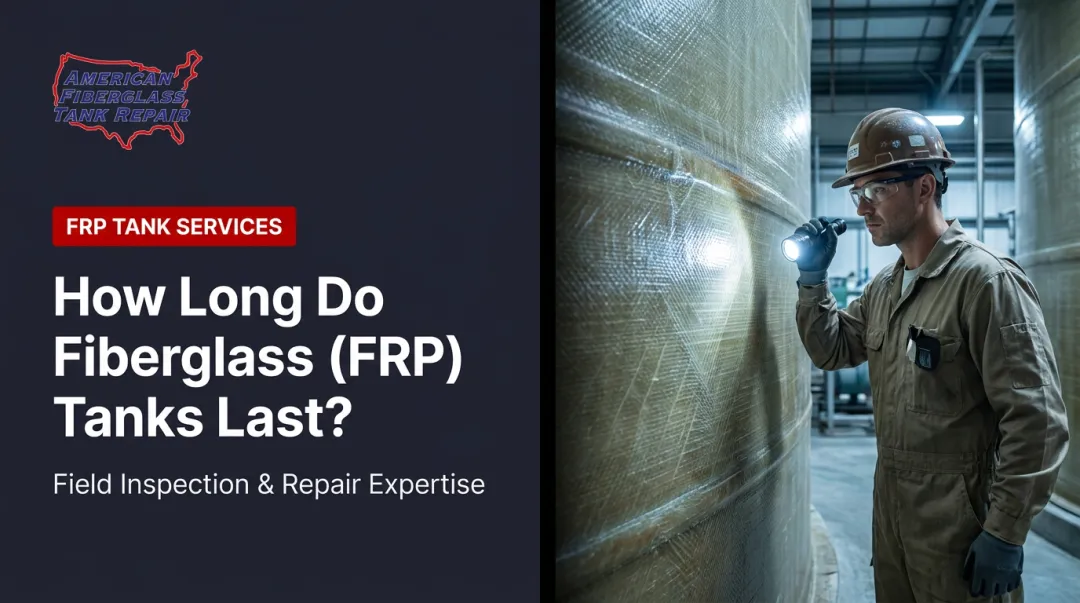
- High-intensity backlight: Reveals capillary migration of process fluid beneath the corrosion coat and other subsurface conditions invisible to standard visual inspection
- Barcol hardness: Quantifies resin cure state and flags surface degradation caused by chemical attack
- Visual inspection: Identifies spidering, disbondment, blistering, discoloration, and floor stress cracking during interior examination
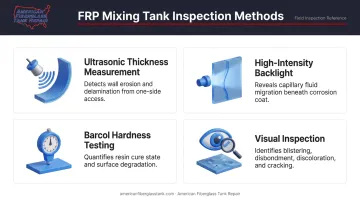
AFTR's inspection programs combine all four methods, supervised by Fiberglass Tank & Pipe Institute certified inspectors, and conclude with detailed findings and prioritized repair recommendations.
Common Issues and Misconceptions
"FRP" Is Not a Single Material
The most consequential misconception in FRP mixing tank procurement is treating "FRP" as a uniform specification. It isn't. A polyester-resin tank and a vinyl ester-resin tank are FRP — but they have completely different chemical compatibility profiles. Exposing a polyester tank to service conditions that require vinyl ester construction can result in rapid lining failure.
Internal Degradation Is Often Invisible Externally
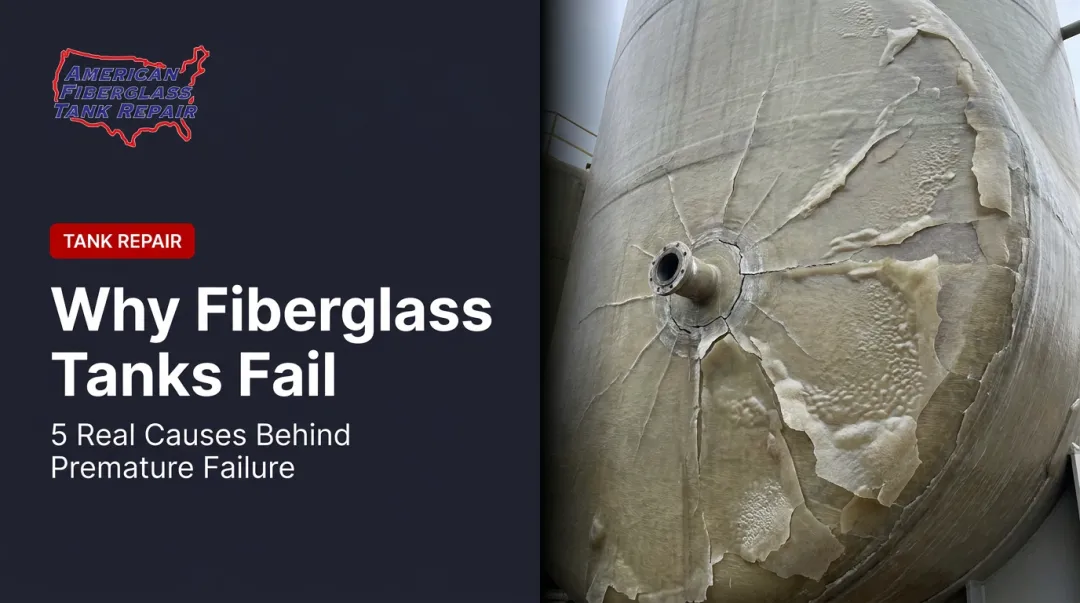
Many operators assume that an intact exterior means a healthy interior. In FRP mixing tanks, the failure mode that matters most: corrosion barrier degradation, develops on the inside. Blistering, delamination, and resin erosion progress inward before any external indicator appears.
A 2018 inspection of a 37,000-gallon FRP caustic tank at a City of Denton water production plant found deep cracks in the chopped mat layers of the corrosion barrier and blister-like mounds on the interior surface. Identifying those conditions required professional assessment; nothing on the exterior indicated a problem.
That case is not unusual. By the time external signs appear, the structural laminate may already be compromised. AFTR's field experience confirms that even moderate chemical exposure eventually degrades the interior corrosion barrier — and a tank passing a hydrostatic test today does not guarantee the same result three months from now.
When FRP Is Not the Right Answer
FRP mixing tanks are designed for ambient-to-moderate temperature, low-to-moderate pressure service. They are not appropriate for:
- High-temperature reactions exceeding AWWA D120 service limits (180°F aboveground)
- High-pressure autoclaves or pressurized reactors
- Concentrated halogenated solvents beyond resin compatibility limits
Using FRP outside its design envelope, when a lined metal vessel or specialty alloy is the correct specification, is an engineering error. It isn't a cost-saving measure.
Frequently Asked Questions
What is the purpose of an FRP mixing tank?
An FRP mixing tank blends, dissolves, or chemically reacts liquid materials in industrial processes. The fiberglass reinforced plastic construction resists corrosion from acids, caustics, oxidizers, and other aggressive chemicals that would degrade metal vessels — making it the preferred choice for corrosive mixing service.
What does FRP stand for in tanks?
FRP stands for Fiber Reinforced Plastic, also called GRP (Glass Reinforced Plastic). It's a composite material made of a polymer resin matrix reinforced with glass fibers, combining the chemical resistance of the resin with the tensile strength of the glass fiber reinforcement.
Are FRP mixing tanks compatible with sodium hypochlorite?
Compatibility depends on the resin system, concentration, and temperature. Brominated epoxy vinyl ester resins are specifically recommended for sodium hypochlorite service; standard polyester resins are not adequate for oxidizing bleach environments.
How long do FRP mixing tanks last?
With correct resin selection, proper installation, and periodic inspection, FRP mixing tanks typically remain in service for 20–30 years or more. In aggressive chemical service — such as sodium hypochlorite — a realistic service life runs 10–20 years depending on construction quality and maintenance history. Chemical incompatibility and undetected lining degradation are the most common causes of premature failure.
What resin system should be used for a chemical mixing tank?
The resin — isophthalic polyester, vinyl ester, or epoxy vinyl ester — must be matched to the specific chemical, its concentration, temperature, and oxidizing character. Vinyl ester is the most commonly specified resin for aggressive chemical service; brominated epoxy vinyl ester is required for strongly oxidizing environments.
How do you know when an FRP mixing tank needs repair?
Warning signs include interior blistering, discoloration, resin erosion, or unexplained product contamination. Instrument-based inspection methods — ultrasonic thickness measurement and high-intensity backlight — can detect capillary migration of process fluid beneath the corrosion coat before surface symptoms appear. Regular internal inspections by Fiberglass Tank & Pipe Institute certified inspectors — such as those on the American Fiberglass Tank Repair team — catch corrosion barrier degradation before it reaches the structural wall.
Conclusion
FRP mixing tanks are durable, cost-effective industrial vessels: durable when the resin system is correctly matched to the chemical service, the agitation system is properly engineered, and the internal lining is maintained in serviceable condition.
The critical variable is specificity. Specifying "FRP" without defining the resin system, corrosion barrier thickness, and veil construction is like specifying "steel" without defining alloy grade. Facilities that treat FRP as a generic material category are the ones that end up with premature failures.
Proactive inspection changes that outcome. Identifying lining degradation early — through ultrasonic testing, Barcol hardness, and high-intensity backlight assessment — turns a potential tank replacement into a planned relining job.
American Fiberglass Tank Repair's inspection and relining services cover exactly that scope: evaluating in-service FRP mixing tanks, identifying what's happening beneath the surface, and restoring the corrosion barrier before structural damage occurs. With Fiberglass Tank & Pipe Institute certified inspectors and over two decades of field experience, AFTR helps facilities protect their capital investment and avoid the unplanned shutdowns that undetected liner failure causes.