Introduction
When a sprinkler system activates or a fire crew needs pressure, there's no room for a tank that leaks, corrodes, or delivers contaminated water. The stored supply must be clean, accessible, and delivered without interruption. The material that tank is built from carries real consequences.
Fiber Reinforced Plastic (FRP) is now widely specified for fire water storage across industrial, commercial, and municipal applications. Its corrosion resistance, structural durability, and low maintenance profile suit the demanding reality of fire suppression service: tanks that sit full for years, rarely tested, and must perform flawlessly when called upon.
What follows covers what makes FRP the right material for fire water storage, how it stacks up against steel and concrete, the compliance standards that govern these systems, and why even the most durable tanks require scheduled inspection to stay fit for service.
Key Takeaways
- FRP tanks resist corrosion and structural degradation, keeping stored fire water uncontaminated and the tank intact across decades of standby service
- FRP construction follows AWWA D120-19 and ASTM D3299/D4097; fire water systems must meet NFPA 22, with NFPA 25 defining inspection intervals
- Steel and concrete remain viable alternatives, but each carries trade-offs in maintenance burden, environmental performance, and installation complexity
- Even well-built FRP tanks develop lining wear, laminate fatigue, and fitting degradation; only professional inspection catches these before they become failures
What Makes FRP Ideal for Fire Water Storage
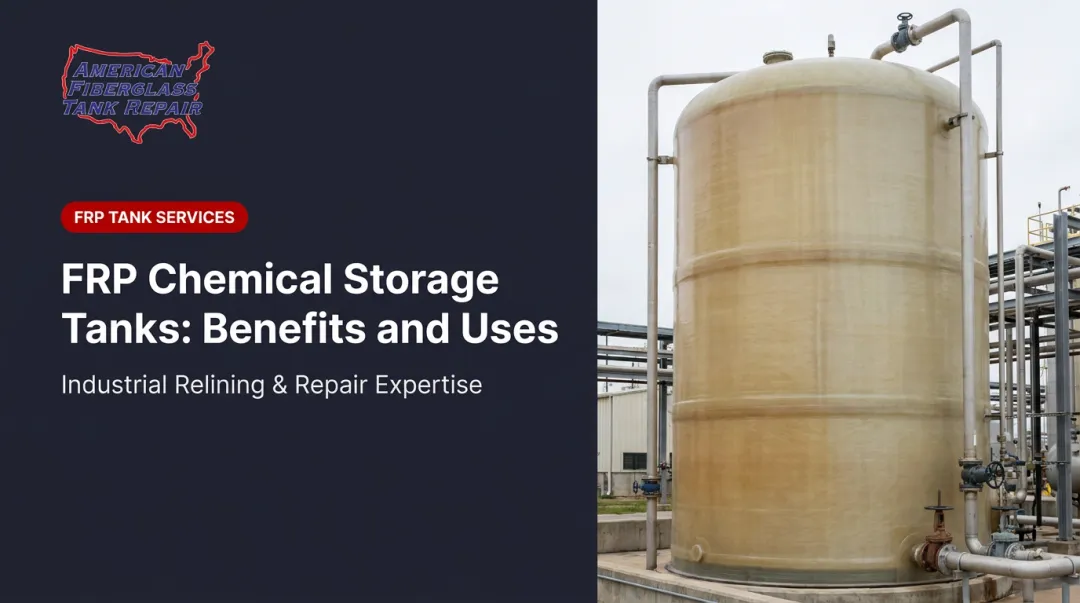
FRP is a composite material: glass fiber reinforcement embedded in a polymer resin matrix. That combination produces a vessel that is lightweight, structurally strong, and chemically inert — properties that matter more in fire water storage than in almost any other tank application.
Corrosion Resistance Without Coatings
Unlike steel, FRP does not rust or oxidize when in continuous contact with water or moisture. According to the Fiberglass Tank & Pipe Institute (FTPI), fiberglass tanks resist common corrosion modes including galvanic, aerobic, pitting, and intergranular corrosion — and this resistance is inherent to the material, not dependent on a coating system that can degrade over time.
For fire water storage, this means:
- No rust contamination in stored water
- No coating maintenance cycles or reapplication schedules
- Structural integrity maintained even in high-humidity, coastal, or chemically aggressive environments
Resin Selection for Specific Environments
Not all FRP tanks are built the same. The resin system — polyester, vinylester, or epoxy — determines chemical compatibility and temperature performance.
Under ASTM D3299-18, filament-wound FRP tanks are specified using commercial-grade polyester or vinylester resin. The FTPI identifies epoxy and polyester as the primary thermosetting resin systems used in fiberglass tank construction.
AWWA D120-19, the governing standard for thermosetting FRP water tanks, sets maximum service temperatures for fire water storage applications:
| Tank Type | Max Service Temperature |
|---|---|
| Aboveground | 180°F (82°C) |
| Underground | 150°F (66°C) |
Both thresholds fall well within the range of most fire water storage environments.
Matching resin to environment is where material expertise matters. AFTR works with custom-blended isophthalic and terephthalic polyester, vinylester, and epoxy resins, paired with over 45 laminate types, to align resin systems with specific service conditions when relining or restoring fire water tanks.
Smooth Interior Surface
FTPI documentation describes surface veils as resin-rich smooth surfaces used in FRP construction. This smooth interior limits the accumulation of sediment and deposits — a practical advantage in tanks held on standby for extended periods between fire events.
FRP vs. Steel vs. Concrete: A Practical Comparison
Choosing between FRP, steel, and concrete for fire water storage comes down to installation environment, expected service life, and how much ongoing maintenance your operation can realistically support.
Steel
Steel tanks — including epoxy-coated and glass-fused-to-steel variants — offer high structural strength and are common in large-capacity fire water installations. The trade-off is corrosion management. An AMPP case study on steel water tank coatings found that once rust forms on a steel surface, it expands over time and can cause progressive coating system breakdown. In coastal, humid, or chemically aggressive environments, that cycle accelerates, increasing both inspection frequency and relining costs.
Concrete
Concrete tanks provide thermal stability and proven longevity, but carry significant installation costs and longer construction timelines. Stress cracking is a known risk as concrete ages. FRP tanks can be assembled on-site with less heavy equipment, making them better suited for retrofit projects or sites with limited access.
Side-by-Side Reference
| Factor | FRP | Steel | Concrete |
|---|---|---|---|
| Corrosion resistance | Inherent — no coatings required | Requires protective coatings | Generally resistant, but prone to stress cracking |
| Maintenance requirements | Low | Moderate to high (coating cycles) | Low once installed |
| Installation complexity | Moderate — modular, less heavy equipment | Moderate to high | High — long timelines, heavy equipment |
| Harsh environment suitability | Strong | Varies by coating quality | Moderate |
| Retrofit/remote site use | Well-suited | Less practical | Limited |
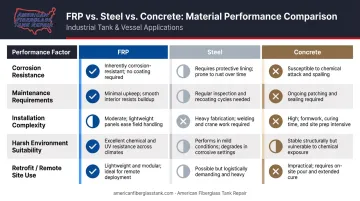
This comparison is qualitative. Site-specific factors — soil conditions, proximity to saltwater, available maintenance resources — will shift the calculus in any given project. When FRP is already in service, the more relevant question is often whether the existing tank's corrosion liner is still performing, which an inspection can answer directly.
Safety Standards and Compliance
Fire water tanks carry their own regulatory framework — separate from general storage tank standards — and understanding that framework is essential before specifying FRP.
NFPA 22 and NFPA 25
NFPA 22 (Standard for Water Tanks for Private Fire Protection) governs the design, construction, installation, and maintenance of fire protection water tanks and accessory equipment. NFPA's own documentation confirms that covered tank materials include steel, concrete, and fiberglass-reinforced plastic.
Inspection, testing, and maintenance intervals are governed by NFPA 25, not NFPA 22. Intervals from the 2014 edition are listed below — verify against your jurisdiction's adopted edition:
- Exterior inspection: Quarterly
- Interior inspection (tanks without corrosion protection): Every 3 years
- Interior inspection (all other tanks): Every 5 years
NFPA 25 also requires that inspection and maintenance be performed in accordance with the manufacturer's instructions alongside the standard itself.
Material and Construction Requirements
For FRP specifically, compliance extends beyond material selection. Laminate construction, wall thickness, resin quality, and fitting specifications all require documentation, and tanks must be fabricated by certified manufacturers.
The governing construction standard is AWWA D120-19. ASTM D3299 applies to filament-wound tanks; ASTM D4097 covers contact-molded construction.
Inspector Credentials
For ongoing compliance verification, inspector credentials matter. The Fiberglass Reinforced Plastic Institute (FRPI) administers the SP8310 inspector credentialing program, a structured qualification framework covering tank inspection procedures.
AFTR's compliance support includes:
- Inspections supervised by Fiberglass Tank & Pipe Institute certified inspectors
- Compliance documentation maintained throughout a tank's service life
- AWWA membership, supporting alignment with water industry standards for waterworks and treatment facility applications
Inspection and Maintenance: Protecting Your Investment
FRP is durable, but it isn't maintenance-free. Fire water tanks are kept full and on standby — sometimes for years — which means internal degradation can develop silently and go undetected without a formal inspection program.
What Fails and Why
Common failure modes in FRP fire water tanks include:
- Internal lining delamination — particularly in older tanks or those with original laminate deficiencies
- Laminate microcracking — often invisible at the surface but detectable with advanced testing
- Capillary migration — liquid product permeating beneath the corrosion coat before surface damage appears
- Fitting and nozzle degradation — corrosion at metal-to-FRP interfaces
- Sediment and surface deposit accumulation — in tanks without adequate circulation
AFTR's field inspectors also look for spidering, disbondment, abrasion wear, emulsification, low Barcol hardness readings, floor stress cracking, shell distortion, and UV degradation on exterior surfaces. As AFTR notes in their inspection documentation: containment breaches can occur before any noticeable signs of trouble emerge — making visual-only assessments insufficient on their own.
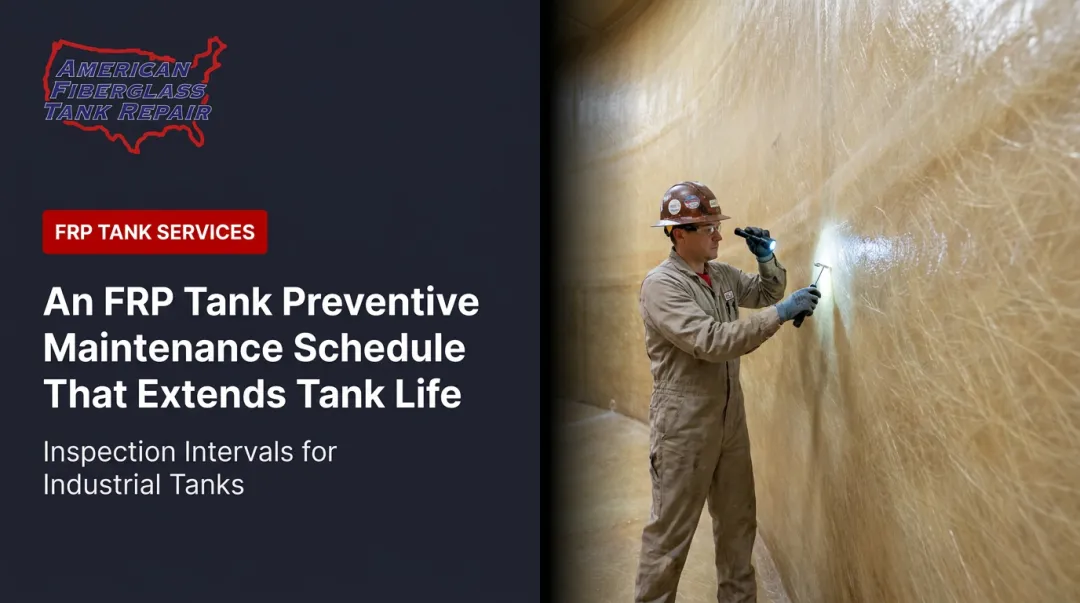
How FRP Fire Water Tanks Are Inspected
AFTR deploys three primary testing methods:
- Ultrasonic thickness testing — sends high-frequency sound waves through the laminate to identify voids, delaminations, and wall thinning without cutting into the tank
- High-intensity backlighting — illuminates internal surfaces to reveal micro-fractures and disbondment
- Laser testing — detects subsurface conditions within the structural body, including capillary migration under the corrosion coat
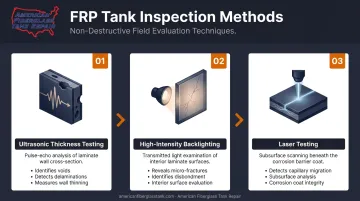
Together, these methods reveal what's happening inside the tank wall — not just what can be seen from the surface.
Warning Signs That Need Immediate Attention
Schedule a professional assessment if you observe any of the following:
- Visible cracks or blistering on the tank exterior
- Discolored or odorous stored water
- Unexplained pressure drop during system testing
- A tank that has reached 15–20 years of service without a formal inspection
AFTR's Approach
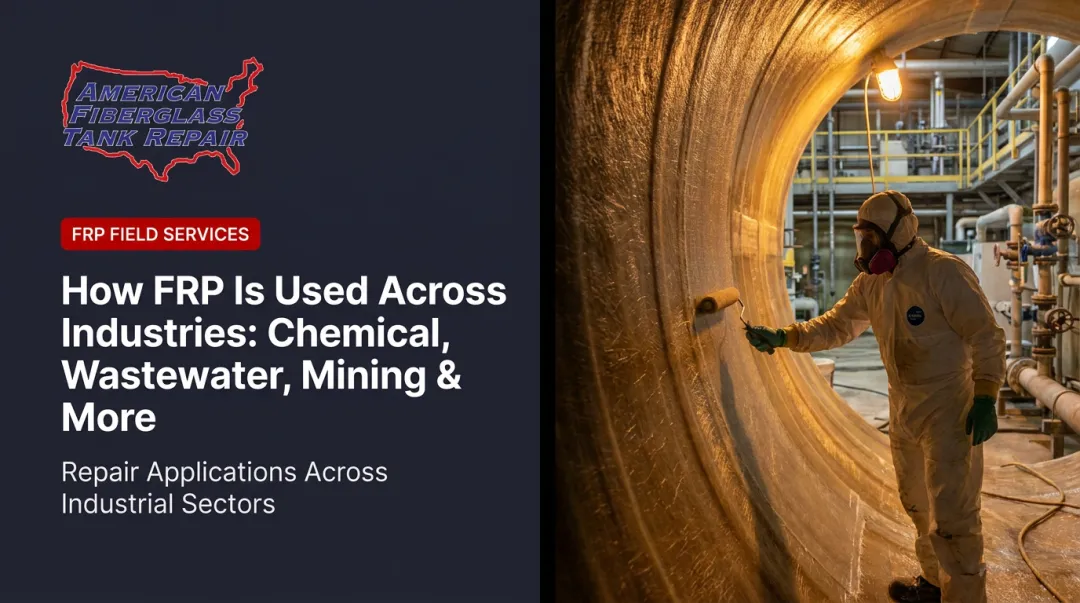
American Fiberglass Tank Repair provides engineer-driven FRP tank inspection, testing, and repair services with FTPI-certified inspectors and advanced NDT methods across all 50 U.S. states. Assessments can be structured as one-time evaluations or periodic programs, and AFTR works around facility schedules, including planned shutdowns, night shifts, and weekends.
When confirmed lining damage or delamination is found, AFTR's repair and relining process uses custom-blended resin systems and a portfolio of 45+ laminate types to restore the corrosion barrier and extend service life.
Detecting problems early makes repairs simpler and adds years of useful service life. A tank that passes a hydrostatic test today may not pass in three months, which is why comprehensive inspection goes well beyond pressure testing alone.
Frequently Asked Questions
What is an FRP water tank?
An FRP (Fiber Reinforced Plastic) water tank is a storage vessel constructed from a composite of glass fibers and polymer resin. It's valued for its high strength-to-weight ratio, corrosion resistance, and suitability across water storage, chemical, and industrial applications.
What is the difference between a fire tank and a water tank?
A fire water tank is a dedicated storage vessel engineered and sized specifically for fire suppression use, built to maintain a reliable, uncontaminated water reserve for emergency firefighting systems. General-purpose water tanks serve process, potable, or utility supply functions and are built to different specifications.
How long do FRP fire water tanks typically last?
Well-constructed FRP tanks commonly achieve 30–50 years of service life. Actual longevity depends on resin quality, laminate construction, chemical exposure, and inspection history. Tanks that receive regular professional inspections consistently outlast those that don't.
Are FRP fire water tanks compliant with NFPA standards?
FRP tanks can be engineered and certified to meet NFPA 22 requirements for private fire protection water storage, provided they are built to specification under AWWA D120-19 and inspected at required intervals by Fiberglass Tank & Pipe Institute (FTPI) certified inspectors.
What are the most common causes of FRP fire water tank failure?
Internal lining delamination, laminate microcracking, fitting corrosion at metal-to-FRP interfaces, and prolonged service without inspection are the leading causes of degradation that compromise fire water tank reliability.
How often should FRP fire water tanks be inspected?
NFPA 25 defines baseline intervals: exterior inspection quarterly, interior inspection every 3 years for tanks without corrosion protection, and every 5 years for all other tanks. Older tanks or those in harsh environments may need more frequent inspections. Always verify against the edition adopted by your jurisdiction.