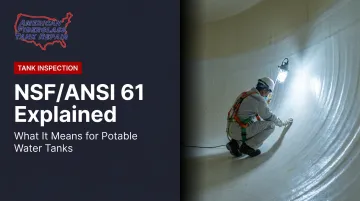
The standard itself is straightforward: NSF/ANSI/CAN 61 (Drinking Water System Components – Health Effects) sets minimum requirements ensuring that materials contacting drinking water don't leach harmful substances into it at levels that pose a health risk. What's less obvious is what "materials" actually covers for a storage tank, and what happens to that compliance status over the tank's service life.
This matters because according to a 2022 NSF/ASDWA survey, 49 U.S. states have legislation, regulations, or policies requiring drinking water system components to comply with or be certified to NSF/ANSI/CAN 61. That makes it effectively mandatory for most public water system applications, not a voluntary quality upgrade.
Key Takeaways
- NSF/ANSI 61 verifies that water-contact materials won't leach harmful contaminants above allowable health-based limits
- Certification covers the entire water-contact system — liner, coatings, gaskets, sealants, and fittings — not just the tank shell
- 49 states require compliance; it's not optional for most public water system operators
- Repairs using non-listed materials void the original certification — even on a previously compliant tank
- Confirm listings through the NSF Certified Drinking Water System Components database, not manufacturer claims
What NSF/ANSI 61 Actually Is
The full title is NSF/ANSI/CAN 61: Drinking Water System Components – Health Effects, with the current version designated NSF/ANSI/CAN 61-2025.
NSF International develops and maintains it through a balanced stakeholder committee that includes industry representatives, public health officials, regulators, certification bodies, and end users. The process is accredited by both ANSI and the Standards Council of Canada.
The standard's purpose is specific: establish maximum allowable contaminant levels that can migrate from a material or component into drinking water, ensuring those materials don't create a health risk across the product's service life. It evaluates chemical contaminants and impurities indirectly imparted to water through contact — heavy metals, organic compounds, and other regulated substances.
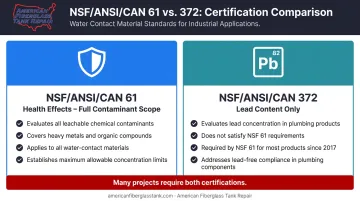
NSF 61 vs. NSF 372 — Not the Same Thing
These two standards are often confused, but they cover different things:
| Standard | What It Covers |
|---|---|
| NSF/ANSI/CAN 61 | Full range of health-effects contaminants that may leach from any water-contact material |
| NSF/ANSI/CAN 372 | Lead content specifically — establishes lead limits for plumbing products |
Many potable water projects require both certifications. As of October 2017, NSF/ANSI/CAN 61 was updated to require NSF 372 compliance for most covered products. NSF 372 compliance alone, however, does not satisfy NSF 61's broader leachate requirements. A product with low lead content can still fail NSF 61 for other contaminants.
Why NSF/ANSI 61 Matters for Potable Water Tanks Specifically
The regulatory case is straightforward. A 2022 NSF/ASDWA survey found 49 states with NSF 61 requirements on the books — Hawaii was the only exception. For most public water system operators, this isn't a quality differentiator. It's a baseline compliance checkpoint.
Storage tanks present a higher-risk contact scenario than pipes or fittings. Water moving through a pipe has brief, intermittent contact with the pipe wall. Water stored in a tank sits against the internal surface continuously — sometimes for days. That extended contact time amplifies any leaching from non-compliant materials, which is why tank storage draws heavier regulatory scrutiny than piping does.
What "Food Grade" Labels Don't Cover
A common mistake: treating "food grade," "drinking water safe," or similar marketing language as equivalent to NSF 61 certification. They're not. The EPA and NSF direct users to verified certification marks and public product listings — not generic labels — when confirming compliance. A manufacturer can apply "food grade" labeling without any third-party leachate testing.
Facilities using non-certified components risk:
- Introducing regulated contaminants into their water supply
- Failing project approval reviews from state drinking water agencies
- Carrying liability exposure that no marketing label can protect against
What NSF/ANSI 61 Actually Evaluates for a Tank
The standard evaluates chemical contaminants that may migrate from any product in contact with drinking water. For a complete FRP storage tank, that scope is broader than most buyers realize.
Every Water-Contact Component Counts
NSF/ANSI 61 covers distinct component categories, each evaluated separately:
- Pipes, nozzles, and fittings (Section 4) — flanges and threaded connections
- Barrier materials (Section 5) — internal liners and protective coatings
- Joining and sealing materials (Section 6) — gaskets, sealants, joint compounds
- Mechanical devices and access hardware — any other wetted components
A tank that passes NSF 61 evaluation for its FRP shell and internal liner still has a compliance gap if a non-listed gasket is installed on a nozzle flange. Every water-contact surface needs to be verified individually.
The Testing Method
Understanding how each component is evaluated helps clarify why no single material gets a blanket pass. Test specimens are submerged in controlled extraction waters — including pH 5, pH 8, and pH 10 exposures — simulating real-world contact conditions. The resulting samples are analyzed for contaminants against a defined list.
Results are compared to health-based maximum allowable contaminant levels derived from EPA and other regulatory guidelines. Products that pass are listed in the NSF certified products database.
Why FRP Resin Type Matters
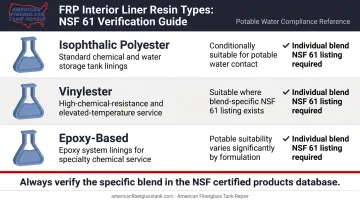
Resin chemistry determines whether an FRP liner can meet NSF 61 leachate thresholds — and not every formulation within a resin family qualifies. Common interior liner resins include:
- Isophthalic polyester — widely used for potable water; specific blends vary in listed status
- Vinylester — higher chemical resistance; requires individual blend verification
- Epoxy-based — used in specialty applications; not interchangeable with polyester listings
A tank built for chemical service uses different resin systems than one built for potable water. The chemical service tank would not carry the same certification, even if the base resin family sounds familiar.
Before purchasing or relining, confirm that the specific resin blend used in your tank's liner has been individually tested and listed — not just that the general resin family is "commonly used for potable water."
Verify any product through the NSF Certified Drinking Water System Components database, searchable by manufacturer, trade name, material type, and product type.
How the Certification Process Works
Manufacturers voluntarily submit products to an accredited certification body — NSF International, UL Solutions, CSA Group, IAPMO R&T, and others are EPA-recognized for this purpose. The listing remains valid only while the product continues to meet the standard and the manufacturer remains in good standing. The process itself follows three defined stages:
Step 1: Product Submission and Sample Preparation The manufacturer submits representative samples using the exact resin formulation, cure process, and application method intended for production. Any deviation in materials or process can invalidate the certification scope.
Step 2: Controlled Exposure and Leachate Analysis Test specimens are exposed to water under controlled conditions. Accredited laboratories analyze the resulting water for the defined contaminant list. Results are evaluated against health-based thresholds.
Step 3: Listing, Labeling, and Ongoing Surveillance Products that pass are added to the NSF certified products listing and may carry the NSF mark. Manufacturers undergo periodic facility audits and product retesting. Changes to formulations, materials, or manufacturing processes require technical review by the certification body before continued compliance can be confirmed.
Key Compliance Factors for FRP Tanks in Service
Certification at the time of purchase is a starting point, not a permanent status. Several variables affect whether an FRP tank continues to meet NSF 61 requirements over its service life.
Lining Integrity Over Time
NSF 61 certification applies to a material in its original, intact condition. When an internal liner develops cracking, blistering, delamination, or chemical erosion, the leaching profile of that surface changes. Degraded areas can expose unreacted compounds or substrate materials to stored water that were never part of the certified product configuration.
AWWA D121, the standard for bolted aboveground FRP panel-type tanks used in potable water storage, recommends annual inspections for maximum tank life. That cadence reflects the reality that liner condition changes, and the only way to verify ongoing suitability is through periodic assessment.
AFTR's inspection teams use ultrasonic, laser, and high-intensity backlight testing methods to detect not just surface conditions but subsurface degradation within the laminate — including capillary migration of stored product beneath the corrosion coat, which may not be visible through surface inspection alone.
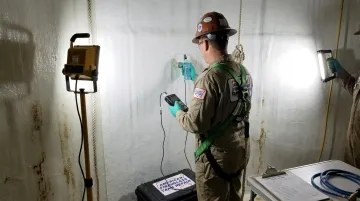
All inspections are supervised by Fiberglass Tank & Pipe Institute certified inspectors.
Repair and Relining Material Compliance
NSF explicitly states that repairs or modifications that alter wetted surfaces or introduce unevaluated materials fall outside the original certification scope. This means:
- Any resin, patch material, or sealant introduced during a repair must be NSF 61-listed for potable water contact
- A previously certified tank repaired with general-purpose FRP materials may no longer meet the standard for the repaired area
- Operators should confirm repair contractors use only compliant resins and veil systems
AFTR selects resin and veil systems specifically for potable contact and the applicable water chemistry when performing repair and relining work on drinking water storage tanks. For detailed material specifications, contact AFTR's engineering team directly.
Ancillary Component Compatibility
Gaskets, manway seals, nozzle linings, and fitting materials must each be verified individually in the NSF database. A compliant tank shell paired with a non-listed gasket creates a compliance gap at that joint. This is a common oversight during tank modification or nozzle repair projects — the FRP work is compliant, but an off-the-shelf seal component is not.
Common Misconceptions and Compliance Risks
"NSF 61 Certified" Doesn't Mean Everything Is Covered
Three assumptions consistently put facilities out of compliance — and none of them hold up under scrutiny:
- Certification covers the entire tank as built. It doesn't. A manufacturer's certification covers specific materials in their submitted configuration. Field-installed fittings, customer-specified components, or modified assemblies may fall outside that scope. Confirm coverage matches your actual build, including any site-added parts.
- Original certification is permanent. A tank certified at manufacture loses that status if its liner has degraded, been improperly repaired, or had non-listed replacement parts introduced. Ongoing compliance requires periodic verification — not a one-time stamp.
- FRP is inherently safe for potable water. The resin formulation, cure state, and lining construction of a specific tank determine whether its surfaces meet NSF 61 criteria. An FRP tank built for industrial chemical service and one built for potable water storage may look identical from the outside but have fundamentally different liner compositions.
FTPI-certified inspectors, like those at AFTR, can identify liner degradation, map areas requiring repair, and confirm remediation work uses materials appropriate for potable water service. That inspection record also directly supports a facility's compliance documentation.
Conclusion
NSF/ANSI 61 is a tested, documented standard verifying that the full water-contact system of a potable water tank won't introduce harmful contaminants into stored water. For anyone specifying, procuring, or operating FRP tanks in drinking water service, understanding its scope — what it covers, what requires separate verification, and what can compromise it — determines whether a tank genuinely protects the water supply it serves.
Maintaining compliance requires attention across the full service life of the tank. Each of the following contributes to whether a tank continues to meet the standard's intent:
- Resin system selection and original laminate quality
- Lining condition and barrier coat integrity over time
- Connected components (fittings, gaskets, coatings) with independent NSF/ANSI 61 listings
- Repair materials that match the original certification requirements
Regular inspection and qualified repair contractors are how compliance gets maintained — not optional add-ons, but core requirements of responsible potable water system operation.
Frequently Asked Questions
What is NSF 61 for potable water tanks?
NSF/ANSI 61 is a health-effects standard that evaluates whether materials contacting drinking water leach harmful contaminants above allowable limits. For potable water tanks, it applies to the internal liner, coatings, gaskets, sealants, and fittings — not just the tank shell. Every water-contact component requires individual verification.
What is a potable water tank?
A potable water tank is any storage vessel holding water that meets drinking water quality standards and is intended for human consumption or food contact use. These tanks require materials that will not degrade water quality — liner resins, veil systems, and sealants all fall under that requirement.
Which sealants are NSF 61-approved for potable water tanks?
NSF 61-approved sealants are product-specific and manufacturer-listed — there's no generic approval by material type. Verify any sealant through the NSF certified products database by searching the specific manufacturer and product name before use.
Is NSF/ANSI 61 certification required by law?
NSF/ANSI 61 is a voluntary standard, but 49 U.S. states have adopted regulations requiring drinking water system components to comply with it. In practice, this means public water system operators typically have no path to approval without certified materials.
Does repairing or re-lining a fiberglass tank affect its NSF/ANSI 61 compliance?
Yes. Any repair or relining introduces new water-contact materials. If those materials are not NSF 61-listed for potable water service, the repaired area may no longer meet the standard's requirements. Operators should confirm that repair contractors use only compliant resins, veil systems, and sealants.
What is the difference between NSF 61 and NSF 372?
NSF/ANSI 61 evaluates the full range of health-effects contaminants that may leach from water-contact materials. NSF/ANSI 372 addresses lead content specifically in plumbing products. Many projects require both certifications — verify which applies to your specific components before procurement.