In chemical plants, waterworks, and wastewater treatment facilities, a compromised flange isn't just a maintenance issue. It's a potential containment failure. EPA SPCC regulations under 40 CFR 112.7(c) require facilities to maintain containment structures that prevent discharges, while OSHA PSM under 29 CFR 1910.119 governs the prevention of catastrophic releases of hazardous chemicals. A failed flange in either regulatory context carries serious consequences.
This article covers how to identify fiberglass flange damage early, what repair methods apply to different damage types, and what best practices separate repairs that last from repairs that fail prematurely.
Key Takeaways
- Fiberglass flanges crack, delaminate, and leak — early detection prevents costly failures
- Most damaged flanges can be repaired — not replaced — when problems are caught early enough
- Repair method depends on damage depth — surface cracks, through-cracks, and delamination each need a different approach
- Surface preparation and resin chemical compatibility drive repair longevity more than any other factor
- Complex repairs benefit from assessment by certified FRP inspectors before work begins
Why Timely Fiberglass Flange Repair Matters
Fiberglass flanges are pressure-rated, load-bearing components. Under cyclic pressure loading — common in pumped chemical systems and water treatment infrastructure — even a hairline crack can propagate. Research on industrial GFRP pipes published in Composite Structures demonstrates that cyclic internal hydrostatic pressure is a recognized fatigue concern for glass fiber reinforced pressure systems, with failure progression observed in stages: whitening, leakage, and eventual burst.
The operational consequences of a failed flange in industrial service are significant:
- Process fluid loss — containment breaches that trigger regulatory reporting obligations
- System pressure drops — affecting downstream process performance
- Chemical exposure hazards — particularly serious with acids, oxidizers, or sodium hypochlorite
- Unplanned downtime — ABB's 2023 survey puts unplanned downtime costs at $125,000 per hour for industrial manufacturers
A documented Belzona case study (KHIA 5654) shows what timely intervention looks like in practice: a cracked fiberglass flange with active pressurized leakage, repaired in half a day, with $30,000 saved compared to full replacement. That's one case, not an industry average — but it reflects a pattern FRP repair specialists see repeatedly. Proactive repair protects capital investment. Deferred maintenance does not.
The math compounds quickly when you factor in regulatory reporting, process downtime, and chemical hazard response.
Detecting problems early keeps repairs simple and extends component service life — which is why regular inspection programs matter as much as the repair techniques themselves. The GRP pipes market is valued at $1,868.5 million in 2024 and growing — the industrial asset base that depends on FRP flange integrity is only expanding.
How to Tell If Your Fiberglass Flange Needs Repair
Fiberglass flange damage is not always obvious. Some of the most serious damage — subsurface delamination, capillary migration of fluid under the corrosion coat — is invisible to a standard walkdown. That said, most significant flange problems leave detectable signs if you know what to look for.
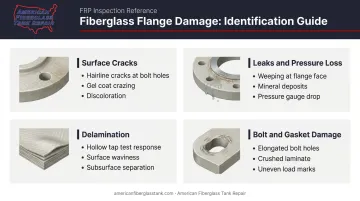
Visible Surface Indicators
During a visual inspection, look for:
- Hairline cracks radiating from bolt holes — the most common failure point due to stress concentration at fastener locations
- Surface crazing or gel coat cracking around the flange face
- Discoloration, staining, or resin bleed-through suggesting fluid migration
- UV degradation or chalking on exposed exterior surfaces
One critical rule: always trace cracks to their full extent before beginning any repair. What appears as a minor surface crack can extend significantly deeper into the laminate. The Belzona KHIA 5654 case noted that cracks on a fiberglass flange were found to extend into three separate areas upon close inspection — damage that wasn't apparent at first glance.
Leaks and Pressure Loss
Flange seal compromise shows up as:
- Visible moisture, mineral deposits, or efflorescence around the flange face or bolt circle
- Active weeping — even intermittent — during pressurized operation
- Unexplained pressure drops on system gauges during normal operation
Any active weeping from a flange face warrants immediate investigation, not just monitoring.
Structural and Delamination Indicators
Surface cracks are straightforward to spot. Delamination is not — it can exist well into the laminate while the exterior looks intact. Field detection methods include:
- Tap testing — systematic tapping across the flange face; hollow or dull tones indicate layer separation beneath
- Visual inspection — look for bubbling, surface waviness, or visible separation between laminate layers
- Ultrasonic testing — the most reliable method for subsurface delamination detection
When tap testing isn't enough, AFTR uses ultrasonic, laser, and high-intensity backlight testing to identify subsurface conditions including capillary migration of fluid beneath the corrosion coat. For flanges in chemical service, this distinction determines whether a surface repair is sufficient or a full laminate buildup is required.
Bolt and Gasket Area Damage
Bolt holes are high stress-concentration points. Watch for:
- Elongated or cracked bolt holes from mechanical overload
- Chipped or crushed laminate around fastener locations from over-torquing
- Uneven bolt load distribution evidence (witness marks, gasket extrusion patterns)
Over-torquing is a leading cause of bolt hole damage in FRP flanges. Unlike steel, fiberglass laminate crushes under excessive bolt load — and once crushed, it cannot be compressed back to its original thickness without laminate buildup repair.
Types of Fiberglass Flange Damage and Repair Methods
Fiberglass flange repair is not one-size-fits-all. The correct method depends on damage depth, system pressure rating, and the chemical environment. Using the wrong approach — or the wrong resin — can result in a repair that fails faster than the original damage would have.
Surface Crack and Gel Coat Repair
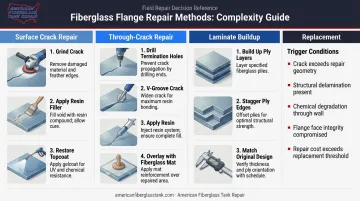
For cracks that don't penetrate the structural laminate:
- Grind or route the crack to remove all contaminated and oxidized material
- Apply a compatible resin filler — isophthalic polyester for general service, vinylester for chemical service involving acids or oxidizers
- Finish with a corrosion-resistant topcoat or gel coat to restore the barrier layer
This approach is only appropriate when the crack is confirmed to be shallow. Probing and tap testing before repair helps confirm that the damage doesn't extend into the structural plies.
Through-Crack and Structural Crack Repair
Through-cracks require more involved repair:
- Drill crack termination holes at each end of the crack to stop propagation
- V-groove the crack to allow full resin penetration rather than a surface-only fill
- Apply catalyzed resin into the groove and termination holes
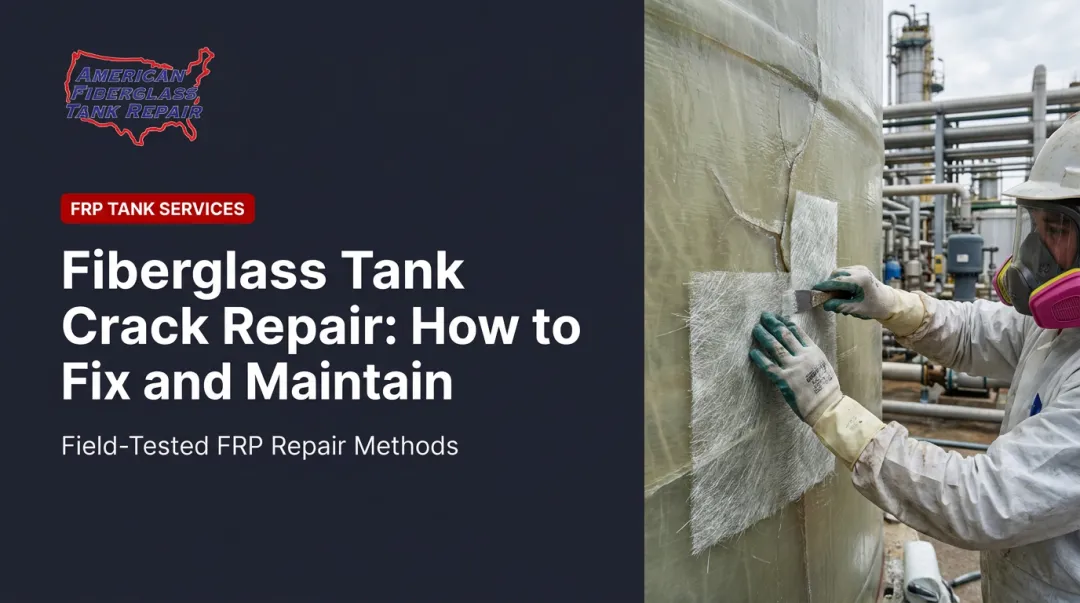
- Overlay with fiberglass mat or woven roving plies to restore structural integrity
A well-documented example: a cracked, leaking fiberglass flange repaired by drilling crack ends, V-grooving, filling with structural compound, and fitting an internal backing plate. The full sequence was completed in half a day — a realistic target for a properly executed through-crack repair.
Laminate Buildup and Flange Face Reconstruction
When over-torquing has crushed the bolt hole area, corrosion has reduced flange thickness, or delamination has compromised the face, laminate buildup becomes necessary:
- Build up plies of fiberglass mat and resin to restore original laminate thickness
- Use staggered (stepped) ply edges to distribute load into undamaged structure
- Match the repair laminate to the original design, including fiber orientation, ply count, and resin system
For industrial FRP flanges in chemical or waterworks service, AFTR's engineer-driven approach uses custom-blended resins (isophthalic, vinylester, or epoxy selected for the specific chemical service) and over 45 fiberglass laminate options to ensure the repair matches the original design intent.
When Repair Is Not Enough: Full Flange Replacement
Even a sound repair method has limits. Replacement becomes the right call when:
- The damage extends across too large a proportion of the flange cross-section to restore structural integrity through overlay repair
- The flange cannot be returned to its rated pressure after repair
- Damage is too close to a nozzle or vessel wall to allow a structurally sound repair overlap
Repair-versus-replace decisions should be treated as engineering assessments, not generic threshold calls. ASME PCC-2 Part 4 addresses nonmetallic and bonded repairs, including repair thickness and length calculations; it provides the technical framework for qualified repair design. AFTR's in-house fabrication shop can produce custom replacement FRP flanges when replacement is the correct path, eliminating dependence on OEM lead times.
Best Practices for Fiberglass Flange Repair
Surface Preparation
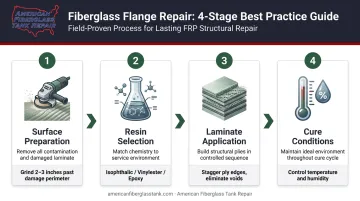
Surface preparation is the single factor that most determines whether a repair lasts. The repair area must be:
- Ground to a clean, dry, abraded surface free of contamination, oxidation, and coatings
- Extended well beyond the visible damage boundary — typically grinding back 2–3 inches past the crack or damage perimeter
- Free of any moisture, oil, or release agent contamination
Inadequate surface prep is the leading cause of repair failure. Adhesion between the repair laminate and the existing substrate depends entirely on mechanical and chemical bonding to a properly prepared surface.
Resin Selection and Chemical Compatibility
The repair resin must be compatible with both the original laminate and the process chemical. General guidelines:
| Chemical Service | Minimum Resin Recommendation |
|---|---|
| Water, mild chemicals | Isophthalic polyester |
| Acids, hypochlorite, oxidizers | Vinylester |
| Strong acids, caustics at elevated temp | Epoxy or high-performance vinylester |
Resin manufacturer guides (AOC, Ashland Hetron, Interplastic CoREZYN) provide chemical resistance tables, but selection depends on the specific chemical, concentration, and operating temperature — not just the chemical family. An incompatible resin will degrade even a structurally sound repair, often within the first service cycle.
Laminate Ply Guidelines for Structural Repairs
- Use appropriate ply count to replace the laminate thickness being restored
- Step (stagger) ply edges to distribute load gradually into undamaged structure
- Include a corrosion liner veil layer where the repair contacts process fluid
- Eliminate voids during wet lay-up — consolidate each ply fully before adding the next
Cure Conditions and Post-Cure
- Ambient temperature must be above the minimum cure threshold specified in the resin TDS
- Humidity control matters for moisture-sensitive resin systems
- Allow full cure before returning to service — partial cure leaves the repair mechanically weak
- For critical pressure applications, post-cure heat treatment may be required to achieve full resin mechanical properties
AFTR's field teams control the work environment during repairs (heating or cooling as needed), so weather conditions don't compromise cure quality.
Verification Before Return to Service
A completed flange repair should not go back online without verification:
- Visual inspection of the cured laminate surface
- Tap testing across the repair area to detect voids or disbonding
- Hydrostatic or pressure testing to rated working pressure per ASTM D2992
- Documentation of the repair scope, materials, and test results
For certified industrial applications, AFTR's inspection services use ultrasonic and high-intensity backlight testing, supervised by Fiberglass Tank & Pipe Institute certified inspectors, to confirm repair integrity before a system goes back online.
Conclusion
Most fiberglass flange damage is repairable when identified early and addressed with the right materials and technique. The difference between a repair that lasts years and one that fails prematurely comes down to three things: thorough surface preparation, chemically compatible resin selection, and sound laminate practice.
For industrial FRP flanges in chemical, waterworks, or wastewater service, the stakes of a failed repair are too high to leave to guesswork. Certified FRP repair specialists bring the material science knowledge, damage assessment experience, and resin-matching expertise that guesswork simply can't replicate. AFTR's Fiberglass Tank & Pipe Institute certified inspectors have been doing exactly that across chemical, waterworks, and wastewater facilities since 2003 — preventing the unplanned shutdowns and containment failures that make a poor repair far more costly than the original damage.
Frequently Asked Questions
Can a broken fiberglass flange be repaired?
Yes, most broken fiberglass flanges can be repaired rather than replaced. Through-cracks, delamination, and even partial flange face loss can typically be addressed with proper laminate repair techniques. Replacement is only necessary when structural integrity cannot be fully restored through overlay repair.
What causes fiberglass flanges to crack or fail?
Common causes include:
- Over-torquing of bolts, which crushes the laminate
- Cyclic pressure loads and thermal cycling
- UV degradation or chemical attack on an incompatible resin system
- Mechanical impact
Most failures involve a combination of these factors rather than a single cause.
What materials are used to repair fiberglass flanges?
Repair materials typically include catalyzed polyester, vinylester, or epoxy resin matched to chemical compatibility requirements, along with fiberglass mat or woven roving for laminate buildup. A corrosion-resistant topcoat or gel coat restores the barrier layer against process fluid exposure.
How long does a fiberglass flange repair last?
A properly executed repair — with correct surface prep, compatible resin, and sound laminate technique — can last many years, sometimes matching the remaining service life of the surrounding structure. Poor surface preparation and incompatible resin selection are the leading causes of early failure.
When should a fiberglass flange be replaced rather than repaired?
Replacement is warranted when damage covers too large a proportion of the flange cross-section, when rated pressure cannot be restored, or when the damage location prevents a structurally sound repair overlap. This determination requires an engineering assessment — not a generic checklist.
How do I verify a fiberglass flange repair was successful?
Begin with visual inspection and tap testing to check for voids or disbonding, then follow with hydrostatic or pneumatic pressure testing to rated working pressure. For industrial applications, ultrasonic thickness testing by a certified FRP inspector provides the most reliable confirmation before returning the system to service.